
Reciprocal linking is a simple concept on the surface: it’s a mutual agreement where Site A links to Site B, and Site B links right back to Site A. Think of it as a digital handshake between two websites, a way to share audiences and, ideally, give both a little boost in the search engine rankings.
What Is Reciprocal Linking In Simple Terms
At its heart, reciprocal linking is just like a good old-fashioned business partnership.
Imagine a top-notch web designer in Kansas City who often works with a fantastic local SEO agency. The web designer recommends the agency to clients who need better visibility, and the agency sends clients who need a new website over to the designer. It's a win-win. Each business sends valuable, relevant customers to the other.
In the digital world, that "recommendation" is a hyperlink. For a long time, this was a go-to trick for climbing the search results. But search engines like Google got a lot smarter. Now, they look at these links much more closely to figure out if they're genuine endorsements or just a lazy attempt to game the system.
The Modern View On Reciprocal Links
Today, the value of a reciprocal link is all about context and relevance.
A natural link between two related, authoritative sites can still be a good thing. It can drive targeted referral traffic your way and help you build valuable professional relationships online.
On the other hand, getting into large-scale link swaps with a bunch of irrelevant or low-quality sites is a recipe for disaster. That kind of behavior can trigger penalties that crush your website's credibility and torpedo your search rankings.
The key takeaway is this: A reciprocal link should exist because it provides genuine value to the user, not just as a tool for SEO. If the link makes sense for your audience, it likely makes sense for search engines.
This is why you have to think about what each link brings to your overall online presence. Every single backlink, reciprocal or not, becomes a part of your digital footprint. A strong collection of relevant links helps build a healthy backlink profile, which is something you can learn more about in our guide on what is a backlink profile.
The goal is to build a network of connections that reflects real-world authority and trust. That, right there, is the foundation of any successful, long-term SEO strategy.
How Reciprocal Links Evolved Over Time
To really get why we treat reciprocal links with caution today, you have to understand where they came from. In the early days of the internet, search engine algorithms were pretty simple. They basically saw links as votes of confidence, and the more "votes" a website had, the more important it must be.
This created a kind of "wild west" for SEO. Reciprocal linking became one of the go-to tactics because it was a dead-simple way to rack up a ton of links, fast. If the game was all about link quantity, then swapping links was the quickest way to win.
The Link Farm Era
This obsession with numbers over quality gave rise to massive, low-quality link farms and automated exchange programs. It wasn't uncommon to see websites with dedicated pages crammed with hundreds of totally unrelated links, all in a desperate attempt to trick the algorithms into giving them a boost.
The logic was crude but effective for a while: more links meant better rankings, no matter how irrelevant they were.
The Penguin Update Changes Everything
The game completely changed with the rollout of major Google updates, especially the Penguin update in 2012. This algorithm was specifically built to hunt down and penalize websites with unnatural backlink profiles. It went straight after sites involved in manipulative link schemes, including large-scale reciprocal linking.
Reciprocal linking was a massive part of the SEO playbook in the 2000s, with some studies estimating that nearly 40% of early backlink strategies involved it in some form. After Penguin hit, countless websites that had relied on these schemes saw their rankings and traffic completely flatline overnight.
The update sent a crystal-clear message to the SEO world: relevance and quality now trumped sheer numbers. Websites were forced to do a massive cleanup, disavowing spammy links and shifting their entire focus toward earning high-quality, natural backlinks.
If you suspect your site might have old, questionable links, checking your backlink profile is a must. Our guide on how to set up Google Search Console is a great starting point for that.
Today, the legacy of Penguin shapes our entire approach. The goal is no longer to just hoard as many links as possible. Instead, successful SEO is all about building genuine, relevant connections that provide real value—a principle that now defines how we use reciprocal links in the modern era.
The Risks and Rewards of Reciprocal Linking
When you're thinking about reciprocal linking, it’s a bit like standing at a crossroads. One path can lead to valuable partnerships and a nice boost in visibility. The other? It can land you in hot water with search engines and damage the reputation you’ve worked so hard to build. Before you take a step in either direction, you need to understand both sides of the coin.
On one hand, the rewards can be pretty compelling. A strategic link from a relevant, high-authority website acts as a powerful endorsement. This can send highly qualified referral traffic your way—people who are already interested in what you do. These links also help you build genuine credibility in your industry and can even blossom into business relationships that go far beyond a simple link swap.
But the risks are just as real. The biggest danger is getting hit with a penalty from search engines like Google, which are always on the lookout for manipulative link schemes.
The Downside of a Poor Strategy
Linking out to irrelevant or low-quality sites is a huge red flag for search engine algorithms. It creates an unnatural backlink pattern that they're specifically designed to sniff out and devalue. An association like that can also tarnish your brand’s reputation by connecting you with spammy or untrustworthy sources.
Here’s a cautionary tale: a local e-commerce store went all-in on an aggressive link exchange program. They swapped links with dozens of completely unrelated websites, from pet grooming services to auto repair blogs. Within a few months, their organic traffic plummeted by over 60% after a Google algorithm update flagged their profile for manipulative practices.
That kind of nosedive in rankings can be incredibly difficult and time-consuming to recover from. It often involves a painstaking process of trying to get links removed and formally disavowing the ones you can’t.
Balancing Risk with Strategic Reward
The key to navigating this is to stop thinking of reciprocal linking as a shortcut and start treating it as a deliberate partnership strategy. The real value comes from a mutual benefit that actually extends to your audience. You have to ask yourself: does this link actually make sense for my visitors? Does it point them to helpful, related information?
A strong reciprocal link should always come from a site with respectable authority of its own. This is where understanding SEO metrics becomes critical. To get a better handle on this, check out our detailed guide explaining what is page authority and how it affects your site's credibility.
Ultimately, the best approach is a balanced one. A handful of high-quality, relevant reciprocal links tucked inside a diverse and natural backlink profile can be a good thing. But relying on them as your main link-building tactic is a gamble that almost never pays off in the long run. Your goal should always be to build genuine connections, not just a list of links.
Finding and Vetting the Right Link Partners
Knowing the risks and rewards is one thing, but putting a safe, effective strategy into action is a whole other ballgame. Building reciprocal links that actually help—rather than harm—your SEO requires a careful, deliberate approach to choosing your partners. The goal isn't just to find someone willing to swap links. It's to find a genuine partner whose audience and purpose truly align with yours.
Think of this process less like casting a wide net and more like scouting for a strategic business alliance. You’re on the hunt for complementary, non-competing businesses that serve a similar crowd. For example, a Kansas City marketing agency and a local video production company make a perfect pair; they offer different services to the exact same types of clients.
Identifying Potential Partners
Your search should always start with the businesses you already know and respect in your niche. Think about your professional networks, industry forums, and even your own satisfied clients—these can be excellent sources for potential partners right off the bat.
Once you've exhausted your immediate network, you can get a bit more structured:
- Practical Example: A wedding photographer in Kansas City could search for
Kansas City wedding planning blogorbest wedding venues in KC. The top-ranking sites are prime candidates for partnership because they already have an established, relevant audience. - Competitor Backlink Analysis: This is a slightly more advanced tactic, but it's pure gold. Use a tool like Semrush to see who is linking to your competitors. This shows you which websites are already active in your niche and reveals a list of warm prospects.
- Social Media Listening: Keep an eye on hashtags like
#KCBizor industry-specific terms on platforms like LinkedIn. This is a great way to identify influential voices and local businesses that would be a natural fit for collaboration.
This infographic simplifies the core decision you have to make when a reciprocal link opportunity comes up.
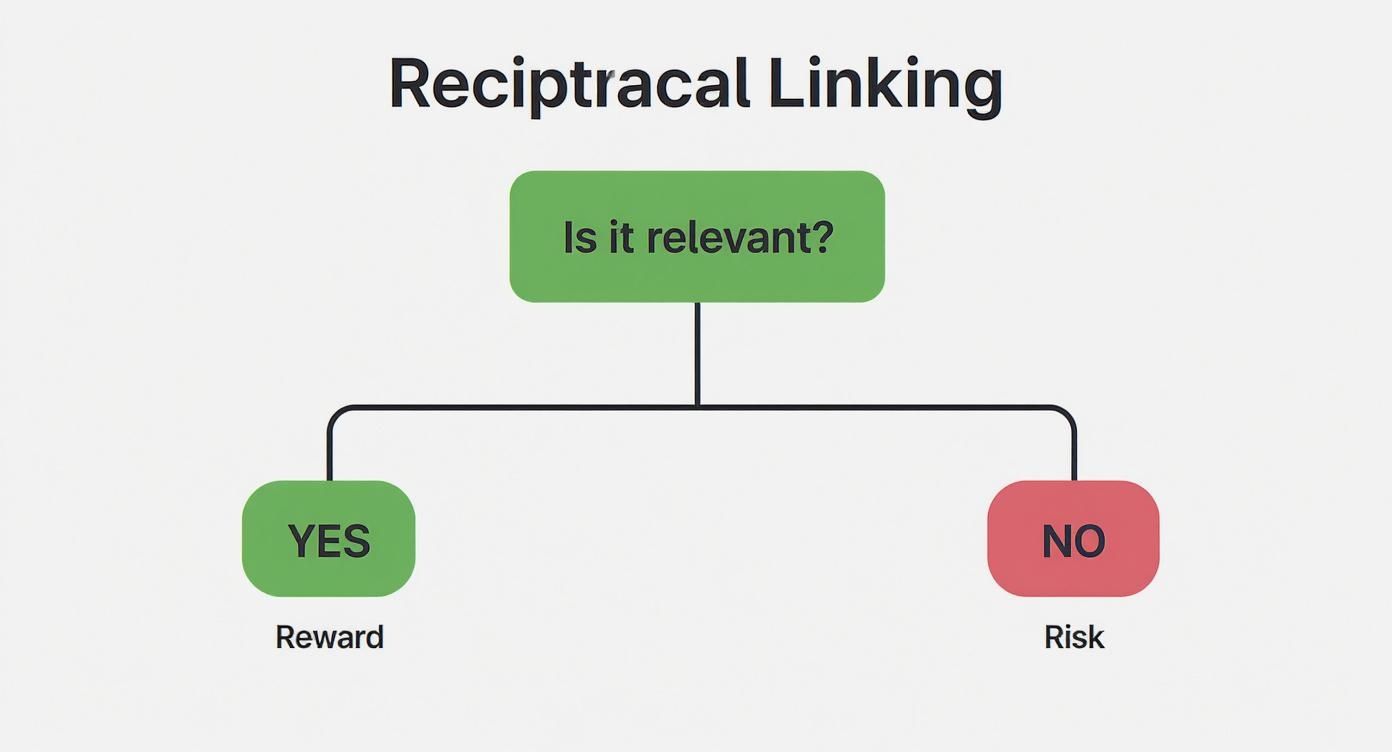
Ultimately, that decision tree shows that relevance is the non-negotiable factor. It's what separates a rewarding partnership from a risky gamble.
Vetting Your Prospects
Okay, you have a list of potential partners. Now the real work begins: the vetting process. This step is absolutely critical to avoid associating your brand with low-quality or spammy websites. You need to perform due diligence on every single prospect before you even think about reaching out.
Your evaluation should focus on three key areas: their content quality, their site's authority, and their existing backlink profile. High-quality content is a clear sign of a reputable site, while metrics like Domain Authority (DA) can give you a quick snapshot of their credibility. To really dig in, you need to understand how to check backlinks in Google to make sure their link profile looks natural and healthy.
A potential partner's backlink profile is like a credit report for their website. A clean, diverse profile from authoritative sources is a green light, while a history of spammy or manipulative links is a major red flag.
Crafting Your Outreach
Finally, your outreach needs to reflect that partnership mentality. Ditch the generic, transactional emails that just scream "link swap." Instead, personalize your message to show you've actually done your homework.
Here’s a simple structure for a mutually beneficial proposal:
- Start with a genuine compliment. Mention a specific article or resource on their site that you found valuable.
- Introduce yourself and your value. Briefly explain what you do and who your audience is, highlighting the overlap between your brands.
- Propose a specific collaboration. Suggest a natural way to link. For instance, "I'm writing an article on 'Top 10 Landscaping Mistakes for KC Homeowners' and would love to feature your guide on 'Choosing Native Missouri Plants' as a key resource for my readers."
- Suggest the mutual benefit. Gently mention that if they find your content useful down the road, a link back would be appreciated.
This approach frames the exchange as a collaboration built on mutual value, setting the stage for a healthy, long-term professional relationship.
Modern Best Practices for Reciprocal Linking
Let's be clear: the old days of reciprocal linking are long gone. The wild-west tactic of swapping links with anyone and everyone who asks is a surefire way to get on Google's bad side. Today, you have to play a much smarter, more strategic game where quality and user value are the only things that matter.
Think of every reciprocal link not as a quick SEO hack, but as a genuine editorial endorsement. You're vouching for another site's content, and that's a responsibility you can't take lightly.

The single most important rule is contextual relevance. A link needs to feel like a natural part of the conversation, placed right where it makes sense for a reader who wants to learn more. Tossing it onto a generic "Partners" or "Links" page is a relic of the past—and a massive red flag for search engines.
It all comes down to being selective and purposeful. You're curating resources for your audience, and every link you place on your site needs to add real value.
Keep Your Link Profile Diverse and Natural
A healthy backlink profile is like a balanced investment portfolio—it’s all about diversification. Reciprocal links should only ever be a small slice of your overall profile. If you lean on them too heavily, you create an unnatural pattern that search engines are specifically trained to spot and devalue.
In fact, a 2024 analysis of top-ranking websites found that reciprocal links made up only about 15-20% of their total backlinks. The real powerhouse? One-way links, which accounted for over 65%. This shows that while reciprocal links have their place, they should never dominate your strategy.
Your goal is to build a profile that looks organic. A few strategic link swaps mixed in with earned media mentions, guest post links, and brand citations is the ideal scenario.
To pull this off, you have to focus on other link-building methods. For some practical advice on rounding out your efforts, check out our complete guide on how to build backlinks naturally.
Use Natural Anchor Text
The actual words you use for the link—the anchor text—are another critical piece of the puzzle. It needs to be descriptive and natural, helping both users and search engines understand what the linked page is all about. Forget about aggressively stuffing your target keywords into the anchor text or using generic phrases like "click here."
Here are a few ground rules to live by:
- Prioritize relevance: The link must fit perfectly within the context of the content. If it feels forced, it probably is.
- Focus on quality over quantity: A single link from a high-authority, relevant site is worth more than dozens of low-quality swaps.
- Use natural anchor text: Let the text describe the destination in a way that helps the reader, not just a search bot.
- Avoid link schemes: Never, ever participate in large-scale, automated link exchanges. It's a fast track to an SEO penalty.
By sticking to these modern guidelines, you can use reciprocal linking as a smart tool to build valuable relationships and drive results—all without putting your site's authority at risk.
Got Questions About Reciprocal Links? We've Got Answers.
Even with the best game plan, reciprocal linking can feel like walking a tightrope. It's totally normal to have questions pop up along the way. Let's tackle some of the most common ones I hear from clients.
How Many Reciprocal Links Are Too Many?
There's no single magic number here, but the consensus among SEO pros is that reciprocal links should only be a small, natural slice of your backlink pie. If you're pushing past 15-20% of your total profile, you're wandering into a risky neighborhood.
But honestly, stop counting and start judging. Your focus should be on quality, not quantity. A handful of truly valuable links from authoritative partners in your niche are worth more—and are a heck of a lot safer—than dozens of lazy link swaps. If your backlink profile looks like it’s built on a foundation of "I'll link to you if you link to me," search engines will notice, and not in a good way.
Does Google Penalize All Reciprocal Linking?
Nope. Google isn't on a mission to destroy every reciprocal link on the internet. What it does penalize are blatant, manipulative link schemes designed purely to game the rankings.
A natural, logical link between two websites that are topically related and actually provide value to users? That's almost always fine.
Think of it this way: if a local Kansas City SEO agency links to a trusted web design firm they frequently partner with, that makes perfect sense to both users and Google. The real danger comes from large-scale, automated, or totally irrelevant link exchanges that serve no purpose beyond trying to trick the algorithm.
Is Reciprocal Linking Still Effective For SEO?
Yes, but its job has changed. It's no longer the powerful ranking booster it once was. Instead, it’s evolved into a strategy with some killer secondary benefits. A great reciprocal link can be a fantastic source of high-quality referral traffic, bringing engaged visitors right to your digital doorstep.
Beyond just traffic, these links help build your brand's authority within a specific niche and can open doors to new business relationships and collaborations. While a well-placed link can still pass some SEO value, its main purpose today is to help you build a real, interconnected presence online.
When you do it right, it's still a valuable tool in a modern SEO toolkit. Just think of it as a networking strategy, not a shortcut.
At Website Services-Kansas City, we specialize in building robust SEO strategies that drive real results. From creating high-authority backlinks to optimizing every page of your site, we provide the expertise small businesses need to grow their online presence. Learn more about our professional SEO solutions.