
Organic search traffic is the lifeblood of a healthy website. This is the free, earned traffic you get when people find you through a good old-fashioned search on Google or Bing. They type in a question, see your site in the natural, unpaid results, and click.
Think of it like this: these visitors found your business because a trusted friend recommended it, not because you paid for a flashy billboard on the side of the highway.
Understanding the Foundation of Your Digital Presence
Let's imagine your website is a new coffee shop in Kansas City. You could hand out flyers on the street or run ads in the local paper—that's the equivalent of paid digital advertising. It works, but it costs you for every single person you reach.
Now, what if people started walking in simply because they were searching for "best espresso in KC," and your shop naturally came up at the top of their list? That's the incredible power of organic search traffic.
This type of traffic comes from one place: your website providing genuinely helpful answers to the questions people are asking. It’s not about paying for a spot at the top; it’s about earning it.
How Is Organic Different From Other Traffic?
To really appreciate its value, you have to see how organic traffic stacks up against the other ways people find you online. Each one has its place, but organic stands apart for a reason.
Here’s a clear breakdown of the five main ways people will land on your website.
Comparing Organic Search to Other Traffic Sources
This table offers a clear, side-by-side comparison of the five primary website traffic sources, breaking down their mechanics, costs, and the typical intent of the users they attract.
| Traffic Source | How It Works | Cost | User Intent |
|---|---|---|---|
| Organic Search | Users find you through unpaid, natural search engine results. | Free (earned through SEO) | High (actively seeking solutions) |
| Paid Search | Users click on ads (marked "Ad" or "Sponsored") at the top of search results. | Pay-per-click (PPC) | High (often ready to buy) |
| Direct Traffic | Users type your URL directly into their browser or use a bookmark. | Free (brand awareness) | Very high (already know you) |
| Referral Traffic | Users click a link to your site from another website, like a blog or directory. | Free (earned through relationships) | Varies (depends on the context) |
| Social Traffic | Users click a link from a social media platform like Facebook or LinkedIn. | Free (earned through engagement) | Low to medium (often passive) |
As you can see, each traffic source plays a different role. While paid search can bring in quick wins and social media is great for community, organic search is the foundation for long-term, sustainable growth.
The data backs this up without question. Organic search is the single largest source of website visits on the planet, making up about 53% of all traffic sources. This massive share is exactly why building a solid SEO strategy isn't just a good idea—it's essential. You can dig into more of these stats and their impact at seoinc.com.
In essence, organic traffic is the bedrock of sustainable online growth. While other sources have their place, organic visitors are often highly motivated because they actively sought out a solution and found you on their own terms.
Getting this kind of visibility doesn't happen by accident. It takes a deliberate, long-term strategy known as Search Engine Optimization (SEO). If your site isn't showing up when potential customers are looking for your services, it’s like having an invisible storefront. If you're struggling to get found, you can explore the reasons why your website is not showing up on Google Search in our detailed guide.
How Search Engines Deliver Organic Visitors
To really get what organic search traffic is, you have to look at the whole process through the eyes of a search engine like Google. Imagine Google is the world's smartest librarian, with the monumental task of organizing every single piece of information on the internet. Its main job? To give you the most relevant, helpful, and trustworthy answer to your question in a matter of seconds.
This isn't some kind of digital magic. It's a surprisingly logical, three-step system that decides which websites earn a spot on the results page. Understanding how this system works is the first step toward getting more visibility and, in turn, more visitors.
The Three Core Jobs of a Search Engine
It all starts with discovery. Search engines use automated programs, often called "spiders" or "crawlers," that travel across the web 24/7. These little bots follow links from one page to another, finding new websites and updated content as they go.
Once a page is discovered, the search engine's next job is to figure out what it's all about. This is the indexing phase.
- Crawling: This is the discovery process. Search engine bots systematically browse the web, looking for new and updated content to add to their library.
- Indexing: After crawling, the content gets analyzed and stored in a massive database called an index. Think of it as creating a library card for every single webpage, noting its topic, keywords, and overall quality.
- Ranking: This is the final step. When you type something into the search bar, the engine dives into its index, finds the best possible answers, and arranges them in order of relevance and authority on the search engine results page (SERP).
This simple visualization shows the journey from a user's search to them landing on your website.
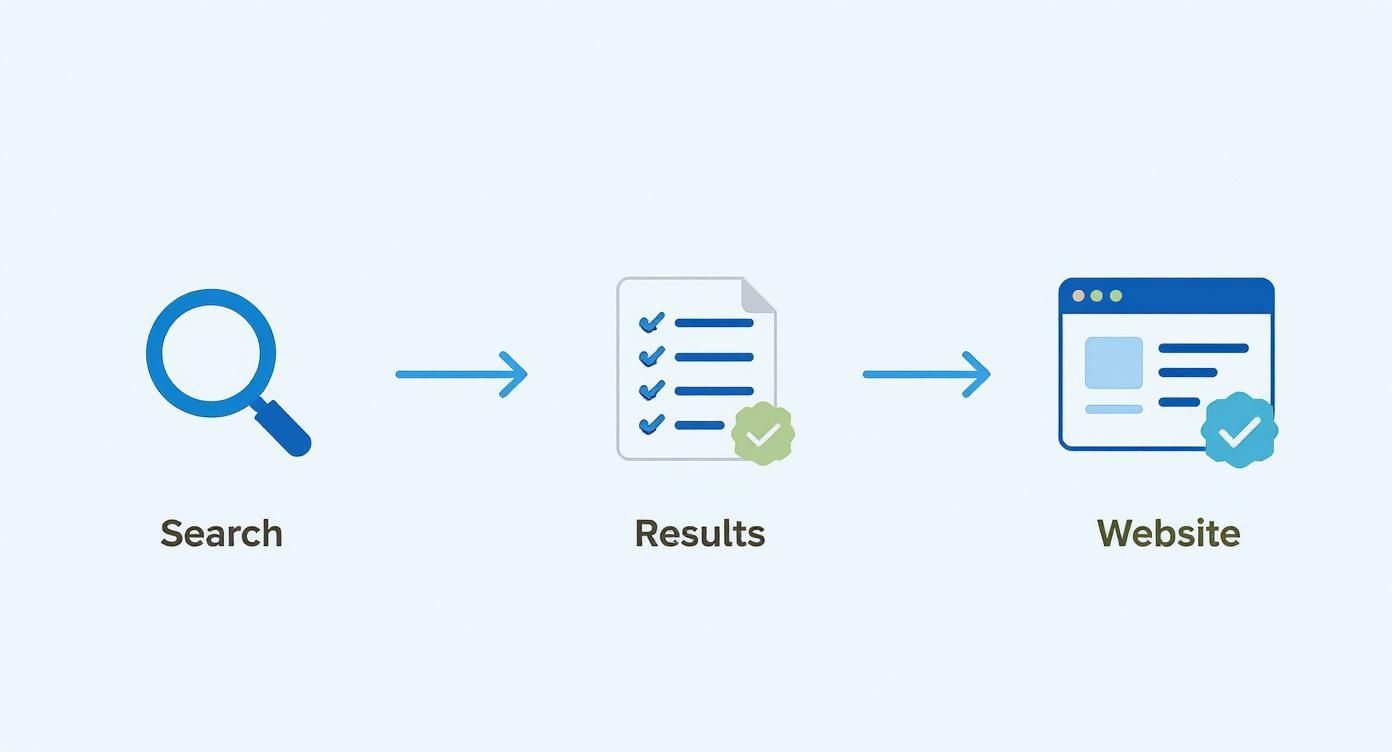
As you can see, it's a clear, direct path: a user has a need, the search engine offers up the best options, and the user clicks on the result that seems most helpful, becoming organic traffic for that website.
What Search Engines Value Most
The ranking process is easily the most complex piece of the puzzle. Google uses hundreds of different signals to decide which pages deserve the top spots. While the exact algorithm is a closely guarded secret, the core principles are pretty well understood—and they all revolve around providing the best possible user experience.
The ultimate goal for a search engine is to satisfy the user's intent. Every ranking factor, from keyword relevance to page speed, is designed to measure how well a page achieves that goal.
What this means is that your website has to prove its expertise and value. For instance, if you're a plumber based in Kansas City, a blog post on "how to fix a leaky faucet" needs to be more than just a wall of text. It has to be comprehensive, easy to follow, and demonstrate that you are a genuine authority on the subject.
Key Factors That Influence Your Ranking
While the list of ranking factors is long, they generally fall into three main buckets. Nailing these areas is how you signal to search engines that your content is worth showing to their users.
- Relevance: This is the absolute foundation. Your content must directly match the search intent behind what a user is looking for. If someone searches for "best BBQ in Kansas City," they expect to see reviews, lists, and restaurant locations—not an article on the history of BBQ sauce.
- Authority: Search engines trust websites that are seen as experts in their field. You build authority over time by consistently publishing high-quality content, getting positive user engagement, and earning backlinks from other reputable websites.
- User Experience (UX): A website that is slow, confusing, or doesn't work well on a phone provides a poor experience. Google pays attention to signals like page load speed, mobile-friendliness, and how long visitors stick around on your site to gauge its quality.
To make sure your website is being properly crawled and indexed, it's critical to have the right tools in place. One of the most important first steps for any site owner is to learn how to set up Google Search Console, a free tool that gives you a direct line of sight into how Google sees your site. It lets you monitor your performance, submit sitemaps, and find technical issues that could be holding you back from earning more organic search traffic.
Why Organic Traffic Is Your Most Valuable Asset
Understanding how search engines send you visitors is one thing, but truly getting why that traffic is so special is another game entirely. While paid ads can feel like a quick win, organic search traffic is the bedrock of any business that wants to grow sustainably. It’s not just another marketing channel; it’s a powerful asset you build over time.
Think of it like this: paid traffic is like renting an apartment. The moment you stop paying the rent, you’re out on the street. Organic traffic, on the other hand, is like owning a home. Every bit of work you put in today builds equity that pays you back for years to come.
This long-term value comes from a few key benefits that set organic traffic apart from just about every other marketing effort you can make.
Builds Unshakeable Trust and Credibility
Let's be honest—we all know the difference between a paid ad and a real result. Users inherently trust organic results more, and the data backs it up. Organic results often get more than 70% of all clicks on a search results page.
Why? Because people know you can’t buy your way to the top organic spot; you have to earn it.
When your business shows up naturally at the top of Google, it sends a powerful psychological signal. It tells potential customers that an impartial third party—the world's biggest search engine—sees you as a credible, authoritative source. That builds instant trust before they even click your link.
A high organic ranking is the digital equivalent of a word-of-mouth referral. It's an endorsement from the most trusted guide on the internet, which makes potential customers far more likely to do business with you.
Delivers Highly Qualified, High-Intent Visitors
People using search engines aren't just scrolling through a feed to kill time. They’re actively looking for answers, solutions, and products. This means the visitors arriving from organic search are often highly motivated and already well into their buying journey.
For instance, a Kansas City contractor who ranks for "emergency roof repair near me" is connecting with a lead at the exact moment of need. This person isn't just browsing—they have a leaky roof and are looking for an immediate fix. The intent behind that search is incredibly high, making that visitor far more valuable than someone who just stumbled upon a social media ad. This targeted approach is a cornerstone of using SEO for lead generation, as it connects you with customers who are already seeking out your services.
Offers a Superior Return on Investment
While paid search demands a constant budget to keep the traffic flowing, SEO is an investment that compounds. The content you create and the authority you build today can keep attracting visitors for months, or even years, with little to no additional cost.
Think about the cost-per-click (CPC) for a competitive term like "Kansas City SEO agency," which can be painfully expensive. A single click from a paid ad might cost a small fortune, and that traffic vanishes the second your ad budget runs out.
In contrast, a well-optimized blog post that ranks organically for that same term can generate thousands of clicks over its lifetime for just the initial investment of creating it. This is why the long-term return on investment (ROI) for organic search is significantly higher than it is for most paid channels.
Creates a Sustainable Competitive Advantage
Your organic presence is an asset your competitors can't just go out and buy. While any business can fire up a paid ad campaign tomorrow, building strong organic rankings takes time, expertise, and consistent effort.
Every piece of high-quality content you publish and every authoritative backlink you earn widens the gap between you and your competition. This creates a protective "moat" around your business. Once you've established strong rankings for valuable keywords, it becomes incredibly difficult for newcomers to knock you off your perch, securing a steady stream of qualified traffic for your business. It's a powerful competitive edge that's tough to overcome.
Proven Strategies to Increase Organic Traffic
Knowing what organic search traffic is and why it’s important is the first step. Now for the fun part: learning how to get more of it. Moving from theory to practice, getting more visitors boils down to a few proven, actionable pillars of Search Engine Optimization (SEO). Don't think of this as some complex puzzle—it's a series of achievable steps you can start taking today.
Think of these strategies as the foundation for building a house. Without them, your website is on shaky ground, unlikely to attract the steady stream of visitors it needs to grow. Each pillar works in tandem to show search engines that your site offers value, authority, and a great user experience.
Start with Smart Keyword Research
Before you write a single word, you have to understand what your customers are actually searching for. This is the heart of keyword research—it’s less about gaming the system and much more about understanding human intent.
Imagine you own a bakery in Kansas City. You might assume "gourmet cupcakes" is the best term to target. But your research could reveal that "custom birthday cakes KC" gets ten times the search volume from people who are ready to buy right now. This kind of insight is what turns your website from a quiet digital storefront into a bustling hub of activity.
Keyword research is market research for the modern era. It gives you a direct line into the thoughts, needs, and pain points of your target audience, letting you create content that perfectly matches what they're looking for.
To get started, you need to identify the phrases and questions your audience uses. You can explore our complete guide on how to conduct keyword research to master this essential first step. It covers everything from finding your initial seed keywords to analyzing what your competitors are up to.
Optimize Your On-Page SEO
Once you have your target keywords, the next step is to weave them into your website's content. This is what we call on-page SEO, and it’s all about making it crystal clear to both users and search engines what each page is about.
This isn’t about stuffing keywords everywhere you can. It’s about strategically placing them where they have the most impact.
- Title Tags: This is the clickable headline that shows up in search results. It absolutely needs to include your primary keyword and be compelling enough to earn a click.
- Meta Descriptions: This is the short blurb under your title tag in search results. While not a direct ranking factor, a great meta description convinces people to visit your page instead of someone else's.
- Headings (H1, H2, H3): Use your main keyword in your H1 (the main page title) and related keywords in subheadings. This helps structure your content and makes it much easier to read.
- URL Slugs: Keep your URLs clean, descriptive, and include your target keyword (e.g.,
yourbakery.com/custom-birthday-cakes-kc).
These elements all work together to send strong relevance signals to Google, helping your page show up for the right searches.
Nail Your Technical SEO Foundation
Technical SEO covers all the behind-the-scenes optimizations that help search engines crawl and index your site more effectively. If your site has technical problems, even the best content in the world might not get seen.
Think of it as the plumbing and wiring of your house. It’s not the most glamorous part, but without it, nothing works right.
Here are the key technical elements to focus on:
- Site Speed: Users expect pages to load in under three seconds. A slow site leads to high bounce rates, which is a major red flag to Google that your user experience is poor.
- Mobile-Friendliness: With over half of all web traffic now coming from mobile devices, your site must look and function perfectly on a smartphone. No exceptions.
- Clean Site Structure: A logical site structure with clear navigation helps both users and search engine crawlers find your most important pages without getting lost.
Create Genuinely Valuable Content
At the end of the day, all SEO efforts point to one thing: creating high-quality, helpful content that answers a user's question better than anyone else. This is where you prove your expertise and build the trust that turns visitors into customers.
Valuable content is your most powerful tool for attracting organic search traffic. For example, a roofer in Kansas City could create a detailed guide on "how to spot hail damage on your roof." This not only targets a relevant keyword but also establishes them as a knowledgeable, trustworthy expert.
Ranking at the top for these valuable terms has a huge impact on your traffic. The #1 organic search result alone commands close to 39.8% of clicks, and this number can climb even higher if it becomes a featured snippet. Since roughly 75% of users never go past the first page, securing a top position is critical for visibility, a reality you can explore further with these revealing SEO statistics. By consistently publishing content that solves your audience's problems, you build a library of assets that will attract organic traffic for years to come.
How to Measure Your Organic Search Success
If you don't measure it, you can't improve it. Diving into the world of SEO without tracking your performance is like driving a car blindfolded—you might be moving, but you have no idea if you're heading in the right direction. Fortunately, you don't need a bunch of expensive software to figure out what's working.
Two of the most powerful tools for measuring your organic search success are completely free: Google Analytics 4 (GA4) and Google Search Console (GSC). Think of them as a dynamic duo. Together, they give you the complete story of your SEO performance, from how people find you on Google to what they do once they land on your site.
Using Google Search Console to Track Visibility
Think of Google Search Console as your direct line to Google. It tells you exactly how the search engine sees your website before anyone even clicks. GSC is where you go to find the real, foundational answers about your organic search traffic.
This tool lets you monitor the core performance metrics that reveal your visibility in the search results. The key data points you’ll want to watch here are:
- Impressions: This is how many times your website popped up in a Google search result. It’s a raw measure of your overall visibility.
- Clicks: This tells you how many people actually clicked on your link after seeing it in the search results.
- Click-Through Rate (CTR): Calculated by dividing clicks by impressions, this percentage shows you how effective your page titles and meta descriptions are at grabbing attention.
- Average Position: This shows your average ranking for specific keywords over a period of time.
By keeping an eye on these metrics in GSC, you can see which keywords are driving the most visibility and which pages are performing best, allowing you to double down on what’s already working.
Using Google Analytics to Measure Engagement
While GSC shows you what happens on Google, Google Analytics 4 shows you what happens on your website. Once a visitor arrives from an organic search, GA4 picks up the story, telling you who they are and how they interact with your content.
This platform helps you understand the quality of the organic traffic you're bringing in. For a deeper dive into the specifics, our guide on how to track website traffic provides a comprehensive overview of setting up and interpreting this data.
Here’s a look at a typical traffic acquisition report in Google Analytics 4, which breaks down exactly where your users are coming from.

This dashboard clearly shows "Organic Search" as a top channel, highlighting just how important it is for driving new users to this site.
In GA4, you should focus on a few key metrics to really gauge the health of your organic traffic:
Users and Sessions: GA4 tracks both the number of individual users and the total number of visits (sessions) coming from organic search. An upward trend here is the clearest sign your SEO efforts are paying off.
Engaged Sessions: This metric is a massive improvement over the old "bounce rate." An engaged session is a visit that lasts longer than 10 seconds, has a conversion event, or has at least two pageviews. It’s a much better indicator of whether your organic visitors are finding your content valuable and sticking around. A high engagement rate means you're attracting the right people with the right content.
The Future of Organic Search and How to Adapt
The world of search is changing faster than ever before. With the rise of artificial intelligence and shifting user habits, what it means to win at organic search is being completely redefined. It's no longer just about getting the most clicks; it’s about earning meaningful visibility in a world of instant answers.
You've probably seen it already. AI-driven results, like Google's AI Overviews, often answer a user's question directly on the search results page. That means people might not need to click through to your website to find what they're looking for. This seismic shift has led many to wonder about the long-term value of traditional organic traffic.
While some forecasts predict a major drop in organic traffic because of these "zero-click" searches, the reality is a bit more nuanced. The game is shifting away from chasing massive traffic numbers and toward attracting high-intent visitors who are actually ready to spend money. You can find more insights about this shift in the future of organic search at theedigital.com. This simply means adapting your strategy isn't just a good idea—it's essential.
How Your Business Can Adapt and Thrive
Instead of fearing these changes, you can lean into them. The core principles of providing real value and a fantastic user experience are more important now than they have ever been. The key is to adjust your tactics to meet people where they are now.
Here are a few practical ways you can prepare your business for sustained success:
- Create 'Answer-Rich' Content: Structure your articles and pages to directly answer specific questions. Use crystal-clear headings, bullet points, and concise language that makes it incredibly easy for AI to pull your information for featured snippets and AI-generated summaries.
- Optimize for Conversational Queries: People are searching the way they talk, using long, natural-sounding questions. Target these conversational phrases to capture traffic from both voice search and detailed text searches. Think "how do I fix a leaky faucet under the sink?" instead of just "plumber."
- Focus on E-E-A-T: Double down on demonstrating your Experience, Expertise, Authoritativeness, and Trustworthiness. This is your human advantage. Showcase author bios with real credentials, cite credible sources, and publish original data or case studies that an AI can't just scrape and replicate.
Ultimately, the future of organic search belongs to businesses that become the undeniable, go-to authority in their niche. The specific tactics for getting noticed might change, but the fundamental goal of being the most helpful and trustworthy resource will always be the winning strategy.
Got Questions About Organic Traffic? Let's Clear Things Up.
Even with a solid handle on the basics, a few common questions always seem to pop up. It's totally normal. Let's tackle some of the most frequent ones I hear from clients to make sure everything is crystal clear.
SEO vs. Organic Traffic: What's the Difference?
Think of it this way: SEO is the work, and organic traffic is the reward.
Search Engine Optimization (SEO) is the entire process of improving your website—from the content you write and the keywords you target to its technical performance—all to rank higher in search results. Organic traffic is the direct result of that hard work; it's the actual visitors who find and click on your site from those unpaid, natural search listings.
How Long Until I See SEO Results?
I get it, you're ready for results now. But SEO is a long-term investment, not an overnight fix. While you might spot some minor improvements in a few weeks, it typically takes four to six months of consistent effort to see significant, measurable growth in your organic traffic.
This steady, patient approach is what builds sustainable growth that actually lasts.
Unlike paid ads that vanish the moment you stop paying, the authority and rankings you build through SEO can keep delivering valuable organic traffic for years. It's a powerful business asset.
Can I Just Use Paid Ads Instead?
You could, but relying only on paid ads is like building your house on rented land. Paid advertising gets you immediate traffic, but that traffic disappears the second your budget runs out. You're essentially renting your audience.
Organic traffic, on the other hand, is all about building equity. It establishes a deep-seated trust and brand credibility that ads just can't buy, creating a far more stable and cost-effective foundation for long-term success.
Is Organic Search Traffic Really "Free"?
While it's true you don't pay search engines like Google for each click, organic traffic isn't entirely "free." It requires a very real investment of time, expertise, and resources.
This investment goes into creating high-quality content people actually want to read, performing technical site optimizations, and executing a thoughtful SEO strategy. You're not paying for the click; you're investing in the work it takes to earn those valuable top rankings.
Ready to turn these insights into action and start growing your own organic traffic? The team at Website Services-Kansas City specializes in building powerful SEO foundations that drive sustainable growth for businesses just like yours. Explore our SEO services and start building your most valuable asset today.