
So, what on earth is Domain Authority? Put simply, it’s a predictive score, ranging from 1 to 100, that estimates how likely a website is to rank in search results. Think of it as your site’s online reputation—a higher score suggests you have a stronger ability to compete for those coveted top spots on Google.
What Is Domain Authority in Simple Terms
Let's cut right through the technical jargon. Imagine you're opening a brand-new coffee shop in Kansas City. On day one, nobody really knows who you are. Your reputation is basically zero. This is exactly like a new website, which starts out with a Domain Authority of 1.
Now, picture this: over a few months, your coffee shop gets rave reviews in The Kansas City Star, is featured on popular local food blogs, and gets recommended by the Chamber of Commerce. Your real-world reputation starts to build, and more and more customers trust you.
Domain Authority, a metric developed by the SEO software company Moz, works the exact same way for your website. It’s a simulation of that reputational growth, but in the digital world.
An Analogy For Kansas City Businesses
Think of Domain Authority as your website’s online “street cred.” It's not a direct ranking factor that Google uses, but it’s an incredibly useful benchmark. Why? Because it closely mirrors the signals Google does care about, like the quality and quantity of other websites linking back to yours.
A higher DA score is a strong indicator of a healthy backlink profile, which is one of the most powerful ranking factors in SEO. It signals to search engines that your website is a credible and trustworthy source of information.
Essentially, a high DA means your site has earned trust from other reputable places on the web. For a local Kansas City business, a link from a respected institution like the University of Missouri-Kansas City (a site with high DA) is a far more powerful endorsement than a link from some unknown personal blog.
Key Things to Understand About DA
To really get a handle on what is domain authority in seo, it's important to know a few of its quirks. It’s not a score you can just tweak overnight; it's a reflection of all your ongoing SEO work.
Let’s break down the essentials into a quick reference table.
Domain Authority At a Glance
Here’s a quick summary to help you grasp the core components of Domain Authority and what they mean for your business strategy.
| Key Aspect | What It Means for Your Business |
|---|---|
| It’s a Comparative Metric | Your DA is most useful when stacked up against your direct competitors. If other businesses in your Kansas City niche have a DA of 35-40, your goal is to hit that range and push past it—not to aim for Wikipedia’s score of 90+. |
| It’s Logarithmic | Moving your score from DA 10 to DA 20 is a whole lot easier than jumping from DA 60 to DA 70. Each new level requires a significantly bigger push and higher-quality backlinks to achieve. |
| It’s Not Page Authority | DA measures the ranking strength of your entire website. Page Authority, on the other hand, predicts the ranking potential of just a single, individual page. They work together but measure different things. |
Understanding these points helps you use DA as the powerful tool it was designed to be: a guide for your strategy, not a grade for Google.
Where Did Domain Authority Come From?
DA was created by Moz back in 2012 as a way to predict a site's ranking potential. And while Google doesn't look at the DA score itself, the metric is built to closely mirror the backlink signals that do heavily influence your search rankings.
This makes it a vital tool for any serious SEO strategy. And it’s important to distinguish it from Page Authority, which focuses on individual pages. You can learn more about those differences in our guide to what is Page Authority.
How a Higher DA Drives Real Business Growth

Domain Authority isn't just some number to brag about; it's a powerful forecast of your website's ability to pull in real customers and fuel your business. While a high score feels great, its real value is in turning abstract "authority" into tangible results like more traffic, better leads, and bigger revenue.
Think of it like this: a website with a high DA is like a business with a stellar local reputation. When people start searching online, Google is far more likely to recommend the shop that everyone else already knows and trusts.
This digital trust has a direct impact on your visibility. A higher DA correlates with a much better shot at landing on the first page for the keywords that actually matter to your business, turning your website into a reliable engine for growth.
The Bakery Analogy: A Real-World Example
Let’s imagine two local bakeries right here in Kansas City. First, we have "KC Sweet Treats," a well-established shop that's been featured on local news sites, mentioned in popular food blogs, and has glowing reviews all over the web. Its website has a strong DA score because it has earned a ton of high-quality "recommendations" (backlinks).
Then there's "New Town Cakes," a brand-new bakery that just launched its website. They might make the best pastries in town, but online, nobody knows they exist yet. Their website has a DA of 1, reflecting its newness and total lack of online reputation.
When a potential customer searches for "best birthday cakes in Kansas City," which one do you think pops up first? Almost certainly, KC Sweet Treats will rank higher. Its established authority signals to Google that it's a credible, relevant result. That top-ranking spot means it gets the clicks, the website visits, and ultimately, the cake orders.
New Town Cakes might be just a few blocks away with a better product, but without that online authority, it's practically invisible. Its low DA leaves it stuck on page two or three of the search results—a place where very few people ever bother to look.
A higher Domain Authority is your digital megaphone. It amplifies your voice in a crowded market, ensuring that when customers are looking for what you offer, they find you first.
This is the very core of what is domain authority in seo—it’s about building the online trust you need to get in front of customers at the exact moment they’re ready to buy. For small businesses, this kind of visibility isn't just a perk; it's the key to competing and thriving.
From Rankings to Revenue: The Compounding Effect
Improving your DA can have a dramatic, compounding effect on your bottom line. Let's say you're a Kansas City law firm targeting the keyword "car accident lawyer Kansas City," which gets 500 monthly searches. Moving from position 20 (page two) to position 8 (page one) by boosting your DA could completely change your results.
At position 20, you might get a 1% click-through rate (CTR), netting you just 5 visits. But jump to position 8, and a 4% CTR brings in 20 visits. If your site converts those visitors into leads at a standard 2%, that’s the difference between 0.1 potential clients and nearly half a lead—a 4x increase from just one keyword. You can explore more data on how Domain Authority impacts business growth on mydoceo.com.
Now, imagine scaling that impact across dozens of relevant keywords. The growth becomes exponential. Each step up in the rankings brings in more visitors, creating more opportunities to turn casual searchers into loyal customers.
The Core Ingredients of Your Domain Authority Score
So, how does Moz actually cook up a Domain Authority score? It’s not some arbitrary number pulled out of thin air. It's a complex score derived from several key ingredients, but the entire system is built on one foundational element: your website's backlink profile.
Think of it this way: when an SEO expert talks about strengthening your site's authority, what they're really talking about is improving the quality and quantity of the links pointing back to your domain. This is the single biggest factor that moves the needle on your DA score.
Backlinks: The Heart of Your Authority
At the absolute center of the DA calculation are linking root domains. In simple terms, this is just the number of unique websites that link to you at least once. Getting ten links from ten different websites is far more valuable than getting ten links from the same single website.
But it's not just a numbers game. The quality of those linking domains is what truly matters.
A single, powerful recommendation from a high-authority site like the Kansas City Chamber of Commerce is worth exponentially more than dozens of mentions from unknown, low-quality blogs. This principle of "quality over quantity" is central to understanding what domain authority is.
Search engines see every link as an endorsement. A link from a trusted, authoritative source passes more of that "trust"—what we call "link equity"—to your site, telling Google you're also a credible resource. This is why a strategic backlink-building campaign is non-negotiable for serious DA improvement. Getting a handle on your site's inbound links is critical, and you can get a deeper look by learning about what a backlink profile is.
The image below from Moz shows how different DA scores correlate with ranking potential, reinforcing just how important it is to build a strong link profile.
This visual makes it clear: as Domain Authority climbs, so does a site's ability to rank for a high volume of keywords. The metric is directly tied to tangible SEO performance.
Beyond the Links: Other Contributing Factors
While backlinks are definitely the main event, other signals contribute to the final score. Moz’s machine-learning algorithm is sophisticated and considers the overall health and trustworthiness of the sites linking to you, looking for any red flags that might suggest a link is unnatural or manipulative.
One related concept here is Spam Score, another Moz metric. It estimates the percentage of sites with features similar to yours that have been penalized or banned by Google. If sites with a high Spam Score are linking to you, it can drag your perceived authority down, even if you have a ton of backlinks.
- Link Quality: Are your backlinks coming from respected, relevant websites in your industry, or from spammy, unrelated directories? A KC roofer wants links from home improvement blogs, not fashion sites.
- Link Diversity: Do you have links from a healthy mix of sources, like blogs, news sites, educational institutions, and local business organizations?
- Content and Site Structure: While these are indirect factors, a well-organized site with high-quality content makes it much easier to earn the powerful backlinks that drive up your DA score in the first place.
The evolution of Domain Authority's calculation gives small business owners a clear roadmap for SEO success. Originally created by Moz in 2012 as a 1-100 score, DA predicts ranking likelihood based on backlinks, domain trust, content strength, and site structure—mirrored by Ahrefs' Domain Rating and Semrush's Authority Score. Crucially, while Google doesn't use DA directly, its core components, especially quality backlinks, are what the search engine values most.
Ultimately, a strong DA score is the natural byproduct of a healthy, holistic SEO strategy. It’s a reflection of the trust you’re earning across the web—and that’s precisely what Google wants to see.
Your Action Plan For Increasing Domain Authority
Knowing what Domain Authority is gets you to the starting line. Actually improving it is the race. This is where a clear strategy and consistent action come into play. There’s no secret button to push; boosting your DA is all about executing a steady, multi-faceted plan built on the three core pillars of SEO.
Think of it like building a house. You need a solid foundation (Technical SEO), a well-designed interior (On-Page SEO), and a great location in a good neighborhood (Off-Page SEO). If you neglect one, the whole structure suffers.
This diagram boils it down, showing how a steady stream of quality backlinks is the engine that drives your Domain Authority score upward.
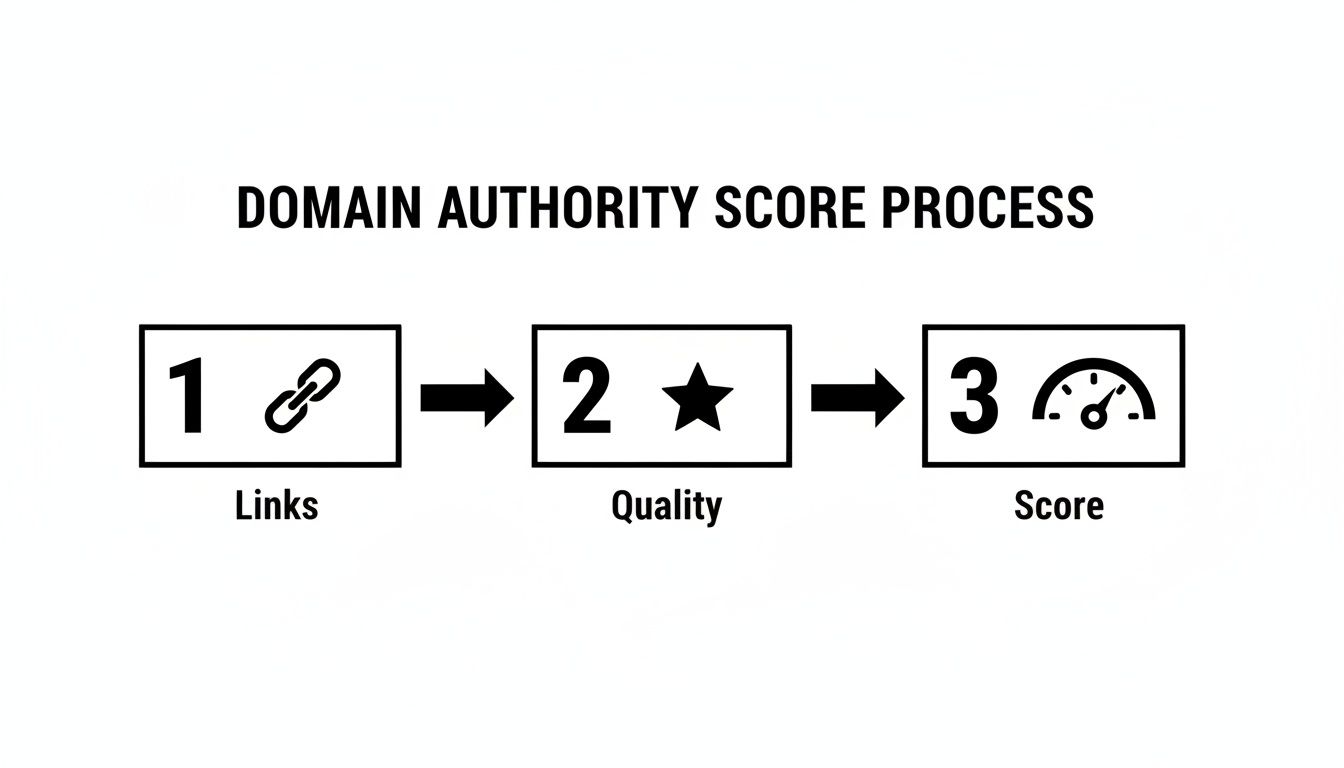
As you can see, the process starts with getting links, filters them for quality, and results in a stronger score. It’s a powerful cycle of growth.
Pillar One: Fortify Your On-Page SEO
Your on-page SEO is everything you have direct control over—the content, the structure, and the user experience of your website. It’s the absolute bedrock of any authority-building campaign. Without amazing content, trying to earn high-quality backlinks is a nearly impossible task.
The whole goal is to create content so genuinely useful that other websites want to link to it as a resource. That’s the true essence of earning authority.
Here’s where to focus your efforts:
- Create Link-Worthy Content: Develop in-depth guides, original research, or helpful tutorials that serve your Kansas City audience. A local plumber could create a definitive guide to preventing frozen pipes in Midwest winters—a resource local news and community blogs would be happy to reference.
- Optimize for Search Intent: Make sure every page on your site clearly and quickly answers the question a user is asking. High-quality content that satisfies what the user is looking for keeps them on your page longer, sending all the right signals to search engines. For example, a search for "Kansas City BBQ" expects a list of restaurants, not a history of barbecue.
- Build a Smart Internal Linking Structure: Use internal links to connect related pages on your site. For instance, on a blog post about "choosing a realtor," you should link to your main "Kansas City real estate agent" service page. This simple step helps search engines understand how your content is related and spreads "link equity" (authority) throughout your domain.
Pillar Two: Master Your Technical SEO
Technical SEO is all the work you do behind the scenes to make sure your website is fast, secure, and easy for search engines to crawl and index. If the search engine bots can't properly access your content, even the best articles and backlink strategies won't matter a bit.
A technically sound website is a fundamental signal of trust. It tells search engines that your site is professional, well-maintained, and provides a good user experience—a prerequisite for being seen as an authoritative source.
Your technical SEO checklist should include:
- Mobile-Friendliness: With most searches happening on phones, your site absolutely must be responsive and easy to navigate on a small screen. Use Google's Mobile-Friendly Test tool to check your pages.
- Site Speed: A slow website is a frustrating website. Aim for page load times under three seconds to keep users happy and engaged. Tools like Google PageSpeed Insights can identify exactly what's slowing you down.
- Clean URL Structure: Use simple, descriptive URLs that are easy for both people and search engines to understand (e.g.,
yourkcshop.com/services/residential-roofing). - XML Sitemap: Make sure you have an up-to-date sitemap submitted to Google Search Console. This acts as a roadmap, helping Google find and index all of your important pages efficiently.
Fixing these foundational issues ensures that all your other hard work can have the maximum impact.
Pillar Three: Execute a Robust Off-Page SEO Strategy
Off-page SEO covers all the actions you take outside of your website to raise its authority, with the main focus being on building a strong, natural backlink profile. This is often the most challenging part, but it’s also the most impactful for increasing your Domain Authority score.
The core principle is simple: earn high-quality links from other reputable websites. This is the digital world’s version of a powerful, trusted recommendation.
Your strategy should be proactive and varied:
- Pursue Local Partnerships: Collaborate with other non-competing Kansas City businesses. A wedding photographer, for example, could write a guest post on a local venue's blog, earning a relevant, high-authority backlink. Sponsoring a local charity event often results in a link from their website.
- Create Linkable Assets: As we mentioned in on-page SEO, assets like comprehensive guides or checklists are designed to be shared. Once you create them, actively promote them to relevant blogs and publications in your industry.
- Secure Local Citations: Ensure your business is listed consistently across reputable local directories like Yelp, the Better Business Bureau, and the KC Chamber of Commerce. These citations reinforce your location and legitimacy.
- Analyze Competitor Backlinks: Use SEO tools to see who is linking to your top competitors. This can uncover some fantastic link-building opportunities you might have missed. If a local blogger wrote about your competitor, they might be interested in your business, too.
A winning off-page strategy isn’t about getting as many links as possible; it’s about earning the right links. To get a deeper look at this process, our full guide explains how to build backlinks naturally without resorting to spammy tactics.
By systematically working on these three pillars—on-page content, technical health, and off-page authority—you create a powerful, self-reinforcing cycle that will steadily increase your Domain Authority and, more importantly, your visibility in search results.
How to Check and Monitor Your Domain Authority
You can't improve what you don't measure. So, if you're serious about boosting your site's authority, you have to get comfortable with tracking it. Think of it as your SEO scorecard—it shows you where you stand, tells you if your hard work is paying off, and gives you a clear target to aim for.
Keeping an eye on your score isn't just about stroking your ego. It’s about strategy. Monitoring your authority lets you see if your link-building efforts are actually moving the needle. It also lets you do a little digital snooping on your competitors, uncovering their secrets so you can start replicating what works.
Essential Tools for Tracking Authority
While Moz created the original Domain Authority (DA) metric, it’s not the only game in town. Other major SEO platforms have developed their own versions, each with a slightly different secret sauce. They all aim to do the same thing: estimate a website's authority based on its backlink profile.
Here are the big three you'll run into:
- Moz Link Explorer: This is the official home of Domain Authority (DA). The free version is the perfect starting point, giving you a quick look at your score and backlink profile.
- Ahrefs: Their metric is called Domain Rating (DR). A lot of SEO pros swear by DR because it’s highly sensitive to both the quality and quantity of unique websites linking to you.
- Semrush: Semrush uses the Authority Score (AS), which takes a well-rounded approach by factoring in link power, any potentially "toxic" links, and even organic traffic signals to gauge a site's overall influence.
A quick word of advice: don't obsess over tiny day-to-day changes in these scores. They fluctuate. What really matters is the long-term trend and, most importantly, how your score stacks up against your direct competitors in the Kansas City market.
How to Check Your Score and Your Competitors
Checking your score couldn't be simpler. Most of these tools offer a free checker or a trial period. You just pop in your domain name, and it will spit out a report with your score and other key backlink data.
But the real power isn't in knowing your own score—it’s in understanding the competitive landscape.
Once you have your number, run the exact same check for your top three to five competitors. This context is everything. A DA of 25 might feel low on its own, but if all your local rivals are hovering around 20, you're actually leading the pack.
This snapshot from Semrush is a perfect example of the instant overview you can get.
The report lays out the Authority Score, the number of referring domains, and the total backlinks, giving you a clear benchmark to measure your own site against.
The goal isn't just to know your score; it's to understand the gap between you and the businesses you're competing against. Analyzing their backlink profiles reveals who is linking to them, giving you a roadmap of high-quality link-building opportunities to pursue for your own site.
This process of reverse-engineering your competitors' success is a fundamental part of building a winning SEO strategy. To get a better handle on this, you can check out our guide on how to check backlinks in Google and other tools. By regularly monitoring these metrics, you can turn raw data into an actionable plan that systematically closes the authority gap and boosts your search rankings over time.
Building Your Authority with a Professional Partner
Boosting your Domain Authority isn’t a quick fix or an overnight project. It’s a long-term commitment that takes consistent effort, a ton of technical know-how, and a real understanding of what search engines actually want to see. This is where having a strategic partner in your corner can make all the difference.
Let's be honest, trying to master the endless complexities of SEO while also running your business is a monumental task. It’s a marathon of creating content, fixing technical glitches, and building relationships—all of which demand specialized knowledge and time that most business owners just don't have.
Uncovering Hidden Opportunities
The first thing an expert partner will do is a comprehensive SEO audit. We go deep, digging into your website's foundation to find all the technical snags and on-page weaknesses that are holding your DA score back. Think of it as a detailed home inspection that reveals everything from slow page speeds to a messy internal linking structure, giving you a clear, actionable roadmap for improvement.
From there, we pivot to what really fuels authority growth: earning the right kind of backlinks. Our team is all about building high-quality, natural links from relevant, authoritative sources. We don't just "get" links; we build genuine relationships and create content that makes other sites want to reference you. If you’re curious about what this crucial process looks like, our guide on how to outsource backlink building breaks down the strategic value of professional outreach.
Your Strategic SEO Ally
A professional partner is more than just a vendor; we're your dedicated guide. At Website Services Kansas City, we use advanced tools to constantly monitor your DA, keep an eye on your competitors, and tweak our strategy based on real-time data. We handle all the complexities so you can get back to what you do best—running your business.
This kind of partnership is more than just a service; it's a strategic investment in your business's long-term visibility. By systematically improving your online reputation, you secure a stronger competitive position and create a sustainable engine for growth.
Common Questions About Domain Authority
Even after you get the hang of the basics, some questions about Domain Authority always seem to pop up. Let's tackle some of the most common ones I hear from business owners, breaking them down into quick, straightforward answers.
How Long Does It Take to Increase Domain Authority
Building your Domain Authority is a marathon, not a sprint. If you’re starting with a brand-new website at DA 1, you can realistically expect to see it climb into the 10-20 range within 6 to 12 months of consistent, smart SEO work.
It’s also important to know that the scale is logarithmic. This just means jumping from DA 10 to 20 is a whole lot easier than climbing from DA 60 to 70. Patience and a long-term strategy are non-negotiable for seeing real, lasting growth.
Is Domain Authority the Same as Page Authority
Nope, but they're related metrics from Moz. Think of it this way: Domain Authority (DA) is like the overall reputation of your entire company. It measures the predictive ranking strength of your website as a whole.
Page Authority (PA), on the other hand, is the reputation of a single employee—or in this case, a single page. A viral blog post could earn a high PA all on its own, and while that certainly helps your company's overall reputation (DA), the two scores are measuring different things.
Can I Have a High DA but Still Get Low Traffic
Yes, this happens all the time. A high DA score is a fantastic indicator of your potential to rank, but it’s no guarantee of website traffic. If your DA is high but your traffic is low, it usually comes down to one of these culprits:
- Targeting the Wrong Keywords: Your content might be authoritative, but it isn't aligned with what your actual customers are searching for.
- Missing Search Intent: Your pages don't quite deliver the answer a user was hoping to find when they typed their query.
- Technical SEO Glitches: Sneaky issues like poor indexing can make your pages invisible to search engines, no matter how much authority they have.
DA is a huge piece of the puzzle, but it can't work in a vacuum. It needs to be paired with a sharp content strategy and a technically sound website to actually drive traffic and bring in leads.
Why Did My Domain Authority Score Go Down
Seeing your DA score drop can be a little jarring, but it's rarely a reason to panic. Because DA is a relative metric, your score can change for reasons that are completely out of your control.
For example, if massive authority sites like Wikipedia or Forbes suddenly gain millions of new links, it can shift the entire 1-100 scale, causing your score to dip slightly in comparison. A drop could also mean you've lost a few high-quality backlinks, or maybe a recent crawl found a new batch of spammy links pointing your way.
Ready to build your website's authority and climb the search rankings? The experts at Website Services-Kansas City can perform a comprehensive SEO audit and develop a backlink strategy to drive sustainable growth. Start building a stronger online presence by visiting us at https://websiteservices.io.