
At its core, anchor text is the visible, clickable text you see in a hyperlink. Think of it as a signpost on the internet; it tells both people and search engines what to expect on the other side of that click. For any Kansas City business, getting this small but mighty element right is a foundational step toward a stronger online presence.
Understanding Anchor Text and Why It Matters for SEO
Anchor text is one of the fundamental building blocks of the web. It acts as a bridge between pages, providing context and helping users navigate. When you link from one piece of your content to another, the specific words you choose for that link send a powerful signal to search engines like Google about what the destination page is about.
A well-chosen anchor helps algorithms understand relevance, which has a direct impact on your website's authority and, ultimately, your search rankings.
Here’s a simple visual of what we're talking about, with the anchor text "Wikimedia Foundation" linking to its page.
This image clearly separates the visible, clickable text from the underlying URL, showing how it provides a clean, user-friendly description of where the link will take you.
The Role of Anchor Text in SEO History
This concept isn't some new-fangled SEO trend; anchor text has been a powerful ranking signal since the early days of search engines. Back in the late 1990s, researchers discovered that the text in a link often described a target page more accurately than the page itself.
This breakthrough allowed early search engines to rank pages based on the words other websites used to describe them. The tactic became so effective that stuffing links with keywords became a primary ranking strategy—that is, until Google's Penguin update in 2012 cracked down on unnatural link patterns and over-optimization.
Building a Foundation for Authority
Ultimately, every single link pointing to your site contributes to your overall backlink profile. The anchor text within those links tells Google whether your site is a true authority on "Kansas City SEO services" or just another generic business page.
By paying close attention to your anchor text strategy, you can:
- Improve User Experience: Clear, descriptive links help visitors find information easily without having to guess where a link leads.
- Establish Topical Relevance: Consistent and relevant anchors tell search engines exactly what your pages are about, leaving no room for interpretation.
- Build Link Equity: Good anchors help pass authority from one page to another, strengthening your entire site from the inside out.
Getting these basics down is absolutely essential before you can start building a linking strategy that will outpace your local competitors.
Breaking Down the Different Types of Anchor Text
To build a link profile that looks natural and performs well, you absolutely need a healthy mix of different anchor text types. A common rookie mistake is thinking all links are the same. In reality, each category sends a unique signal to search engines. A varied approach is your best bet for a strategy that looks organic and keeps you safe from penalties.
Let’s unpack the main types you’ll run into. To make this super practical, we'll use a hypothetical Kansas City plumbing company for all our examples.
This concept map breaks down the basic journey: a user sees clickable text, gives it a click, and lands on a new page. It’s that simple.
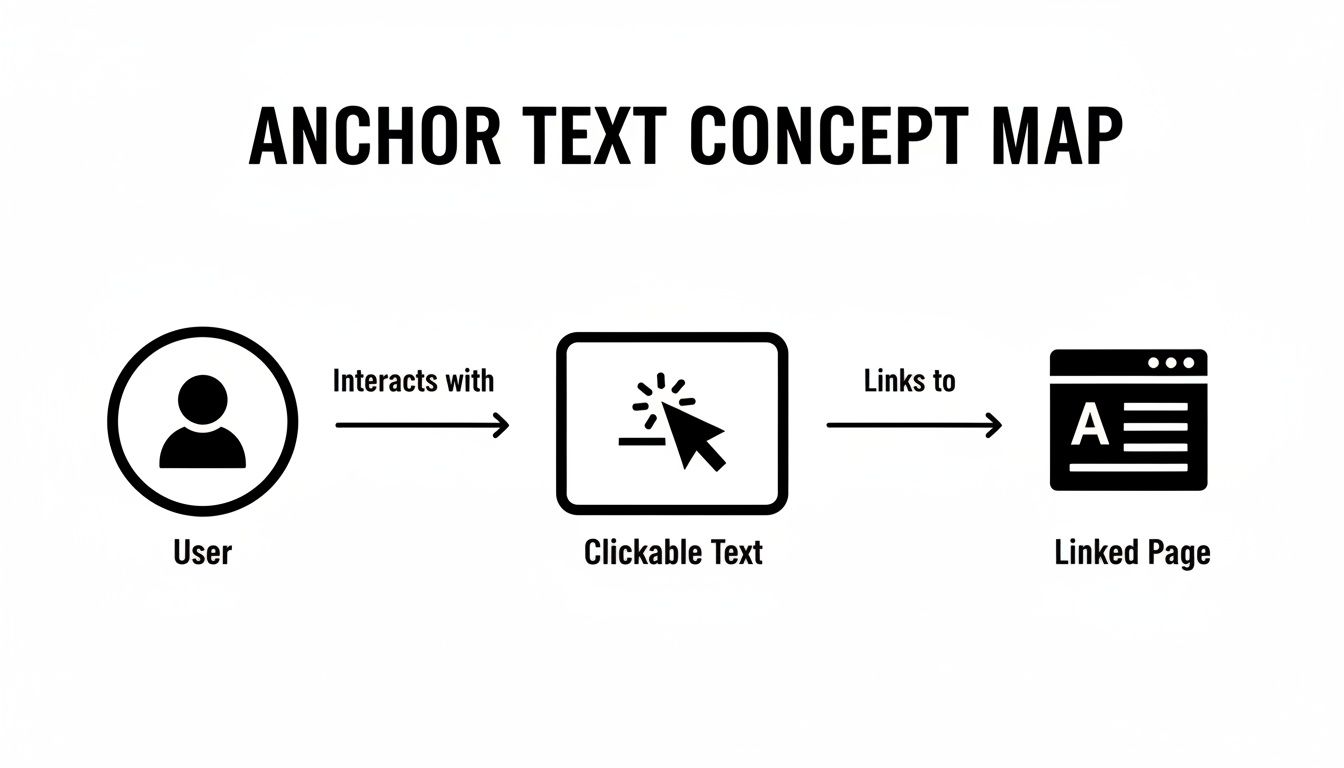
The image really drives home that anchor text is the critical bridge connecting what a user wants with the content you've created. Getting it right is non-negotiable.
Here's a quick table to help you keep these anchor text types straight. It's a handy reference for building out a natural-looking, effective linking strategy.
A Practical Guide to Anchor Text Types
A summary of common anchor text types, their strategic purpose, and clear examples to guide your linking strategy.
| Anchor Text Type | Description | Example |
|---|---|---|
| Exact Match | The link text is the exact target keyword. | "emergency plumber Kansas City" |
| Partial Match | The link text includes the target keyword plus other words. | "top-rated plumbing services in KC" |
| Branded | The link text is simply your brand name. | "KC Pro Plumbers" |
| Naked URL | The link text is the full, raw URL of the page. | "https://kcproplumbers.com" |
| Generic | A non-descriptive, action-oriented phrase. | "click here" or "read more" |
| Image (Alt Text) | The link is an image, and the alt text serves as the anchor. | alt="leaky pipe repair in Kansas City" |
Let’s break these down a bit further so you know exactly when and how to use them.
Keyword-Focused Anchors
These are the anchors that directly target the keywords you want a page to rank for. They're incredibly powerful but have to be used sparingly to avoid looking manipulative to Google.
- Exact Match Anchor: This is when the anchor text is the exact keyword you're targeting. For instance, a link using "emergency plumber Kansas City" points directly to a page optimized for that specific phrase.
- Partial Match Anchor: This type includes your target keyword but mixes in other words, which helps it sound more natural. An example would be something like "one of the best plumbing services in KC."
Branded and URL Anchors
These are often considered the safest and most natural types of anchors because they focus on your identity rather than just keywords. A healthy, mature backlink profile is typically dominated by these.
- Branded Anchor: The anchor text is simply your brand name. For our plumbing company, this would be "KC Pro Plumbers."
- Naked URL Anchor: This is just a direct link showing the full URL, like "https://kcproplumbers.com." It's simple, direct, and very common in the real world.
A diverse anchor text profile is your best defense against algorithm updates. A profile that is over 90% exact match keywords is a massive red flag for Google and can trigger penalties that are difficult to reverse.
Generic and Image Anchors
Finally, we have anchors that don't fit neatly into the keyword or brand categories but still play a vital role in making your overall profile look natural.
- Generic Anchor: These are those non-descriptive, action-oriented phrases you see everywhere. Common examples include "click here," "read more," or "learn more." While they don't provide much SEO context, they're a normal part of how the web works.
- Image Anchor: When an image itself is the link, search engines look at its alt text to understand what it's about. So, if an image of a repaired pipe links to a service page, its alt text—"leaky pipe repair in Kansas City"—becomes the anchor.
Getting a handle on these types is the first step toward building a balanced linking strategy. This is especially important when you're actively building links, as we cover in our guide on what is reciprocal linking, where your choice of anchor text is just as critical.
How Anchor Text Directly Influences Your SEO Rankings
Think of every anchor text link pointing to your site as a vote of confidence. When another website links to you using descriptive text like “best BBQ in Kansas City,” it’s sending a powerful signal to Google. It’s a recommendation that tells the search engine your page is a genuinely relevant resource on that topic.
This is fundamental to how search engines discover and organize the web. Each one of those descriptive links helps Google build a map of connections, figure out which pages are related, and ultimately decide which ones are the most authoritative. The more high-quality, relevant links you earn, the more trust Google puts in that page, which directly impacts your ability to climb the search results. It's a core piece of the puzzle when you're figuring out what page ranking is and how to make it better.
The Penguin Update and Over-Optimization Risks
For years, the SEO playbook was simple: build as many links as possible using the exact keyword you wanted to rank for. This system was easy to game, and it worked—until it didn't. In 2012, everything changed with the rollout of Google's Penguin update. This algorithm was specifically designed to hunt down and penalize websites with unnatural-looking link profiles, especially those stuffed with keyword-rich anchors.
Suddenly, a strategy that once guaranteed top rankings became a one-way ticket to a penalty, practically erasing sites from the search results overnight. This update forced the entire industry to pivot toward building more natural and diverse anchor text profiles. The lesson was crystal clear: trying to manipulate search rankings with aggressive, low-quality linking was a game Google would no longer tolerate.
Google's algorithms have become incredibly sophisticated at sniffing out unnatural patterns. A link profile that looks manufactured or too perfectly optimized is a major red flag that can lead to significant ranking drops.
Semantic Search and Modern Anchor Text Strategy
Today, anchor text is just one piece of a much bigger puzzle. Since about 2015, with the introduction of algorithms like RankBrain and BERT, Google has moved toward a deeper semantic understanding of the web. This means it doesn't just count keywords anymore; it analyzes the context around the link, the authority of the linking site, and the overall topical relevance to understand a link's true meaning.
This evolution brings very real risks for over-optimization. Most modern SEO guidance suggests that if more than 5-10% of your anchors are exact-match keywords, you're increasing your chances of an algorithmic penalty. A balanced, safe profile mixes branded, generic, and descriptive topic anchors to look natural and trustworthy. Building a varied link profile isn't just a best practice—it's the key to sustainable, long-term success in search.
Actionable Best Practices for Anchor Text Optimization

Knowing the different types of anchor text is one thing, but actually using them to build a smart, effective linking structure is a whole different ballgame. This isn't about guesswork; it's about following a clear playbook that helps users and search engines without accidentally setting off any of Google's alarms.
Think of it like this: your strategy for links within your own site (internal links) will be totally different from how you approach links you earn from other sites (external links). You’re in the driver’s seat with internal links, giving you a powerful tool to build topical authority. External links, on the other hand, demand a more hands-off, natural-looking approach.
Dos and Donts of Anchor Text
Getting anchor text right boils down to finding that sweet spot between providing helpful context and looking like you're trying to manipulate the system. Here are the core principles that should guide every link you build.
The Dos:
- DO Keep It Relevant: Your anchor text needs to be an honest preview of the page you're linking to. If a link says “Kansas City BBQ restaurants,” it better not lead to a page about plumbing services. It sounds simple, but this is a fundamental rule of user trust.
- DO Vary Your Anchor Text: A natural link profile is a healthy mix of branded, partial match, naked URL, and generic anchors. Overloading on one type—especially exact match keywords—is a massive red flag for Google.
- DO Write for Humans First: The link needs to feel natural within the sentence. If you have to twist your grammar into a pretzel just to fit a keyword in, it's a bad link. User experience always comes first.
The Don'ts:
- DON'T Over-Optimize: Never, ever stuff your anchor text with keywords. Using "best seo services kansas city mo" again and again is a textbook sign of manipulation that can get you penalized.
- DON'T Use Misleading Text: Tricking users with anchor text that doesn't deliver on its promise is a fast way to lose all credibility and send your bounce rate through the roof.
- DON'T Overuse Generic Anchors: Generic anchors like "click here" or "read more" give search engines zero contextual information. A few here and there won't kill you, but you should always choose descriptive text whenever you can.
Internal vs. External Linking Strategies
The rules of the game shift depending on whether you're linking within your own digital real estate or earning links from others. Mastering both sides of the coin is what separates a good SEO strategy from a great one.
Internal Linking Strategy
With internal links, you're the architect. You have 100% control over the anchor text, so you can be far more intentional. Use descriptive anchors to guide both users and search engines to your most important pages, creating a logical flow of information.
Actionable Insight: On a blog post about "The Benefits of Routine AC Maintenance," you can create an internal link to your service page using a descriptive anchor like, "For professional AC tune-ups in Kansas City…" This is much more effective than a generic "click here" and passes relevant signals to Google.
Pro Tip: Internal linking is a cornerstone of solid on-page SEO. By strategically linking your pages together with descriptive anchors, you tell Google which pages are the most important hubs of information on your site. This helps spread authority (or "link equity") and dramatically improves your site's overall structure. For a deeper look, check out our guide on what is on-page optimization.
External Linking Strategy
When it comes to external links (or backlinks), your goal is a profile that looks completely natural and earned. Since you can't directly control the anchor text other sites use, the aim is to attract a diverse mix.
Most organic links will be branded ("Website Services-Kansas City") or naked URLs ("https://websiteservices.io"). When you're doing outreach, it’s fine to suggest a relevant partial-match anchor, but demanding an exact-match keyword is a risky game that can look incredibly manipulative. A healthy backlink profile should be dominated by brand and URL anchors, with only a small, natural-looking percentage of keyword-focused text.
How to Conduct an Anchor Text Audit on Your Website

Okay, theory is great, but real progress happens when you dig into your own website’s data. Running an anchor text audit is how you diagnose the health of your link profile, spotting over-optimization or a lack of diversity before they snowball into ranking problems.
Think of it as a routine check-up for your backlinks. The whole point is to make sure everything looks natural, balanced, and isn’t accidentally sending red flags to Google.
Using SEO Tools to Gather Data
First things first: you need the right information. This is where industry-standard tools like Semrush or Ahrefs are non-negotiable. These platforms crawl the entire web, collecting massive amounts of data so you can get a detailed breakdown of your anchor text distribution.
You'll usually find what you need in a "Backlink Analytics" or "Anchors" report. Your goal is to pull a list of every anchor text being used in links pointing to your site, along with how often each one appears.
This kind of visual report is perfect for spotting imbalances at a glance.
Interpreting Your Anchor Text Profile
Once you have the data, it's time for the analysis. You’re essentially playing detective, looking for clues that might point to an unnatural or risky link profile.
Here’s what you should be hunting for:
- Over-optimization: Is your profile packed with exact-match keywords? This should always be a tiny slice of the pie. A heavy concentration here is a classic sign of manipulative link building.
- Lack of Diversity: A healthy profile is a mixed bag of branded, naked URL, partial-match, and generic anchors. If one type completely dominates, it can look suspicious to search engines.
- Spammy Anchors: Look out for totally irrelevant terms or anchors in foreign languages. These are often signs of a negative SEO attack or just plain low-quality links you don’t want.
So, what does a "good" profile look like? While there's no magic formula, recent industry analyses give us some solid benchmarks. For a safe and effective profile, branded and naked URL anchors should make up the bulk of your links, often around 60-80% combined.
On the other hand, you need to keep your exact-match anchors on a tight leash—typically under 5% of your total profile, and sometimes as low as 1% for any single keyword in a competitive niche.
An audit empowers you to move from guessing to making data-driven decisions. By identifying an over-reliance on exact-match anchors, you can proactively build more branded and natural links to balance your profile and protect your site.
Performing a thorough audit is a key part of understanding your overall link-building health. For more on this, check out our guide on how to check backlinks in Google.
Ready to turn all this anchor text theory into actual growth? At Website Services-Kansas City, we’re not just about explaining SEO; we’re about making it work for local businesses like yours. We live and breathe this stuff so you don't have to.
From digging into your current link profile to building a smart, natural strategy that gets you noticed, we handle the heavy lifting. If you’re ready to see what a perfectly executed linking strategy can do for your traffic and your bottom line, let's talk. We're here to help you get the results you've been looking for.
Got Questions About Anchor Text? We've Got Answers.
Even when you’ve got the basics down, a few practical questions always pop up when it's time to put theory into practice. Let's tackle some of the most common ones I hear from Kansas City business owners, with clear, direct answers to help you fine-tune your linking strategy.
What’s the Ideal Percentage for Exact-Match Anchors?
There isn't a single magic number here, but the expert consensus is crystal clear: keep it low. A safe upper limit for exact-match anchors is generally somewhere between 1% and 5% of your entire backlink profile. Pushing past that, especially beyond 10%, is practically asking for an algorithmic penalty from Google for over-optimization.
A healthy, natural-looking profile is always dominated by branded anchors and naked URLs. These two types should typically make up over 60% of all your links combined.
How Do You Fix Over-Optimized Anchor Text?
Fixing an over-optimized profile isn't about frantically trying to remove links. It’s all about dilution and balance. The goal is to build new, high-quality links with more natural anchor text to improve your overall ratios and drown out the bad stuff.
Here’s a simple action plan:
- Audit Your Profile: First, you need to know where you stand. Use a tool like Semrush or Ahrefs to get a clear picture of your current anchor text distribution.
- Build Branded Links: Shift your link-building focus to acquiring links that use your brand name or your website's URL. These are the safest and most natural-looking links you can get.
- Disavow Harmful Links: If your audit uncovers some truly spammy, low-quality links with exact-match anchors, use Google's Disavow Tool as a last resort. This tells Google to simply ignore them.
The real key is to build a healthier, more diverse profile moving forward. This proactive approach shows search engines you’re focused on earning natural links, not trying to manipulate their rankings.
Is Anchor Text Strategy Different for Internal vs. External Links?
Yes, and it's a night-and-day difference. You need a completely different mindset for each.
With internal links—the ones on your own site that point to other pages on your site—you have 100% control. Here, you can be more direct and descriptive. Using keyword-rich anchors like "Kansas City web design services" to link to your service page is a great way to build topical relevance and guide both users and search engines.
But for external links (backlinks coming from other sites), the goal is to look as natural as possible. Since you don't control them, a healthy profile will always have a mix of branded, URL, and generic anchors. Pushing for too many exact-match external anchors is a massive red flag for Google.
Mastering anchor text is a huge piece of the puzzle, but it's just one part of a winning SEO strategy. At Website Services-Kansas City, we specialize in building powerful, natural link profiles that drive real results for local businesses. If you're ready to turn all this knowledge into more traffic and leads, visit us at https://websiteservices.io to see how we can help.
