
A SERP feature is any result you see on a Google search page that isn't one of the classic, standard blue links. These are the dynamic, visual, and interactive elements—things like maps, image carousels, or instant answer boxes—that Google uses to give you information more directly, often without you even needing to click.
Beyond the Ten Blue Links

Think back to what Google used to look like. You’d type in a search and get a clean, predictable list of ten blue links. It was simple and straightforward, kind of like flipping through an old phone book—just text and numbers. Today, that same search results page has evolved into a dynamic dashboard, packed with visuals and interactive features.
This whole transformation is driven by one thing: Google’s obsession with satisfying what a user wants as fast as possible. The modern search page is less like a phone book and more like your smartphone's contact list, rich with photos, maps, and one-tap buttons to get directions or make a call. These extra elements are what we call SERP features.
They’re a huge deal because they grab all the attention, often pushing the traditional organic results way down the page and tanking their visibility. While understanding what is page ranking is still the foundation, SERP features have added a whole new, competitive layer to SEO.
Why SERP Features Matter More Than Ever
The fight for a user's attention on Google is getting fiercer by the day. To put it in perspective, back in 2019, a typical search might have triggered around 1.8 different SERP features. Fast forward to 2026, and that number is expected to climb to an average of 4.2 features per page.
That’s more than double the competition crowding out the traditional results. For any business, from a local service shop in Kansas City to a national e-commerce brand, this shift changes the entire game. Ignoring SERP features isn’t just a missed opportunity; it’s a recipe for becoming invisible. The goal is no longer just to rank—it's to win these features.
Actionable Insight: Securing a spot in a SERP feature is like getting prime real estate on the busiest street in town. It places your business directly in front of potential customers at the exact moment they need a solution, building trust and authority before they even visit your website.
Mastering these elements is the first critical step toward boosting your online presence and outperforming competitors in today's search environment.
Quick Guide to Common SERP Features
To help you get a quick handle on what's out there, here’s a simple breakdown of the most common SERP features you'll run into. Think of this as your field guide to the modern Google results page.
| SERP Feature Type | What It Looks Like | Actionable Insight |
|---|---|---|
| Featured Snippet | A box at the top with a direct answer pulled from a webpage. | Answer "what," "why," and "how" questions in your content with a concise 40-60 word paragraph. |
| Local Pack | A map with three local business listings underneath. | Optimize your Google Business Profile with complete, accurate information and gather positive reviews. |
| Knowledge Panel | An info box on the right side about a person, place, or thing. | Establish a Wikipedia page and use Organization schema markup on your site to build brand authority. |
| Rich Snippets | Extra info under a standard link, like ratings or prices. | Implement Product or Review schema on your pages to add star ratings and pricing directly to your listings. |
| People Also Ask | A dropdown list of related questions and their answers. | Use these questions as subheadings (H2s, H3s) in your content and answer them directly. |
| Image/Video Carousels | A horizontal, scrollable row of images or videos. | Name your image files and YouTube videos with descriptive keywords (e.g., "kansas-city-kitchen-remodel.jpg"). |
Getting familiar with these features is the first step. The next is learning how to optimize your content specifically to capture them, which is exactly what we'll be diving into.
The Most Valuable SERP Features for Local Businesses
Not all SERP features are created equal, especially when you're a local business in Kansas City trying to pull in nearby customers or a new Shopify store fighting for every single click. While dozens of these features exist, a select few deliver the biggest bang for your buck by directly building customer trust and sparking immediate action. Focusing your energy here is how you turn searchers into actual customers.
For local businesses, the undisputed champion is the Local Pack. This is the map with three business listings you see pop up at the top for searches like "plumber near me" or "best coffee in KC." Getting your business here puts you front and center for customers who have an urgent, location-specific need. It’s a massive signal that you are a relevant, nearby, and trusted solution.
Beyond the map, two other features are incredibly powerful for building credibility and boosting your click-through rate (CTR) before anyone even lands on your website.
Featured Snippets: The Coveted "Position Zero"
A Featured Snippet is that answer box sitting at the very top of the results page, a spot so valuable it’s often called “Position Zero.” It pulls a direct, concise answer to a user's question right from a high-ranking page.
Practical Example: A Kansas City HVAC company creates a blog post titled "How to Tell if Your AC Needs a Repair." Within the article, they include a clear, bulleted list under an H2 heading "Signs Your AC is Failing." Google might pull this list directly into a featured snippet, instantly positioning them as an expert for anyone searching that query in the area.
Actionable Insight: Capturing a Featured Snippet is like having Google itself endorse your content. It answers a user's question immediately, building trust and making your link the most logical next click for more detailed information.
Rich Snippets: Building Instant Trust
While a standard search result is just a title, URL, and description, Rich Snippets add extra visual details that help you stand out from the crowd. These small enhancements make a huge difference in grabbing a user's attention and earning their click.
Think about it from your own experience: when you're choosing a product, which result are you more likely to click on? The plain blue link, or the one showing five gold stars, a price, and availability right there on the search page?
Here are a few practical examples of Rich Snippets in action:
- Star Ratings: A local Kansas City restaurant can use Review schema to pull its 4.8-star average rating directly into its search result, offering immediate social proof.
- Pricing and Availability: For a local boutique using Shopify, Product schema can show that a popular dress is "In Stock" and costs "$75," attracting buyers ready to make a purchase.
- Event Information: A theater in the Power & Light District promoting a concert can use Event schema to display the date, time, and venue, answering key questions upfront.
These visual cues help manage user expectations and build confidence from the very first impression. They answer those secondary questions—Is it well-rated? Is it in my budget?—instantly, making your result far more compelling than your competitors'. For a local business, building this trust starts with a strong local presence, which you can learn more about by understanding what is a local citation in our detailed guide. These features work together to create a powerful first impression that drives real business results.
Exploring Other Key SERP Feature Opportunities
Once you get past heavy hitters like the Local Pack and Featured Snippets, Google's results page is still jam-packed with other elements that can steal a searcher's attention. Getting a handle on these different opportunities is how you diversify your SEO strategy and start claiming more digital real estate. Each one has a unique job, from answering follow-up questions to putting your products on visual display.
To successfully target these features, you have to start thinking like Google. It’s about aligning your content with the formats the search engine prefers for certain types of searches—moving beyond just plain text to embrace images, videos, and question-and-answer formats that solve a user's problem on the spot.
Answering Questions with People Also Ask
One of the most common features you'll run into is the People Also Ask (PAA) box. It’s that interactive dropdown list of questions that pops up, directly related to what you just searched for. When a user clicks on one, it expands to show a short, direct answer pulled from a relevant website.
Practical Example: A search for "kansas city seo" is likely to trigger PAA questions like "How much does SEO cost in Kansas City?" or "Is SEO worth it for a small business?"
Actionable Insight: The PAA box is a goldmine for content ideas. Use a free tool like AnswerThePublic to find these questions, then create a dedicated FAQ page or blog section that answers them clearly and concisely. This positions your site as the go-to source for those queries.
Winning with Visuals: Image Packs and Video Carousels
For any search where seeing something is more helpful than reading about it, Google will often serve up an Image Pack or a Video Carousel. The Image Pack is a horizontal row or grid of pictures, while the Video Carousel is a similar scrollable row of video thumbnails.
These features are non-negotiable for businesses where a picture is truly worth a thousand words.
- Image Pack: A Kansas City web design agency could target this by optimizing high-quality portfolio images with descriptive file names and alt text (e.g.,
<img src="kc-law-firm-website-design.jpg" alt="Kansas City law firm website design portfolio example">). - Video Carousel: A local roofer could create a short video titled "How to Spot Hail Damage on Your Roof in Kansas City," optimizing the YouTube title and description with local keywords.
Securing a spot in these visual carousels can drive incredibly engaged traffic because these users have already shown they’re in the mood for visual content.
Establishing Authority with the Knowledge Panel
The Knowledge Panel is that big information box that shows up on the right side of the search results, usually for searches about specific entities like people, brands, or organizations. It pulls data from all over the web to give a quick summary of key facts.
While you can't just "build" a Knowledge Panel yourself, you can heavily influence its creation by building a strong, consistent online presence. This means having a verified Google Business Profile, a detailed "About Us" page, and making sure your information is consistent across authoritative platforms like Wikipedia and industry directories. For a small business, this is the ultimate sign of authority.
To get a better handle on which terms trigger these valuable features, you can learn more about how to conduct keyword research.
How to Optimize Your Website to Win SERP Features
Knowing what SERP features are is one thing, but actually winning them is where the magic happens. This isn’t a passive process; it’s a deliberate strategy that combines a little bit of technical savvy with smart, user-focused content. It all comes down to giving Google exactly what it needs to understand, trust, and showcase your content in those high-visibility spots.
The bedrock of this whole effort is something called structured data, or Schema markup. Think of it as a secret translator for search engines. Google is brilliant, but at the end of the day, it reads code. Schema is a special vocabulary you add to your website’s code to tell Google, in no uncertain terms, what your content is all about.
For instance, you can use Schema to say, "This isn't just a number; it's a price," or "This text block is a step in a recipe," or "These are our official business hours." This level of clarity takes all the guesswork out of the equation for Google, making it incredibly easy for the algorithm to pull your information directly into Rich Snippets, Knowledge Panels, and other features.
Implement Schema Markup for Richer Results
Getting started with Schema is a lot easier than it sounds. You don't need to be a coding wizard. Most modern website platforms and SEO plugins, like Rank Math for WordPress, do all the heavy lifting for you, letting you implement high-impact markup with just a few clicks.
Here are a few of the most common types of Schema and how they directly help you win SERP features:
- LocalBusiness Schema: This is non-negotiable for any brick-and-mortar shop or local service business in Kansas City. It's how you define your address, phone number, and hours, feeding Google the exact info it needs for the Local Pack.
- Product Schema: Essential for any e-commerce store. This markup lets you specify price, availability, and review ratings, which can then show up as those eye-catching star ratings and other details right in the search results.
- Review Schema: This markup highlights ratings and testimonials, building instant social proof. A great way to put this into action is by optimizing review widgets for SEO, which helps pull those valuable on-site reviews into rich snippets.
This flowchart breaks down some of the most common SERP features you can target with both on-page content and technical optimizations.
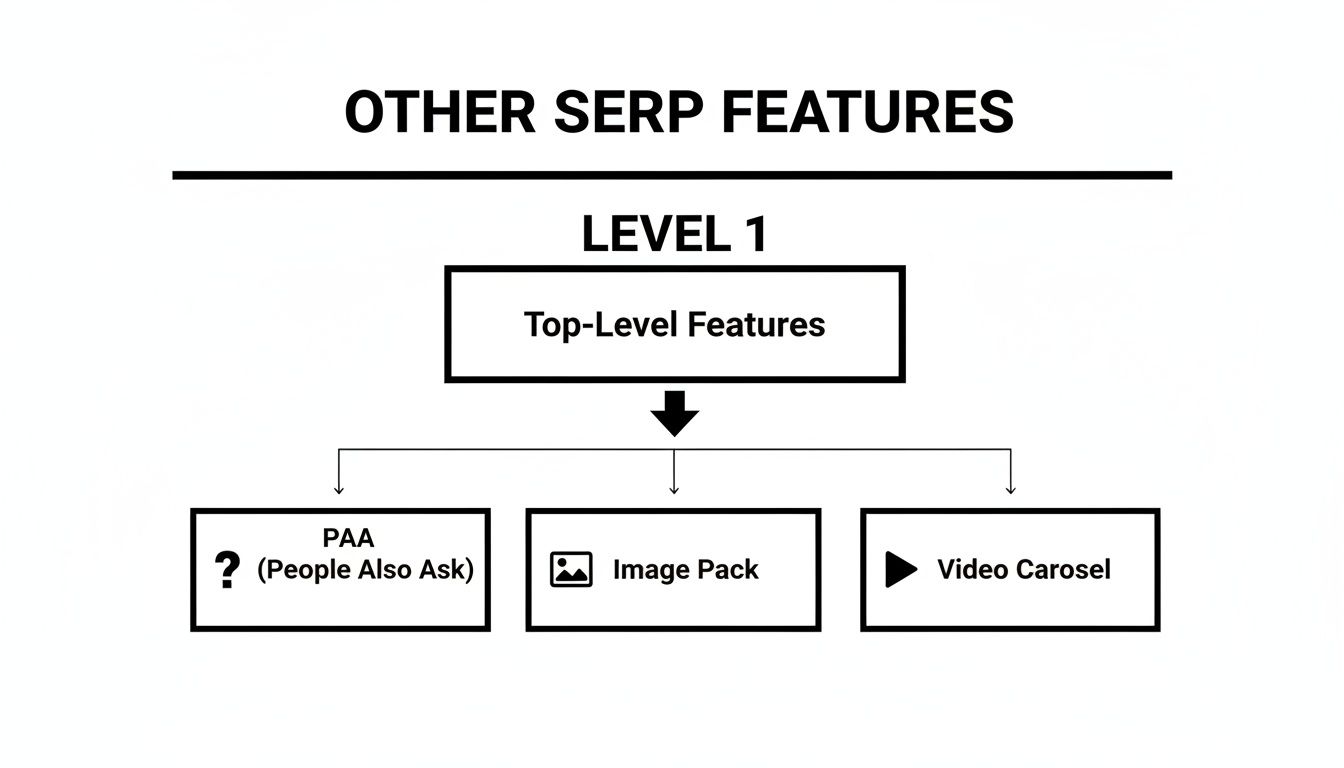
As you can see, different content formats—like question-based articles, high-quality images, and engaging videos—are crucial for capturing these distinct opportunities on the SERP.
Fine-Tune Your On-Page Content
Beyond the code, the actual content on your page plays a massive role. Google’s number one goal is to give users the best, most direct answer to their questions. If you format your content to make that answer easy to find, you’re halfway there.
Actionable Insight: The secret to winning SERP features is to stop thinking only about keywords and start thinking about answers. Structure your content to solve a user's problem clearly and concisely, and you'll align your site with Google's goals.
One of the most powerful tactics is to structure your content around questions. Use headings (H2s and H3s) that directly mirror the phrases your audience is typing into Google. This makes your page a prime candidate for both Featured Snippets and the "People Also Ask" boxes. To learn more about optimizing the elements search engines see first, check out our guide on how to write meta description at https://websiteservices.io/how-to-write-meta-description/.
You should also use formatting elements that Google loves to pull for snippets:
- Numbered and Bulleted Lists: Perfect for "how-to" articles or "best of" roundups.
- Tables: Ideal for comparing data or features, making complex info easy to digest.
- Short, Direct Paragraphs: Aim to answer a specific question in a concise paragraph of about 40-60 words. This is the sweet spot for many Featured Snippets.
Combining the technical clarity of Schema with thoughtfully structured on-page content creates a powerful one-two punch that dramatically increases your chances of capturing that valuable SERP real estate.
SERP Feature Optimization Checklist
To tie it all together, here’s a quick-reference checklist. Use this table to match the SERP feature you’re targeting with the specific action you need to take.
| Target SERP Feature | Key Optimization Tactic | Primary Tool/Method |
|---|---|---|
| Featured Snippet | Answer a specific question in a concise 40-60 word paragraph. | On-page content formatting (lists, tables, short paragraphs). |
| Rich Snippets (Reviews, Price) | Implement Product, Review, or FAQ Schema markup. | SEO plugins like Rank Math or manual JSON-LD script. |
| Local Pack | Fully optimize your Google Business Profile and use LocalBusiness Schema. | Google Business Profile management and on-page Schema. |
| People Also Ask (PAA) | Structure content with question-based H2/H3 headings. | Content strategy and on-page formatting. |
| Image Pack | Use descriptive file names, alt text, and high-quality images. | On-page image optimization best practices. |
| Knowledge Panel | Verify your Google Business Profile and use Organization/Person Schema. | Google Business Profile and Schema markup. |
| Video Carousel | Host videos on YouTube and embed them with VideoObject Schema. | YouTube optimization and on-page Schema. |
This checklist isn't exhaustive, but it covers the core actions that will give you the best shot at winning these features. By systematically working through these tactics, you can turn your website into a SERP-dominating machine.
Essential Tools for Tracking and Winning SERP Features
You can't improve what you don't measure. When it comes to consistently winning SERP features, you need a smart workflow that combines competitive analysis with on-page execution. This is where powerful tools like Semrush and Rank Math become your best friends, turning guesswork into a clear, data-driven strategy.
Think of these tools as your SEO command center. They help you spot opportunities, keep an eye on your progress, and roll out the technical changes needed to tell Google exactly what your content is all about. Without them, you’re flying blind, never sure where your competitors are winning or how to claim that valuable real estate for yourself.
Uncovering Opportunities with Semrush
Your first move should be to figure out which SERP features your competitors in the Kansas City market already own. This is where a tool like Semrush becomes absolutely invaluable. It lets you run a deep competitive analysis, showing you not just the keywords your rivals rank for, but the specific features they’ve managed to capture.
Practical Example: You run a Kansas City marketing agency. Using Semrush, you enter the domains of three local competitors. The report shows that none of them rank in video carousels for the keyword "small business marketing KC." This is your golden opportunity. You can create a series of short, helpful videos on this topic to capture that wide-open SERP feature and attract clients.
Actionable Insight: By analyzing the SERP landscape, you can pinpoint the exact features that are up for grabs. If your top three competitors are absent from video carousels, that's a clear signal to create video content and claim that space.
This analytical approach helps you focus your efforts where they'll have the biggest impact. To effectively monitor your presence across various SERP features and understand where you stand, consider leveraging specialized services like those offered by LLM visibility tracking agencies.
Executing with the Rank Math Plugin
Once you’ve identified which SERP features you’re going after, it’s time to get to work. For WordPress users, the Rank Math plugin is a complete game-changer for implementing Schema markup without writing a single line of code. It takes what used to be a complex technical task and boils it down to a few simple clicks.
Let's say you want to win an FAQ snippet. Rank Math has a dedicated FAQ block that automatically adds the correct Schema for you. All you have to do is type in your questions and answers, and the plugin handles the rest. This same easy process works for adding other crucial markups, like:
- Article Schema to properly define your blog posts.
- Recipe Schema for any food-related content.
- LocalBusiness Schema to power up your visibility in the Local Pack.
This one-two punch of analysis and execution empowers you to systematically claim more and more SERP real estate. By keeping an eye on your progress, you can see how each win translates directly into more traffic and leads. To complete your tracking toolkit, you might be interested in our guide on how to set up Google Search Console, an essential free tool from Google.
Where Search Is Headed—And What It Means for Your Business
Let's be honest: the Google SERP feels like it's changing every other week. With major shifts like AI Overviews taking center stage, it's easy to feel a little overwhelmed by the constant flux.
These changes can look intimidating, but here’s the good news: they don’t change the core principles of what actually works. The best defense against any algorithm update, AI-driven or not, is a rock-solid commitment to creating high-quality, well-structured content that puts your user first.
This has never been more true. While the technology is evolving, Google's mission is exactly the same as it was a decade ago: give the user the best possible answer to their question. If you focus on clear, authoritative content that solves a real problem, you'll always have a winning strategy.
Actionable Insight: Think of SERP feature optimization not as a one-time SEO task, but as a core business strategy. It's the modern frontier for visibility, connecting you with customers at their precise moment of need.
For a local business in Kansas City or anywhere else, understanding what is a SERP feature and how to capture it is no longer optional. Mastering these elements isn't just about climbing a few spots in the rankings; it's about owning the most valuable digital real estate where your future customers are looking.
This is how you build a resilient online presence and drive real, sustainable growth for your business.
Got Questions About SERP Features? We've Got Answers
Even with a solid game plan, the world of SERP features can feel a bit puzzling. It's totally normal for questions to pop up, so let's tackle some of the most common ones we hear from business owners.
Can I Pay Google to Get a SERP Feature?
For the most valuable organic spots, the answer is a hard no. You can't buy your way into organic placements like Featured Snippets or the Local Pack. Google's algorithm awards those spots to the most relevant, helpful, and authoritative content it can find.
That said, you can definitely pay for ad placements that look and act like SERP features. These include:
- Google Ads: The sponsored results you see at the very top of the page.
- Shopping Results: Those product carousels that show up for commercial searches are also paid placements.
Do I Need to Know How to Code to Win SERP Features?
Absolutely not. While some of the behind-the-scenes magic involves adding code (like Schema markup), modern tools have completely eliminated the need for you to become a developer.
Actionable Insight: WordPress plugins like Rank Math make it ridiculously easy. You can add complex Schema for reviews, FAQs, or your local business details with just a few clicks in a simple interface—no coding required.
How Long Does It Take to Win a SERP Feature?
There’s no magic number here. It all depends on your site's authority, how good your content is, and how tough the competition is for that search term.
For low-competition keywords, some sites can snag a Featured Snippet just days after publishing a perfectly optimized article. But for the more competitive features, like the Local Pack, you're looking at a longer game. It can take several months of consistent work, like building out your Google Business Profile and getting local citations.
The key is patience and consistency.
Ready to stop guessing and start winning valuable SERP real estate? Website Services-Kansas City specializes in creating and optimizing websites that are built to capture Google's attention. From technical SEO audits to strategic content creation, we give your business the tools it needs to thrive online. Visit us at https://websiteservices.io to learn how we can boost your visibility.
