
At its heart, a reciprocal link is a straightforward deal: Website A links out to Website B, and in return, Website B links right back to Website A. Think of it as a digital handshake or a classic “you scratch my back, I’ll scratch yours” arrangement between two site owners.
Understanding the Digital Handshake

The concept is simple. Two websites agree to exchange links, usually hoping to boost their SEO and send a bit of traffic each other's way. This is a totally different ballgame from a one-way backlink, where one site links to another without expecting anything in return.
But here’s the catch: the role of reciprocal links in modern SEO is way more complicated than it was back in the early days of the internet. Search engines like Google are now incredibly savvy at spotting linking patterns.
A natural, logical link swap between two relevant sites can be a good thing. For example, if a Kansas City home builder links to their preferred local interior designer, and the designer links back from their "Partners" page, that’s a logical connection that helps users. But an excessive or manipulative scheme? That can do a lot more harm than good.
Reciprocal Links Vs. One-Way Backlinks
To really get a feel for this, it helps to see how these links stack up against the one-way backlinks that SEO pros are always chasing.
- Reciprocal Link: This is a two-way street. A Kansas City marketing agency links to a local web designer they partner with, and that designer’s site links back to the agency. The value is mutual but scrutinized by Google.
- One-Way Backlink: This is a one-way endorsement. A major news outlet like the Kansas City Star writes a story on the best local businesses and links to that same marketing agency, but the agency doesn’t link back. This is seen as a genuine vote of confidence.
Search engines almost always see one-way links as more valuable because they look like genuine, unprompted endorsements. They help build a healthy and authoritative collection of links pointing to your site—what’s known as your backlink profile.
To help clarify the core idea, here's a quick summary.
Reciprocal Links At A Glance
This table breaks down the basic attributes of a reciprocal link.
| Attribute | Description |
|---|---|
| Definition | A mutual agreement where two websites link to each other. |
| Primary Purpose | Historically used for SEO benefits and mutual traffic referral. |
| Modern Perception | Viewed with caution by search engines; its value depends entirely on relevance and user intent. |
The key takeaway is that context and relevance are everything in today's SEO.
The crucial distinction for modern SEO lies in intent. Is the link exchange designed to genuinely help users by connecting relevant resources, or is its sole purpose to manipulate search rankings?
Ultimately, knowing what reciprocal links are is just the first step. Understanding their context, their history, and the very real risks involved is essential for any small business owner or new website trying to build an SEO strategy that lasts. This foundation will help you make smarter decisions as we dig deeper into their evolving role.
The Shifting Role of Reciprocal Links in SEO History
To really get why everyone’s so cautious about reciprocal links now, we need to jump in a time machine. Back in the early days of the internet, search engine algorithms were way simpler, and link building felt like the Wild West. Quantity was king, and trading links was one of the go-to strategies.
During this era, a lot of SEO was about finding tactics you could scale up quickly. Since the early 2000s, reciprocal links were a staple for anyone trying to improve their site's visibility. This mutual exchange, often called a 'digital handshake,' signaled relevance to search engines and could even drive some decent referral traffic by sending a targeted audience from one site to another. You can find more insights on this old-school SEO strategy on rhinorank.io.
This led to the rise of massive, low-quality link exchange schemes. Websites would slap up dedicated "links" or "partners" pages, often just a graveyard of dozens—or even hundreds—of totally irrelevant links. The only goal was to hoard as many inbound links as possible, context be damned, all in an effort to game the rankings.
The Penguin Update Changes Everything
The game changed for good in 2012 with the rollout of Google's Penguin update. This wasn't just a minor tweak; it was a seismic shift designed specifically to combat webspam and penalize sites that were violating its Webmaster Guidelines with manipulative link schemes.
Penguin's impact was swift and brutal. It completely devalued the "quantity over quality" playbook and started hammering websites caught up in schemes like:
- Excessive link exchanges: Engaging in large-scale "I'll link to you if you link to me" programs.
- Low-quality directory links: Submitting a site to countless spammy, worthless web directories.
- Over-optimized anchor text: Stuffing exact-match keywords into anchor text in a way that looked completely unnatural. For example, a plumber's site having 100 links all with the anchor text "best plumber in Kansas City" was a huge red flag.
Before Penguin, more links almost always meant better rankings. After Penguin, the quality and relevance of those links became the most critical factors, forever changing the landscape of SEO.
The Modern SEO Mindset
This history explains the guarded approach modern SEO professionals take toward reciprocal links. The Penguin update forced the entire industry to pivot away from manipulative shortcuts and focus on earning links naturally. Today, the focus is on building a healthy, diverse backlink profile that signals genuine authority and trust to search engines.
While a natural, relevant link swap between two businesses that actually complement each other is still perfectly fine, the ghost of Penguin serves as a constant reminder. Any linking strategy that looks like it was designed just to fool search engines carries a serious risk. This is exactly why the conversation around what are reciprocal links is now layered with warnings about context, relevance, and, most importantly, intent.
The Benefits and Dangers of Reciprocal Linking
Reciprocal linking isn’t a simple case of "good" or "bad" for your SEO. Its real value hinges entirely on context, relevance, and most importantly, your intent. When done thoughtfully, a link swap can be a genuine, positive signal. But when it’s done carelessly, it can quickly turn into a liability that tanks your site's credibility with search engines.
Getting this balance right is everything. A reciprocal link should always serve a clear purpose for the user first and your SEO second. Let's break down the potential upsides and the very serious downsides you need to have on your radar.
The Legitimate Benefits of Smart Link Swaps
When a reciprocal link just makes sense, it delivers real benefits that go far beyond SEO. These advantages are all about creating a better experience for your visitors and building authentic connections in your industry.
Here are the main perks of a healthy reciprocal link:
- Drives Highly Relevant Referral Traffic: A link from a complementary business puts your brand right in front of a pre-qualified audience. Think of a Kansas City bakery linking to a local coffee shop they partner with—they’re sending over customers who are already looking for local treats.
- Fosters Valuable Industry Partnerships: Linking to your partners, suppliers, or collaborators is a natural way to strengthen business relationships. It’s a public thumbs-up that builds goodwill and can easily lead to more co-marketing opportunities down the road.
- Enhances User Experience: A good link is just plain helpful. If you're a marketing agency in Kansas City writing about a successful website launch, linking to the web design firm you collaborated with saves your visitor a search and provides instant value. That helpfulness improves on-site engagement and builds trust.
The Serious Dangers of Manipulative Linking
The risks that come with bad reciprocal linking are huge and can leave a lasting negative mark on your website's performance. The danger pops up when the primary goal of the link exchange is to game the search rankings instead of providing real value to a reader.
Research has shown that while reciprocal linking can boost referral traffic when sites share engaged audiences, excessive or irrelevant exchanges are a huge red flag for manipulative behavior. These schemes often lead to algorithmic penalties and a steep drop in rankings. You can dig into the findings on Midland Marketing's blog.
The major risks include:
- Receiving a Google Penalty: This is the worst-case scenario. If Google's algorithm spots a pattern of unnatural, low-quality, or excessive reciprocal links, it can slap you with a penalty that makes your search rankings disappear overnight.
- Diluting Your Site's Authority: Linking out to low-quality, spammy, or totally irrelevant websites can damage your own site's reputation by association. This can weaken your site's perceived trustworthiness and water down your own SEO efforts. To get the full picture, check out our guide explaining what page authority is and how it impacts your rankings.
- Creating a Poor User Experience: A page cluttered with a bunch of irrelevant links just looks spammy and untrustworthy to visitors. This can send your bounce rate through the roof and signal to search engines that your page isn't giving users what they want.
To make the difference crystal clear, it helps to see the good and bad scenarios side-by-side.
Risk vs Reward A Comparison Of Reciprocal Linking Scenarios
This table breaks down the key differences between a safe, value-driven link swap and a risky, manipulative tactic. Use it to quickly spot good opportunities and steer clear of the bad ones.
| Characteristic | Safe Reciprocal Link (Good) | Risky Reciprocal Link (Bad) |
|---|---|---|
| Primary Intent | To provide genuine value and a helpful resource for the user. | To manipulate search engine rankings with minimal user value. |
| Relevance | Both websites are in the same or a highly complementary niche. | Websites are completely unrelated and have no audience overlap. |
| Context | The link is placed naturally within relevant content where it adds value. | Links are buried in footers, sidebars, or dedicated "link pages." |
| Scale | A few select, high-quality exchanges that make logical sense. | A large-scale, automated, or aggressive exchange with many sites. |
| Traffic | The goal is to drive relevant referral traffic that converts. | There is no expectation of real traffic; the link is purely for SEO. |
| Relationship | The link reflects a genuine business partnership or collaboration. | There is no real-world relationship between the two websites. |
Ultimately, the best way to approach reciprocal linking is with a simple question: "Does this link genuinely help my audience?" If the answer is a clear "yes," you’re likely on safe ground. If you have to stretch to justify it, it’s probably not worth the risk.
How to Build Reciprocal Links the Right Way
If you're going to dabble in reciprocal links, you need a smart, cautious playbook. This isn't about racking up a high score of link swaps; it’s about nurturing genuine partnerships that actually help your audience. To do it right, you have to shift your mindset from pure SEO gains to creating a better user experience.
The entire process kicks off with finding the right partners. Your goal is to connect with websites that aren't just in your industry but feel like a natural extension of your own brand. Think complementary, not competitive.
Identifying Quality Link Partners
Before a single outreach email gets written, you need a solid list of potential collaborators. The quality of these partners will single-handedly determine whether a reciprocal link helps you or hurts you. A link from a relevant, high-authority site is a valuable asset. One from a spammy, unrelated site is a liability waiting to happen.
Here’s what to look for in a potential link partner:
- High Topical Relevance: Their website has to be directly related to your niche. If you run a Kansas City SEO agency, a great partner might be a local web design firm or a digital marketing software company—not a random e-commerce shop selling pet supplies.
- Audience Alignment: Do you both serve a similar crowd? A local KC realtor and a mortgage broker serve different needs for the same customer journey, making them excellent partners. A link exchange between them delivers real value.
- Strong Site Authority: Use an SEO tool to check their domain authority or a similar metric. A link from an established, trusted website carries far more weight and comes with a lot less risk.
- Quality Content: Take a few minutes to read their blog and website content. Is it well-written, genuinely informative, and professional? Linking to a low-quality site can make your own brand look bad by association.
The golden rule of reciprocal linking is simple: If you wouldn't send your own customers to their website, you shouldn't ask for a link from it. This user-first mindset is your best defense against potential penalties.
Once you have a shortlist of high-quality potential partners, the next step is reaching out in a way that feels collaborative, not transactional.
This infographic illustrates the clear difference between a beneficial partnership and a risky scheme.
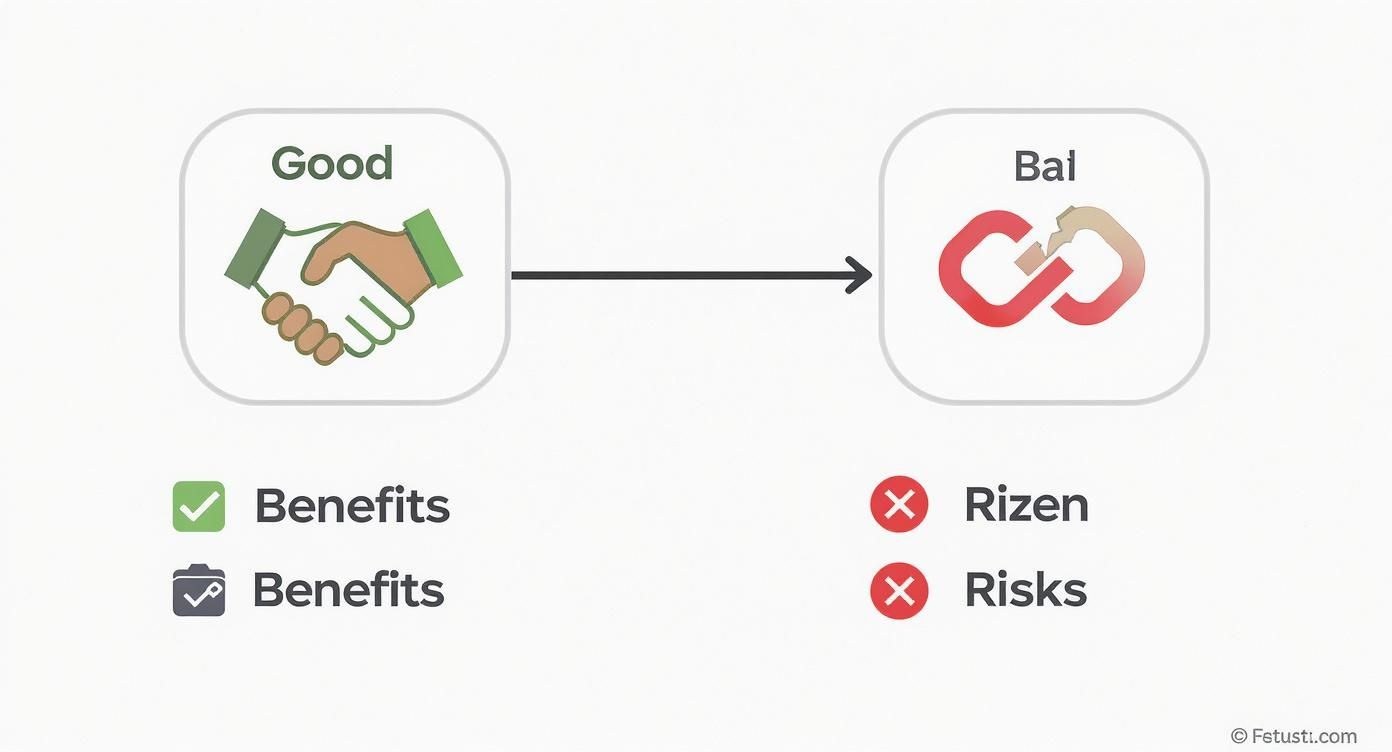
As the visual shows, good reciprocal linking is built on mutual value and audience benefit, while bad practices are purely manipulative and lead to negative outcomes.
Crafting a Value-First Outreach Email
Your outreach email sets the entire tone for the relationship. Ditch the generic templates that scream "link scheme." Instead, get personal and frame the whole request around the mutual benefit for both of your audiences.
Here’s a simple structure that works:
- Start with a Genuine Compliment: Mention a specific article or resource on their site that you actually found helpful. This shows you've done your homework.
- Introduce Yourself and Your Value: Briefly explain who you are and why your content would be a great fit for their readers.
- Propose the Collaboration: Suggest a specific spot where a link to one of your resources would add real value to their content. Then, offer to return the favor by finding a natural place to link to one of their valuable resources.
- Keep it Focused on the User: Emphasize how this exchange will help your readers and theirs, not just your SEO metrics.
This approach is fundamentally different from a cold, transactional request. It’s the first step toward building a real partnership, which is far more valuable than a single link. For a deeper dive into earning links, explore our guide on how to build backlinks naturally. By prioritizing relevance and genuine collaboration, you can safely navigate reciprocal linking while avoiding the red flags that harm your site's reputation.
Building Authority with Smarter Link Building Alternatives
While a few carefully chosen reciprocal links might play a tiny role, the most effective and sustainable SEO strategies are all about earning one-way backlinks. These are the links that act as genuine endorsements, signaling to Google that your site is a credible, trustworthy source of information.
The real key to building lasting authority is shifting your focus from trading links to earning them.
Instead of asking, "Who can I trade links with?" the much better question is, "What can I create that people will want to link to on their own?" This approach lines up perfectly with what search engines want to see: websites that provide real, undeniable value.
Create Authoritative Cornerstone Content
Hands down, the most powerful way to attract high-quality backlinks is by producing exceptional content that people can't help but reference. I'm not talking about just another blog post; I'm talking about creating the definitive resource on a particular topic.
These "linkable assets" become magnets for backlinks over time.
- Ultimate Guides: Go deep. Create comprehensive guides that cover a subject from every possible angle. A Kansas City marketing firm, for example, could write the "Ultimate Guide to Local SEO for Small Businesses," making it the go-to resource for others in the city.
- Original Research and Data: Conduct a survey on local consumer habits, analyze industry data, or publish your own unique findings. When other bloggers and journalists need a statistic to back up a claim, they'll link to your original research as the source.
- Free Tools and Templates: Develop a simple calculator (like a marketing ROI calculator), a checklist (e.g., "Kansas City Small Business Launch Checklist"), or a template that solves a common problem for your audience. These practical resources are incredibly shareable and attract links from sites whose readers would find them genuinely useful.
The most straightforward way to earn backlinks is to create content so valuable that it becomes a resource. By focusing on quality, your content becomes an asset that others want to cite, boosting your site's authority organically.
Contribute Valuable Guest Posts
Guest posting on reputable, industry-leading blogs is another excellent way to build authority and earn relevant backlinks. This isn't about spamming low-quality sites with generic articles. It’s about sharing your genuine expertise with a new, relevant audience.
A successful guest posting strategy involves identifying respected blogs in your niche and pitching them a unique, high-value article. For instance, the owner of a local Shopify store could write a guest post for a major e-commerce blog about their best inventory management tips. This method places your brand—and a link back to your site—on an already-established platform.
Leverage Digital PR for Media Mentions
Digital PR focuses on getting your brand mentioned by online media outlets, journalists, and industry publications. This approach often results in some of the most powerful backlinks you can get.
This can involve sending out press releases about a company milestone, sharing expert commentary on a trending topic, or promoting a unique piece of research you’ve published. For example, a KC-based SEO agency could offer expert commentary to a local news station about how a recent Google update impacts small businesses in the area.
Each of these alternatives requires more effort than a simple link swap, but the payoff is significantly greater. They build a diverse, natural backlink profile that Google rewards, solidifying your site's authority for the long term. A robust and well-planned link acquisition strategy is essential for any business looking to dominate organic search results.
How to Audit Your Existing Reciprocal Links

Knowing the theory behind reciprocal links is one thing, but rolling up your sleeves and digging into your own website is where the real progress happens. Even if you’ve never deliberately built one, you’ve probably got a few reciprocal links hiding in your backlink profile. An audit lets you find these links, figure out what they’re worth, and clean up anything that could be holding you back.
This process doesn't need to be some monumental task. With the right tools and a clear game plan, you can take firm control of your link profile and make sure it’s only sending positive signals to search engines.
Tools for Uncovering Your Links
First, you need to figure out who’s linking to you and which of those sites you’re linking back to. You can’t fix what you can’t find. Luckily, a few powerful tools can give you the complete picture of your backlink profile.
Your go-to options include:
- Google Search Console: This is a free, must-have tool from Google that gives you a solid report on your top linking sites. It's the perfect starting point for any website owner. For a full walkthrough, you can learn more about how to check backlinks in Google.
- Ahrefs or Semrush: These premium SEO platforms deliver much more granular backlink data. They make it ridiculously easy to spot reciprocal links by letting you compare your referring domains (sites linking to you) with your linked domains (sites you link out to).
These tools will spit out a list of domains. From there, your job is to put on your detective hat and analyze each one to see if it's helping or hurting.
Don't be shocked if you find a bunch of reciprocal links. Mutual linking is a fundamental part of how the web is wired. Research shows that about 73.6% of websites have reciprocal links in their profile.
A Framework for Evaluating Each Link
Once you have your list, run each reciprocal relationship through this simple, three-question framework:
- Is the other site relevant and high-quality? Does the site operate in your niche or a closely related one? Does it have a good reputation and solid authority? A link from an irrelevant, low-quality site brings nothing to the table.
- Does the exchange offer real value to users? Would you honestly send one of your customers to this site? If the link actually makes sense and helps your audience, it’s probably a good one.
- Does the link look natural? Is it placed within the body of relevant content, or is it just stuffed into a footer or a generic "partners" page? Context is everything.
This framework helps you get past the basic question of "what are reciprocal links" and into the far more important territory of "what are good links." A reciprocal link isn't bad by default; in fact, some studies have found that nearly 43.7% of top-ranking pages have some form of them. You can check out more insights on reciprocal link prevalence from PostAffiliatePro.
Based on what you find, you can decide whether to keep the good links, remove or "nofollow" the questionable ones, or use the disavow tool as a last resort for truly toxic connections. This is how you turn knowledge into action.
Frequently Asked Questions About Reciprocal Links
Even with a solid game plan, some specific questions about reciprocal links always seem to pop up. Let's tackle some of the most common ones I hear from clients to help you make smart, safe decisions for your site.
Are All Reciprocal Links Bad for SEO?
No, absolutely not. The idea that every single reciprocal link is toxic is a myth. What really matters to search engines is the context and intent behind the link exchange.
A link swap is perfectly fine—and even helpful—if it provides genuine value to users and connects two websites that are topically relevant. Think of a Kansas City web designer linking to a trusted copywriter they partner with all the time (and vice versa). That’s a natural, helpful connection that reflects a real-world relationship.
Google penalizes links created with the sole purpose of trying to game the system, not the ones that actually help an audience.
How Many Reciprocal Links Are Too Many?
There isn't a strict "magic number," but the best practice is to keep reciprocal links to a tiny fraction of your overall backlink profile. Many SEOs I know suggest keeping it well under 5-10% to avoid looking unnatural.
Instead of obsessing over a specific count, focus on quality and relevance. A handful of high-quality, editorially justified reciprocal links is far more beneficial than dozens of low-quality, irrelevant ones.
A lopsided profile where a huge chunk of your backlinks are mutual exchanges is a massive red flag for search engines. It signals a manipulative strategy rather than organic authority that was earned over time.
Should I Use a Nofollow Tag on Reciprocal Links?
Using a rel="nofollow" tag is a smart, safe move if you have any doubts about the other site's quality or if you just want to be extra cautious. This tag tells search engines not to pass any "link equity" or authority, effectively preventing any negative association from affecting your site.
However, for a link that stems from a trusted, valuable partnership, a standard (dofollow) link is totally appropriate. It signals to Google that you endorse the other website and its content. Your decision should always come down to the quality of your partner and the context of the link itself.
Ready to build a powerful and penalty-proof backlink profile? The experts at Website Services-Kansas City specialize in creating natural, high-authority links that drive real results. Learn more about our professional SEO solutions.
