
An SEO link audit is the process of digging into every single backlink pointing to your website to figure out its quality and how it’s affecting your search engine rankings. Think of it as a critical health check for your site, helping you find and get rid of harmful links while also showing you which ones are actually driving value. It's your secret weapon for improving your digital reputation here in the Kansas City market.
Why Backlinks Drive Your Kansas City SEO Success

For a lot of Kansas City business owners, SEO can feel like a pretty complex puzzle. You put in the hours on keyword research and get your website looking perfect, but there’s a massive ranking factor that often gets ignored—your backlink profile.
Backlinks are basically votes of confidence from other websites. Each one signals to Google that your content is credible, authoritative, and worth showing to people.
Think of it like a local recommendation. If your Overland Park law firm gets a link from the Kansas City Bar Association website, that carries serious weight. It tells search engines you're a legitimate, respected voice in the community. On the flip side, a link from some low-quality, spammy directory is like a bad review. Get too many of those, and you can seriously tank your online reputation and your search rankings.
The Power of a Clean Link Profile
A clean, high-quality backlink profile is the foundation of long-term SEO success. It has a direct impact on your site's authority and its ability to rank for the keywords that actually matter. If you don't know what your link profile looks like, you’re flying blind.
A proactive SEO link audit gives you a few key advantages:
- Identify Harmful Links: You can uncover and deal with "toxic" backlinks that might be holding your rankings down or even put you at risk of a Google penalty.
- Understand Your Strengths: Discover which high-authority sites are already linking to you. This gives you priceless insights for planning future link-building campaigns.
- Gain a Competitive Edge: A lot of local competitors in the KC metro completely ignore their off-page SEO. A thorough audit gives you a clear advantage by making sure your digital foundation is rock-solid.
A study by Ahrefs revealed that 96.55% of all pages on the internet get zero organic traffic from Google. A primary differentiator for the pages that do rank is a strong profile of high-quality backlinks.
More Than Just a Cleanup
Running a regular SEO link audit isn't just about damage control. It’s a strategic analysis that should inform your entire marketing plan.
By getting a clear picture of your current links, you can better define what a healthy backlink profile even looks for your industry. This knowledge helps you build a proactive strategy, focusing your energy on earning links that genuinely move the needle. You can learn more about this by exploring what a backlink profile is and how it shapes your site's authority.
Ultimately, this process is all about taking control of your online narrative.
Gathering Your Tools for a Backlink Investigation
Before you can start analyzing your links, you need to get them all in one place. This is the foundation of any serious SEO link audit. You’re essentially creating a complete and accurate inventory of every link pointing to your site.
Think of it like trying to solve a puzzle. If you only have half the pieces, you’ll never see the full picture. The goal is to pull every single backlink from multiple sources into one master spreadsheet. This is the only way to spot hidden patterns and make decisions based on real data, not just a guess.
Choosing Your Primary Investigation Tools
For a proper deep dive, you’re going to need professional-grade tools. The data they provide is leagues ahead of free alternatives, giving you the critical metrics needed to judge a link's true quality. For most Kansas City businesses, a couple of platforms are the gold standard.
- Semrush: This one is a beast. It's known for its huge backlink database and a fantastic Backlink Audit tool that automatically flags potentially toxic links. It gives you a great head start on finding the obvious red flags.
- Ahrefs: Famous for having one of the biggest and freshest link indexes out there. Its Site Explorer feature is second to none for digging up almost every link and seeing what your competitors are up to.
Sure, these tools have a subscription cost, but there's another powerful resource you can tap into for free.
Leveraging Google Search Console
Google Search Console (GSC) is your direct line to the mothership. It shows you a list of links that Google itself has found pointing to your site. Since the data comes straight from the source, it's incredibly valuable. You’ll find this under the "Links" report in your GSC dashboard.
The main catch with GSC is that it doesn’t show you every backlink—it just gives you a sample. Still, it’s an essential piece of the puzzle and should always be cross-referenced with your other tool data.
You can easily export your links from GSC to get started. For a more detailed walkthrough, our guide on how to check backlinks in Google breaks it down step-by-step. Combining this free data with a report from a premium tool is how you build the most complete dataset possible.
Comparing Top SEO Link Audit Tools
Choosing the right tool can feel overwhelming, but it really comes down to your specific needs and budget. Here’s a quick breakdown of the big players to help you decide which one is the right fit for your audit.
| Tool | Key Feature for Link Audits | Best For | Pricing Model |
|---|---|---|---|
| Semrush | Toxicity Score in its Backlink Audit tool, which automatically flags potentially harmful links. | Businesses looking for an all-in-one SEO platform with strong, user-friendly audit tools. | Subscription-based (monthly) |
| Ahrefs | The largest live backlink index, providing the most comprehensive data on new and lost links. | SEO professionals who need the most exhaustive, up-to-the-minute backlink data available. | Subscription-based (monthly) |
| Google Search Console | Free, first-party data directly from Google showing which links it has crawled. | Every website owner, as a foundational and free data source to cross-reference. | Completely Free |
Ultimately, the best approach is to combine the free, essential data from Google Search Console with the deep, analytical power of a tool like Semrush or Ahrefs. This gives you both breadth and depth for a truly thorough investigation.
Consolidating Your Backlink Data
Okay, you've picked your tools. Now it's time to export the data and get organized. Your mission is to create a master spreadsheet in Google Sheets or Excel that will act as your command center for this whole audit.
Start by exporting a complete backlink report from your main tool (Semrush or Ahrefs). Then, grab the links report from Google Search Console.
Now for the important part: merge these exports into a single sheet and remove all the duplicate entries. This will leave you with a clean, comprehensive list. Make sure your spreadsheet includes these essential columns for every single link:
- Source URL: The exact page where the link is located.
- Target URL: The page on your site the link points to.
- Anchor Text: The clickable words used in the link itself.
- Referring Domain: The root domain of the site linking to you.
- Authority Score/Domain Rating: The key metric from your tool (like Semrush's AS or Ahrefs' DR).
- First Seen Date: When the tool first discovered the link.
For a more advanced audit, you might want to understand the historical context of a linking page. To see how a page has changed over time, a specialized Wayback Machine Archived Pages Scraper can be incredibly useful.
With this consolidated list in hand, you finally have a complete, organized inventory. You're now fully armed and ready to dive into the most critical phase: analyzing each link to find out what it's really worth.
Sorting High-Value Links From Harmful Ones
Alright, you’ve got your backlink data pulled into a spreadsheet. Now the real work begins. This is the detective phase of your SEO link audit, where you go beyond just looking at a list and start making judgment calls. The whole point is to figure out which links are lifting your site up and which ones are actively dragging it down.
Your mission is to sort every single link into one of three buckets: keep, investigate, or remove. This simple framework makes an overwhelming task manageable and gives you a clear path forward.
Decoding the Quality of a Backlink
Let's be clear: not all backlinks are created equal. A single link from a high-authority, relevant site can be worth more than a thousand spammy ones. But how do you spot the difference? It really boils down to looking for a few key signals.
- Relevance: Does the link come from a site that’s even remotely related to what your Kansas City business does? If you're a local plumber, a link from a home improvement blog is pure gold. A link from some random foreign-language casino site? That's a massive red flag.
- Authority: How trustworthy is the website linking to you? This is where metrics like Domain Authority (DA) or Authority Score (AS) come in handy. While they aren't perfect, they give you a quick way to gauge a site's overall strength. To get a better handle on this, you can learn more about what domain authority means and why it's such a crucial metric.
- Placement: Where is the link on the page? A link placed naturally within the body of an article, surrounded by relevant text, carries way more weight than one buried in a footer or a long list of other businesses in a directory.
Actionable Example: A fantastic link would be an in-content mention of your Kansas City bakery in a local food blogger's post about "The Best Croissants in KC." A harmful link? One from a generic business directory filled with thousands of listings from all over the world.
Spotting the Signs of a Toxic Link
Toxic backlinks are the digital equivalent of bad company. They can seriously damage your site's reputation in Google's eyes and hold your rankings back. Learning to identify them is a skill every site owner needs.
Keep an eye out for these tell-tale signs:
- Low-Authority Directories: Links from generic, low-quality directories that seem to exist only for SEO are almost always toxic.
- Irrelevant Sites: If you're getting links from websites in completely unrelated industries or in foreign languages, it signals manipulation.
- Site-wide Links: A link that shows up on every single page of another website, often in the footer or sidebar, can look spammy, especially if the site itself is low-quality.
- Private Blog Networks (PBNs): These are networks of websites built for the sole purpose of linking out to manipulate search rankings. They usually have thin content and very unnatural outbound link patterns.
A critical part of any SEO link audit is identifying and neutralizing these threats. Failing to do so can leave your site vulnerable to algorithmic suppression or even manual penalties from Google, effectively making you invisible in search results.
Analyzing Your Anchor Text Profile
Beyond the quality of the linking site, you also need to look at the anchor text—the clickable words used in the link itself. A natural anchor text profile has a healthy mix of different types. An unnatural one is a huge red flag for Google.
Your profile should ideally look something like this:
| Anchor Text Type | Description | Example | Natural Percentage |
|---|---|---|---|
| Branded | Your business name. | "Website Services-Kansas City" | ~50-60% |
| Naked URL | The direct URL of the page. | "https://websiteservices.io" | ~20% |
| Generic | Non-descriptive, common phrases. | "click here," "read more" | ~10% |
| Keyword-Rich | The exact or partial keyword you want to rank for. | "best plumber Kansas City" | ~1-5% |
| Topic/LSI | Related keywords and phrases. | "local website development services" | ~5-10% |
| Image/ALT Text | Links from images, using the ALT text as the anchor. | Image of your logo linked to your homepage | ~5% |
If your audit reveals that 40% of your links use the exact anchor text "best plumber Kansas City," you have an over-optimization problem. This looks manipulative to search engines and needs to be addressed immediately.
The process of weeding out these harmful links is more than just a cleanup exercise; it can be a powerful lever for growth. In fact, disavowing toxic links can have a profound impact on your visibility. Data shows that a thorough cleanup can improve rankings significantly, making a complete backlink audit one of the most impactful quick wins in SEO.
By the end of this analysis, your spreadsheet should have a new column with one of three labels for each link: Keep, Investigate, or Remove. This simple classification sets the stage for the next crucial phase: taking decisive action.
Your Action Plan for Link Removal and Disavowing
Alright, you've sorted your links and flagged the toxic ones. Now it's time to take action. This isn't just about spring cleaning; it’s about actively protecting your website's reputation in the eyes of search engines. The game plan involves a one-two punch: first, direct outreach to get links removed, and only as a final resort, using Google's Disavow Tool.
The absolute best outcome is getting a harmful link completely removed. It’s the cleanest solution and sends the clearest possible signal to Google. You’d be surprised how often a simple, polite request works—many webmasters are happy to remove a link if they understand it's causing a problem.
The First Step: Manual Outreach
Always start with manual outreach. This means you'll be getting in touch with the owners or webmasters of the sites with toxic links and simply asking them to take the link down. Keeping your communication professional, short, and to the point is the secret to getting a positive response.
Here’s a simple, effective email template you can tweak:
Subject: Link Removal Request for [Your Website Name]
Hello [Webmaster Name or "Webmaster"],
I'm contacting you on behalf of [Your Website URL]. We're currently in the middle of an SEO link audit to clean up our backlink profile.
We noticed you're linking to us from this page: [URL of the page with the toxic link]
The link uses the anchor text "[Anchor Text]".
We would be incredibly grateful if you could remove this link. Thanks so much for your time and help.
Best regards,
[Your Name]
[Your Website]
Actionable Insight: Keep a simple spreadsheet to track your outreach. Note the domain, the date you contacted them, and any response. If you don’t hear back after a week, one polite follow-up is fine. Don't be pushy or send a barrage of emails; if they ghost you, it's time to move on to the next step.
The decision tree below is a great visual for how to think about this process before you start sending emails or building a disavow file.
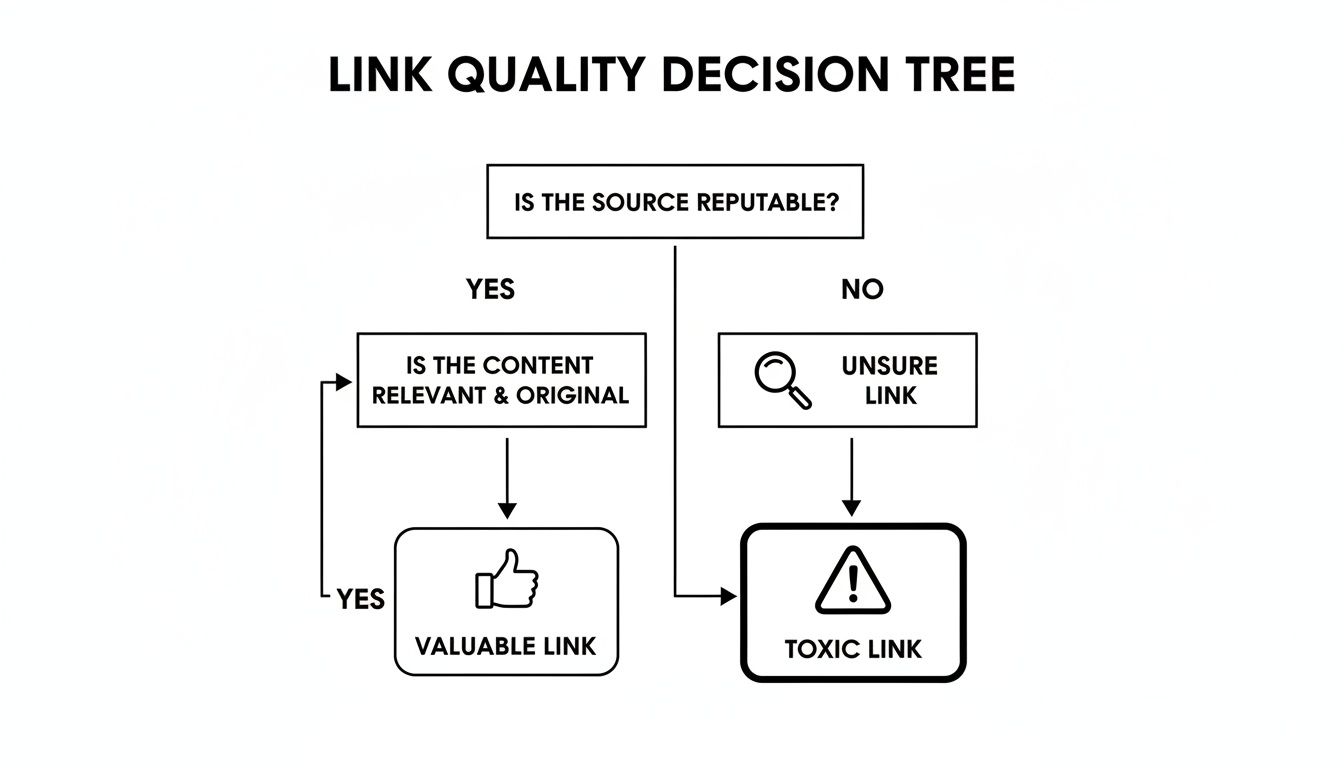
This flowchart helps you triage your backlinks, separating the keepers from the junk while flagging questionable ones for a closer look before you decide their fate.
When Outreach Fails: Introducing the Disavow Tool
Sometimes, you just won't get a response. The site might be abandoned, or the webmaster could simply refuse. For these situations, your next line of defense is Google's Disavow Tool. Think of this as telling Google directly, "Hey, I don't endorse this link. Please ignore it when you're evaluating my site."
It's a powerful tool, but it needs to be used with extreme caution. Disavowing a link that's actually helping you can do more harm than good. Only use it as a last resort for links you are 100% certain are toxic and that you couldn't get removed manually.
To really nail your removal plan, it's worth understanding the proven strategies for removing links in Google Search that SEO pros use.
Creating Your Disavow File
The disavow file is just a simple text file (.txt) that you upload to Google Search Console. It lists the domains or specific URLs you want Google to ignore. The formatting has to be perfect, or Google will reject the file.
Here's how to structure it:
- Each entry gets its own line.
- To disavow an entire domain (which is usually best for spammy sites), use the format:
domain:examplespam.com - To disavow just one specific page, list the full URL:
http://examplespam.com/page-with-bad-link.html - You can add comments by starting a line with a hash symbol (#). This is great for leaving notes for yourself or your team.
A real-world file might look something like this:
Contacted webmaster on 01/15/2024, no response.
domain:spammysitedirectory.com
Link from an irrelevant foreign language site.
domain:anotherbadsite.ru
Single bad link from an otherwise okay-ish site.
http://questionableblog.com/spammy-article/
Once your file is ready, you submit it through the Disavow Tool in your Google Search Console account. Just remember, it can take several weeks for Google to process the file, so patience is key. To make sure you're following the latest best practices, you might want to review a comprehensive guide on building a Google disavow list.
By methodically working through outreach and then carefully using the disavow tool, you can effectively clean up your backlink profile, ditch the negative signals, and build a much healthier foundation for all your future SEO work.
Building a Proactive and Healthy Link Strategy
Think of a thorough SEO link audit as more than just a cleanup job. It's the strategic blueprint for your future growth. You've moved beyond the reactive process of just stamping out toxic links, and now you can shift into a much more powerful, proactive mindset. The real goal is to build a healthy, authoritative backlink profile that consistently drives results for your Kansas City business.
This transition starts by figuring out what’s already working. Your audit didn't just shine a light on the bad links—it also revealed the good ones. These high-quality links are your roadmap, showing you exactly what kind of opportunities to chase next.
Replicating Your Link Building Wins
Take a hard look at your best-performing backlinks. Where did they come from? What makes them so valuable? When you start identifying these patterns, you can build a targeted and effective link-building strategy instead of just throwing things at the wall to see what sticks.
Let's break it down with some real-world scenarios:
- The Local Sponsorship: Did a link from sponsoring a Kansas City charity run bring in a surprising amount of referral traffic? That’s a clear signal to start seeking out more local event sponsorships or partnerships with community organizations.
- The Expert Interview: Was your business featured in an article by a local industry blogger? It's time to reach out to other relevant bloggers, podcasters, or journalists in the area. You now have a proven track record to show them.
- The Guest Contribution: Did that guest post you wrote for a trade publication actually perform well? Start identifying other high-authority publications in your niche and pitch them some fresh, valuable content ideas.
This approach strips the guesswork out of link building. You’re no longer just chasing any link you can get; you’re strategically pursuing opportunities that have already proven to be effective for your specific business.
By reverse-engineering your successes, you can create a repeatable process for acquiring high-impact backlinks. This turns link building from a reactive task into a core part of your growth engine.
Creating Content That Naturally Attracts Links
One of the most sustainable ways to build a strong backlink profile is to create content that people genuinely want to link to. Instead of constantly having to ask for links, you can create assets that earn them organically. This is where your on-page content strategy and your off-page link building efforts become powerfully connected.
The key is to produce in-depth, valuable resources that cement your authority. This isn't about churning out short, generic blog posts. It’s about creating cornerstone content that serves as the go-to resource in your field.
For a Kansas City business, this could look like:
- A real estate agent: A comprehensive guide to local neighborhood attractions, school districts, and property tax rates in Johnson County.
- A B2B service provider: A detailed case study with hard data showing how you helped another local KC business increase their revenue by 25%.
- A local manufacturer: An original research report on a local industry trend, providing unique data that journalists and bloggers are desperate to cite.
This strategy is backed by hard data. In fact, long-form content with 3,000 or more words earns approximately 4 times more backlinks than short-form content. On average, long content also receives 77.2% more backlinks than short articles, highlighting a clear path for attracting high-quality links naturally. You can explore more SEO statistics that confirm the power of in-depth content.
By investing in high-value content, you create a magnet for authoritative links. This approach complements your proactive outreach and solidifies your website's foundation. For Kansas City businesses looking to dominate their local market, mastering this is a game-changer. Our guide to local link building provides even more specific tactics you can use to get started.
Ultimately, integrating the findings from your SEO link audit into your ongoing strategy transforms it from a one-time project into a continuous cycle of improvement, ensuring every new link is a valuable asset that pushes your business forward.
Got Questions About SEO Link Audits? We’ve Got Answers.
Even after walking through the process, it’s completely normal to have a few questions lingering. Let's tackle some of the most common ones I hear from Kansas City business owners to give you that last bit of clarity before you dive in.
How Often Should I Run a Link Audit?
For most businesses, a deep-dive link audit once a year is a solid baseline. It’s frequent enough to stay on top of your backlink profile without the task becoming a massive time sink.
But honestly, the right answer depends on your situation. If you’re in a hyper-competitive Kansas City market or you’re running active link-building campaigns, you’ll want to bump that up to a quarterly review. That's a much safer bet. And for brand-new sites? Give it about six to twelve months to let enough backlinks accumulate before you run your first truly meaningful audit.
Pro Tip: Set up automated alerts in a tool like Semrush or Ahrefs. Think of it as an early-warning system that flags suspicious new links in real-time. This lets you handle small issues before they snowball into bigger problems.
Can I Do This Myself, or Do I Need to Hire an Agency?
You can absolutely perform a basic link audit on your own. Using free tools like Google Search Console will give you a good starting list of your backlinks. This is a fantastic way to get your hands dirty and really understand your site's current reputation on the web.
That said, a professional SEO agency here in Kansas City brings a couple of huge advantages to the table. First, they have access to premium tools that provide much deeper and more accurate data. But more importantly, an expert knows how to interpret that data. They can spot the subtle differences between a valuable link and a toxic one, which prevents you from making costly mistakes—like accidentally disavowing a link that was actually helping your rankings.
What's the Difference Between Link Removal and a Disavow?
This is a crucial distinction. Link removal is always the ideal outcome. This is when you physically contact a site owner and they agree to delete the hyperlink pointing to your website. Poof. The link is gone for good.
A disavow, on the other hand, is a formal request you make directly to Google. You create a special file listing all the sketchy links or domains you want Google to ignore when it's evaluating your site. The link still exists out there on the web, but you’re essentially telling Google, "Don't let this link affect my reputation."
Always, always prioritize manual removal first. A disavow should be your last resort, reserved for those stubborn links you just can't get taken down through outreach.
Will a Link Audit Guarantee a Ranking Boost?
While there's no such thing as a "guarantee" in the world of SEO, cleaning up a toxic backlink profile very often leads to positive movement in the rankings. When you get rid of the negative signals that might have been suppressing your site, you clear the path for much better performance.
Think of it like this: a link audit is one critical piece of a much larger puzzle. It’s like removing an anchor that's been dragging your ship down. Once that anchor is gone, all your other SEO efforts—from creating great content and optimizing your pages to providing a stellar user experience—can finally work more effectively, letting your site sail faster and climb higher in the search results.
A comprehensive SEO link audit is a powerful tool for protecting and improving your website's performance. If you're ready to ensure your backlink profile is a true asset, the team at Website Services-Kansas City is here to help. We offer professional SEO audits that provide the actionable insights you need to succeed.
Get Your Professional SEO Audit Today at https://websiteservices.io