
Think of reciprocal links as two galleries swapping VIP passes—each site gets to showcase the other’s highlights. Online, this mutual nod can spark referral traffic and introduce your brand to a ready-made audience that’s already interested in your niche.
Understanding Reciprocal Links In SEO
At its heart, a reciprocal link is a simple give-and-take: Site A links to Site B, and B links back. When these exchanges happen between complementary websites, both parties can benefit from fresh eyeballs and a dash of credibility.
- Referral Traffic from audiences who’ve already shown interest in similar topics
- Niche audience sharing, where like-minded readers bounce between trusted sites
- Collaborative relationships that can lead to joint projects or co-marketing efforts
Of course, there’s a fine line between a natural partnership and a manipulative scheme. Overdo the swapping—especially with low-quality or irrelevant sites—and search engines might label your efforts as a link scheme, which can dent your rankings or erode trust.
Keep it genuine: If you wouldn’t recommend the partner site to a friend, it’s probably not worth the link exchange.
Actionable Insight: Quick Start
- List 5 complementary sites in your niche (e.g., local blogs or industry resource pages).
- Check their Domain Rating and traffic with Semrush or Rank Math.
- Craft a brief, personalized pitch proposing an equal-value link swap.
Comparison Of Reciprocal Links And One Way Links
Below is a side-by-side look at two-way link swaps versus traditional one-way editorial links:
| Link Type | Definition | SEO Impact | Referral Traffic | Risk Level |
|---|---|---|---|---|
| Reciprocal | Mutual link exchange between two sites | Moderate boost when contextually relevant | Medium to high if audiences overlap | Medium risk if overused |
| One-Way | Unreturned editorial link pointing to your website | High authority signal | Variable—depends on placement | Low risk when naturally earned |
This quick comparison highlights why blending both strategies often makes sense. Reciprocal links can open doors to niche communities, while one-way links deliver pure authority that search engines value most.
Learn more about keeping your link profile healthy in our detailed guide: What Is Backlink Profile.
How Reciprocal Links Work
Swapping links with another site works like two shop owners placing each other’s flyers on their counters. That back-and-forth creates a two-way street that can send more referral visitors your way.
Picture two collectors trading rare baseball cards. When Site A links to Site B with matching anchor text, search engines treat it as a valuable exchange. That’s anchor text matching in action.
Search engine crawlers follow these link paths as if they were roadmaps. They note which pages link back and forth, check the context, and then assign link equity based on anchor text and domain authority.
| Type | Description | Typical Use |
|---|---|---|
| Direct | Explicit link-swap agreement between two sites | Co-marketing campaigns |
| Indirect | Natural two-way links without formal setup | Unplanned citations |
Here’s what a basic reciprocal link looks like in HTML:
Anchor Text Signals
Matching anchors like “SEO guide” on both sites send a clear signal of shared focus. Strong matches can boost keyword relevance, but too many identical anchors can look manipulative.
You’ll often spot link swaps in scenarios such as:
- Co-marketing partnerships swapping blog posts
- Resource pages featuring each other
- Guest bloggers cross-referencing their contributions
Check out this infographic to see the step-by-step flow of reciprocal link exchanges:
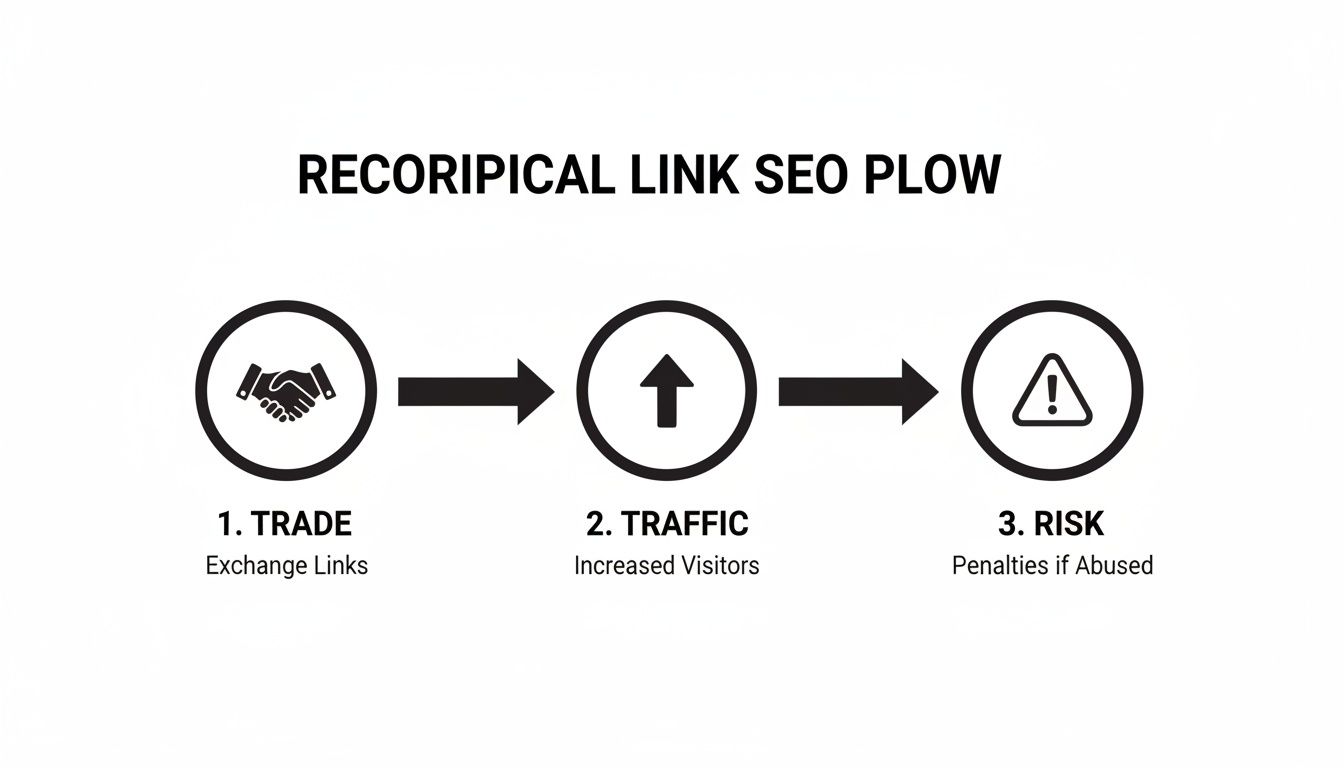
Industry data shows reciprocal linking remains common. Authority Hacker found that roughly 51.6% of link builders still engage in link swaps for 2024–2025. Learn more in the SearchAtlas study.
Action Steps: Launch Your First Swap
- Use Semrush’s Link Building tool to find domains linking to similar content.
- Filter for sites with DA above 30 and monthly traffic over 1K.
- Reach out with a tailored email highlighting mutual benefits and suggested anchor text.
Assessing Risks And Value
Not every swap pays off. Google’s algorithms flag patterns that look too perfect. When reciprocal links make up more than a small slice of your backlink profile, you risk penalties.
Keep these red flags and green lights in mind:
- Keep reciprocal links under 20% of your total backlinks (green light)
- Avoid repeated, identical anchor text trades (red flag)
- Partner only with sites that share your audience and authority level (green light)
- Steer clear of low-quality or irrelevant partners (red flag)
Small businesses should run regular link audits to stay on track. Check out our guide on Domain Authority to see how authority scores influence your profile.
When reciprocal links are context-driven and limited, they act like bonus trading cards rather than spam.
Evolution Of Reciprocal Links
Reciprocal linking kicked off as a simple bartering system on the wild early web. Picture site owners trading treasure maps in dusty online bazaars. Those swaps felt fair and visibility jumped almost overnight.
By the mid-2000s, automated link-exchange networks sprang up. Thousands of swaps happened without any human oversight. Search engines soon spotted the manipulative schemes and handed out penalties. Entire blog networks watched their traffic disappear in one penalty sweep.
Early link farms proved that too much swapping ruins credibility.
Below are a few key milestones in this evolution:
- Mid-2000s link exchange rings thrived.
- 2012 Google introduced the Penguin update.
- 2015 saw the rise of context-driven partnerships.
Mapping these shifts helps small businesses understand why pure link bartering is a risky game today.
Context Driven Exchanges
After Penguin shook up the SEO world, link swaps got smarter. Marketers shifted from bulk exchanges to niche guest posts and resource-page collaborations.
Real-world example: A Kansas City startup cut 150 low-value link swaps, then exchanged high-value tutorials with authoritative industry blogs. Within three months, their organic traffic climbed by 30% and lead form submissions rose 22%.
Quality partnerships act like trusted referrals rather than forced trades.
For a deeper dive, Check out our guide on link acquisition strategy.
Modern Best Practices
Today’s healthy backlink profile blends one-way editorial links with carefully chosen reciprocal nods. Use tools like Semrush and Rank Math to audit two-way links and ensure they stay relevant.
An Ahrefs analysis found that 43.7% of top-ranking pages include reciprocal links—showing nearly half of high performers still use this tactic. Learn more about these findings on Backlinko.
Here are a few best-practice tips:
- Audit two-way links quarterly to catch irrelevant or low-quality swaps.
- Keep reciprocal links under 20% of all referring domains.
- Prioritize exchanges with sites that share your audience and content focus.
Reciprocal linking in SEO has come a long way from simple bartering. Today’s exchanges demand genuine collaborations and data-driven relevance to fuel sustainable, long-term growth.
Best Practices For Reciprocal Links
When you think of your link profile, picture a well-balanced meal. Too many low-quality link swaps are like empty carbs—nothing but padding. A mix of link types, on the other hand, feels more like lean protein: it fuels growth.
Think of each reciprocal link as a helping of protein. When you vet partners carefully, you make sure every swap packs value instead of just filling space.

Check Partner Relevance
- Verify site authority sits in a similar range to yours.
- Ensure topics line up so referred visitors stick around.
- Confirm active traffic levels with Semrush or Google Analytics.
Recommended Reciprocal Link Ratios And Risks
Below is a quick reference for safe reciprocal link ratios and the potential payoff or pitfalls at each level.
| Reciprocal Link % | Benefits | Risks |
|---|---|---|
| 5-10% | Targeted referrals, trust signals | Low penalty risk |
| 10-20% | Niche traffic boost, partnership growth | Monitor for overuse |
| 20-30% | High referral potential | High risk of link scheme |
Actionable Steps: Apply the Diet
- Add partner vetting criteria to your onboarding checklist (DA range, traffic metrics, audience overlap).
- Cap reciprocal links at 20% of total referring domains—automate checks with a Google Sheets formula.
- Review the balance monthly: compare referral traffic vs. site visits from organic search.
Monitor Key Metrics
Track referral sessions and goal completions to see if swaps are driving value or just crowding your backlink profile.
- Set up custom segments in Google Analytics.
- Use Semrush traffic analytics to compare sources.
- Schedule monthly audits with Rank Math link reports.
Effective monitoring turns link swaps into growth engines, not liabilities.
Example Case
A local bakery teamed up with a food blogger and kept its reciprocal links at 12% of the profile. Within two months, their order conversions jumped by 25%.
Additionally, industry guidance frames reciprocal linking as beneficial for referral visitors when links are exchanged between relevant, engaged sites. You should track outcomes like referral sessions and goal completions to ensure these links account for only a minority of referring domains. Learn more about reciprocal link benefits on Bluehost.
For natural backlink tactics, check out our guide on building backlinks naturally in our article on how to build backlinks naturally.
Schedule Regular Reviews
A monthly audit keeps you ahead of any unexpected swings. Use a simple spreadsheet with columns for partner URL, link date, traffic change, and notes.
- Use Rank Math link monitoring to get instant notifications.
- Configure email alerts for any broken links.
- Cross-check findings with Semrush backlink audit reports.
Example Case
A fitness coach ran a biweekly audit and removed 18 stale links. In one quarter, organic search sessions climbed by 15%.
Refine Strategy Continuously
Treat your reciprocal link plan as a living document. Experiment around 10% to find the right mix for your niche. Document each tweak and review outcomes every quarter.
Safe Alternatives To Reciprocal Links
Trading links back and forth can feel like swapping baseball cards—fun at first but risky if you pick the wrong partner. Instead, consider tactics that build sustainable backlinks and earn genuine trust from search engines. Over time, these strategies strengthen your domain authority without pinging Google’s spam radar.
One of the most reliable methods is guest posting. By sharing your expertise on relevant blogs, you can secure backlinks that feel natural and context-driven.
- Identify five niche blogs with a similar audience
- Craft customized pitches that speak to each editor’s interests
- Offer unique assets—like data-driven case studies or exclusive recipes
Read our guide on SEO guest posting in our article about effective guest post strategies.
Guest Posting With Outreach Templates
- Review each blog’s submission guidelines and audience topics.
- Write a clear, engaging subject line—reference a recent post you admired.
- Pitch an article idea with a benefit-driven angle.
- Send a polite follow-up after 5–7 days.
Tip: Include a stat in your outreach, for example, “Our last post drove a 50% increase in organic links over 90 days.”
Digital PR Case Studies
Digital PR combines storytelling with outreach to land high-authority mentions and backlinks. Imagine an HVAC company creating a winter energy-saving guide. Journalists loved it, linking back 10 times and boosting organic sessions by 25%.
“Digital PR turns useful data into newsworthy hooks,” says one veteran marketer.
Key steps to follow:
- Write a press release packed with unique research
- Build a targeted media list based on reporter beats
- Offer expert interviews or quotes to add depth
Resource Creation
Creating something remarkable—like an interactive tool, infographic, or in-depth manual—gives other sites a reason to link back. A pet store, for example, built a free dog-calorie calculator and earned 15 in-content mentions within a month.
| Asset Type | Example | Mentions |
|---|---|---|
| Infographic | Calorie calculator | 15 |
| Interactive Tool | Neighborhood foot traffic map | 12 |
| In-Depth Guide | Seasonal marketing trends report | 9 |
Authoritative Directory Listings
Well-chosen directory listings can deliver steady, credible backlinks. Aim for niche-specific, high-authority directories rather than generic link farms. A boutique law firm that joined its state bar directory saw a 5% monthly bump in referrals.
- Check that the directory’s domain authority is at least 30
- Ensure your business details are accurate and match across the web
- Link directly to a closely related service page
- Track referral traffic in Google Analytics
Mix guest posting, digital PR, resource creation, and directory listings to diversify your backlink profile and build a resilient, high-quality link ecosystem.
Auditing And Implementing Reciprocal Links
Think of your backlink audit like tuning a classic sports car: every reciprocal link needs a close look to keep performance humming. With tools such as Semrush and Rank Math, you’ll uncover two-way links, spot oddities, and lay the groundwork for a healthier link profile.
Audit Steps With Semrush And Rank Math
- Use Semrush Backlink Audit to filter for reciprocal patterns.
- Activate Rank Math’s link counter to log two-way links.
- Flag any domain authority under 30 (e.g., DA<30).
- Identify spikes in link growth month over month.
Evaluating Link Quality
Begin by reviewing three core metrics: domain authority, referral traffic, and contextual relevance. A link from an off-topic or low-authority site can do more harm than good.
Rapid surges in reciprocal links often trigger algorithmic scrutiny and penalties.
Use Semrush reports and anchor-text distribution charts for an at-a-glance view. Save snapshots of filter settings and Rank Math link-status reports for team reference.
Negotiating New Reciprocal Links
When you’re ready to add new partners, personalize every outreach. Focus on shared audiences and content alignment—this boosts acceptance rates.
- Research the partner’s audience and pick a relevant page to link.
- Write an email that references a specific article and proposes a swap.
- Suggest anchor text that fits both sites naturally.
- Agree on link placement and review timeline up front.
Log each agreement in your tracking sheet to prevent mix-ups later.
Monitoring Template
| Site | Link URL | DA | Date | Traffic Change | Next Review |
|---|---|---|---|---|---|
| Example.com | https://example.com/page | 45 | 2024-07-01 | +12% | 2024-10-01 |
| Partner.org | https://partner.org/resource | 38 | 2024-07-15 | +8% | 2024-10-15 |
Review this sheet quarterly to catch broken or irrelevant links before they dent your SEO.
Frequently Asked Questions
What Makes a Quality Reciprocal Link?
A genuinely valuable reciprocal link comes from a site whose audience overlaps with yours and that carries real authority. For instance, teaming up with a blog in your niche can drive targeted referral traffic straight to your pages. Before you swap links, always check domain rating, relevance of their content, and their traffic numbers.
How Many Reciprocal Links Should I Exchange?
Think of two-way links as seasoning, not the main course. Aim to keep them under 20% of your total referring domains. That way, you won’t raise any red flags for link schemes. A healthy backlink profile mixes one-way editorial mentions with a modest number of swaps.
“Limit reciprocal links to maintain a natural backlink profile and avoid penalties.”
How Do I Audit Existing Reciprocal Links?
A regular audit keeps your link profile clean and penalty-proof. Here’s how to do it step by step.
Audit Checklist And Workflow
- Export your backlink data from Semrush or Ahrefs.
- Filter the list for domains that link back to you.
- In Rank Math, tag those two-way links and flag any site with an authority score under 30.
- Log everything in a spreadsheet with columns for:
- Domain name
- Domain Authority (DA)
- Date the link went live
- Notes on relevance or quality
- Review this sheet every quarter and reach out to remove or replace any low-value links.
Which Outreach Template Works Best For New Exchanges?
Keep your email short, friendly, and specific. Mention a particular page of theirs you admire, then offer something of equal value—like co-authored content or a resource swap. A subject line such as “Quick Link Proposal for Your Post” sets the right tone. If you don’t hear back, follow up in 5–7 days with a polite reminder and a fresh angle.
What Are Safe Non-Reciprocal Alternatives?
When in doubt, skip the swap and go for strategies that earn organic links:
- Guest post on high-authority sites to secure in-content backlinks.
- Launch digital PR campaigns or case studies that naturally attract media mentions.
- Create compelling infographics or tools that invite others to cite your work.
- List your business in reputable directories for steady referral traffic.
By tackling these FAQs, you’ll confidently weave reciprocal links into your SEO plan without stumbling into penalties. You’ll also discover stronger, one-way backlink strategies that stand the test of time.
Ready to amplify your backlink strategy? Partner with Website Services-Kansas City for professional SEO solutions and natural in-content backlinks. Get started today!