
Product description SEO is an art form. It's about writing compelling, keyword-rich copy for your product pages that not only ranks high on search engines but actually persuades people to buy. This strategy blends persuasive writing with technical optimization to pull in qualified organic traffic right to your products, turning a simple Google search into a sale.
Why Product Description SEO Is Your E-commerce Superpower
Many e-commerce stores treat product descriptions as an afterthought—a few bullet points, a generic sentence, or worse, copy-pasted text from the manufacturer. Honestly, this is a massive missed opportunity.
Your product descriptions are far more than filler content. They're one of your most powerful assets for grabbing the attention of customers who are actively searching for exactly what you sell.
Strategic product descriptions SEO can turn these neglected sections into a sustainable engine for growth. Unlike paid ads, which stop dead the moment you stop paying, a well-optimized product page can generate organic traffic for months, sometimes even years. This creates a direct path from a customer's search on Google to your checkout page, catching high-intent buyers right when they’re ready to pull the trigger.
Building a Foundation for Sustainable Growth
Think of each product description as a dedicated salesperson working for you 24/7. When optimized correctly, it does more than just describe an item; it answers questions, handles objections, and builds trust. This approach has a direct, measurable impact on your bottom line.
Here’s why it’s so effective:
- Attracts High-Intent Traffic: You connect with shoppers using the exact phrases they’re typing into search engines. This means the visitors you get are already qualified leads for your product.
- Boosts Conversion Rates: A compelling, benefit-focused description doesn't just list features; it shows visitors how your product solves their specific problem, nudging them to click "Add to Cart." For example, a local Kansas City boutique could see a 15-20% lift in online sales by optimizing descriptions to answer common customer questions upfront.
- Enhances Brand Authority: Unique, helpful, and well-written copy positions your store as a knowledgeable and trustworthy source, setting you miles apart from competitors who rely on generic text.
At its heart, product description SEO is a specialized form of what is SEO copywriting. It's all about blending persuasive techniques with search engine optimization to get higher rankings. You're basically learning to speak the language of your customer and the language of search engines at the same time.
The Contrast with Paid Advertising
Sure, paid ads give you immediate visibility, but they often come with steep costs and diminishing returns. You're essentially renting traffic. The second your ad budget dries up, the flow of visitors stops cold.
Investing time in product description SEO, on the other hand, is like building an asset. It creates a cumulative effect, where every single optimized page adds to your site's overall authority and visibility. This builds a reliable stream of organic traffic that doesn't depend on a daily ad spend, giving you a much more stable and cost-effective foundation for long-term success.
Finding the Keywords That Shoppers Actually Use
Before you write a single word of your product description, you need to get inside your customer's head. The entire game is won or lost here, by figuring out the exact language people use when they’re ready to buy something.
It's easy to get distracted by generic, high-volume keywords, but they often just attract window shoppers. What we're after are the high-intent, long-tail keywords—those longer, super-specific phrases that signal someone is about to make a purchase.
Think about it. A person searching for "leather tote bag" is just browsing. But someone searching for a "crossbody leather work tote with laptop compartment"? That person knows exactly what they want. If that's your product, you need to be there with the right language to meet them.
Going Beyond the Obvious Search Terms
Guessing which keywords to use is a recipe for failure. A structured approach is the only way to make sure you’re targeting phrases that bring in qualified traffic, not just clicks. A great place to start is by seeing what your competitors are already doing successfully. It's a massive shortcut.
This is where tools like Semrush and Ahrefs become indispensable. Just pop a competitor’s product page URL into one of these tools, and you can see the exact keywords it ranks for. The goal isn't to copy them, but to spot patterns and find keyword gaps they might be missing.
Keyword Intent Comparison for Product Pages
Understanding the "why" behind a search query is crucial. This table breaks down different types of keywords, their likely user intent, and how to apply them to product descriptions for maximum impact.
| Keyword Type | Example | User Intent | Best Use in Product SEO |
|---|---|---|---|
| Broad | "Tote bag" | Informational | Use as a primary category, but too generic for a specific product page. |
| Modifier | "Leather tote bag" | Navigational | Good for category pages. A user is narrowing their options. |
| Long-Tail | "Italian leather tote with zipper" | Transactional | Perfect for H1s and product descriptions. The user knows what they want. |
| Question | "Can a tote bag fit a 15-inch laptop?" | Informational/Transactional | Ideal for an FAQ section within the product description. |
By mapping keywords to intent, you ensure every word on your page serves a purpose, guiding the right customer toward a purchase.
Tapping into Your Customer’s Mind
Your own customers are a goldmine of keyword ideas. Dive into their reviews, questions, and support tickets. The natural, conversational language they use is exactly what you should be weaving into your descriptions. They're literally telling you what matters most to them.
Another powerful source is right under your nose: Google itself. Type your main product keyword into the search bar and pay close attention to what it gives you back.
- Google Autocomplete shows you what people are actively searching for right now.
- The "People Also Ask" box reveals the specific questions shoppers have.
- Related Searches at the bottom of the page offer even more long-tail variations.
These features are a direct line into user intent. Answering questions from the "People Also Ask" section right in your product description doesn't just boost your SEO; it tackles customer concerns before they even have to ask, which is a huge conversion driver.
From a Vague Idea to Specific Phrases
Let's walk through a real-world example. Say you sell a high-end, Italian leather tote bag. Your starting keyword is just "leather tote bag."
- Competitor Analysis: You use Semrush and see your top competitors are ranking for phrases like "full-grain leather tote" and "structured work tote for women."
- Google PAA: You find questions like, "Can a leather tote bag fit a laptop?" and "How to care for a leather tote bag?"
- Customer Reviews: You notice customers repeatedly praise the "soft leather," the "secure zipper closure," and the "handy interior pockets."
By layering these insights, you turn a generic term into a list of powerful, high-intent keywords. If you want to go deeper on this process, our complete guide on how to conduct keyword research will give you a rock-solid foundation.
Your new target keyword list might now include phrases like:
- Structured full-grain leather work tote
- Women's leather tote with zipper closure
- Italian leather bag with laptop compartment
- Soft leather tote with interior pockets
This process transforms keyword research from a guessing game into a repeatable, data-driven strategy. When you find the exact phrases your ideal customers use, you can write product descriptions that don't just appeal to search engines—they speak directly to the person ready to buy.
Crafting Compelling Descriptions Google and Customers Love
Alright, you've got your list of high-intent keywords. Now for the fun part: turning that research into copy that actually convinces people to buy. This is where the real magic happens, moving from a spreadsheet to a description that makes your product irresistible.
The best product descriptions pull double duty. They have to answer a shopper's questions and overcome their objections while simultaneously signaling relevance to Google. It's a blend of art and science.
A great description isn't just a block of text; it follows a proven structure designed to grab attention and drive a decision. Think of it as your silent, 24/7 salesperson. It usually flows through three key stages: a powerful hook, a benefit-driven body, and a clear next step. Getting this flow right is the key to product descriptions SEO.
The Anatomy of a High-Converting Description
Let's break down what separates a description that sells from one that just sits there. Each piece has a specific job to do in guiding a visitor from "just browsing" to "add to cart," all while reinforcing your SEO.
- The Hook: Your first sentence or two is everything. It needs to grab a reader's attention immediately by hitting on a pain point, asking a relatable question, or promising a powerful benefit.
- The Body (Benefits Over Features): This is the core of your pitch. Instead of just listing what your product is (its features), you need to explain what it does for the customer (its benefits). This is the crucial shift from cold, hard specs to a real emotional connection.
- The Details (Scannable Formatting): Not everyone reads every word. Use bullet points or short, bolded subheadings to call out key features, materials, and specs. This makes it easy for scanners to find the critical info they need to make a decision.
- The Call-to-Action (CTA): End with a clear, simple instruction. While "Add to Cart" is the main event, a softer CTA in the copy itself, like "Find your perfect fit and feel the difference today," can give that extra nudge.
By structuring your copy this way, you cater to both the meticulous researcher and the hurried scanner, giving you the best shot at closing the sale.
From Dull to Dynamic A Before-and-After Example
Theory is one thing, but seeing the transformation in real-time makes it all click. Let's take a generic, feature-heavy description for a blender and inject it with some personality and benefit-driven, SEO-friendly copy.
Before (Feature-Focused):
"This blender features a 1200-watt motor and a 64-ounce container. It has stainless steel blades and five pre-programmed settings for different blending tasks. The unit is made of BPA-free plastic."
This is boring. It's uninspired and does absolutely nothing to help a customer imagine it in their kitchen. It fails to solve a problem or connect on any real level.
After (Benefit-Focused & SEO-Friendly):
"Tired of chunky smoothies and noisy blenders that wake up the whole house? Create silky-smooth green smoothies and creamy soups in seconds with our whisper-quiet, 1200-watt high-performance blender. The powerful stainless steel blades pulverize ice, nuts, and frozen fruit effortlessly, unlocking nutrients for a healthier you.
- Effortless Blending: Five one-touch settings for smoothies, soups, and frozen desserts take the guesswork out of your morning routine.
- Family-Sized Capacity: The durable, 64-ounce BPA-free container is perfect for making large batches for the entire family.
- Quick & Easy Cleanup: Spend less time cleaning and more time enjoying your creations with our simple-to-clean design."
See the difference? The "After" version uses sensory language ("silky-smooth," "whisper-quiet"), solves real problems (chunky smoothies, noise), and naturally weaves in keywords. To take this even further, you can explore guides on how to write website copy that truly connects with your target audience.
The core principle is simple: Features tell, but benefits sell. A customer doesn't want a "1200-watt motor"; they want a blender that can effortlessly crush ice for their morning smoothie. Always frame your features within the context of solving a customer's problem or fulfilling a desire.
Weaving in Keywords and Optimizing for Mobile
As you write, gently sprinkle your primary and secondary keywords into your sentences, headings, and bullet points. They should feel completely natural. Avoid keyword stuffing at all costs—search engines are smart enough to spot it, and it makes your copy sound robotic to actual humans.
Don't forget that over 60% of e-commerce traffic now comes from mobile devices. This means your descriptions absolutely must be formatted for small screens. Keep paragraphs short (one or two sentences), use plenty of white space, and lean heavily on bullet points and bold text to make your copy easy to scan on the go. To ensure your product descriptions are fully optimized for current standards and AI algorithms, consider utilizing a detailed Amazon Listing Audit Checklist for AI Optimization. This can help you stay ahead of the curve.
Mastering Technical SEO for Product Pages
Great copy is only half the battle. For your brilliant product descriptions to be seen, they need a solid technical foundation. This is where the behind-the-scenes magic of product descriptions SEO comes into play, making sure search engines can find, understand, and properly rank your pages.
Don't let the word "technical" scare you off. We're talking about simple, actionable steps that give your products a huge advantage—small tweaks like meta titles, image alt text, and clean URLs that make a massive difference.
A huge piece of this puzzle is something called Product Schema markup. This is just a bit of special code that helps search engines understand details like price, availability, and reviews, then display them as eye-catching "rich snippets" right in the search results.
Optimizing Your On-Page Elements
Think of these elements as the signposts that guide both Google and your potential customers. Getting them right is fundamental. Your meta title is your page's headline in the search results, while the meta description is the short summary that appears right underneath it.
Did you know that just optimizing these meta elements can skyrocket your click-through rates? A well-written meta description alone can boost clicks from organic search by +43%. That's a huge lift, making users far more likely to click your link over a competitor's.
- Meta Title: This is arguably the most important on-page SEO factor. It should include your main keyword, the product name, and your brand name—all while staying under 60 characters. Actionable Tip: Front-load your most important keyword. For example: "Waterproof Hiking Boots | The Summit Pro | YourBrand".
- Meta Description: While it doesn't directly impact rankings, it heavily influences clicks. Write a compelling summary (around 155 characters) that includes a key benefit and a call-to-action. Actionable Tip: Try including a benefit and a trust signal like "Free Shipping". Example: "Conquer any trail with our Summit Pro waterproof hiking boots. Built for comfort and durability. Shop now & get free shipping!"
- URL Structure: Keep your URLs clean, short, and descriptive. A URL like
yourstore.com/products/leather-work-toteis way better thanyourstore.com/products/item-12345?cat=bags.
The simple process flow below shows how these technical elements are the foundation supporting your compelling copy.
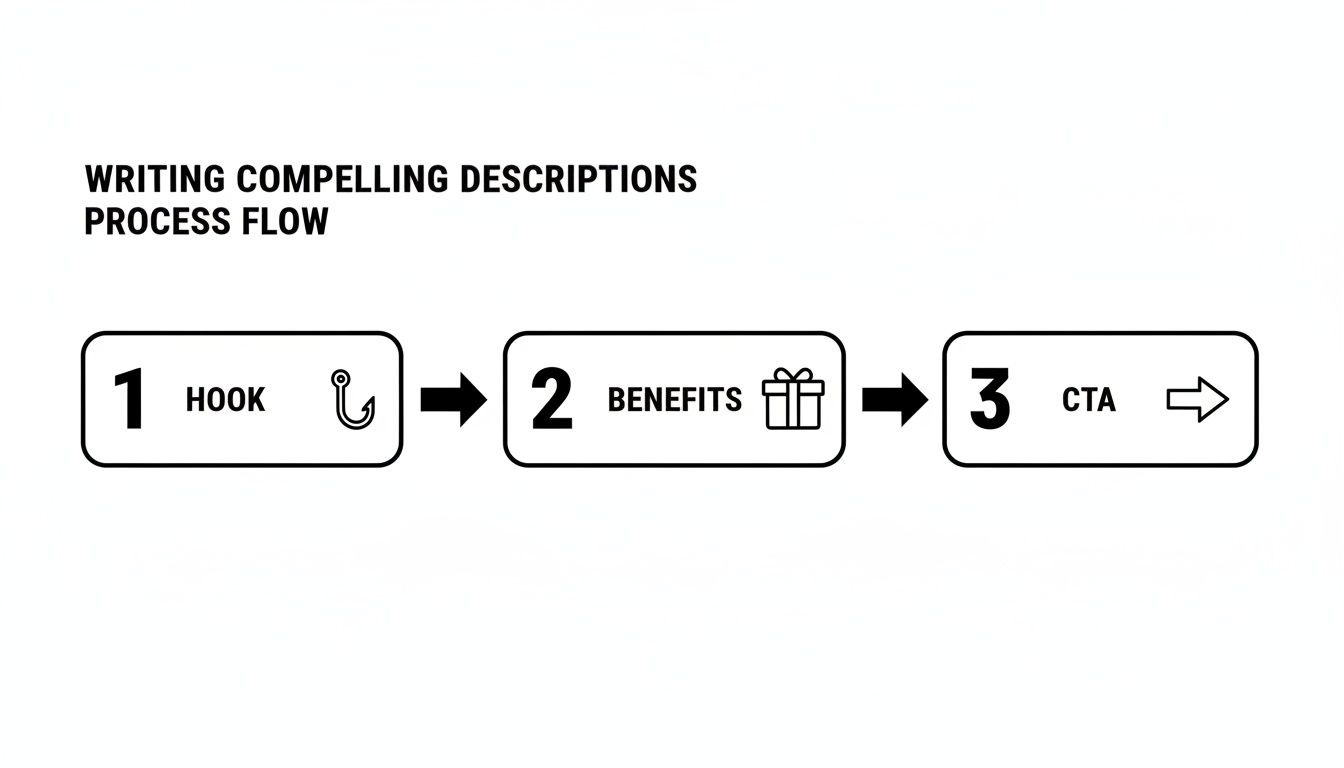
This visual just reinforces the idea: a strong hook and clear benefits, all propped up by solid technical SEO, lead customers straight to a powerful call-to-action.
The Power of Product Schema Markup
If you've ever seen star ratings, prices, or "In Stock" labels right in Google's search results, you've seen Product Schema in action. This structured data gives search engines specific information about your product in a language they can easily digest.
Implementing it turns a standard search listing into a rich, informative snippet that grabs attention and builds trust before a user even clicks. For a Shopify store owner, this is incredibly easy. Apps like Yoast SEO for Shopify or even native Shopify features can automatically add this schema for you—no coding required.
Key Takeaway: Implementing Product Schema is one of the highest-impact technical SEO actions you can take. It directly increases your visibility and click-through rate from search results by making your listing more attractive and informative than your competitors'.
Image Alt Text and Canonical URLs
Every single image on your product page is another opportunity for SEO. Image alt text is a short, written description of an image that serves two key purposes: it's used by screen readers for visually impaired users, and it helps search engines understand what the image is about.
Always write descriptive alt text that includes your target keyword. Something like, "Side view of the Italian leather work tote with zipper," is perfect.
Finally, you need to manage potential duplicate content issues with canonical URLs. Sometimes, the same product page can be accessed through multiple URLs (for example, from different collection pages), which can confuse search engines. A canonical tag simply tells Google which version of a URL you want to appear in search results, consolidating all your SEO value onto a single page. If you'd like to dive deeper, you can learn more about what is a canonical URL in our detailed guide. This small technical fix prevents duplicate content penalties and ensures your authority is concentrated correctly.
Building Authority with Links and Site Structure
An optimized product page is a great start, but it can't succeed in a vacuum. To really win in search, that page needs to be a core part of your website, woven into a structure that tells both users and Google exactly how important it is. Building real authority is a two-part game: strengthening your site from the inside out and earning trust from all over the web.
This all comes down to links. Internal links are the pathways you build within your own site, guiding Google's crawlers and spreading authority around. Backlinks, on the other hand, are links coming from other websites, and they act like powerful votes of confidence that signal your content is trustworthy and valuable.
Weaving an Internal Linking Web
Strategic internal linking is probably one of the most overlooked parts of product descriptions SEO. It’s the art of connecting your content in a way that builds a clear hierarchy and funnels value to your most important pages—and for an e-commerce site, that means your product pages.
Think of it this way: if you write a killer blog post called "The Ultimate Guide to Cold Brew Coffee," it’s a massive missed opportunity not to link directly from that article to your cold brew maker product page. That simple link creates a relevant, contextual bridge that accomplishes two crucial things:
- It gives an interested reader a clear next step, guiding them from learning to buying.
- It sends a powerful signal to Google that your product page is an authoritative resource on the topic of cold brew makers.
The goal is to make your product pages feel like the natural conclusion to a user's journey. By linking from high-value informational content to relevant commercial pages, you tell search engines, "This product is the solution to the problem discussed here."
Earning Powerful External Backlinks
While internal links are all about organizing your own authority, backlinks are about earning it from others. A backlink from a reputable website is one of the strongest ranking factors in all of SEO. But you don't just "get" them; you earn them by creating assets that people have a genuine reason to share.
For e-commerce, this means you have to think beyond the product page itself. You need to create content so genuinely useful that other site owners, bloggers, and influencers feel compelled to link to it. For more advanced strategies, you can explore detailed guides on link building for ecommerce sites to really move the needle.
Here are a few proven strategies for earning natural backlinks:
- Create Unique Comparison Guides: Develop an in-depth, unbiased guide comparing your product against several top competitors. If it’s truly honest and helpful, other review sites and bloggers are highly likely to reference and link to it as a valuable resource for their own readers.
- Collaborate with Niche Influencers: Partner with influencers in your space for authentic reviews, tutorials, or "how-to" content featuring your product. Their articles or video descriptions will often link back to your product page, driving both traffic and SEO value. For a local Kansas City brand, this could mean partnering with a well-known KC lifestyle blogger for a feature.
- Publish Original Data or Research: Conduct a survey or study related to your industry and publish the findings in a compelling format. Data-driven content is incredibly linkable, as journalists and bloggers constantly need statistics to cite and support their own articles.
When you combine a smart internal linking structure with a proactive strategy for earning external backlinks, you build a powerful, interconnected website. This approach doesn't just boost the SEO value of a single product page—it elevates the authority of your entire domain.
Measuring Success and Refining Your Strategy
Crafting the perfect product description is a fantastic start, but that's where the real work begins. The biggest gains don't come from a one-time setup; they come from knowing what's working, what isn't, and doubling down on your winners. SEO isn't a "set it and forget it" task. It’s a constant loop of measuring, analyzing, and refining.
To turn all your hard work into actual business growth, you need to see the data. For that, your two best friends are Google Search Console and Google Analytics. They stop you from guessing and let you make data-driven decisions that directly impact your bottom line.
Key Metrics to Monitor
To get a clear picture of your performance, you don't need to track a million different things. Just a few essential metrics will tell you the story of how both users and search engines are responding to your product pages. If you're new to this, our guide on how to track website traffic is a great place to start.
Focus on these core numbers:
- Organic Traffic to Product Pages: In Google Analytics, are you seeing a steady increase in traffic to your key product pages? This is the first and most obvious sign that your SEO efforts are paying off.
- Keyword Rankings: Google Search Console will show you exactly which keywords are driving clicks to your pages. Are you climbing the ranks for the terms you're targeting? Are new, relevant keywords starting to appear?
- Click-Through Rate (CTR): This metric, also in Search Console, tells you the percentage of people who see your product in the search results and actually click on it. A low CTR could mean your meta title or description isn't compelling enough to grab their attention.
- Conversion Rate: This is the ultimate test. In Google Analytics, you can track how many visitors arriving from organic search end up making a purchase. High traffic with low conversions is a major red flag that something on the page itself—the copy, the images, the user experience—needs fixing.
A Framework for Continuous Improvement
Once you have a baseline of data, you can start testing and making your pages even better. A/B testing is a simple but incredibly powerful way to find out what really resonates with your audience. It just means creating two versions of a single element on your page and showing each version to a different group of visitors to see which one performs better.
A simple tweak can lead to significant gains. For example, just changing your product title to a question can lift your click-through rate by 14.1% or more, turning more browsers into buyers. You can learn more about how small changes impact SEO statistics and find more insights at AIOSEO.
Start small. Test one thing at a time, like your main headline, a hero product image, or the text on your "Add to Cart" button. Let the test run long enough to get meaningful data, then make the winning version the new default. This iterative process ensures your product pages are always evolving and improving, driving sustainable, long-term success for your business.
Got Questions About Product Page SEO? Let's Clear Them Up.
Optimizing your product pages can feel like solving a puzzle. It's totally normal for questions to pop up as you dive in. Let's tackle some of the most common ones I hear from clients to reinforce what we've covered.
How Long Should a Product Description Really Be?
There’s no magic number here, but a great target to aim for is 300+ words of genuinely useful, unique content. This usually gives you enough room to naturally weave in your keywords, answer customer questions, and really sell the benefits without just adding fluff.
The main goal is always to be comprehensive, not just long-winded. Focus on spelling out the benefits, giving real-world examples of how the product is used, and listing out the specs that matter. That’s always better than writing filler just to hit a word count.
Can I Just Use the Manufacturer's Product Description?
Absolutely not. This is one of the biggest mistakes you can make. Copying and pasting the manufacturer's description creates duplicate content, which search engines hate. It directly hurts your rankings and makes it incredibly hard to stand out when everyone else is selling the exact same thing.
Writing your own unique copy is a critical opportunity. It's your chance to inject your brand's voice, speak directly to your specific audience, and give shoppers a reason to buy from you instead of the ten other stores using the same generic text.
How Often Should I Update My Product Descriptions?
It’s smart to review your most important product pages every 3 to 6 months. I'm not talking about a complete rewrite every time, but a strategic check-in to see how things are performing.
Take a look at a few key metrics:
- Keyword Rankings: Have you started to slip for your main keywords?
- Organic Traffic: Is the page pulling in fewer visitors from search than it used to?
- Conversion Rates: Are people buying less from this page?
If you spot a page that's underperforming, it’s a sign that a refresh is in order. You might try optimizing for some new long-tail keywords, A/B testing a new headline, or adding updated images. These small tweaks can get your sales back on track.
Ready to turn your website into a powerful growth engine? The team at Website Services-Kansas City specializes in creating and optimizing websites that get found. From expert SEO audits to professional web development, we provide the tools you need to succeed. Learn more at https://websiteservices.io.