
Low-competition keywords are the terms and phrases you can realistically rank for without going head-to-head with the internet's giants. For a new website, they're not just a good idea—they're your secret weapon for getting seen.
Instead of fighting a losing battle for super broad keywords, you get to zero in on the niche queries that bigger, slower competitors completely ignore.
Why Low-Competition Keywords Are a Game Changer

Trying to get a new website off the ground can feel like shouting into the void. You're up against industry titans with huge budgets and a decade's head start. This is exactly where shifting your strategy to low-competition keywords changes everything. It’s not about avoiding the fight; it’s about choosing battles you can actually win.
Imagine you run a local plumbing company in Kansas City. Trying to rank for "plumber" is next to impossible. But what about "emergency sump pump repair in Overland Park"? That phrase is typed in by someone with a real, urgent problem. By targeting it, you're not just sidestepping the national chains; you're attracting a customer who's ready to hire you right now.
The True Power of Niche Targeting
Focusing on these less-contested terms gives small businesses and new sites a massive leg up. It's a foundational tactic we use with our clients to build that initial traffic and get a foothold in the search results.
Here’s why it’s so effective:
- Faster Rankings: It takes way less time and effort to rank for a keyword with low competition. You can often see real results in weeks or months, not years.
- Higher Conversion Rates: These keywords are usually longer and more specific, which means the searcher knows exactly what they want. Traffic from "best coffee beans for cold brew" is far more likely to buy something than someone just searching for "coffee."
- Builds Topical Authority: When you consistently rank for related, low-competition terms, you send a powerful signal to Google that you're an expert in your niche. That authority snowballs, making it easier to rank for bigger keywords down the road.
To really make this work, you have to understand the concept of keyword difficulty. It’s a metric, usually scored from 0 to 100, that estimates how tough it will be to crack the first page of Google for a specific term.
Actionable Insight: For a new site, we almost always recommend targeting keywords with a difficulty score under 30. That's the sweet spot where you can gain real traction without needing a huge backlink profile.
From Small Wins to Major Growth
Think of each low-competition keyword you rank for as a small, strategic victory. A single keyword might only bring in 50 visitors a month, but that's 50 highly qualified potential customers you didn't have before.
Now, imagine ranking for 20, 50, or even 100 of these terms.
Those small streams of traffic quickly combine into a river. This cumulative effect is what drives real, sustainable growth—building your site's authority, generating leads, and transforming SEO from an impossible mountain into a series of small, achievable hills.
How to Build Your Initial Keyword List
Every powerful SEO strategy starts with a simple list of ideas, not some complex, expensive tool. Right now, the goal isn't perfection. It's about brainstorming a big, messy pool of potential keywords that actually sound like your customers. This is the foundational step where you find the low-competition gems that everyone else is missing.
The key is to get out of your own head and stop using your internal business jargon. You might call your service "holistic wellness coaching," but your ideal client is probably typing "how to deal with work burnout" or "natural ways to reduce anxiety" into Google. That gap in language is where your best opportunities are hiding.
Go Where Your Customers Are
To find that authentic customer language, you need to become a fly on the wall in the digital spaces they already hang out in. This isn't guesswork; it's about listening to real conversations and picking up on genuine pain points.
Here are practical starting points:
- Industry Forums and Reddit: Subreddits like r/smallbusiness or other niche-specific forums are absolute goldmines. Look for threads where people are asking for recommendations or complaining about a problem. The exact way they phrase their questions—like "looking for a CRM that isn't confusing"—is a potential keyword right there.
- Customer Reviews (Yours and Theirs): Dig through reviews on Google, Yelp, and your competitors' product pages. Pay close attention to both the glowing praise and the frustrated rants. A review that says, "I loved how this service helped with my Shopify store's abandoned cart issue," just handed you the keyword "Shopify abandoned cart solution."
- 'People Also Ask' on Google: Type one of your main services into Google and just scroll down to the "People Also Ask" box. These are the exact questions Google knows people are asking. Each one is a potential blog topic and a fantastic source for related long-tail keywords.
By gathering these raw, unfiltered phrases, you’re creating a list that’s rooted in what people actually need. This is a core part of building a successful strategy. For a complete walkthrough, you can check out our guide on how to conduct keyword research.
Uncover Niche Competitor Strategies
Here's another great tactic: go spy on your smaller, local competitors—not the big national brands. These businesses often survive by zeroing in on highly specific, low-competition keywords that the major players completely overlook.
Browse their service pages and blog posts. Do they have an entire page dedicated to "WordPress maintenance for Kansas City nonprofits"? That's a niche keyword you might have missed. They've already done some of the legwork for you by identifying service areas with specific local demand.
Actionable Insight: The goal is to collect a broad list of at least 50-100 phrases. Don't get hung up on search volume or difficulty scores just yet. We're just trying to capture the full spectrum of customer language, from broad topics to super-specific questions.
To build a truly effective list, you have to move beyond those broad terms and start mastering long tail keyword research, as this is where you’ll find the most promising low-competition opportunities. Long-tail keywords are just longer, more specific phrases that usually have lower search volume but much higher conversion rates.
Think about it. Instead of a broad term like "SEO services," a long-tail version would be something like "affordable SEO for new ecommerce sites." The person searching for that has a clear, immediate problem they need to solve. This initial brainstorming phase is your chance to gather dozens of these high-intent phrases, which we’ll validate and refine in the next steps.
Using SEO Tools to Uncover Hidden Gems
Your initial brainstorming list is a fantastic starting point, but it's loaded with assumptions. Now it’s time to bring in the data to separate the real winners from the duds. This is where SEO tools like Semrush or Ahrefs become your best friend, turning those raw ideas into a strategic hit list of keywords you can actually rank for.
These platforms cut through the guesswork with hard numbers. Instead of crossing your fingers, you get concrete metrics like search volume and, most importantly, Keyword Difficulty (KD). This score, usually on a scale of 0-100, gives you a solid estimate of how tough it will be to crack the first page of Google for a specific term.
Decoding the Metrics That Matter
When you first fire up a tool like Semrush's Keyword Magic Tool, the sheer amount of data can feel like you're trying to drink from a firehose. The trick is to tune out the noise and zero in on just two core metrics to start: Keyword Difficulty (KD) and Search Volume.
- Keyword Difficulty (KD): This is your primary filter. For a new or smaller website, you're hunting for keywords with a KD score of 20 or less. Think of this as the "low-hanging fruit" zone—the sweet spot where you have a fighting chance to compete.
- Search Volume: This tells you how many people are searching for a keyword each month. While huge numbers are tempting, they almost always come with brutal competition. A great starting point is to filter for keywords with a monthly search volume of at least 100.
Just applying those two simple filters will instantly slice through thousands of impossible keywords, leaving you with a clean, manageable list of genuine opportunities.
Pro Tip: Don’t automatically write off keywords with lower search volumes, like 20-50 searches a month. If the phrase has powerful commercial intent—think "emergency plumber for flooded basement"—it can be incredibly valuable, even if the search numbers look small.
This simple workflow shows how you can gather your initial ideas before you even touch an SEO tool.
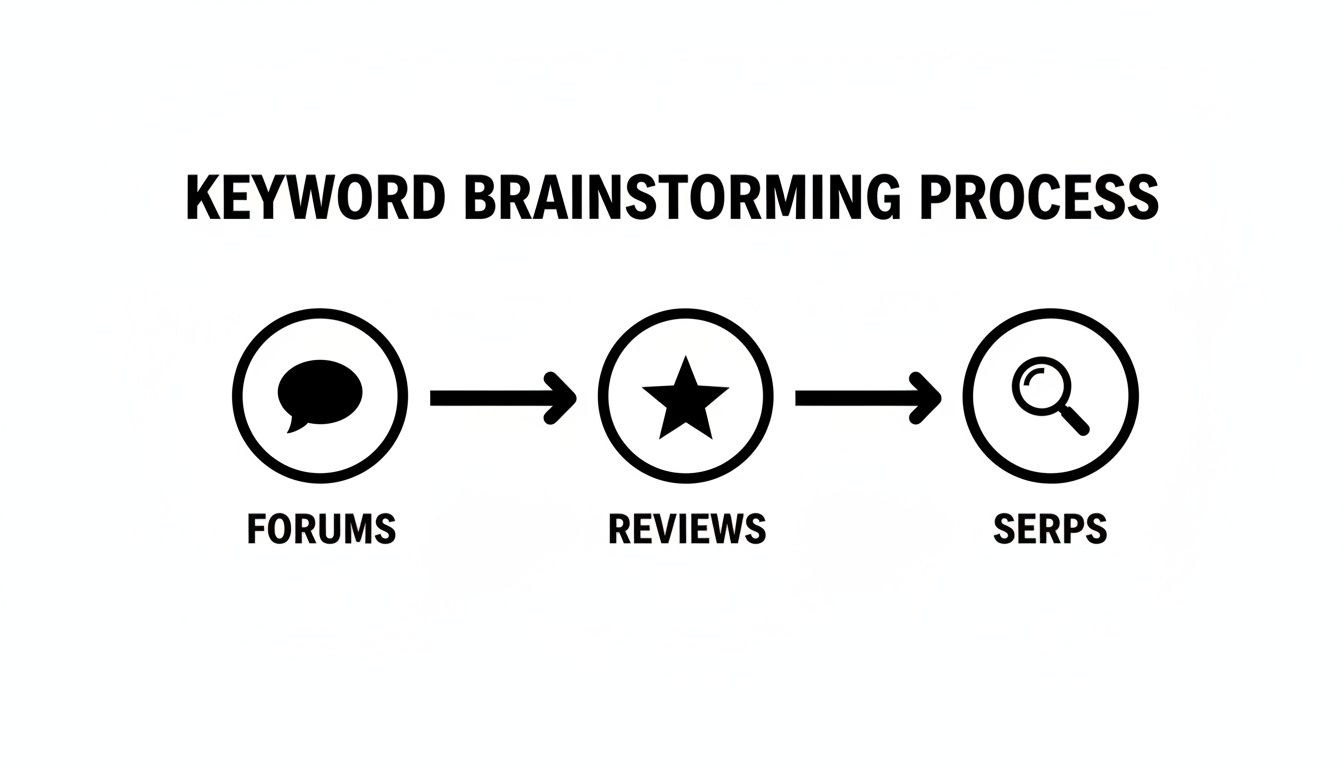
Starting with real user language from forums and reviews gives you a much stronger foundation for the data-driven analysis that comes next.
A Practical Example of Filtering
Let’s make this real. Imagine you run a digital marketing agency in Kansas City. A broad, brainstormed keyword like "Kansas City SEO" sounds great, but plugging it into an SEO tool reveals a sky-high difficulty score. For a new site, that's a non-starter.
This is where the magic of filtering comes in. By setting the KD to "Easy" or "Very Easy" and layering on other modifiers, you can instantly whittle down a broad topic to find actionable, low-competition phrases that are perfect for a smaller site.
So, instead of banging your head against a wall, you apply those filters: KD <20** and Volume **>100. Suddenly, the tool might spit out some much smarter alternatives:
- "local SEO for KC service businesses" (KD: 15, Vol: 150)
- "Shopify SEO expert Kansas City" (KD: 12, Vol: 110)
- "how to rank on Google Maps in KC" (KD: 18, Vol: 200)
Just like that, you've pivoted from one impossible target to three highly specific, winnable keywords that will attract qualified leads. That’s the entire game with low-competition keywords—driving meaningful traffic without needing a massive budget or years of authority-building. Long-tail keywords, which are naturally less competitive, are one of the most powerful tools for growing a new website. The strategy is simple: filter for terms with difficulty scores under 30 and search volumes above 100, and you'll find easy wins that let you rank with substantially less effort.
While these tools are powerful, don't forget the free insights you can get directly from Google itself. Once you have a promising keyword, pop over to Google Search Console to see if you're already getting impressions for related terms you didn't even know about. You can learn more about how to set up Google Search Console in our detailed guide. Fusing paid tool data with free Google insights is how you build a truly well-rounded and effective keyword strategy.
How to Manually Analyze SERPs and Validate Keywords
An SEO tool’s Keyword Difficulty score is a fantastic guide, but it’s just that—a guide. It gives you an educated guess based on backlink profiles, but it can’t see the full picture.
The final, most critical step in validating your list of low-competition keywords is to roll up your sleeves and manually eyeball the Search Engine Results Page (SERP).
This hands-on check is non-negotiable. It’s where you move past automated metrics and use your own judgment to see if a keyword is truly winnable. What you're really looking for are signs of weakness on the first page—clues that Google isn't entirely satisfied with the current results and is open to something better.
Identifying the True Competition
Your first task is to get a feel for the neighborhood. Who is currently ranking on page one? Are you walking onto a street filled with untouchable giants, or are there smaller players you could realistically outperform?
Just type your target keyword into Google and scan the top 10 results. What you see will tell you everything you need to know.
- Who is ranking? Are the top spots held by household names like Forbes, Wikipedia, or major industry publications? If so, that's a red flag. These sites have immense domain authority, and dislodging them will be an uphill battle, no matter what the KD score says.
- What type of content is it? Do you see other small business blogs, niche websites, or even forum discussions from places like Reddit and Quora? This is a fantastic sign. The presence of user-generated content often indicates a content gap that a well-crafted article from a dedicated site like yours can easily fill.
This manual SERP analysis is our final validation gate for every client at Website Services. It prevents us from wasting time and resources on keywords that look good on paper but are unwinnable in practice.
Seeing smaller, less authoritative sites ranking high is a clear signal that you have a shot. Google is showing you that it values relevant, focused content over sheer domain power for that particular query.
Spotting Weak and Outdated Content
Once you've sized up the authority of the ranking domains, it's time to dig into the content itself. This is where you can find some major opportunities. Your goal is to find pages that are ranking simply because there's nothing better available.
Look for these signs of weakness:
- Thin or Underdeveloped Content: Click on a few of the top results. Are the articles short, superficial, or lacking in detail? If you can confidently say, "I can create something 10x better than this," you've found a golden opportunity.
- Outdated Information: Check the publication date. If the top-ranking content is several years old and contains outdated statistics or advice, it's vulnerable. A fresh, updated piece of content can often leapfrog older results.
- Poor Search Intent Match: Does the content really answer the question behind the search? Sometimes you'll find pages that rank for a keyword but don't directly address the user's need. For example, if the query is "how to fix a leaky faucet" and the top result is a product page for new faucets, there's a clear intent mismatch you can exploit.
This quick checklist can help you evaluate the SERP at a glance and decide if a keyword is truly worth pursuing.
SERP Analysis Checklist
| Checklist Item | What to Look For (Good Sign) | What to Avoid (Bad Sign) |
|---|---|---|
| Domain Authority | Smaller, niche sites and blogs ranking in the top 10. | Domination by huge brands like Forbes, Wikipedia, or government sites. |
| Content Type | Forum posts (Reddit, Quora) or other user-generated content. | Highly polished, in-depth guides from established industry leaders. |
| Content Freshness | Publication dates are 3+ years old; information is clearly outdated. | All top results have been published or updated within the last year. |
| Content Quality | Articles are short, thin on details, or poorly written. | Content is comprehensive, well-researched, and expertly presented. |
| Search Intent Match | Results don't directly answer the user's question. | Every top result perfectly satisfies the reason behind the search. |
By identifying these weaknesses, you build a clear picture of not just if you can rank, but how. The gaps in the current SERPs become the blueprint for your own superior content.
Of course, once you start ranking, you'll need to monitor your progress. Our guide on how to check keyword ranking offers practical steps for tracking your success over time.
This manual check transforms keyword research from a numbers game into a strategic analysis, ensuring every piece of content you create has a clear and achievable path to the first page.
Creating Content That Ranks for Your Chosen Keywords

Finding a validated, low-competition keyword is a huge win, but let's be honest—that's only half the job. Now for the crucial part: creating a piece of content so valuable that Google has no choice but to rank it.
This isn’t about just stuffing your keyword onto a page. It's about building the single best answer on the internet for that specific query. Your absolute top priority is to master search intent. If someone searches "how to fix a leaky faucet," they want a step-by-step guide with pictures, not a sales pitch for a new sink. Satisfying that core need is the bedrock of every single successful content strategy.
Building the On-Page SEO Foundation
Before you even write your first sentence, you need to get the core on-page elements right. Think of these as the technical signposts that tell Google exactly what your page is about and why it’s relevant to your target keyword.
Getting these details right ensures your content is properly indexed and understood by search engines from the moment you hit "publish."
- Compelling Title Tag: This is the blue link that shows up in search results. It has to include your primary keyword, ideally near the beginning, and be engaging enough to actually earn the click. For our keyword "Shopify SEO expert Kansas City," a great title would be "Shopify SEO Expert in Kansas City | Drive More Sales."
- Click-Worthy Meta Description: Think of this as your 160-character sales pitch in the search results. While it doesn't directly impact rankings, a good one dramatically increases click-through rates. Mention your keyword and highlight the main benefit for the person searching.
- Logical URL Structure: Keep your URL short, clean, and descriptive. A simple structure like
yourwebsite.com/shopify-seo-kansas-cityis way better than a long, confusing URL with a bunch of random numbers.
These foundational elements are completely non-negotiable. For a deeper look at optimizing your site's text, you might be interested in our guide on how to write website copy that converts and ranks.
Structuring Content to Satisfy Search Intent
With the technicals in place, it's time to build the content itself. The real key to outranking the competition is to provide a more thorough, helpful, and easy-to-digest answer than anyone else. This means structuring your content logically to address the user's main question—and all their follow-up questions, too.
Start with a clear introduction that immediately confirms the reader is in the right place. Then, use headings (H2s and H3s) to break your content into logical sections that are easy to scan. Sprinkle your target keyword and related phrases naturally within these headings and the body text.
Actionable Insight: The best content doesn't just answer the main question; it anticipates the next question. If your keyword is "how to choose a business bank account," your content should also cover topics like "common bank fees for small businesses" and "required documents for opening an account."
The strategic value of low-competition keywords is about more than just rankings; it's a cost-effective way to gain visibility, especially for new businesses. Recent data shows that nearly 80% of keywords triggering Google's AI Overviews have a low keyword difficulty.
What's more, over 68% of these terms get 100 or fewer searches per month. This creates a huge opportunity for small websites to appear in prominent AI-powered results by targeting these under-the-radar keywords. You can discover more insights about AI Overviews and keywords on trafficthinktank.com.
Ultimately, your goal is to create a resource so comprehensive that the user doesn't need to click the back button and visit another site. When you become the final destination for their search, Google takes notice and rewards you with higher rankings.
Frequently Asked Questions About Keyword Strategy
As you start weaving low-competition keywords into your SEO process, a few common questions always pop up. Getting the hang of the nuances here will help you use this strategy way more effectively and set the right expectations for your results.
Let's break down the questions we hear the most.
What Is Considered a Low Keyword Difficulty Score?
This is usually the first question people ask, and the honest answer is: it depends on your tool. Every platform, from Semrush to Ahrefs, has its own way of calculating keyword difficulty (KD).
That said, a solid rule of thumb for a new or small website is to aim for keywords with a KD score under 30. This range is usually labeled "Easy" or "Very Easy" and it’s the sweet spot where you can actually compete without needing a massive backlink profile or years of authority.
Just remember to always pair this number with a manual SERP analysis to see what the competition really looks like.
How Long Does It Take to Rank for These Keywords?
Getting results faster is one of the biggest perks of targeting low competitive keywords, but it's not instant. The real timeline hinges on your website's overall health and authority.
For a brand-new site that’s well-structured, you might see your content crack the top 20-30 search results within just a few weeks of publishing. For the really low-competition phrases, hitting the first page within two to four months is a very achievable goal.
That's a huge step up from the six to twelve months (or longer) it can take for more cutthroat keywords. If you want to dig deeper, our full article explains the factors that influence how long it takes to rank on Google.
Is Targeting Keywords with Low Search Volume Worth the Effort?
Absolutely. This is where a strategic mindset really shines. A keyword with just 50 monthly searches might look like small potatoes, but its true power is in its search intent.
Think about a keyword like "emergency commercial roof repair Kansas City." The person searching isn't just browsing—they have an urgent, high-value problem that needs a solution right now. Landing one or two of those clients could be worth more than thousands of visitors from a broad, unfocused term like "roofing."
Actionable Insight: A portfolio of 20 such keywords, each bringing in 50 qualified visitors, can drive 1,000 highly motivated potential customers to your site every month. It's about quality over quantity.
The data backs this up. The overwhelming majority of searches happen in this low-competition space. Research shows that roughly 94.74% of all keywords get 10 or fewer monthly searches. This proves that the search landscape isn't totally dominated by big brands, creating a massive opening for small businesses to own their niche. You can read the full research about these SEO statistics on aioseo.com. This is a critical insight for any new business trying to gain meaningful traction.
Should I Still Target High-Competition Keywords?
Yes, but think of them as your long-term, aspirational goals—not where you start. Trying to rank for a huge "money" keyword right out of the gate is just a recipe for frustration and wasted effort.
A much smarter play is to use a tiered strategy:
- Build Your Foundation: First, go after a cluster of related, low-competition keywords. This will build your initial traffic, help you earn your first backlinks, and establish topical authority with Google.
- Gain Momentum: As your site's authority grows from these early wins, you'll find it gets easier to rank for slightly more competitive terms.
- Aim Higher: Once your domain authority is more established, you can finally start creating content for those tougher, high-volume keywords you’ve had your eye on.
This approach creates a sustainable growth path. Each low-competition win acts as a stepping stone, building the authority you need to eventually compete for the bigger prizes. It’s all about playing the long game by racking up small, strategic victories first.
Ready to stop fighting for keywords you can't win and start attracting qualified customers? At Website Services-Kansas City, we specialize in finding these hidden opportunities for businesses just like yours. Let us build an SEO strategy that delivers real, measurable results.