
Improving your Shopify store’s SEO isn’t about flipping a single switch. It’s a mix of smart technical work, compelling on-page content, and building real authority online. You start by making sure your site is fast and easy for Google to crawl, then you optimize your product pages with the right keywords, and finally, you earn the kind of backlinks that prove your credibility.
When you nail this, you create a steady stream of high-intent traffic, breaking free from the endless cycle of paying for ads.
Building Your Shopify SEO Foundation
Relying completely on paid ads is a dangerous game. The moment you turn off the spend, your traffic vanishes. In sharp contrast, a solid SEO strategy for your Shopify store builds a lasting asset that pulls in organic traffic day in and day out.
Think of it as building a house on a solid foundation versus setting up a temporary tent. The goal is to show up for shoppers who are already searching for the exact products you sell.
This whole process stands on three core pillars:
- Technical Health: This is all the behind-the-scenes stuff that ensures search engines can find, crawl, and index your store without a hitch. We’re talking site speed, mobile experience, and a clean site structure.
- On-Page Relevance: This is where you optimize the content on your product and collection pages—from titles and descriptions to images—to perfectly match what your ideal customers are typing into Google.
- Off-Page Authority: This is all about building your store's reputation across the web, mainly by earning high-quality backlinks from other reputable websites.
Why Organic Search Matters More Than Ever
Over the last decade, Shopify has exploded into an e-commerce giant, with more than 5.7 million businesses now running on the platform. In a marketplace this crowded, showing up in organic search has become an absolute game-changer.
Time and again, we see that around 30–33% of traffic to well-optimized Shopify stores comes from SEO—not paid ads or social media. This means that if your store gets 10,000 monthly visits, a focused effort on how to improve Shopify SEO can realistically bring in an extra 3,000+ qualified visitors without spending a dime more on ads.
Starting With a Clean Structure
Before you even think about keywords and content, your site’s architecture has to make sense for both your customers and for search engines. A confusing layout is a surefire way to hurt your rankings.
This starts with clean, descriptive URLs for your products and collections. To get this right from the very beginning, check out our guide on the best URL structure for SEO, which lays out practical steps for organizing your site effectively.
For a truly effective approach, it's also worth understanding the synergy between SEO and accessibility. These strategies often go hand-in-hand, leading to better rankings and a far better experience for everyone. Making your site accessible isn't just good practice—it's good business.
Shopify SEO Quick Wins Checklist
Getting started with Shopify SEO can feel overwhelming, but some changes pack a bigger punch than others. This checklist covers the low-hanging fruit—tasks that are relatively easy to implement but can deliver a noticeable impact quickly.
| SEO Area | Actionable Task | Estimated Impact |
|---|---|---|
| Technical SEO | Submit your XML sitemap to Google Search Console. | High |
| On-Page SEO | Optimize product page title tags with target keywords and your brand name. | High |
| Image SEO | Compress all product images to improve page load speed. | High |
| Content Strategy | Write unique, benefit-driven product descriptions (no manufacturer copy). | Medium |
| Site Architecture | Create logical product collections and link to them from your main navigation. | Medium |
| Local SEO | If you have a physical store, set up and optimize a Google Business Profile. | High (for local) |
Focusing on these quick wins can build momentum and start driving results while you work on the more complex, long-term aspects of your SEO strategy. They provide a solid foundation to build upon.
Alright, let’s talk about the engine under the hood of your Shopify store: technical SEO. If this engine sputters, your entire SEO strategy is dead in the water.
You can have the most beautiful product photos and the most persuasive copy in the world, but if search engines can't efficiently find, crawl, and understand your pages, you might as well be invisible. This is all about making sure your site speaks Google's language fluently so all your hard work actually gets seen.
This infographic breaks down the three core pillars of a solid Shopify SEO strategy.
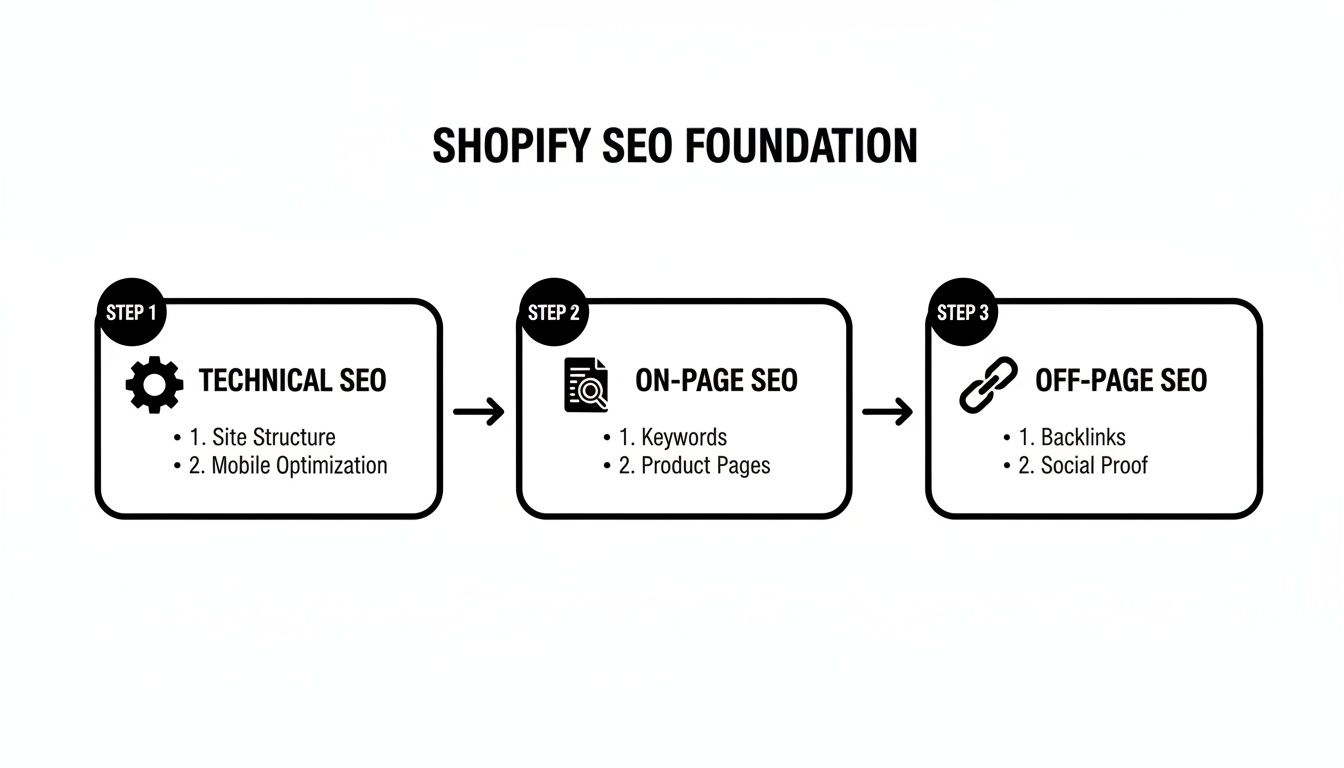
As you can see, a technical audit is the essential first step. You have to build a solid foundation before you start worrying about on-page content and off-page authority.
Start with Google Search Console
Your first stop, and your most important tool, is Google Search Console (GSC). It’s a free service that acts as a direct line of communication between your store and Google itself. If you're serious about SEO, setting this up is completely non-negotiable.
GSC is the ultimate source of truth, giving you invaluable data on how Google sees your site. It’s where you'll monitor indexing status, find mobile usability issues, and see the actual search queries bringing people to your store. Think of it as your command center for spotting technical problems before they hurt your rankings.
The most critical report in there is the Coverage report. This tells you which of your pages are indexed and, more importantly, which ones aren't—and why. Common errors you'll want to watch for include:
- Server errors (5xx): A red flag indicating a problem with your server.
- Redirect errors: Shows you where your redirect chains are broken or messy.
- Blocked by robots.txt: Pages you’ve accidentally told Google not to crawl.
- Discovered – currently not indexed: Google knows the page exists but has decided not to crawl it yet. This one often points to content quality issues.
Tackle Common Shopify Technical Headaches
Shopify is a fantastic platform, but its out-of-the-box structure can create some specific technical SEO challenges if you're not careful. The biggest culprit, by far, is duplicate content.
This often happens automatically through Shopify's tagging and collection systems. For instance, a single product might be accessible through multiple URLs if it's featured in several different collections, which creates duplicate pages that dilute your ranking power.
The fix for this is the canonical tag (
rel="canonical"). This small piece of code tells search engines which version of a URL is the "master copy" that should be indexed. Thankfully, Shopify handles this pretty well for product pages, but you should always double-check your theme's implementation, especially for collections and paginated pages.
Another huge area to focus on is site speed. The data here is crystal clear: slow-loading pages kill sales. Research consistently shows that a mere one-second delay in page load time can cause a 7% reduction in conversions.
Use tools like Google's PageSpeed Insights or Lighthouse (which is built right into Chrome's developer tools) to analyze your store's speed. They’ll give you a performance score and, more importantly, a list of actionable recommendations, like compressing your images or minifying CSS and JavaScript files.
Ensure Crawlability and Indexability
Before Google can rank your pages, it has to be able to find and crawl them. Your store’s XML sitemap is the official roadmap you hand over to search engine crawlers. Shopify automatically generates one for you, which you can almost always find at yourstore.com/sitemap.xml.
Your only job is to make sure this sitemap is submitted to Google Search Console. It's a simple step, but it helps Google discover all your important pages—products, collections, and blog posts—even if your internal linking isn't perfect yet. For a deeper look, you can learn more about how to create and manage an XML sitemap to ensure search engines can effectively index all your content.
Finally, take a quick look at your robots.txt file (located at yourstore.com/robots.txt). This file gives instructions to search engine bots. Shopify sets up a default file that correctly blocks bots from crawling internal pages like the cart, admin, and checkout areas. You just need to make sure you haven't accidentally added any custom rules that block important product or collection pages.
With your technical SEO in a good place, it's time to zero in on the pages that actually make you money: your product and collection pages. This is where the real magic happens, turning casual searchers into paying customers.
Effective on-page optimization isn't about stuffing keywords everywhere. It’s about creating a compelling, informative experience that answers a shopper's questions before they even think to ask them.
Your product pages are your digital salespeople. They need to be clear, persuasive, and perfectly aligned with what a potential buyer is searching for. This means ditching the generic manufacturer descriptions and writing unique, benefit-driven copy that sells.

Crafting Title Tags That Get Clicks
Your title tag is arguably the single most important on-page SEO element. It’s the big blue link people see in the search results, and it's your primary signal to Google about what your page is about. A weak title tag is a massive missed opportunity.
A simple formula that works wonders is:
Primary Keyword | Secondary Keyword | Brand Name
Let’s say you sell running shoes. A poorly optimized title might just be Running Shoe – Model X. That tells a user almost nothing.
An optimized version looks more like this: Men's Trail Running Shoes – Model X | Outdoor Footwear | YourBrand.
This version is so much better. It targets a high-intent keyword ("Men's Trail Running Shoes"), adds a relevant secondary term ("Outdoor Footwear"), and reinforces your brand. It instantly tells both Google and the user exactly what they're going to get.
Writing Meta Descriptions That Convert
While meta descriptions don't directly influence your rankings, they have a huge impact on your click-through rate (CTR). Think of your meta description as the ad copy for your search result—it has to convince the user that your page is the one they need to click.
Your goal is to be concise, weave in your target keyword naturally, and highlight a key benefit or unique selling proposition (USP).
Let's imagine you sell handmade leather wallets.
- Weak Meta: This is a leather wallet. It has several card slots and is made of genuine leather. Buy it now.
- Strong Meta: Discover our handcrafted full-grain leather wallet, designed for durability and style. Features RFID blocking and a lifetime guarantee. Shop now with free shipping!
The second one is far more persuasive. It hits on key features (RFID blocking) and tangible benefits (lifetime guarantee, free shipping) that make someone want to click. Learning how to write website copy that connects with customers is a crucial skill for mastering this.
Leveraging Schema Markup for Rich Results
This is where you can get a serious competitive edge. Schema markup, or structured data, is a bit of code you add to your site to help search engines understand your content on a deeper level. For a Shopify store, this is an absolute goldmine.
When you get it right, schema unlocks rich snippets in the search results. These are the eye-catching extras like star ratings, pricing, and stock availability that appear right under your title. This is a high-ROI move. Pages with this kind of data can get around 25% more clicks than pages without it. Considering the first organic result gets about 27.6% of all clicks anyway, anything that makes you stand out is a huge win.
For any e-commerce store, these are the must-have schema types:
- Product Schema: To display price, availability, and reviews.
- Review Schema: This is what powers the aggregate star ratings.
- FAQ Schema: Allows you to answer common questions directly in the search results page.
Many modern Shopify themes and apps can handle this for you, but you should always double-check your work with Google's Rich Results Test tool to make sure it's implemented correctly.
Key Takeaway: Rich snippets make your listings pop in a sea of boring blue links. They build instant trust and can dramatically increase the odds that a user clicks on your result over a competitor's, even if you rank a spot lower.
Optimizing Images and Page Structure
High-quality product images are non-negotiable, but they have to be optimized. Huge, uncompressed images are one of the biggest culprits behind slow-loading pages, which kills both your SEO and your conversion rates.
Before you upload anything, compress your images with a tool like TinyPNG or a Shopify app built for image optimization. Just as important is your alt text. This descriptive text not only helps search engines understand what's in an image but is also critical for accessibility.
- Bad Alt Text:
image123.jpg - Good Alt Text:
Hand-stitched brown leather bifold wallet with RFID protection
Finally, use a clean heading structure (H1, H2, H3) on your pages. Your product title should always be the H1. Use H2s and H3s to break up the content into logical sections like "Product Details," "Specifications," or "Customer Reviews." This makes the page easier for people to read and helps search engines understand the hierarchy of your content.
Developing a Content Strategy That Sells
If your Shopify store is just a collection of product and category pages, you're only talking to people who are already pulling out their credit cards. That’s a tiny slice of your potential audience. A smart content strategy casts a much wider net, pulling in shoppers at every stage of their journey—from the moment curiosity strikes to the final click to buy.
This means building a blog that works as a powerful lead-generation engine. It’s your chance to answer questions, solve problems, and build a real relationship long before someone is ready to make a purchase. When you get this right, your site stops being just a store and becomes a go-to resource.
The data doesn’t lie. Stores that invest in content—especially blogs—see up to 55% more organic traffic than those that just rely on product pages. For a new LLC running a Shopify store, that can mean turning 100 orders a month into 155 with the exact same marketing budget. You can discover more insights about Shopify growth on WiserReview.com.
Uncovering What Your Customers Search For
The bedrock of any solid content plan is knowing what your audience is actually typing into Google. This is where keyword research becomes your best friend. You need to think beyond your product names and dig into the questions, comparisons, and problems your future customers are trying to solve.
These are often called "informational keywords," and they are absolute gold. Put yourself in their shoes. What would someone search for before they even know your specific product is the answer?
Let's say you sell high-end kitchen knives. Your customers aren't just searching for your brand name. They're asking things like:
- "best chef knives for home cooks"
- "german vs japanese steel knives"
- "how to sharpen a kitchen knife"
- "what knives does a beginner cook need"
Every single one of these queries is a golden opportunity to create a genuinely helpful piece of content that positions your brand as the expert. This is a core part of learning how to conduct keyword research that drives actual sales.
Key Takeaway: Your blog should be the answer key to your customers' most pressing questions. When you provide that value upfront, you build trust and become the obvious choice when they're finally ready to buy.
Building Topical Authority with a Content Calendar
Just publishing random blog posts here and there is a recipe for getting nowhere. To really move the needle and improve your Shopify SEO, you need to build topical authority. This means creating a whole cluster of related content around your main product categories, which sends a massive signal to Google that you're an expert in your niche.
A content calendar is the tool that keeps you strategic instead of sporadic. Forget about one-off posts. Plan out an entire series of articles that tackle a single topic from every conceivable angle.
Imagine you sell sustainable yoga gear. Your content calendar might feature a "topic cluster" all about eco-friendly yoga practices:
- Pillar Post: "The Ultimate Guide to Sustainable Yoga Gear"
- Supporting Post 1: "5 Best Eco-Friendly Yoga Mats of 2024"
- Supporting Post 2: "What to Look for in Organic Cotton Yoga Apparel"
- Supporting Post 3: "How to Clean Your Cork Yoga Mat Naturally"
This strategy proves you have deep expertise and helps all of those articles rank better together.
The Art of the Internal Link
Creating fantastic content is only half the job. The last, and most critical, step is to create a bridge from your informative blog posts to your money-making product pages. This is done with smart, strategic internal linking.
Every single blog post you write should be a pathway. As you're writing, be on the lookout for natural opportunities to link to relevant products or collections. If your article on the "5 Best Eco-Friendly Yoga Mats" reviews a mat you happen to sell, you better believe you should link directly to that product page.
This accomplishes two critical things:
- It Improves the User Experience: You're creating a seamless journey for readers who are inspired by your content to find the very products you're talking about.
- It Boosts Your SEO: It passes link equity (or "ranking power") from your content-heavy blog posts over to your important commercial pages, giving them a lift in the search results.
This simple habit directly connects your content strategy to your bottom line, transforming your blog from a nice-to-have into a core part of how you improve Shopify SEO and drive revenue.
Building Authority with Quality Backlinks
Think of every backlink pointing to your Shopify store as a vote of confidence. When another reputable website links to your product page or blog post, they’re essentially telling search engines, "Hey, this content is trustworthy and valuable." This is how you build real authority, moving from an unknown store to a recognized leader in your niche.
Forget about outdated, risky tactics like buying links. The only sustainable path forward is to earn them. This means focusing on strategies that naturally attract links because you’re offering something genuinely valuable. It’s all about leveraging what you already have—great products and unique expertise—to build a powerful backlink profile.
Partner with Niche Bloggers and Influencers
One of the most effective ways to earn high-quality backlinks is to get your products into the hands of people who are already creating content for your target audience. Niche bloggers, YouTubers, and Instagram influencers are constantly on the hunt for great products to review and feature.
Don't just blast out a generic mass email. Follow them, get a feel for their content, and personalize your pitch.
- Compliment their work specifically: Mention a recent article or video you genuinely enjoyed.
- Explain why your product is a perfect fit: Connect the dots for them and their audience.
- Make it incredibly easy for them: Offer a free sample with zero strings attached.
A single, authentic review from a respected voice in your niche can drive not only a valuable backlink but also a stream of direct sales. This approach is central to effective link building for ecommerce sites because it builds both authority and brand awareness at the same time.
Create Link-Worthy Content Assets
Sometimes, the best way to get links is to create a resource so good that other websites can't help but link to it. This moves beyond standard blog posts and into the realm of what we call "linkable assets."
Think about creating:
- A Definitive Buying Guide: A comprehensive guide like "The Ultimate Guide to Choosing the Right Coffee Grinder" becomes the go-to resource for other bloggers to cite.
- An Original Data Study: If you sell skincare, you could survey 1,000 people about their morning routines and publish the findings. Journalists and bloggers love citing original data.
- A Unique Tool or Calculator: A "How Much Fabric Do I Need?" calculator for a store selling sewing supplies would earn links from countless crafting blogs.
These assets require more upfront work, but they pay off enormously over time by attracting backlinks passively.
Pro Tip: When you publish a major content asset, don't just wait for people to find it. Actively promote it. Reach out to bloggers who have written about similar topics and let them know you've created a new, more in-depth resource they might find valuable.
Get Featured in Gift Guides and Roundups
Every year, countless publications and blogs create "Best Of" lists, holiday gift guides, and product roundups. Getting your product included is a fantastic way to secure a high-authority backlink and a ton of exposure.
Start by searching for lists relevant to your niche from the previous year, like "best hiking gear for beginners 2023." This gives you a ready-made list of websites to contact for their next edition.
Find the editor or writer responsible for that content and send them a polite, concise pitch. Explain what makes your product a great fit for their upcoming guide. For more practical strategies on outreach and more, this guide on how to build backlinks to your website provides a solid framework for growing your authority. By focusing on earning links through genuine value, you build a resilient SEO foundation that can stand the test of time.
While you can get incredibly far steering your own Shopify SEO ship, there comes a point in every store’s journey where bringing in a seasoned crew is the only way to break through to the next level of growth.
Let's be honest: managing a comprehensive SEO strategy is a serious time commitment. Eventually, the hours you sink into keyword research and link building might deliver a much better return if you invested them back into product development, customer service, or other core parts of your business.
Knowing the signs that it's time to call in an expert is crucial for scaling up without burning out. Maybe you've hit a traffic plateau that your current tactics just can't seem to crack. Or perhaps you're bumping into complex technical hurdles—like implementing international SEO or advanced schema markup—that are way outside your wheelhouse. For a lot of store owners, it’s simply a matter of running out of time.
Identifying the Right Time to Hire Help
If any of these scenarios feel painfully familiar, it’s probably time to start looking for a specialized agency:
- You've Hit a Growth Ceiling: Despite your best efforts, your organic traffic and sales have been flat for months.
- You Lack Technical Expertise: You’re wrestling with site speed, crawl errors, or other technical gremlins that are holding your store back.
- Your Competitors Are Pulling Ahead: You constantly see the competition outranking you for the keywords that matter most.
- You Just Don't Have the Time: As a busy entrepreneur, you can no longer dedicate the 10-20 hours a week that effective SEO really demands.
Organic search is only getting more important. With global ecommerce projected to hit around $6.8 trillion in sales by 2026, the digital shelf is getting crowded. In competitive markets, solid on-page SEO, quality backlinks, and a smart content strategy are the baseline—not optional extras. You can learn more about Shopify's growth trajectory and its impact to see just how big the opportunity is.
When you're ready to make the move, look for an agency with proven, real-world experience on the Shopify platform, like many of the top firms in Kansas City. A good partner should kick things off with an in-depth audit, present a clear strategy for earning high-quality backlinks, and provide transparent reporting you can actually understand. Don't be shy—ask for case studies and be crystal clear about your goals. The right partnership can deliver a massive ROI and, just as importantly, free you up to focus on what you do best: running your business.
Got Questions About Shopify SEO? We've Got Answers
Even with a solid game plan, it's natural for a few questions to pop up. Let's tackle some of the most common ones I hear from store owners who are digging into their Shopify SEO.
How Long Does It Take to See Results from Shopify SEO?
Let's be clear: SEO is a marathon, not a sprint. While you might see small bumps from quick technical fixes within a few weeks, the real, meaningful results—like a steady flow of organic traffic and higher rankings—typically take about 4-6 months to build.
That timeline really depends on a few things: how competitive your niche is, where you’re starting from, and how consistently you’re creating great content and earning backlinks. Patience and steady effort are the name of the game.
Are Shopify SEO Apps Necessary to Rank Well?
While they're not absolutely essential, the right Shopify SEO apps can be a huge help. They're fantastic for simplifying tedious tasks like generating schema markup, compressing images, or hunting down broken links.
But an app is just a tool; it's not a substitute for a real strategy. It can't write compelling product descriptions or build genuine authority for you. My advice is to master the fundamentals in this guide first. Then, you can bring in apps to make your workflow more efficient and save you time.
Expert Insight: An app can automate a technical checklist, but it can't create a brand story that connects with people or builds the kind of trust that earns backlinks. Always prioritize your strategy over the tools you use to execute it.
What Is the Most Common SEO Mistake Shopify Store Owners Make?
Hands down, one of the biggest mistakes I see is focusing only on product and category pages while completely ignoring other types of content. So many store owners forget to build a blog or create helpful buying guides, and it's a massive missed opportunity.
You're missing out on all the potential customers who aren't quite ready to buy but are searching for information and solutions related to your products.
A solid content strategy does more than just sell—it builds authority, attracts high-quality backlinks, and pulls in qualified traffic that you can nurture into loyal customers. It’s what separates a simple online store from a trusted resource in your industry.
Ready to take your Shopify store's visibility to the next level? The experts at Website Services-Kansas City offer professional SEO audits and strategic website development to drive organic growth. Get your free consultation today!