
Before you even think about picking a color palette or writing a single headline, you have to lay the groundwork. This initial strategic phase is non-negotiable; it's the blueprint that determines whether your website will attract the right audience or just float around in the digital ether.
Skipping this step is like building a house without a foundation. Sure, it might look fine for a little while, but it's destined to crumble. The whole process starts with a simple but critical question: what are your potential customers actually searching for? It’s not about guessing; it's about data.
Uncovering Opportunities with Keyword Research
Keyword research is your market intelligence. It’s where you stop assuming and start discovering the exact language your customers use. Tools like Semrush or Ahrefs are indispensable here, helping you move beyond the obvious search terms to find high-intent keywords. These are the phrases people type into Google when they're ready to learn, compare, or buy.
For instance, a plumber here in Kansas City might assume people are just searching for "plumber KC." While that’s true, the real gold is in the details. Deeper research might uncover far more valuable, specific terms like:
- "emergency plumber Kansas City open now" (High transactional intent)
- "cost to fix leaky faucet in Overland Park" (Informational and commercial intent)
- "best drain cleaning service Johnson County" (Commercial and comparison intent)
Focusing on these long-tail keywords lets you capture users with a specific, urgent need, which almost always leads to higher conversion rates. This research will inform every single piece of content you create, from your main service pages to your blog posts.
Analyzing Your Competition
Once you know what your audience is searching for, the next move is to see who’s already showing up for those terms. Analyzing your competitors isn't about copying what they do. It’s about finding their strengths and, more importantly, their weaknesses. You're looking for content gaps—topics they haven’t covered well or questions they've failed to answer.
A competitor's weakness is your strategic opportunity. If the top-ranking sites have thin, unhelpful content on "tankless water heater installation," that's your chance to create the definitive guide on the topic and steal that ranking.
This analysis gives you a clear roadmap for your content strategy. It shows you where the bar is set and what you need to do to create something 10% better than what currently exists.
Designing a Logical Site Architecture
Your keyword and competitor research should all flow directly into your site architecture—the logical structure of your website. A well-planned architecture makes it dead simple for users to navigate and for search engine crawlers to discover and index your pages. It creates a clear hierarchy, signaling to Google which pages are the most important.
This flowchart shows how these foundational pieces fit together, moving from initial research to a solid site structure.
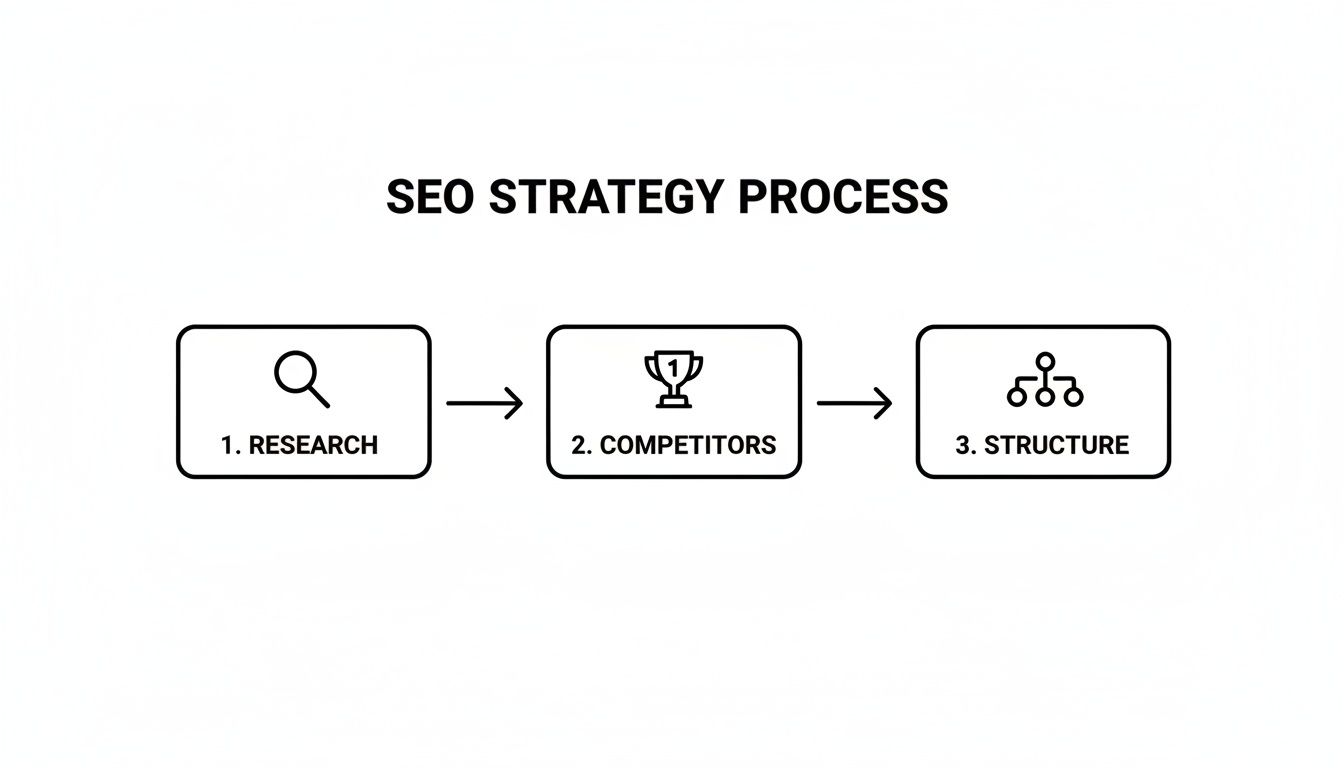
As you can see, each step builds on the last, forming a cohesive and powerful SEO plan.
Let's go back to our Kansas City plumber. A logical structure would have a homepage linking to core service pages (or "silos") like "Emergency Plumbing," "Drain Cleaning," and "Water Heater Repair." Each of these main pages can then link out to more specific sub-pages or blog posts, such as "How to Unclog a Sink Drain" or "Signs Your Water Heater is Failing," creating an organized web of relevant content.
This clear path helps spread authority (or link equity) throughout your entire site. For a deeper dive, check out our in-depth guide on how to plan website structure. Getting this foundational map right from the very beginning is absolutely critical for long-term SEO success.
Mastering On-Page SEO for Higher Rankings
With your website's architecture planned out, it's time to zoom in on the page level. This is where we shift from blueprints to interior design, focusing on what your visitors and search engines actually see on each page. This is the heart of on-page SEO—the art of turning a simple page into a high-performing asset.

This process is so much more than just sprinkling in a few keywords and calling it a day. Effective on-page optimization sends powerful signals to Google about your content's relevance, helping it understand exactly what your page is about and who it should be shown to. Getting these elements right is non-negotiable for building a website that ranks.
Crafting Compelling Titles and Descriptions
Your title tag and meta description are your first impression in the search results. Think of them as a mini-advertisement for your page. A great one can dramatically boost your click-through rate (CTR), even if you aren't in the number one spot.
A generic title like "Plumbing Services" is forgettable and easily ignored. But something specific and benefit-driven like "Emergency Plumbing Repair in Kansas City | 24/7 Service" instantly grabs the attention of someone with a burst pipe.
Here’s how to make them count:
- Title Tags: Keep them under 60 characters. Get your main keyword in there, preferably near the beginning, and add a hook like a benefit, a number, or a question.
- Meta Descriptions: You've got about 155 characters to work with here. Use this space to expand on the title, include your target keyword, and add a clear call to action like "Get a Free Quote Today."
Structuring Content With Heading Tags
Heading tags (H1, H2, H3, etc.) aren't just for making text look pretty; they create a logical hierarchy for your content. This structure makes your articles much easier for people to skim and helps search engines understand the main topics and sub-topics of your page.
A page should only ever have one H1 tag. This is your main headline and it should contain your primary keyword. From there, use H2 and H3 tags to break the content into logical, digestible sections. For a page about "tankless water heaters," your H1 would be that exact phrase, while your H2s could be things like "Benefits of Going Tankless," "Installation Costs," and "Top Brands Compared."
Think of your headings as the table of contents for your page. A clear, well-organized outline not only improves the user experience but also gives Google a perfect roadmap to your content's structure and relevance.
Standing Out With Schema Markup
Schema markup is a bit of code you add to your website to help search engines return more informative, eye-catching results for users. When you implement schema correctly, you can earn "rich snippets"—those search results with review stars, prices, or FAQ dropdowns that immediately grab your attention.
For a local business, this is an absolute game-changer. Imagine your Kansas City bakery's search result showing a five-star rating and the price range for your custom cakes. That visual cue builds instant trust and makes your listing far more clickable than your competitors'.
Common types of schema for small businesses include:
- Local Business Schema: Displays your address, hours, and phone number right in the results.
- Review Schema: Shows off those aggregate star ratings.
- FAQ Schema: Creates interactive dropdowns for frequently asked questions.
The Power of Strategic Internal Linking
Internal linking is the practice of connecting pages on your own website to one another, and it's one of the most underrated parts of on-page SEO. A smart internal linking strategy accomplishes three critical goals.
First, it helps users discover more of your content, keeping them on your site longer. Second, it helps search engines find and index all the pages on your site. And third—most importantly—it passes authority (often called "link equity") between your pages.
For example, if you have a high-performing blog post about "winter plumbing tips," linking from that article to your "Frozen Pipe Repair" service page sends a powerful signal to Google. It shows that the service page is important and relevant, helping it rank higher for its target keywords.
For a more detailed breakdown, you can learn more about the fundamentals of what on-page optimization is and how these elements all work together. Mastering these on-page factors is a crucial step in creating an SEO-friendly website that consistently attracts qualified traffic.
Getting Technical SEO Right The First Time
You can have the perfect strategy and the most brilliant content on the planet, but if your website’s technical foundation is shaky, you’re dead in the water. Technical issues are the silent killers of SEO. They stop search engines from properly crawling, indexing, and understanding your site, no matter how great your content is.
Think of it like having a world-class engine in a car with four flat tires—it's just not going anywhere.
But don't let the term "technical" scare you off. Breaking it down makes it far less intimidating. By focusing on just a few key areas, you can make sure your website is perfectly tuned for peak performance right from the start.
Make Site Speed A Top Priority
In a world of instant gratification, a slow website is a business killer. Full stop. People expect pages to load almost instantly, and their patience wears thin in a matter of seconds. This isn't just a nice-to-have for user experience; it's a direct ranking factor that Google takes very seriously.
The data doesn't lie: sites that load in just 1 second have 3x higher conversion rates than sites that take 5 seconds. On top of that, bounce rates can skyrocket by 38% if a page takes 5 seconds to load, a delay that contributes to retailers losing an estimated $2.6 billion every year. With Google's Core Web Vitals now a core part of its algorithm, metrics like load time are more critical than ever.
So, how do you actually make your site faster? Start with these moves:
- Shrink Your Images: Large, unoptimized images are the #1 cause of slow websites. Use a plugin like Smush or an online tool like TinyPNG to compress your image files without sacrificing much quality.
- Use Browser Caching: Caching stores parts of your site on a visitor's browser, so on their next visit, it loads way faster because it doesn't have to re-download everything. A plugin like W3 Total Cache can handle this for you.
- Get a Good Host: Your web hosting provider really matters. Cheap, shared hosting plans often cram way too many websites onto one server, slowing everyone down. Investing in a quality host like WP Engine or Kinsta gives you a much faster, more reliable foundation.
Tools like Google's PageSpeed Insights will give you a clear report card on your site's performance and offer specific, actionable recommendations for improvement.
A high score is a sign of a healthy, fast site. A low score highlights urgent problems you can't afford to ignore.
Ensure Perfect Mobile Responsiveness
More than half of all web traffic now comes from mobile devices. Because of this, Google uses mobile-first indexing, which means it primarily looks at the mobile version of your site for ranking and indexing.
If your site doesn't work perfectly on a smartphone, your rankings will suffer. Period.
A mobile-responsive design automatically adjusts its layout to fit any screen, from a huge desktop monitor to a tiny phone. This is non-negotiable. You can use Google's Mobile-Friendly Test tool to make sure your site passes muster.
Guiding Search Engines Effectively
Beyond speed and mobile-friendliness, you need to give search engines a clear map and a set of rules for crawling your site. This is where XML sitemaps and robots.txt files come into play.
An XML sitemap is basically a list of all the important pages on your website, making it much easier for Google to find and index your content. Think of it as handing a table of contents directly to the search engine. Once you've created one (Rank Math does this automatically), you should submit it through Google Search Console. For a step-by-step guide, check out our tutorial on how to create an XML sitemap.
Your robots.txt file, on the other hand, tells search crawlers which parts of your site they shouldn't access. This is useful for blocking private areas, like an admin login page or internal search results, from showing up in Google.
Key Takeaway: A well-configured
robots.txtfile and a comprehensive XML sitemap work together to make sure search engines can efficiently crawl the content you want them to see, while staying away from the parts you want to keep private.
Avoiding Duplicate Content Issues
Finally, it’s crucial to deal with duplicate content. This happens when the same (or very similar) content shows up on multiple URLs, which can confuse search engines and dilute your ranking power.
The fix is the canonical tag. This is just a small piece of HTML code that tells search engines which version of a page is the "master copy" that should get all the credit.
For instance, if a product page can be reached via two different URLs, a canonical tag on the duplicate page points back to the preferred one. This consolidates all your ranking signals and prevents any penalties. Good SEO plugins like Rank Math handle this automatically for most pages, but it's essential to understand its role in keeping your site's technical health in check.
Building Authority With Backlinks And Local Signals
A technically sound website with brilliant on-page SEO is a fantastic foundation, but it's only half the battle. To really start climbing the search results, your site needs to build a reputation. This is where you prove to Google that you're a trusted, authoritative voice in your industry, and that authority is built primarily through two powerful signals: backlinks and local relevance.
Think of backlinks as votes of confidence from other websites. When a reputable site links to your content, it’s basically telling Google, "Hey, this is a valuable resource." These endorsements are arguably one of the strongest signals for ranking high. The connection is undeniable; a staggering 92.3% of the top 100 results have at least one backlink.
But it’s a high-stakes game. Link building remains the most challenging task for 41% of marketers for a reason.
Earning Links With Valuable Assets
The old days of buying a bunch of cheap, low-quality links are long gone. Today, the best links are earned, not bought. The most sustainable way to do this is by creating "link-worthy" assets—pieces of content so valuable that other people in your industry can't help but link to them.
Instead of just writing another generic blog post, you need to think bigger.
- Create a Comprehensive Local Guide: A Kansas City marketing agency could create "The Ultimate Guide to Digital Marketing for KC Startups," packed with local data, resources, and expert interviews. This becomes an indispensable resource for the local business community.
- Publish Original Data or a Case Study: A local roofer could publish a detailed analysis of "The Most Common Storm Damage Repairs in Johnson County," using their own job data. This unique information is highly linkable for local news outlets or insurance blogs.
- Develop a Free Tool or Calculator: An accountant could offer a free "Kansas City Small Business Tax Calculator." Tools are incredibly effective at attracting links because they provide direct, tangible value.
A truly link-worthy asset solves a specific problem or answers a complex question better than anyone else. When you create the definitive resource on a topic, links will naturally follow.
Once you have a great asset, you need a smart way to promote it. Developing a solid link acquisition strategy is crucial for getting your content in front of the right people.
Mastering Local SEO Signals
For businesses targeting a specific area like Kansas City, local SEO signals are just as important as backlinks. You need to prove to Google that you are the most relevant and trusted option for customers searching "near me."
Your Google Business Profile (GBP) is the cornerstone of your local presence. It's often the very first thing a potential customer sees. Optimizing it is not a one-time task; it's an ongoing effort.
Actionable GBP Optimization Tips:
- Fill Out Everything: Don't skip any sections. Add your services, products, accessibility information, and business hours. The more complete your profile, the better.
- Use Google Posts Weekly: Share updates, offers, or new blog content directly on your profile. This keeps it active and shows Google you're an engaged business.
- Answer Questions in the Q&A: Proactively answer common questions people might have. If you're a restaurant, add questions like "Do you have outdoor seating?" and answer them yourself.
The Power of Customer Reviews
Beyond your GBP, a steady stream of positive reviews is a massive trust signal for both customers and search engines. You have to actively encourage your happy customers to leave feedback.
Make it easy for them by sending a direct link to your review page via email or text after a successful service. Responding to all reviews—both positive and negative—is also crucial. It shows you value customer feedback and are committed to providing a great experience. This simple act of engagement can turn a neutral customer into a loyal advocate.
Tracking Performance And Driving Growth
Getting your website live isn't the finish line; it’s the starting block. A truly SEO-friendly website is a living, breathing asset. It needs constant attention to not just maintain its rankings but to improve them over time.
This is where tracking your performance becomes so important. It turns your efforts from pure guesswork into a data-backed strategy for growth. Without monitoring, you're just flying blind.
The first move is getting the right tools set up. The two most critical ones are completely free: Google Analytics and Google Search Console. Think of Analytics as your inside source on user behavior—it tells you who’s visiting your site, how they found you, and what they do once they arrive.
Search Console, on the other hand, is your direct line to Google. It shows you exactly how the search engine sees your site, from indexing issues to the keywords people are using to find you.
Measuring What Matters Most
With your tools in place, you have to focus on the right metrics. It's incredibly easy to get lost in a sea of data, so it's best to zero in on the key performance indicators (KPIs) that actually reflect your SEO health and, more importantly, your business goals.
Here are the core KPIs you should be tracking regularly:
- Organic Traffic Growth: This is the clearest sign that your SEO work is paying off. Is the number of visitors coming from search engines going up month-over-month?
- Keyword Rankings: Are you climbing the ranks for your target keywords? Use the reports in Google Search Console or a tool like Semrush to see where you stand for key terms like "plumber in Kansas City."
- Click-Through Rate (CTR): This metric, found right in Search Console, shows you the percentage of people who saw your site in the search results and actually clicked on it. A low CTR could mean your title tags and meta descriptions need a rewrite.
- Goal Completions: This is the big one. Whether it's a form submission, a phone call, or a product purchase, you have to track these conversions in Google Analytics to measure your site's true business impact.
For a deeper look into monitoring your visitors, check out our guide on how to track website traffic, which provides actionable steps for setup and analysis.
Conducting Regular SEO Health Checks
An ongoing commitment to having an SEO-friendly website involves proactive maintenance. Performing simple, regular health checks helps you catch small issues before they snowball into major ranking problems. This process ensures your site stays technically sound and ready to jump on new opportunities.
Don't wait for your rankings to drop before you look under the hood. A monthly 30-minute SEO audit is one of the best investments you can make in your website's long-term success.
This proactive approach is especially crucial for staying ahead of Google's algorithm changes. For instance, building an SEO-friendly website today means embracing a mobile-first design—it’s completely non-negotiable.
With 62% of top-ranking websites being fully mobile-optimized, this shift is no longer optional. This trend exploded after Google's "Mobilegeddon" update and continues to dominate, as over 60% of all website traffic now comes from mobile devices globally. You can find more insights about small business website statistics on Network Solutions.
By consistently monitoring your KPIs and running these health checks, you create a powerful feedback loop. The data tells you what's working, what's not, and where to focus your energy next. This iterative process of tracking, analyzing, and refining is the key to not just achieving high rankings but keeping them for sustained business growth.
Got Questions About Building an SEO-Friendly Site?
Embarking on the journey to build a site that actually ranks brings up a few recurring questions. I get it. Getting clear, straightforward answers helps you move forward with confidence and set the right expectations for all your hard work.
Let’s tackle some of the most frequent questions I hear from business owners just like you.
How Long Does It Take for a New Site to Rank?
There's no magic number, but a well-optimized new website can often see some initial movement for less competitive keywords within 3 to 6 months. But let's be realistic: gaining ground for the really competitive stuff takes a lot longer and requires a sustained, consistent effort.
A few big factors will dictate your timeline:
- Your Industry: A local Kansas City bakery is going to see results much faster than a national law firm. It's just a different level of competition.
- Content Quality and Pace: How often are you publishing truly helpful content? The more high-quality stuff you put out, the faster Google takes notice.
- Your Backlink Profile: The speed at which you earn links from other authoritative websites plays a huge role in building the trust Google needs to see.
- Technical Health: A speedy, mobile-friendly site with no crawl errors simply gets indexed and ranked more efficiently.
What Is the Single Most Important SEO Factor?
While SEO is a complex puzzle with a ton of interconnected pieces, most experts will tell you the same thing: high-quality content that satisfies what the user is looking for is the absolute cornerstone. Without content that genuinely helps, informs, or solves a problem for your audience, everything else you do will fall flat.
Think of it this way: technical SEO and backlinks get Google to your front door, but your content is what invites them inside and convinces them to stay. Your primary goal should always be to create the best, most comprehensive resource for the topics you want to be known for.
Creating an SEO friendly website starts and ends with value. If your content doesn't serve the user's needs better than anyone else's, you won't achieve lasting rankings, regardless of your technical prowess.
Can I Build the Website Myself or Should I Hire an Agency?
You can absolutely build an SEO-friendly website yourself. There's no doubt about it. Platforms like WordPress, combined with powerful plugins like Rank Math, have made it more accessible than ever for business owners to take the reins. This guide gives you the foundational knowledge you need to get started on the right foot.
However, the learning curve can be steep, and the mistakes you don't know you're making can be costly—both in lost time and missed opportunities.
Partnering with a professional Kansas City SEO agency can save you a ton of time and help you leapfrog all the common pitfalls. Professionals bring deep expertise, advanced tools, and the kind of critical competitive insights that can seriously accelerate your growth and deliver a much stronger return on your investment.
Ready to build a website that doesn't just look great but also drives real business growth? Website Services-Kansas City specializes in creating high-performance, SEO-optimized WordPress sites for businesses ready to dominate the search results. Our work is backed by a 100% money-back guarantee. Get your free consultation today!