
So, you want to know how long it takes to rank on Google? Let’s get straight to it. The honest, no-fluff answer is that seeing real, meaningful results typically takes 3 to 6 months.
Think of it like planting a tree, not flipping a switch. You won't see growth overnight, but with consistent care and effort, it’s pretty much inevitable.
The Honest Answer to How Long Google Rankings Take

To get a handle on SEO timelines, you have to start with realistic expectations. SEO is all about earning trust from Google, and that's not a one-time event. Google’s entire job is to show its users the most helpful and reliable content on the web.
For any new or updated page, Google needs time to discover it, understand what it's about, and evaluate its credibility before it even considers promoting it to the first page. This process has several stages, from the initial crawl and index to the gradual climb up the search results.
Of course, this assumes Google can find your site in the first place. If you're not appearing at all, you might need to figure out why your website is not showing up on Google search before you can even think about ranking.
Why Patience Is a Key SEO Virtue
Building a strong online presence is a marathon, not a sprint. The latest data shows that it typically takes around 3 to 6 months for a brand-new page to start cracking the first page of Google. This timeframe can swing wildly depending on your site's authority, the quality of your content, and just how fierce your competition is.
Google’s algorithm weighs over 200 different factors. What that means in practice is that sites that consistently publish genuinely high-quality content and earn authoritative backlinks will always climb the ranks faster.
Actionable Insight: The core of SEO is building a foundation of trust with both users and search engines. Every piece of quality content you create and every reputable backlink you earn is a brick in that foundation. Rushing the process with black-hat tactics only leads to a weaker structure that can be penalized later.
Variables That Shape Your Timeline
Your specific timeline depends heavily on a handful of key variables. A brand-new website trying to break into a hyper-competitive market like real estate is going to have a much longer journey than an established local business targeting a few niche keywords.
Here are the primary factors at play:
- Website Age and Authority: An older, established website with a strong backlink profile will almost always rank faster than a new domain. It’s already got some trust built up.
- Industry and Keyword Competition: Trying to rank for a term like "Kansas City SEO services" is a whole different ballgame than "best dog groomer in south Overland Park." The first is packed with expert agencies; the second has a much smaller, localized competitor pool.
- Content Quality and Consistency: Regularly publishing valuable, well-researched content signals to Google that your site is a relevant and active resource worth paying attention to.
- Technical SEO Health: A fast, mobile-friendly site with a clean structure is just easier for Google to crawl and index, which speeds up the whole process.
To give you a clearer picture, let's break down how each of these elements impacts your timeline.
Key Factors Influencing Your Google Ranking Timeline
The table below summarizes the main variables that determine how quickly your website can climb the search engine rankings.
| Factor | Influence Level | Typical Impact on Timeline |
|---|---|---|
| Website Age & Authority | High | Older, authoritative sites can rank in weeks. New sites often need 6+ months to build initial trust. |
| Keyword Competition | High | Low-competition keywords can rank in 1-3 months. High-competition terms can take 6-12+ months. |
| Content Quality | High | Consistently great content accelerates ranking. Poor content can stall progress indefinitely. |
| Backlink Profile | High | A strong profile speeds things up significantly. A weak or spammy one can actively harm your rankings. |
| Technical SEO | Medium | A clean technical foundation prevents delays. Major issues can stop Google from even indexing pages. |
As you can see, these factors are all interconnected. A site with great content will naturally earn more backlinks, building authority and helping it compete for tougher keywords. It all works together.
The Six Factors That Control Your Ranking Speed
Figuring out how long it takes to rank on Google feels less like a science and more like an art, but it's governed by a clear set of rules. Your website's journey to the first page isn't random; it's a direct result of several core factors that Google's algorithm is constantly sizing up. Getting a handle on these is the key to speeding up your timeline.
Think of it like training for a marathon. You can’t just show up on race day and expect to win. Success comes down to your existing fitness level, how tough the course is, and the quality of your training. In the world of SEO, those variables translate into six critical components that dictate your ranking speed.
1. Domain Authority and Website Age
First up is Domain Authority, which is basically your website's credibility score in Google's eyes. An older domain that has been consistently putting out reliable content is like a seasoned expert with a long-standing reputation. Google trusts it more, so new content published on that site tends to get indexed and ranked much, much faster.
A brand-new website, on the other hand, starts with zero authority. It’s the new kid on the block with no track record. It takes time—often 6 months or more—just to build that initial layer of trust before Google will even start to seriously consider its content for competitive keywords.
2. Keyword and Niche Competition
Next up is the competitive landscape of your chosen keywords and your niche as a whole. Trying to rank for a broad, high-volume term like "Kansas City marketing" is like deciding to enter a professional marathon. You're going up against established players who have a massive head start.
A much smarter approach, especially for a new business, is to target less competitive, long-tail keywords. A Kansas City-based bakery, for example, will see results way faster by targeting "gluten-free wedding cakes in Leawood" than "best cakes in Kansas City." The competition is lower and the searcher's intent is way more specific, making it a much easier race to win.
Practical Example: A local plumber shouldn't target "plumbing services." Instead, targeting "emergency leak repair in Olathe" or "tankless water heater installation in Johnson County" will attract highly qualified customers and face far less competition, leading to faster rankings.
3. Content Quality and Relevance
High-quality content is absolutely non-negotiable. Google’s primary goal is to satisfy a user's query with the most helpful, comprehensive, and accurate information it can find. Thin, poorly written, or irrelevant content simply won't make the cut, no matter how much you try to optimize it.
So, what does quality content actually look like?
- It solves a problem: Your content needs to directly answer the question the user typed into Google. For the keyword "best lawn care schedule for Kansas City," a winning article would provide a month-by-month calendar, not just a generic list of services.
- It demonstrates expertise: It shows you know your topic inside and out, offering unique insights, original data, or case studies.
- It is engaging: Well-structured articles with short paragraphs, images, videos, and bulleted lists keep readers on the page longer—a huge signal of value to Google.
4. Backlink Profile Strength
Backlinks are one of the most powerful ranking signals out there. Every time a reputable website links to yours, it's like a vote of confidence. Google sees this as a clear sign that your content is trustworthy and valuable. A strong and healthy backlink profile can dramatically shorten the time it takes to rank. You can learn more about how to evaluate your what is backlink profile in our detailed guide.
But not all links are created equal. A single link from a well-respected industry authority site is worth far more than hundreds of links from low-quality or spammy directories. Building a natural, high-quality backlink profile is a slow but absolutely essential process.
5. Technical SEO Foundation
Finally, your site's technical health is the foundation of your entire SEO effort. If Google's crawlers can't easily find, understand, and index your pages, your amazing content might as well be invisible.
Key technical elements include:
- Site Speed: Pages that load slowly frustrate users and are penalized by Google. Use Google's PageSpeed Insights tool to get a free report and actionable tips.
- Mobile-Friendliness: Your site must provide a seamless experience on all devices, period.
- Clean URL Structure:
your-site.com/services/seo-auditsis much better thanyour-site.com/p=123. - XML Sitemap: This file acts as a roadmap, guiding Google to all your important pages. Ensure it's submitted in your Google Search Console account.
Fixing technical issues won't automatically land you on page one, but ignoring them will definitely prevent you from ever getting there.
New Site vs. Established Site Ranking Timelines
When people ask, "how long does it take to rank on Google," the honest answer is always, "it depends." And one of the biggest factors it depends on is your starting line. A brand-new website is like a startup walking into a room of industry veterans—it has zero reputation. An established site, on the other hand, is like a trusted brand with years of credibility. Their journeys to the first page are worlds apart.
Launching a new website means you’re starting from ground zero in Google's eyes. You have no domain authority, no backlink history, and none of the trust signals that Google looks for. The search engine needs time to discover your site, crawl it, figure out what you're all about, and cautiously test your content before it feels confident showing it to searchers.
If you’re just getting started, our guide on how to launch a new website can help you build that solid foundation from day one.
In stark contrast, an established website that has been consistently publishing quality content and earning good links has already built up a ton of trust. When it hits "publish" on a new article, Google pays attention much faster because the domain has a proven track record of delivering value.
A Tale of Two Websites: A Practical Comparison
To make this crystal clear, let's walk through two very different scenarios.
Scenario 1: The New Kansas City Bakery
Imagine a brand-new blog for "KC Sweet Treats," a local bakery trying to make a name for itself in Kansas City. Their goal is to rank for local, specific keywords where they can realistically compete.
- Target Keywords: They aren't going after a massive term like "best cakes." Instead, they get hyper-specific with long-tail keywords like "custom birthday cakes in Overland Park" or "gluten-free cupcakes near Brookside."
- Strategy: They focus on creating genuinely helpful local content, like "5 Things to Ask Your Wedding Cake Baker." They also get listed in local directories like Yelp and Google Business Profile and work on getting links from local food bloggers.
- Expected Timeline: By zeroing in on these low-competition, highly-specific local terms, KC Sweet Treats can realistically start seeing first-page rankings within 3 to 4 months. They aren't trying to fight national brands; they're focused on becoming the best local resource.
Scenario 2: The Established Tech Review Giant
Now, picture a massive, established tech review site with a sky-high domain authority. They've decided to go after a hyper-competitive, high-volume keyword.
- Target Keyword: "best gaming laptop."
- Strategy: Even with all their existing authority, this is a huge undertaking. They'll need to pour resources into intensive content updates, acquire new high-authority backlinks from major tech publications, and perform deep technical optimizations to find any possible edge.
- Expected Timeline: Cracking the top three for a keyword this competitive could easily take over a year of sustained, aggressive effort. Every spot on the first page is already occupied by another powerful, established player.
The key takeaway here is that your starting point completely dictates your strategy and your timeline. A new site can score quick wins by targeting niche or local keywords, while an established site has to invest significant resources to compete for broad, high-value terms.
The timeline below gives you a visual for how authority, competition, and content quality all play together to influence how long it takes to rank.
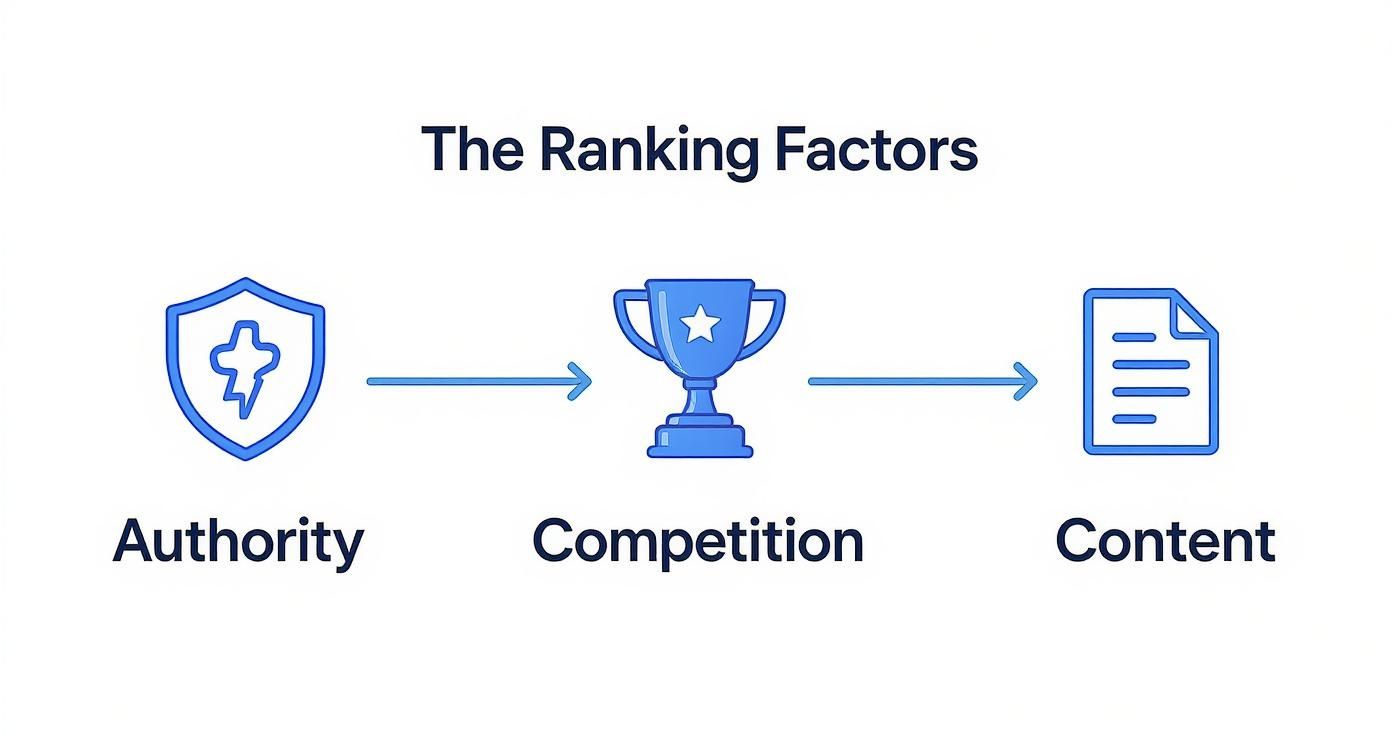
As the visual shows, building true authority is a long-term game. But creating high-quality content can give you much faster traction, especially when you're playing in a less competitive space.
How Google Updates Can Change Your Timeline
SEO is not a 'set it and forget it' game because the rules are always changing. Think of Google's algorithm as the rulebook for a complex sport. Several times a year, the league announces major changes to those rules. In the SEO world, we call these core updates, and they can completely shuffle the rankings overnight.
These updates aren't meant to be punishments. Their real goal is to get better at rewarding websites that give people an excellent experience. A site sitting comfortably on page one today could find itself on page three tomorrow if an update redefines what "quality" looks like for a particular search.
Understanding Core Updates and Their Impact
When a core update rolls out, it can feel like a sudden, unpredictable storm. One day your traffic is humming along, and the next it's spiking or plummeting without you having touched a thing on your site. This volatility is a normal part of the process, and it’s exactly why a resilient, long-term SEO strategy is so critical.
Instead of chasing short-term algorithm tricks that will eventually break, the most durable approach is to build your site around the things Google is always trying to reward:
- Exceptional Content: Pages that are genuinely helpful, comprehensive, and show you really know your stuff.
- Positive User Experience: A site that's fast, mobile-friendly, and dead simple to navigate.
- Trust and Authority: A strong reputation built on quality backlinks and consistently delivering value.
Focusing on these fundamentals turns that potential volatility into a competitive advantage. While your competitors are scrambling to figure out what just happened, a site built on a solid foundation often weathers the storm—or even sees its rankings climb.
The Ever-Shifting SEO Landscape
Looking back at Google’s update history, it's clear these major changes reset the playing field and directly impact how long it takes to rank. Google pushes out core updates every few months. For instance, the March 2024 core update lasted over 45 days, dramatically reshuffling search results and forcing everyone to adapt. You can see the official history of these rollouts on the Google Search Status Dashboard.
Actionable Insight: The goal isn't to perfectly predict every algorithm change, because you can't. The goal is to build a website so good that it's prepared for whatever changes come next. This means prioritizing user experience and helpful content above all else.
To stay ahead of the curve, you absolutely have to monitor your website's performance. Keeping a close eye on your rankings, traffic, and indexing status helps you spot the early tremors of an update. A crucial first step is to set up Google Search Console. It gives you direct insight into how Google sees your site and will flag technical issues before they become major problems.
By proactively managing your site's health, you can respond to algorithmic shifts with data-driven decisions instead of guesswork, keeping your ranking timeline from going completely off the rails.
Three Strategies to Accelerate Your Google Rankings
While you can't force Google to rank your site overnight, you can absolutely give it a good reason to pay attention sooner rather than later. Instead of sitting back and waiting for the magic to happen, taking a proactive approach with a few proven strategies can seriously cut down the time it takes to see real, meaningful traffic.
The secret is to start thinking like Google. The search engine's entire goal is to reward websites that are clear, authoritative, and genuinely helpful. These three strategies are all about sending those exact signals, helping you build momentum much more quickly.
Build Topical Authority with Content Clusters
First up, it's time to stop publishing random blog posts and start building topical authority. Think of this as becoming a recognized specialist instead of just a generalist. When you cover a single topic from every conceivable angle, you send a massive signal to Google that you are the definitive resource on that subject.
This is done using what’s called a "pillar and cluster" model. You create one central, in-depth "pillar" page that covers a broad topic. Then, you surround it with smaller "cluster" articles that dive deep into very specific subtopics.
For a Kansas City web design agency, a content cluster might look something like this:
- Pillar Page: The Ultimate Guide to Small Business SEO in Kansas City
- Cluster Post 1: How to Choose the Right Keywords for a Local Business
- Cluster Post 2: A Beginner's Guide to Google Business Profile Optimization
- Cluster Post 3: Why Page Speed Matters for Kansas City Companies
By linking all these posts back to the main pillar page, you create a tightly-knit web of expert content. This structure boosts your authority and helps you rank faster for a whole group of related search terms, not just one.
Use Strategic Internal Linking
Once you've created all that great content, you need to guide both your visitors and Google's crawlers to your most important pages. That's where strategic internal linking comes into play. Think of your website's authority like water flowing through pipes; internal links let you direct that flow to where it will have the biggest impact.
Whenever you publish a new blog post, don't just let it sit there in isolation. Go back and find older, relevant articles on your site and add links from them to your new piece. This simple step helps Google discover your new content much faster and passes some of the existing page's authority along with it.
Actionable Insight: An internal link from a high-authority page on your own site can be one of the fastest ways to get a new page indexed and ranked. It’s a direct signal to Google saying, "Hey, this new content is important and connected to something you already trust."
Target Low-Hanging Fruit Keywords
While you're working on building the authority to tackle big, competitive keywords, you can score some quick wins by targeting the "low-hanging fruit." These are typically long-tail keywords—longer, more specific search phrases that have lower competition but incredibly high user intent.
For instance, instead of trying to rank for the massive term "SEO services," a new agency could target something like "SEO services for plumbers in Kansas City." Sure, the search volume is lower, but the traffic you get is far more qualified and much easier to capture. You can find more strategies for earning high-quality links by exploring our guide on how to build backlinks naturally.
Ranking for these specific terms can happen in just a few months. This brings in valuable traffic and builds momentum while you continue chipping away at your more ambitious keyword goals. It's an approach that gets you on the board quickly, proving that your strategy is working.
Got Questions About Ranking on Google? We've Got Answers
Even with the best plan, the world of SEO can feel a bit like a puzzle. It's totally normal for questions to pop up along the way, so let's tackle some of the most common ones people ask when they're wondering how long it takes to see real results.
Can I Rank on Google in a Week?
Let's be real: while Google might index your new page in a few days, that's not the same thing as ranking. Indexing just means your page is officially in Google's library. Actually hitting the first page for keywords that matter takes time.
Think of it like this: getting a business license is quick (that's indexing), but becoming the most popular, trusted store in town (that's ranking) is a marathon, not a sprint. You have to build trust and authority, and that takes months. In fact, studies show that only a tiny fraction of newly published pages manage to crack the top 10 within an entire year.
Why Did My Rankings Suddenly Drop?
A sudden drop in your rankings can feel like the sky is falling, but there’s usually a logical reason behind it. The most common culprit? A big Google core update, which is when the algorithm reshuffles results as it re-evaluates what makes a page high-quality.
But don't just point the finger at Google. A few other things could be at play:
- Technical Gremlins: Sneaky issues like a slow site or indexing errors can definitely knock you down a few pegs. Use Google Search Console's "Pages" report to check for errors.
- Lost Backlinks: If a high-authority site that was linking to you removes that link, you lose some of the "link equity" that was propping you up.
- The Competition Got Better: Sometimes, a competitor simply published a superior piece of content or ramped up their own SEO efforts.
Do I Have to Pay to Rank on Google?
Nope. You absolutely do not have to pay Google a dime to show up in the organic search results. Earning a spot there is all about solid SEO—creating fantastic content, building up your site's authority, and making sure all the technical boxes are checked.
Those paid results you see at the very top of the page? That's Google Ads. It’s pure advertising and is a completely separate game from organic SEO. Ads can get you instant visibility, but that visibility vanishes the second you stop paying the bill.
Does Using Google Ads Improve My Organic Ranking?
This is one of the most persistent myths in the digital marketing world. Google has been crystal clear on this: running Google Ads has no direct impact on your organic search rankings. Paying for ads won't give you a shortcut or a boost in the organic results.
However, there can be a small, indirect benefit. A great ad campaign gets your brand name out there, which can lead to more people searching for your business directly. That kind of increased brand recognition can, over the long haul, contribute to the signals that do help your SEO.
Ready to stop waiting and start ranking? The team at Website Services-Kansas City specializes in building the foundational SEO strength your business needs to climb the search results and attract more customers. Explore our SEO services and get started today!