
Guest blogging is a classic, battle-tested SEO play. At its core, you write a piece of content for another website in your industry. In return for your hard work and expertise, the host site usually lets you drop one or two links back to your own website. This simple exchange helps boost your site's authority and, in turn, your search engine rankings.
Why Guest Blogging Still Dominates Link Building
Let's get one thing straight: guest blogging is far from dead. It's just grown up. The old days of spamming out terrible, 500-word articles to any site with a pulse are long gone. Thank goodness.
Today, a smart guest blogging strategy is all about precision and quality. It’s less of a numbers game and more of a strategic move to earn high-impact, authoritative links. Think of it like being invited to speak at a major industry conference. One killer presentation—or one perfectly placed guest post on a top-tier site—can bring you more value than dozens of low-effort appearances combined.
It’s one of the most powerful ways to build your brand’s reputation, pull in highly relevant referral traffic, and secure the kind of backlinks that Google absolutely loves to see.
The Modern Economics of Guest Posting
The world of guest posting has matured, and it’s critical to know the lay of the land before you dive in. You'll find a huge range in what people charge. The average cost for a paid guest post hovers around $77.80, but for a spot on a truly premium, high-authority site, you could be looking at anywhere from $692 to $957.
This massive price gap shines a light on a crucial reality check from a BuzzStream study: a staggering 85.3% of guest posting sites are considered low quality. These are sites with a Domain Rating under 40 and fewer than 10,000 monthly visitors.
That stat alone shows why you have to be incredibly picky. Despite all the low-quality noise out there, guest blogging is still the most popular link-building tactic, with 64.9% of SEO professionals relying on it as a primary strategy. The focus has just shifted—it's all about quality over quantity now.
Let's take a moment to look at the current state of play.
Guest Blogging Quick Facts and Figures
This table summarizes some of the key numbers that paint a picture of the modern guest blogging landscape. It highlights the effort required against the potential rewards.
| Metric | Average Figure |
|---|---|
| Average Cost of a Guest Post | $77.80 |
| Premium Guest Post Cost Range | $692 – $957 |
| % of Low-Quality Sites (DR <40) | 85.3% |
| % of SEOs Using Guest Blogging | 64.9% |
These figures tell a clear story: while the majority of opportunities might not be worth your time, the high-value placements are what make this strategy a cornerstone for so many successful SEO campaigns.
The goal isn't just to get a link; it's to get the right link. A backlink from a highly respected site in your niche acts as a powerful vote of confidence, signaling to search engines that your content is credible and authoritative.
More Than Just a Backlink
While the SEO juice is often the main prize, a well-executed guest blogging campaign is a cornerstone of any solid link acquisition strategy for a few other big reasons:
- Targeted Referral Traffic: A guest post on a popular industry blog puts your brand directly in front of a built-in, highly engaged audience. For example, a Kansas City marketing agency writing for a local business journal can attract direct leads from companies in their service area. These aren't random visitors; they're people already interested in your niche, making them prime candidates to become customers.
- Building Brand Authority: When you consistently show up on respected platforms with insightful, helpful content, you start to build a reputation as an expert. This builds trust not just with potential customers, but with search engines, which are always looking to reward brands that demonstrate true expertise.
- Networking and Relationships: Good guest blogging opens doors. It helps you build real relationships with editors, site owners, and other influential people in your space. Those connections can easily lead to future collaborations, partnerships, and more organic opportunities down the road.
How to Find and Vet High-Value Guest Post Targets
Jumping into guest blogging without a solid prospecting plan is like sailing without a map. You might find land, but it probably won't be the high-value territory you're after. The key is to stop chasing every opportunity and start identifying blogs that offer real authority, relevant traffic, and an engaged audience.
Forget endless scrolling through generic lists. Your time is better spent on surgical tactics that uncover opportunities your competitors are missing. Smart prospecting is what separates a successful campaign from a frustrating one.
Uncovering Opportunities Beyond Basic Searches
Sure, the most obvious first step is a simple Google search, but you can get far more precise results by using advanced search operators. These little commands are your secret weapon for refining searches to pinpoint exactly what you need.
Instead of just typing "fitness guest post," try these more powerful combinations:
"fitness" + "write for us""health" + "guest article""nutrition" + "contribute to our site"inurl:contributors "Kansas City"
This approach filters out all the irrelevant noise and takes you directly to pages where websites are actively looking for contributors. Another killer technique is to hunt where editors hang out. Platforms like LinkedIn are goldmines for this; search for hashtags like #callforcontributors or follow editors in your niche who often post calls for expert sources.
Reverse-Engineering Your Competitors
One of the most effective ways to find proven guest blogging targets is to see where your successful competitors are already getting their links. Tools like Ahrefs or Semrush make this ridiculously easy.
Just plug a competitor's domain into the tool's site explorer and navigate to their backlink profile. From there, you can filter their links to identify the ones that are clearly guest posts. For instance, if you run a KC-based design firm, analyze the backlinks of another top Kansas City web designer. You'll quickly find local business blogs, tech publications, and industry sites that are already open to featuring local experts. You now have a warm list of targets that already link to a business just like yours.
The reality is, guest blogging is a competitive field that demands persistence. The average guest blogger sends out 25.8 pitches per month, with most writing around 6.6 guest posts monthly. This highlights the sheer volume of activity out there, making a targeted, high-quality approach essential to stand out. You can find out more by reviewing these guest blogging statistics and trends.
This simple flow visualizes how to prioritize your guest blogging strategy—focusing first on content quality, then site authority, to ultimately drive meaningful traffic.
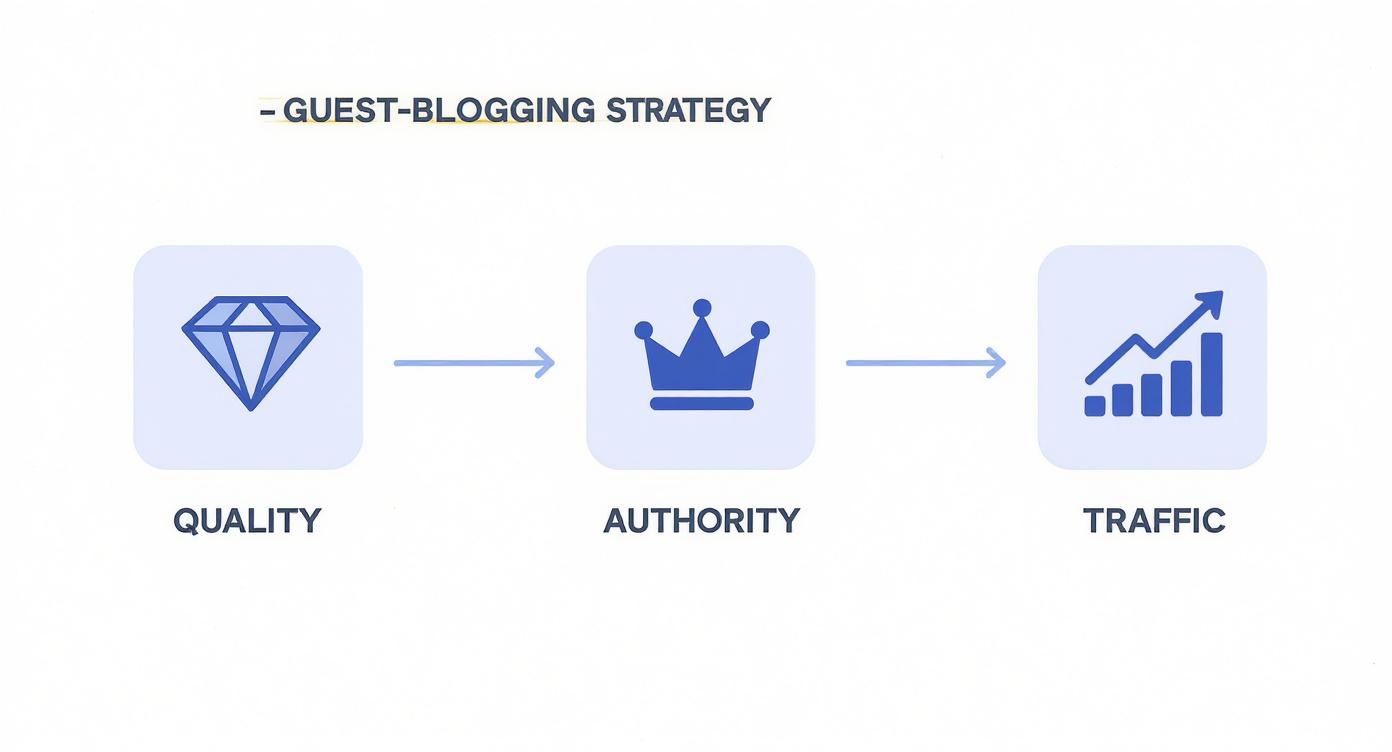
This illustrates that starting with excellent content is the non-negotiable foundation for securing placements on authoritative sites that can deliver real results.
The Vetting Checklist Separating Gems from Junk
Finding a potential site is only half the battle. Proper vetting is where you protect your brand and ensure you get a positive return on your effort. Not all backlinks are created equal, and a link from a low-quality, spammy site can do more harm than good.
Your goal is to get your content on a platform that acts as a respected resource, not a billboard for hire. A link from a genuine authority site is a powerful signal to Google, while a link from a link farm is a major red flag.
Before you ever draft a single pitch, run every potential target through this quick but critical checklist:
- Domain Rating (DR) or Domain Authority (DA): While it's not a perfect metric, a score of 40+ is a good starting point. This indicates the site has an established backlink profile of its own.
- Organic Traffic Trends: Use a tool like Ahrefs to check their traffic graph. Is the site's traffic growing, stagnant, or declining? A steady upward trend suggests a healthy site that Google trusts. A sharp drop is a serious warning sign.
- Content Quality and Relevance: Read their last five blog posts. Is the content well-written, insightful, and actually relevant to your niche? If a "marketing" blog has recent posts on cryptocurrency, dog training, and travel, it's likely a link farm.
- Audience Engagement: Do posts have genuine comments and social shares? An active community is a sign of a real, engaged readership—the kind of audience you want to get in front of.
This vetting process ensures you're investing your time where it counts. For those looking to streamline this process, exploring a curated guest posting site list can provide a solid foundation of pre-vetted opportunities.
Crafting Outreach Emails That Actually Get Opened
Okay, so you've done the hard work of vetting your targets. Now comes the moment of truth: the pitch.
Your outreach email is your first and often only impression. In a world where editors swim in a sea of daily pitches, making yours stand out isn't just a good idea—it's everything. A generic, self-serving email is a guaranteed one-way ticket to the trash folder.
The real secret to getting a "yes" isn't some magic template. It's genuine personalization and showing immediate value. You have to prove you’ve done your homework and that your content will actually help their audience, not just pad your own backlink profile.
The Anatomy of a Winning Pitch
Before you type a single word, get this in your head: your job is to solve a problem for the editor. Their biggest problem? A relentless need for high-quality, relevant content that keeps their readers coming back. Your pitch needs to be the solution.
First off, sending your email to a generic info@ or contact@ address is basically a dead end. Spend the extra five minutes using tools like Hunter.io or LinkedIn to find the actual name of the content manager, blog editor, or head of marketing. This tiny detail instantly shows your email isn't just another mass blast.
Your subject line is the gatekeeper. It has to be compelling enough to earn a click but not so gimmicky that it feels like spam. Ditch the boring stuff.
- Bad Subject Line:
Article Pitch - Good Subject Line:
Guest Post Idea: A Different Take on [Their Blog's Core Topic] - Great Subject Line:
Content Idea for [Blog Name]: The [Your Topic] Mistake We All Make

The best pitches are concise, reference the editor's existing content, and offer specific, value-packed ideas. This level of care is exactly what separates the emails that get opened from the ones that get deleted on sight.
From Bad Pitch to Secured Placement
Let’s look at a couple of real-world examples. First, the kind of lazy, low-effort pitch that editors instinctively delete.
The Terrible Pitch (Don't do this):
"Hi, I am a content writer and I see you accept guest posts. I can write a high-quality, 1000-word article for you on marketing. I have many years of experience. Please let me know if you are interested so I can get started."
This is all about the sender. It offers zero specific value and shows they haven't spent a single second getting to know the blog.
Now, let's contrast that with an approach that leads with value and respect.
The Effective Pitch (Do this instead):
"Hi [Editor's Name],
I'm a huge fan of how [Blog Name] covers [Topic]. Your recent article on [Specific Article Title] was especially insightful—I shared it with my network on LinkedIn.
I noticed you've written a lot about [Topic A], but haven't explored the angle of [Your Unique Idea]. I've been working in this area and have three potential topics I think your audience would love:
- [Specific, Intriguing Title 1] – A fresh take on a common problem.
- [Specific, Intriguing Title 2] – A case study with actionable data.
- [Specific, Intriguing Title 3] – A contrarian view that challenges a popular belief.
For a sense of my writing style, you can see my recent post on [Another Reputable Site].
Let me know if any of these sound like a good fit!
Best,
[Your Name]"
This pitch actually works. It's personal, proves genuine readership, and offers concrete, well-researched ideas that fit right into their existing content. The body of your email is crucial, and knowing how to write website copy that provides real value is a skill that translates directly to crafting better pitches.
The Art of the Non-Pushy Follow-Up
Look, editors are busy. A great pitch can easily get buried. A polite, simple follow-up can make all the difference. In my own experience, sending this exact follow-up 5-7 days after the first pitch has boosted my success rate by over 40%.
My Go-To Follow-Up Template:
"Hi [Editor's Name], just wanted to quickly follow up on the guest post ideas I sent over last week. No worries if you're swamped, just wanted to make sure it didn't get lost in the shuffle. Thanks!"
It's simple, respects their time, and is shockingly effective. It bumps your original email back to the top of their inbox without being annoying.
Writing High-Impact Content and Placing Your Link
Getting your pitch accepted is a great feeling, but the real work starts now. Your mission is to deliver an article so valuable that the editor is thrilled to publish it and their audience feels compelled to click through to your site. This means going way beyond just hitting the word count.
Before you write a single word, dive deep into the host blog's style. Read a handful of their most popular posts. Get a feel for their tone, formatting, and sentence structure. Are they data-heavy and formal, or do they lean into conversational storytelling? Matching their style makes the editor's job a breeze and ensures your post feels like it truly belongs.

This isn't about losing your own voice; it's about adapting it for a new stage. Weave in your unique insights, your own data, or a personal case study that nobody else could possibly provide. That's what makes a guest post memorable and effective for guest blogging for backlinks.
The Crucial Difference Between Body and Bio Links
When it comes to the SEO firepower of your backlink, placement is everything.
A lot of sites will offer you a link in the author bio at the end of the post. While that’s better than nothing, it's not the real prize. The most powerful backlink is a contextual link—one placed naturally right within the body of the article.
Search engines give way more weight to these links because they look like genuine editorial endorsements. A link surrounded by relevant text tells Google your content is a valuable, related resource for the topic at hand.
An in-content link signals relevance and authority in a way an author bio link simply cannot. Always aim to negotiate for at least one contextual backlink. It's the difference between a good SEO result and a great one.
Crafting a Natural and Powerful Backlink Placement
Placing your link shouldn't feel forced or spammy. The key is to write your guest post in a way that creates a logical, natural opportunity to reference a resource on your own site.
For example, if you're writing about "common social media mistakes for small businesses," you might have a section on inconsistent branding. Within that part, you could naturally say something like, "Maintaining a consistent brand voice across platforms is a challenge, but there are several proven frameworks that help you build backlinks naturally and consistently."
See how that works? The link flows with the sentence and offers the reader a chance to go deeper.
The type of content you create also plays a huge role. Interestingly, research has found that blog posts answering ‘what’ and ‘why’ questions tend to generate around 25% more links than simple ‘how-to’ guides. This suggests that content providing deeper, foundational insights is more likely to be cited. You can explore more data-backed blogging statistics and insights to refine your strategy.
Mastering Your Anchor Text Strategy
Anchor text is the clickable text in a hyperlink, and it’s a critical signal to search engines about what the linked page is about. Using it strategically is essential, but over-optimizing it is a fast track to getting penalized. A healthy link profile has a diverse mix of anchor text types.
Let's break down the main types with a practical example. Imagine your Kansas City-based marketing agency is called "KC Digital Pro," and you want a link to your page about local SEO.
-
Branded Anchor Text: This uses your brand name. It’s the safest and most natural type.
- Example: "For more insights, check out the latest study from KC Digital Pro."
-
Partial-Match Anchor Text: This includes your keyword along with other words, making it feel more natural than an exact match.
- Example: "Many businesses can benefit from local SEO services in Kansas City."
-
Natural/Generic Anchor Text: This uses non-descriptive, common phrases. While it provides less keyword relevance, it's crucial for a natural-looking profile.
- Example: "Click here to see the full case study." or "Learn more about the process."
-
Naked URL: Simply using the URL as the anchor text.
- Example: "You can find the data at https://kcdigitalpro.com/local-seo."
A smart anchor text strategy for guest blogging for backlinks involves rotating through these types. Never use the same aggressive, exact-match anchor text on every guest post. A varied profile is exactly what Google wants to see, signaling authentic link building, not manipulative tactics.
Measuring Success and Avoiding Common Pitfalls
Landing a guest post is a great feeling, but it's just the start. If you want those efforts to actually deliver a return, you need a simple way to track what’s happening. Without it, you’re just throwing content out there and hoping for the best.
Effective tracking doesn’t have to be a huge, complicated process. It really just comes down to watching a few key metrics that tell you if search engines are seeing your new links and if they’re driving real results for your business.
Tracking Your Guest Blogging ROI
The most direct way to keep an eye on new backlinks is through Google Search Console. It’s completely free and shows you which sites are linking back to you. It can be a little slow to update, but it’s the best way to confirm that Google has actually indexed your new link.
For a more immediate look, paid tools like Ahrefs or Semrush will show you new backlinks almost as soon as their crawlers discover them.
Beyond just confirming the link exists, you need to see what it's doing. These are the core metrics I always watch:
- Referral Traffic: Is anyone actually clicking the link? A quick look in Google Analytics will show you how much traffic is coming directly from the site where you guest posted. A steady stream of visitors is a fantastic sign your content hit the mark with a relevant audience.
- Keyword Ranking Improvements: This is the big one. Keep a close eye on the rankings for the specific page you linked to. If you built a link to your "local SEO services" page, are you seeing it climb the ranks for that term? That's the ultimate proof your strategy is paying off.
- New Link Acquisition: This is a great bonus. Check to see if your guest post is attracting its own backlinks. When other high-quality sites link to your article, it boosts its authority and passes even more of that value on to your site.
If you need a simple walkthrough for monitoring your link profile, our post on how to check backlinks in Google breaks down the process using Search Console.
Steering Clear of Dangerous Pitfalls
Just as important as knowing what works is knowing what to avoid. A few bad moves in your guest blogging strategy can do more than just waste your time—they can actively damage your site's SEO. You’re trying to build a sustainable asset, not chase a short-term boost that could earn you a penalty.
The two biggest dangers to watch out for are low-quality link schemes and over-optimized anchor text.
Google's guidelines are crystal clear: any links built specifically to manipulate PageRank can be flagged as a link scheme. This includes large-scale guest posting campaigns stuffed with keyword-rich anchors or getting involved with private blog networks (PBNs).
A private blog network (PBN) is a web of sites created for the sole purpose of building links to a target website. These blogs usually have thin content, unrelated topics, and sketchy backlink profiles. A link from a PBN is a massive red flag for Google and can lead to a painful manual penalty.
Another classic mistake is getting too aggressive with your anchor text. I get it—it’s tempting to use your main keyword in every single link. But to Google, this looks completely unnatural and manipulative. A healthy backlink profile has a diverse mix of branded, partial-match, and natural anchor text. Overusing exact-match anchors is one of the clearest signs of a low-quality link building scheme.
To make this crystal clear, here’s a look at the common mistakes versus the right approach.
Guest Blogging Pitfall vs Best Practice
This table highlights the common traps people fall into and the correct, best-practice approach that keeps your strategy safe and effective.
| Common Pitfall | Best Practice |
|---|---|
| Using Aggressive, Exact-Match Anchors | Using a Diverse Mix of Anchor Text |
| Accepting Links on Irrelevant Blogs | Vetting Sites for Relevance and Authority |
| Ignoring Site Quality for a Quick Link | Checking DR, Traffic Trends, and Engagement |
| Participating in Obvious Link Schemes (PBNs) | Focusing on Genuine Editorial Placements |
By sticking to these best practices, you can be sure your guest blogging strategy is building a strong, penalty-proof foundation that will support your site’s growth for years to come.
Your Guest Blogging Questions Answered
Even with a solid plan for guest blogging for backlinks, a few tricky questions always seem to pop up. Let's get them out of the way with some direct, no-fluff answers so you can move forward with confidence.
Think of this as your quick-reference guide for the gray areas and strategic calls you'll have to make.
How Many Guest Posts Do I Need for Results?
This is probably the question I hear most often, and the honest answer is this: it’s not about the number of posts, but the impact of each one. The old "more is better" mindset is a trap that leads you down a path of chasing low-value links that barely move the needle.
A single guest post on a highly respected, DR 80 site in your industry is worth more than 50 posts scattered across irrelevant, DR 20 blogs. That one authoritative link sends a powerful signal of trust to search engines that the other 50 combined could never match.
For most businesses just getting started, a realistic and effective goal is to aim for 2-4 high-quality placements per month. This pace lets you focus on finding exceptional opportunities, crafting amazing content, and building real relationships instead of just churning out articles.
The goal is link quality, not link quantity. Prioritizing impact over volume is how you build a strong, sustainable SEO foundation that delivers results for years to come.
Is It Okay to Pay for a Guest Post?
This is a definite gray area, and you have to understand the difference between a legitimate editorial process and straight-up buying links. Confusing the two can get you into hot water with Google.
Here’s the breakdown:
-
Paying a Legitimate Editorial Fee: Some high-authority publications—think major online magazines or top-tier industry blogs—charge a fee to cover their editorial and production costs. This is often an acceptable practice, as long as the site has strict editorial standards, a real audience, and doesn't guarantee you a spot. You're paying for their team's time, not the link itself.
-
Buying a Link on a "Pay-to-Play" Site: This is a clear violation of Google's guidelines and a huge red flag. These sites are usually just low-quality link farms built for the sole purpose of selling backlinks. The content is garbage, the topics are all over the place, and there are no real editorial standards. Paying for a spot on a site like this is a manipulative tactic that can lead to penalties.
My advice? Steer clear of any site that feels like it's just selling links for a quick buck. Focus your energy and budget on platforms with genuine editorial integrity. If you're paying, make sure it’s for quality control, not a guaranteed backlink.
Can I Republish My Guest Post on My Own Blog?
The answer to this is a firm and absolute no. Republishing the exact same article on your own blog after it’s gone live somewhere else creates a significant duplicate content problem.
When search engines find the same content on multiple websites, they struggle to figure out which one is the original, or "canonical," source. This confusion can dilute the SEO value of the content for both your site and the host’s. In a worst-case scenario, your version could even outrank the original guest post, which is a bad look and a quick way to burn a bridge with an editor.
Every piece of content you write for a guest post must be 100% unique and live exclusively on that host's website.
Instead of republishing, you should be promoting your guest post like crazy:
- Share a link to the article on all your social media channels.
- Email it to your newsletter subscribers, highlighting your expert contribution.
- Write a short "summary" post on your own blog that teases the main ideas and then links out to the full article on the host site.
This approach drives traffic to your guest post, shows the host blog you're a great partner, and builds your authority—all without creating harmful duplicate content issues. It's the professional and SEO-safe way to get the most mileage out of your hard work.
Ready to build a powerful backlink profile without the guesswork? The team at Website Services-Kansas City specializes in securing high-quality, natural in-content links that drive real SEO results. Let us handle the outreach, content creation, and placement so you can focus on what you do best. Explore our professional SEO solutions at https://websiteservices.io.