
Ecommerce link building is all about getting links from other websites to point to your online store. Think of each link as a vote of confidence—a digital nod of approval that tells search engines your shop is the real deal. A smart strategy doesn't just chase any link; it focuses on earning high-quality, relevant links that drive ready-to-buy traffic straight to your product and category pages.
Done right, it's what separates a store that gets found from one that gets lost in the noise.
Why Backlinks Are a Game Changer for Ecommerce
Let's cut right to it. In the cutthroat world of ecommerce, visibility is everything. You can have the best products and a slick Shopify store, but if your customers can't find you on Google, you’re basically invisible. This is where a focused link building strategy becomes a true game changer, directly fueling your bottom line.
Think of backlinks as digital referrals. When a reputable blog, an industry publication, or a popular brand links to one of your product pages, they're essentially vouching for you. Search engines like Google see these links as powerful trust signals, rewarding your store with higher rankings in the search results.
The Direct Path From Links to Revenue
Building a solid backlink profile isn't just a technical SEO chore; it's a core marketing function. It’s about building brand authority and pulling in customers who are actively looking for exactly what you sell. The connection is refreshingly straightforward:
- Higher Rankings: Quality backlinks push you up the results for valuable keywords.
- Increased Traffic: Higher rankings mean more organic clicks from real shoppers.
- More Sales: Targeted organic traffic simply converts better.
This isn't just theory; the data backs it up. On average, the pages ranking at the top of Google have 3.8 times more backlinks than the pages ranking below them. Better yet, many SEO pros report seeing a real impact on rankings and traffic from link campaigns in as little as 1–3 months.
A classic mistake new store owners make is pouring all their energy into social media or paid ads. While those channels are important, they require constant feeding. A quality backlink, on the other hand, is an asset that appreciates over time, driving traffic and building authority for years to come.
For a new store trying to muscle its way into a market dominated by giants, a deliberate link building effort is one of the most powerful ways to level the playing field. Each link you earn strengthens your website's foundation, making it more authoritative in the eyes of both search engines and customers. A strategic approach ensures your marketing efforts build long-term, sustainable growth, not just short-term buzz.
Creating Assets People Actually Want to Link To
Trying to build links only to your product and category pages is like trying to catch fish with an empty hook. It just doesn't work. While those pages are crucial for making sales, they’re transactional. They don't give other websites a compelling reason to point their audience your way.
If you want to attract high-quality backlinks, you have to create "linkable assets"—valuable, informative, or entertaining resources that people naturally want to reference and share.
This whole approach is about shifting your focus from "selling" to "serving." When you start providing genuine value, you position your brand as an authority. Your site becomes a go-to resource that bloggers, journalists, and industry experts are actually happy to cite.
Moving Beyond Product Listings
The big idea here is simple: create content that answers questions, solves problems, or presents information in a really unique way. This content lives on your site and acts as a magnet for links. Instead of begging for a link to a product page, you're earning one with exceptional content. This is a core part of any good plan, which we break down in our guide on how to create a content strategy.
Put yourself in another site owner's shoes for a second. Would they rather link to a generic product page for "running shoes," or a deep, data-backed guide called "The Ultimate Guide to Choosing Running Shoes for Your Foot Type"? The guide is infinitely more valuable to their readers. It's a no-brainer.
Types of Powerful Linkable Assets
So, what do these assets actually look like? They can take a bunch of different forms, each one tailored to your specific niche and audience. The goal is to create something so ridiculously useful that other sites feel like they’re doing their own readers a favor by linking to it.
Here are a few proven formats that work incredibly well for ecommerce stores:
- In-Depth Buying Guides: Go way beyond a simple product description. A detailed guide on "How to Choose the Right Coffee Beans" can pull in links from coffee blogs, lifestyle sites, and articles about morning routines. Actionable Insight: Create a "comparison" style guide that pits three of your top-selling products against each other, detailing the pros and cons for different customer types. This is incredibly linkable for review sites.
- Interactive Tools and Calculators: These are link-building gold because they provide a unique, hands-on experience. A paint store could create a "Room Paint Calculator," or a furniture shop could build a simple "Room Layout Planner" tool. Actionable Insight: If you sell supplements, a "Daily Protein Intake Calculator" is a perfect asset to pitch to fitness and nutrition blogs.
- Original Research and Industry Reports: This is a more advanced tactic, but it's wildly effective. A Kansas City-based apparel store could analyze its sales data to create a "Midwest Style Trend Report"—a one-of-a-kind asset that local fashion bloggers and news outlets would love to reference.
- Visually Compelling Infographics: People love to share visual content. An infographic that breaks down a complex topic, like "The Different Types of Protein Powder and Their Benefits," is easy to share and embed, usually with a required link back to your site.
The best linkable assets often sit at the intersection of your product expertise and your customers' biggest questions. Don't just think about what you sell; think about the problems your products solve and create content around those solutions.
A Real-World Scenario
Let's make this real. Imagine you own a Shopify store that sells high-end gardening tools. Pitching a blogger to link to your "Premium Hand Trowel" product page is going to be a tough sell.
Instead, you create an exhaustive blog post titled, "A Beginner's Guide to Starting Your First Vegetable Garden." Inside this guide, you cover everything from soil preparation to pest control. And naturally, you feature and link to your own products—like that hand trowel—where it makes perfect sense.
Now, your outreach completely changes. You're not asking for a product link; you're offering a genuinely helpful resource. You can reach out to home and garden bloggers, local community garden websites, and even apartment living blogs with a simple message: "I saw you have a great article on container gardening. I just put together a comprehensive guide for beginners that might be a great resource to share with your readers."
This approach transforms your ecommerce link building from a pushy sales pitch into a valuable collaboration. You provide amazing content, and in return, you earn a relevant, authority-building backlink that makes your entire website stronger.
Practical Link Building Tactics for Product Pages
While those big, flashy "linkable assets" are great, you also need a playbook for driving links directly to the pages that actually make you money: your product and category pages. Let's be honest, this is the hard part. Securing these links is tougher because these pages are transactional by nature, but it's an absolutely critical piece of a smart ecommerce link building plan.
Getting these direct links is a powerful signal to search engines that your specific products are valuable and worth trusting. These are the kinds of links that can directly move the needle for high-intent, money-making keywords like "buy organic dog food" or "women's running shoes on sale."
This decision tree helps visualize when it makes sense to create a separate asset versus when you should focus your energy on linking directly to a product page.
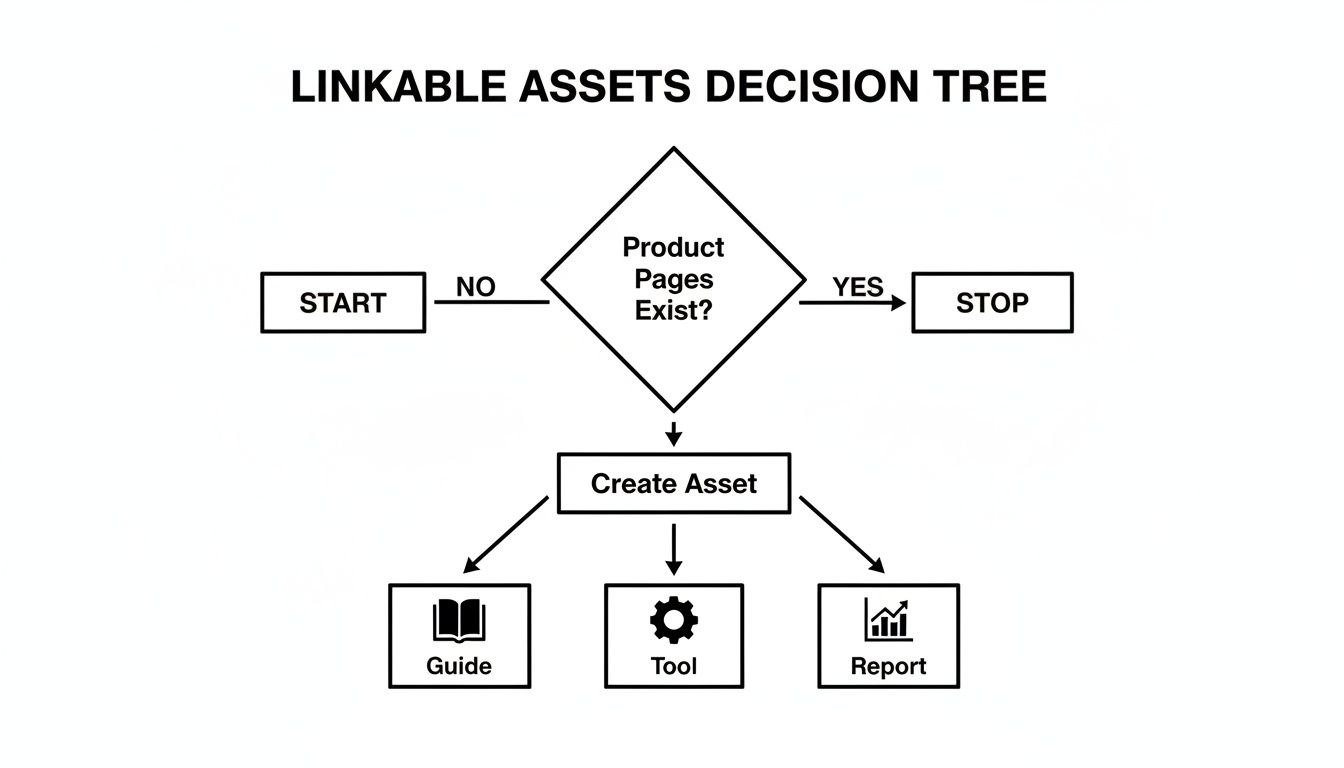
As you can see, even when your goal is to rank a product page, creating a supplementary asset is often the strategic first move to attract those top-tier links.
Tap Into Your Supplier and Manufacturer Relationships
One of the most overlooked—and easiest—tactics is to simply lean on your existing business relationships. The companies that supply or manufacture your products have a real interest in your success, making them a prime source for high-authority links.
Think about it: many manufacturers have a "Where to Buy" or "Stockists" page on their website. This is the definition of low-hanging fruit. If you carry their products, you have a perfectly legitimate reason to be on that list.
Actionable Insight: Go to Google and search for site:yourbrand.com "where to buy" or site:yourbrand.com "stockists". This will show you if your suppliers have these pages. If they do and you're not on the list, send a friendly email to your sales rep.
Just shoot a quick email to your contact person and ask to be added. Frame it as a mutual benefit—you’re helping their customers find and buy their products. A single email can land you a link from a highly relevant, authoritative domain. It doesn't get much easier than that.
Win with Niche-Relevant Guest Posting
Guest blogging is a classic for a reason: it flat-out works. The strategy is simple—write an article for another website in your niche and include a natural, contextual link back to one of your pages. The key is to obsess over quality, not quantity.
Don't waste your time pitching generic, boring articles. Instead, find the blogs your ideal customers are actually reading. A Kansas City-based boutique selling handcrafted leather goods shouldn't just spam any fashion blog. A much better fit would be a blog focused on "American-made goods" or "sustainable fashion."
Your pitch needs to offer them genuine value. Propose a topic that solves a real problem for their audience, like "5 Ways to Style a Leather Tote for Work and Weekend." Within that article, you can naturally link to your product page when you mention a specific style of tote. If you want to really sharpen this approach, our complete guide to SEO guest posting has actionable frameworks you can use.
Pro Tip: When you write a guest post, don't just link to a single product. If it makes sense in the context of the article, link to a relevant category page instead. A link to your "Women's Leather Handbags" category can often provide more long-term SEO value than a link to one product that might eventually go out of stock.
Use Product Reviews and Influencer Seeding
People trust recommendations from other people, not from brands. Sending your products to influencers and bloggers for their honest review is a direct path to getting authentic backlinks and powerful social proof. You can start small by identifying micro-influencers (10,000 to 50,000 followers) in your niche.
Their audiences are often incredibly engaged, and they're usually more open to working with up-and-coming brands. The goal isn't just a fleeting Instagram post; it's to get featured in a blog post or a YouTube video description that includes a direct, followable link to your product.
Just be clear in your outreach that you're offering a product for their consideration, not trying to buy a five-star review. A genuine, unbiased take from a trusted source is far more powerful and builds the kind of links that last.
Master Broken Link Building for Quick Wins
Broken link building is a highly efficient strategy because it's a perfect win-win. You find a dead link on someone else's website and offer your own relevant link as the ideal replacement. You’re helping the site owner fix an error on their page while earning a great backlink in the process.
Here’s how it works:
- Find Resource Pages: Use Google searches like
"your niche" + "helpful resources"or"your industry" + "recommended links"to find pages that link out to other sites. - Scan for Broken Links: Use a free browser extension like Check My Links to quickly scan these pages for any dead (404) links.
- Offer Your Replacement: When you find a broken link that used to point to a resource similar to your product or category, reach out to the site owner.
Keep your email short and helpful. For example: "Hi [Name], I was just checking out your excellent resource page on camping gear and noticed a link to [Dead Page] is no longer working. I actually have a [Your Product Page] that covers a similar topic. It might make a great replacement for your readers." This helpful, non-spammy approach dramatically increases your chances of getting the link.
To help you decide where to focus your energy, this table breaks down these common tactics.
Ecommerce Link Building Tactic Comparison
This table compares some common ecommerce link building tactics, highlighting their difficulty, potential impact, and where they fit best in your strategy.
| Tactic | Effort Level | Typical Target Page | Best For |
|---|---|---|---|
| Supplier Links | Low | Product/Category/Homepage | Quick, easy wins from relevant, authoritative domains. |
| Guest Posting | Medium | Category/Product/Blog | Building authority and driving targeted referral traffic. |
| Influencer Reviews | Medium | Product | Generating social proof and authentic, natural backlinks. |
| Broken Link Building | High | Category/Product/Blog | Earning high-quality links by providing direct value to webmasters. |
Each of these tactics has its place. Supplier outreach is great for foundational links, while broken link building is a more advanced play for scaling your efforts. The best approach is to mix and match based on your resources and goals.
Advanced Plays: Unlinked Mentions and Digital PR
Once you've got the basics down, it’s time to level up. A couple of the most powerful strategies for seriously scaling your ecommerce link building are chasing down unlinked brand mentions and running smart digital PR campaigns.
These tactics shift your focus from one-to-one outreach to creating widespread buzz, letting you earn high-authority links at a much larger scale.
The Low-Hanging Fruit: Finding and Claiming Unlinked Mentions
Unlinked mentions are just about the easiest wins you can get in link building. This is when a blog, news outlet, or review site talks about your brand, your products, or even your founder, but forgets to actually link back to your store.
The heavy lifting—getting on their radar—is already done. Your job is just to find these mentions and give them a gentle nudge to add the link.
The beauty of this is how simple and effective it is. You're not asking for a favor out of the blue; you're helping them make their content better for their own readers by making a reference clickable. It's a true win-win.
You can start finding these opportunities with some pretty basic tools. Setting up Google Alerts for your brand name and product names is a no-brainer first step. To get more firepower, tools like Ahrefs' Content Explorer or Semrush's Brand Monitoring tool can automate the whole process, even filtering out mentions that already have a link.
Once you spot a good prospect, the outreach email should be short, friendly, and helpful.
- Subject: Quick question about your article
- Body: Kick things off with a genuine compliment on their content. Point out exactly where they mentioned your brand and thank them for the shout-out. Then, just ask if they’d consider adding a link to your homepage or the relevant product page to make it easier for their readers to find you.
This low-pressure approach feels less like a demand and more like a helpful tip, which is why it has a much higher success rate than typical cold outreach. A well-oiled plan for reclaiming mentions is a core part of any effective link acquisition strategy.
Making the News: Pivoting to Digital PR for High-Impact Links
While hunting for mentions is reactive, Digital PR is all about being proactive. It’s the art of creating newsworthy stories and campaigns that journalists and industry bloggers actually want to cover.
Instead of begging for one link at a time, you create a story so compelling that it can generate dozens of high-authority links from a single push.
For an ecommerce brand, this doesn't have to be some massive, expensive undertaking. The best stories often come from the data you already have sitting around.
Digital PR transforms your brand from just a seller of products into a source of interesting information. A simple analysis of your own sales data can become a headline that lands you coverage in major publications, driving both links and serious brand awareness.
Let's say a Shopify store selling outdoor gear analyzes its sales data. They could publish a report titled, "The Top 10 Most Popular National Parks for Hiking in 2024, Based on Gear Sales." That's a unique, data-backed story that travel and outdoor lifestyle writers would find genuinely interesting.
A Simple Digital PR Campaign Framework
You don't need a huge budget to pull this off. The core ingredients are a good story, a simple asset to host it, and some targeted outreach.
- Find Your Angle: What unique insight can you offer? Look at your sales data, survey your customers, or tap into seasonal trends. A Kansas City-based coffee roaster, for example, could release a report on the "Most Caffeinated Neighborhoods in KC" based on their local delivery data.
- Create a Simple Asset: You don't need a crazy interactive report. Often, a well-written blog post summarizing your findings is all it takes. Toss in a couple of simple charts or infographics to make the data easy to scan and share.
- Build a Targeted Media List: Identify the specific journalists and bloggers who cover your industry or local area. Use simple Google searches or tools to find their contact info and personalize your pitch.
- Craft Your Pitch: Your email to a journalist should be short and get straight to the point. Lead with your most interesting finding as the headline. Briefly explain how you got the data and provide a link to your full report.
This approach positions your ecommerce store as an authority. By creating stories from data you already have, you give top-tier publications a compelling reason to link back to you, building powerful backlinks that can significantly move the needle on your search rankings and organic traffic.
Measuring and Scaling Your Link Building Efforts
Pouring time and money into ecommerce link building without tracking your progress is like driving blind. Sure, you're moving, but you have no idea if you're actually getting closer to your destination. To prove the ROI of your work, you have to look past the simple link count and focus on the metrics that actually impact your bottom line.
Measuring your campaign isn't about vanity metrics. It’s about figuring out what’s working so you can double down on the smart strategies and ditch the rest. The ultimate goal is always more organic sales, and the right data will show you the clearest path to get there.
Tracking the KPIs That Actually Matter
Don't get lost in a sea of data. For an ecommerce store, a handful of specific metrics will tell you almost everything you need to know about the health of your link building. Setting up a simple dashboard in a tool like Ahrefs or Semrush can help you monitor these vital signs at a glance.
Focus your attention on these core indicators:
- Growth in Referring Domains: This is your foundation. Getting one link from ten different websites is way more valuable than getting ten links from a single site. A steady climb in unique referring domains shows search engines your store is gaining broad authority.
- Domain Authority (DA) or Domain Rating (DR) Improvement: While this is a third-party metric, it’s a useful, high-level snapshot of your site's authority over time. As you earn more quality links, your DA/DR score should gradually tick upward.
- Keyword Ranking Improvements: This is where the rubber meets the road. Are your target product and category pages moving up in the search results for valuable, purchase-intent keywords? Keep an eye on a core group of 10-20 keywords to see how your links are impacting visibility.
- Increase in Organic Traffic and Sales: The final test. Use Google Analytics to connect your link building activities with an uptick in organic traffic and—most importantly—revenue from the organic channel.
The real power of a concentrated campaign is undeniable. Case studies have shown that a focused ecommerce link building effort can produce remarkable results, with some stores seeing their domain rating jump from DR 50 to 65, organic keywords expanding from around 1,038 to 2,101, and monthly traffic value skyrocketing from $1,608 to $8,824 in just six months.
Creating Efficient Scaling Workflows
Once you start seeing positive results, the next challenge is scaling up without letting quality or efficiency slide. Building a repeatable system is the key to sustainable growth. Those one-off emails you started with now need to evolve into streamlined outreach workflows.
Start by creating standardized—but still customizable—email templates for each of your main tactics, like guest posting, broken link building, and claiming unlinked mentions. Use a simple spreadsheet or a more advanced tool like Pitchbox to track your outreach, monitor response rates, and schedule follow-ups. A good system prevents opportunities from slipping through the cracks and makes the whole process manageable.
Knowing When to Get Expert Help
There comes a point where doing everything yourself is no longer the most effective use of your time. Link building is a specialized skill that demands consistent, dedicated effort. If you find that outreach is constantly being pushed to the back burner for more urgent tasks, it might be time to bring in an expert.
Hiring a specialized SEO agency can dramatically accelerate your results. They already have the processes, tools, and relationships needed to execute high-level campaigns at scale. If you're thinking about this path, exploring options to outsource your backlink building can provide the expertise you need to take your Shopify store's growth to the next level. This frees you up to focus on what you do best—running your business.
Common Ecommerce Link Building Questions
Look, diving into the world of ecommerce link building can feel a bit like learning a new language. It's totally normal for a lot of questions to pop up. Let's walk through some of the most common ones I hear from store owners just like you.
How Many Backlinks Do I Need for My Ecommerce Store?
There’s no magic number. I wish there were, but it's really about the quality of the links and how your site stacks up against the stores you're directly competing with.
Instead of getting obsessed with a specific count, a much smarter approach is to analyze the top 3-5 sites that are already ranking for your most important keywords. What do their backlink profiles look like? Your goal is to build a profile with a similar number of high-quality, relevant links over time.
For a realistic starting point, aim to acquire 5-10 great links per month for your key pages. That's a solid, sustainable pace.
Can I Do Link Building Myself or Should I Hire an Agency?
You can absolutely get started on your own. Tactics like reaching out to your suppliers for links, finding and claiming "unlinked mentions" of your brand, or even writing a few guest posts are perfect ways to get your feet wet. It's the best way to really understand the process.
But, you'll find out pretty quickly that as your store grows, effective link building becomes a massive time sink. This isn't a task you can just squeeze in for 30 minutes a day. Partnering with a specialized agency can put your efforts on steroids, accelerating your results and freeing you up to actually run your business.
For a lot of growing stores, a hybrid approach works best. Handle the straightforward, relationship-based stuff in-house. Then, outsource the more complex and time-intensive campaigns—like digital PR or large-scale broken link building—to the pros.
What Is the Difference Between a Good and Bad Link?
This is probably the single most critical thing to understand, because getting it wrong can have major consequences for your site's health. The difference is night and day.
- A Good Link: This comes from a reputable, topically relevant website that has its own real audience. The link feels natural within the content and actually has the potential to send real, interested shoppers to your store.
- A Bad Link: This comes from an irrelevant, low-quality site, like a spammy directory or a Private Blog Network (PBN). It offers zero value to a real user and can actively hurt your SEO, potentially even landing you a penalty from Google.
Always, always prioritize the relevance and authority of the site linking to you over the sheer number of links.
How Long Until I See Results from Link Building?
While you might see some small ranking shifts happen fairly quickly, you should expect to see tangible, meaningful results from your efforts within 3 to 6 months. This means noticeable growth in traffic and significant improvements for the keywords you're targeting.
Think of SEO as a long-term investment. The quality backlinks you build today are assets. They'll continue to deliver value for years to come by strengthening your site’s authority and driving a consistent flow of organic sales.
Ready to build a powerful backlink profile that drives real revenue? The team at Website Services-Kansas City specializes in creating and executing SEO strategies that get results for ecommerce stores. Learn more about how we can help you grow.