
E-commerce link building is the art of getting other websites to link back to your online store. The goal? Better search engine rankings, more organic traffic, and ultimately, a healthier bottom line. But it’s not about just collecting any old links; it's about earning high-quality, relevant links that act as votes of confidence, telling Google your store is a credible and authoritative place to shop.
The right strategy here is the difference between being found and being invisible. A local Kansas City boutique, for instance, won't rank for "women's fashion" by just existing online; they need links from local fashion bloggers and KC-based publications to prove their relevance to Google.
Why E-commerce Link Building Often Fails
Let's be blunt—most e-commerce stores are terrible at earning backlinks. The hard truth is that having great products and a generic company blog is almost never enough to attract the kind of authority links that actually move the needle. Too many brands fall into the "if you build it, they will come" trap, only to find their digital storefront is a ghost town.
The core problem is that product and category pages just aren't very "linkable." Why would a blogger or journalist link to a page selling a $20 t-shirt? Unless there’s an incredible story or a unique resource attached, it just feels like giving away free advertising.
The Content Mismatch Problem
One of the biggest reasons for failure is creating content nobody wants to link to. Generic blog posts like "5 Ways to Wear Our New Scarf" might be fine for your existing customers, but they offer zero value to other websites.
Link-worthy content is different. It solves a tough problem, presents original data, or provides a valuable resource that other sites are genuinely excited to reference. Actionable insight: Instead of a generic post, a Kansas City-based apparel store could create a "Style Guide for Unpredictable KC Weather," offering real utility that local lifestyle bloggers would actually want to reference.
"The reality is that most content gets lost in the digital noise. Without a strategic approach to creating linkable assets, you're essentially hoping for a lucky break that will likely never come."
The numbers don't lie. A staggering 94% of all online content gets zero external links. Think about that. Only a tiny fraction—just 2.2%—earns links from more than one website. This highlights a massive disconnect: stores keep producing content they think is interesting, while publishers are only linking to content that is genuinely useful, newsworthy, or original.
Overlooking the Competitive Landscape
Another classic pitfall is completely underestimating the competition. Giant brands and marketplaces like Amazon or Walmart dominate the search results, and they're backed by insane domain authority and millions of backlinks.
A small store can't compete by simply existing. You have to be strategic and build a strong, healthy backlink profile to prove your credibility to search engines. You can learn more about what a backlink profile is in our detailed guide.
Without a deliberate link building strategy that tackles these common failures head-on, even the best products will struggle to find an audience. Understanding these mistakes is the first critical step toward building a program that actually drives results.
Developing Assets People Actually Want To Link To
Let's be blunt: you can't expect to earn high-quality links without creating something genuinely worth linking to. For an e-commerce store, this is often the biggest hurdle. No one is naturally going to link to a standard product page, so you have to create resources—what we call linkable assets—that serve a real purpose for an audience beyond your immediate customers.
Forget about pumping out generic blog posts. I'm talking about building valuable, evergreen resources that cement your authority and act as a magnet for backlinks from journalists, bloggers, and industry experts. The goal is to make your site an indispensable source of information within your niche.
This requires a fundamental shift in your thinking. Stop asking, "What content can we create?" and start asking, "What problems can we solve for our industry's audience?" The answer to that question is where you'll find your most successful linkable asset.
Moving Beyond Product Pages
The first thing you need to accept is that your product and category pages, while absolutely critical for sales, are not your primary tools for link building. A linkable asset is a piece of content that exists to educate, inform, or entertain, with the commercial side of things taking a backseat for a moment.
Think of it this way: a product page is for someone who is ready to buy. A linkable asset is for someone trying to learn, compare options, or solve a problem. By creating these kinds of resources, you attract a much wider net of people—including the ones who control the links.
Here are a few real-world examples of what this looks like:
- For an apparel store: An interactive sizing calculator that helps people find their perfect fit across different brands, not just your own.
- For a home goods retailer: A comprehensive "Stain Removal Guide" that covers every type of fabric and spill, becoming the go-to resource for anyone in a panic.
- For a supplements company: A data-driven report analyzing the most popular fitness trends, using anonymous customer data to offer unique insights no one else has.
These assets provide genuine value, making it a no-brainer for other websites to justify linking to them. They're not just selling; they're helping.
Finding Content Gaps in Your Niche
The most powerful linkable assets fill a void. They answer questions that no one else is answering well, or they provide a resource that simply doesn't exist yet. Finding these gaps is a critical part of the process and a key part of any well-defined plan. For a deeper dive into this planning phase, check out our guide on how to create a content strategy.
Start by analyzing what's already out there. Use SEO tools to see what kinds of articles are earning the most links for your competitors. Look for recurring themes, but more importantly, look for what’s missing. Are all the existing guides outdated? Are there common customer questions that are only answered in scattered forum posts? Actionable insight: Search Google for "[Your Niche] + statistics" or "[Your Niche] + study." If the top results are old or weak, you've found a perfect opportunity to create a new, data-rich asset that journalists will want to cite.
A linkable asset is your chance to create the definitive resource on a topic. Don't just add to the noise; build the single best page on the internet for that specific query.
The data absolutely backs this up. Research shows that long-form content generates 77.2% more links than shorter articles. On top of that, 'what' and 'why' posts often attract about 25% more links than simple 'how-to' guides, proving the immense value of creating comprehensive content that answers fundamental questions. For more on these findings, you can read the full research on link building statistics.
Linkable Asset Ideas For E Commerce Niches
To get the ideas flowing, think about the unique knowledge or data you already have. Your business is a goldmine of potential content ideas that are impossible for anyone else to replicate. Below are some proven formats that work wonders across different e-commerce niches.
| E Commerce Niche | Linkable Asset Idea | Primary Goal |
|---|---|---|
| Outdoor & Adventure | An interactive map showcasing the best hiking trails with user-submitted photos and tips. | Attract links from outdoor bloggers, travel sites, and local tourism boards. |
| Pet Supplies | A "Puppy-Proof Your Home" checklist and interactive room-by-room guide. | Earn links from veterinarians, dog trainers, and pet adoption agencies. |
| Beauty & Skincare | A "Skincare Ingredient Glossary" that explains the science behind common ingredients. | Become a reference for beauty editors, influencers, and dermatology-focused blogs. |
| Kitchenware & Cooking | A collection of downloadable conversion charts (e.g., metric to imperial, temps). | Gain links from food bloggers, recipe sites, and online cooking schools. |
Each of these examples provides a clear utility that goes way beyond just promoting a product. They establish the brand as a helpful expert, making them a natural choice for anyone looking for a credible source to cite. This is the very core of effective e-commerce link building.
Using Digital PR To Earn High-Authority Backlinks
Let’s be honest: traditional cold outreach is a numbers game, and the returns are getting smaller every year. The single most effective way to land powerful, authority-boosting links today is through Digital PR. This isn't about spamming journalists. It's about building real relationships and positioning your brand as a source worth quoting.
Instead of begging for links, you're earning media placements that drive not only incredible backlinks but also highly relevant referral traffic. This approach turns link building from a tedious SEO task into a genuine brand-building activity.
Before we jump into tactics, it's crucial to understand what digital PR is and how it works. Think of it as the bridge between having a fantastic linkable asset and getting it in front of the people who can give it a massive signal boost.
Crafting a Compelling Story Angle
Journalists and top-tier bloggers don't care about your products. They care about great stories. Your linkable asset—whether it's a data report, an in-depth guide, or a cool interactive tool—is just the foundation. The story you wrap around it is what actually gets you featured.
To find your angle, ask yourself these questions:
- Is it timely? Can you connect your asset to a current event, a season, or a trending conversation? A report on "The Rise of Sustainable Gifting" will land much better in November than it will in March.
- Is it surprising? Does your data reveal something totally counterintuitive or unexpected? A headline like "Survey Shows Gen Z Prefers In-Store Shopping for Electronics" is going to get way more clicks than something generic.
- Does it have a human element? Can you tie your asset to a relatable problem or success story? Frame your "Ultimate Stain Removal Guide" around solving the heart-stopping panic of spilling red wine on a brand-new white carpet.
This story-first mindset is what separates a wildly successful Digital PR campaign from one that falls completely flat.
Identifying and Reaching Out to the Right People
Once you have a great asset and a compelling story, the next step is finding the right journalists and bloggers to pitch. Please, do not blast a generic pitch to a massive, purchased list. Precision is everything here.
Use your SEO tools to find authors who have recently written about your topic or linked to similar content. Look for journalists who cover your specific niche, not just a broad category. A writer who focuses on "sustainable fashion" is a much better target for your organic cotton report than a general "fashion" editor.
When you do reach out, personalization is non-negotiable.
- Reference their previous work. Mention a specific article they wrote and briefly explain why your resource is a perfect complement to it.
- Keep it brief and scannable. Use bullet points to highlight the key, most interesting takeaways from your asset. Make it dead simple for them to see the value in seconds.
- Offer exclusivity. For a truly groundbreaking piece of data, consider offering a short period of exclusivity to a major publication. This can dramatically increase your chances of getting a "yes."
This personalized, relationship-focused approach is a cornerstone of any effective link acquisition strategy.
Why Digital PR Outperforms Traditional Outreach
The data on this is overwhelmingly clear. The old method of sending thousands of cold emails and praying for a 1% success rate is just inefficient and outdated. Digital PR offers a far, far better return on your time and effort.
The entire process of leveraging these assets for links can be boiled down into a simple, repeatable workflow.
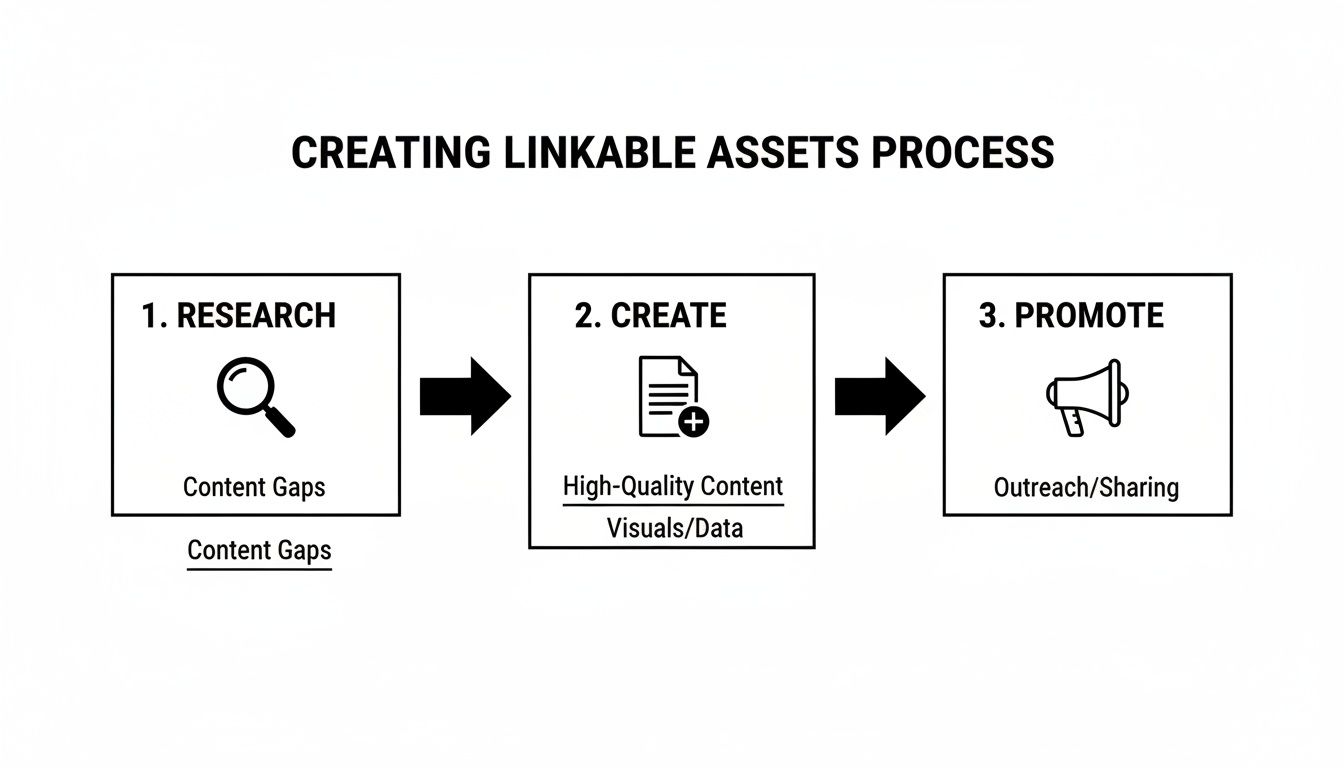
This flowchart visualizes the core engine: you start with deep research to find a real content gap, you create a genuinely valuable asset to fill that gap, and then you promote it with a story that reporters actually want to cover. It's a simple but powerful process that drives successful e-commerce link building campaigns.
A recent survey of SEO specialists highlights this shift perfectly. Projections for 2026 show 67.3% of experts name digital PR as the most effective link-building tactic, far surpassing guest posting. It’s no surprise, considering that only 8.5% of cold outreach emails actually result in a backlink.
This data underscores why strategic, story-driven approaches like digital PR have become the gold standard for earning high-quality links. By focusing on newsworthy angles and building real connections, even a small brand can earn placements in major publications. It's not about the size of your budget; it's about the quality of your ideas and the strength of your story.
Guest Posting On Sites Your Customers Actually Read
Guest posting still packs a serious punch for e-commerce link building, but only if you ditch the old, spammy playbook. The days of blasting out terrible articles to irrelevant blogs just for a link are over. Thank goodness.
Today, smart guest posting is about contributing genuine value to authoritative sites where your target customers are already hanging out. The goal isn't just a backlink; it's about establishing your brand as a trusted expert, driving high-quality referral traffic, and building real relationships in your niche. A single guest post on the right site can easily outperform dozens of links from junk directories.
Finding The Right Guest Post Opportunities
First things first, you need to identify blogs and online publications that are a perfect fit for your brand. You’re not just looking for any site with a "write for us" page; you're looking for the right sites. For example, if you sell high-end kitchenware, your target list should be packed with popular food blogs and home cooking magazines, not generic "lifestyle" sites.
You can dig up these golden opportunities with a few clever tactics:
- Advanced Google Searches: Use search operators to find sites actively looking for content. Try things like
your niche + "write for us",your niche + "guest post guidelines", oryour niche + "become a contributor". - Competitor Backlink Analysis: This is my favorite shortcut. Use a tool like Ahrefs or Semrush to see exactly where your successful competitors are landing guest posts. It’s one of the fastest ways to build a killer prospect list.
- Audience Overlap Tools: Some platforms can analyze a site's audience to see how well it aligns with your own. This is a great way to make sure you're getting your content in front of people who are likely to actually care about your products.
Don't rush this research phase. Pitching the wrong site is a waste of everyone's time and can make your brand look spammy.
Crafting a Pitch Editors Can't Ignore
Once you've got your list of dream sites, the real challenge begins: crafting a pitch that stands out. Editors at popular blogs get absolutely buried in guest post pitches every single day, and frankly, most of them are awful. A generic, copy-pasted email will get deleted before you can blink.
Your pitch has to be personal, concise, and focused on the value you're offering them. Show the editor you’ve actually read their blog and understand their audience. Instead of a vague offer to "write a great post," come prepared with three specific, compelling headlines that fill a content gap you've spotted on their site.
A great pitch isn't about what you want (a backlink). It's about what you can offer them (fantastic, well-researched content their audience will love). This simple shift in perspective makes all the difference.
For a deeper dive into pinpointing these valuable opportunities, you can explore our resources on finding a quality guest posting site.
Placing Your Links Naturally
Finally, let's talk about the link itself. The number one rule is that your link placement has to feel natural and genuinely helpful to the reader. Forcing a keyword-stuffed link to a product page where it doesn’t belong is a massive red flag for editors and Google alike.
Instead of trying to shoehorn in a commercial link, point to your informational content—those valuable linkable assets we talked about earlier.
- Bad Example: "…and for a great night's sleep, you should buy our premium memory foam mattress." This is just a blatant ad and adds zero value.
- Good Example: "…and understanding your sleep cycle is key. In fact, a study we published on the science of deep sleep found that…" This link points to a helpful resource and subtly establishes your authority.
This approach builds trust and earns you a much stronger, more contextually relevant backlink. By focusing on educating the reader, you end up with a link that truly supports your e-commerce link building efforts in a way that’s both sustainable and effective.
Finding Untapped Link Building Opportunities
While big-swing strategies like Digital PR get all the attention, some of the quickest and most satisfying wins in e-commerce link building come from opportunities hiding in plain sight. These tactics are less about launching massive new campaigns and more about smart observation and outreach.
Think of it as finding value where others aren't even looking. By uncovering broken links, reclaiming brand mentions, and tapping into existing partnerships, you can build a diverse and resilient backlink profile with a fraction of the effort of a full-blown content blitz. Honestly, these methods are perfect for grabbing high-quality links your competitors are probably sleeping on.
Master the Art of Broken Link Building
Broken link building is a classic for one simple reason—it just works. The concept is beautifully simple: you find a broken link (a 404 error) on a relevant, high-authority website and then offer your own content as the perfect replacement.
It’s a genuine win-win. You help the site owner fix a nagging problem on their site, and you walk away with a valuable backlink. For an e-commerce store, this is a brilliant way to get links pointing to your linkable assets, like those buyer's guides or in-depth resource pages you've created.
Imagine you sell hiking gear and find a popular outdoor blog linking to a defunct "Beginner's Guide to Hiking." Your own comprehensive guide is the perfect, ready-made substitute.
The process is straightforward:
- Find your targets: Look for authoritative blogs, resource pages, or news sites in your niche.
- Scan for broken links: Use a tool like the Ahrefs Broken Link Checker or a browser extension to crawl their site for dead outbound links.
- Find a perfect match: Pinpoint a broken link that once pointed to content very similar to a resource you already have.
- Reach out politely: Send a friendly email to the site owner, gently point out the broken link, and suggest your page as a helpful replacement.
This tactic is so effective because your email provides immediate value. You're not just asking for something; you're helping them improve their user experience.
Reclaim Your Unlinked Brand Mentions
If your brand has been around for any length of time, I guarantee people are talking about you online. Sometimes, they'll mention your brand or products in an article or blog post without actually linking back to your site. These are called unlinked brand mentions, and they are absolute gold.
Turning these mentions into links is often one of the easiest wins you can score. The author already knows and trusts your brand enough to mention it; you're just giving them a gentle nudge to make that mention clickable.
You can hunt for these using tools like Google Alerts or Brand24. Just set up alerts for your brand name, key product names, and even your CEO's name. When a new mention pops up, check if it's linked. If not, a friendly email to the author or editor is all it takes. Thank them for the mention and politely ask if they'd consider adding a link. You’ll be surprised how often they say yes.
Leverage Your Business Relationships
Your network of suppliers, partners, and distributors is a goldmine of high-quality backlinks that most businesses completely overlook. These are companies you already have a strong, established relationship with. A link from them is not only relevant but also carries a layer of trust that's nearly impossible to replicate with cold outreach. For a deeper look at various methods, our guide on how to find backlinks on Google offers some extra techniques.
Here are a few ways to turn those relationships into powerful links:
- Supplier & Manufacturer Links: Do you sell products made by other companies? Check their websites for a "Where to Buy" or "Stockists" page. If you're not on the list, a quick, friendly email is usually all it takes to get added.
- Testimonials: Offer to write a genuine, glowing testimonial for a tool or service you love using. Businesses adore featuring customer success stories on their homepages, and they will almost always link back to your site as a thank you.
- Collaborative Content: Team up with a complementary, non-competing brand to create a piece of content. For example, a coffee bean seller could co-author a "Perfect Brewing Guide" with a company that sells high-end coffee grinders.
Each link building approach has its own rhythm and payoff. Some are quick wins, while others are a longer-term investment in your site's authority.
Link Building Tactic Comparison
This table breaks down the common tactics to help you decide where to focus your energy based on your available resources and goals.
| Tactic | Effort Level | Typical Impact | Best For |
|---|---|---|---|
| Broken Link Building | Medium | Medium | Securing links to existing content on authoritative sites. |
| Unlinked Mentions | Low | Medium | Quick, easy wins for established brands with some online presence. |
| Relationship-Based | Low | High | Getting highly-relevant links from trusted partners and suppliers. |
| Guest Posting | High | High | Building authority and reaching new, targeted audiences. |
| Linkable Assets | High | Very High | Creating a long-term, sustainable engine for attracting top-tier links. |
Ultimately, a healthy link building strategy isn't about choosing just one of these tactics. It's about building a balanced portfolio of different link types, combining the quick, opportunistic wins with the slower, more deliberate authority-building campaigns.
Common E-Commerce Link Building Questions Answered
Look, let's be honest. Navigating the world of e-commerce link building can feel a bit like flying blind. It brings up a ton of questions, even for seasoned store owners, so it's completely normal to have concerns about where to start, what actually works, and how to know if you're making any progress.
This section is all about tackling the most common questions we hear, day in and day out. I'll give you clear, straightforward answers to help you build your strategy with confidence.
How Many Backlinks Do I Need to Rank?
This is the question everyone asks, but the honest answer is: it depends. There's no magic number of links that guarantees a top spot on Google. Instead of obsessing over quantity, your real goal should be to build a stronger, more relevant backlink profile than your direct competitors.
Start by doing some recon. Analyze the top-ranking pages for your target keywords and use an SEO tool to see how many referring domains they have. More importantly, look at the quality of those links. If the number one result has 50 high-quality links, your target is to get 51 or more of similar or better quality.
Your goal isn't a specific number; it's to be better than the competition. Focus on acquiring high-authority, contextually relevant links one by one, and you'll eventually surpass them.
What Is a Good Link for an E-Commerce Store?
A "good" link really boils down to two key things: relevance and authority.
- Relevance: The website linking to you should be in your niche or a closely related one. A link from a popular food blog to your kitchenware store? That's highly relevant and incredibly valuable. A link from some random, unrelated site is just noise.
- Authority: This is all about the trustworthiness and credibility of the linking site in the eyes of search engines. Links from well-known publications, respected industry blogs, or educational institutions carry some serious weight.
A link that nails both relevance and authority is the absolute gold standard for your e-commerce link building efforts.
How Long Does It Take to See Results?
Link building is a long-term strategy, not a quick fix. You need to think in terms of months, not days. It can take anywhere from three to twelve months to see significant movement in your rankings from a consistent link-building campaign.
How fast you see results depends on a few big factors:
- The competitiveness of your niche.
- The authority your domain has to begin with.
- The quality and velocity of the links you're building.
Patience and consistency are everything here. For e-commerce entrepreneurs in Kansas City and beyond, getting this right is critical. Without a solid link-building strategy, even the best-designed websites with amazing products can stay invisible to potential customers. The challenge gets real when you learn that more than 73% of marketers who do link building gain fewer than 10 links each month, which shows you just how competitive this is.
This reality check underscores the need for a steady, methodical approach. You can't expect overnight success.
Can I Just Buy Backlinks?
In a word: no. Buying backlinks is a direct violation of Google's webmaster guidelines and is a classic black-hat SEO tactic. Sure, it might give you a temporary boost, but the risks are massive.
If you get caught, you could face severe penalties, including a manual action that completely removes your site from the search results. It's just not worth the risk. Instead of buying links, invest those resources into creating the high-quality linkable assets we talked about earlier.
To learn more about building authority the right way, check out these proven, sustainable strategies on how to increase backlinks and boost your SEO. Focusing on earning links through real value and outreach will always deliver better, more lasting results. Building a strong, penalty-proof backlink profile is the only way to ensure long-term success.
At Website Services-Kansas City, we specialize in creating and executing SEO strategies that drive real growth for e-commerce businesses. If you're ready to build a powerful backlink profile that increases your visibility and sales, let's talk. Visit us at https://websiteservices.io to learn more.