
The SEO Skyscraper Technique isn't about just creating content; it's a specific, proven method for creating content that wins. At its core, the strategy is simple: find a competitor's content that's already ranking well and attracting links, create a version that is undeniably better, and then show it to the people who linked to the original.
You’re not just building another piece of content—you're building something "taller and better" than anything else out there to earn serious authority and traffic. For instance, a Kansas City marketing agency could use this technique to create the definitive guide to "local SEO for contractors," outranking weaker articles and capturing valuable leads.
Building Taller Than The Kansas City Skyline
Think about the downtown Kansas City skyline for a second. If you wanted to add a new building that gets noticed, you couldn't just build another one. You'd have to build something taller, more impressive, and with a better view than everything else around it. That’s the exact philosophy behind the SEO Skyscraper Technique.
It’s a powerful, three-part process that helps your business—whether you're a small boutique in Brookside or a creative agency in the Crossroads—outrank established players by creating the definitive resource on a topic.
The idea is straightforward but incredibly effective:
- Find Link-Worthy Content: First, you identify the best-performing content for your target keywords. You're looking for the current "tallest building" that's already earning links and attention.
- Create Something Way Better: Next, you create a piece of content that blows the original out of the water. This isn't just about adding more words; it’s about delivering more value with more depth, better design, fresher data, and more practical insights.
- Promote It to the Right People: Finally, you reach out to the right audience—specifically, the people who have already linked to that older, inferior content—and introduce them to your superior new resource.
This visual shows just how that simple but powerful flow works, breaking the process down into finding, creating, and promoting.
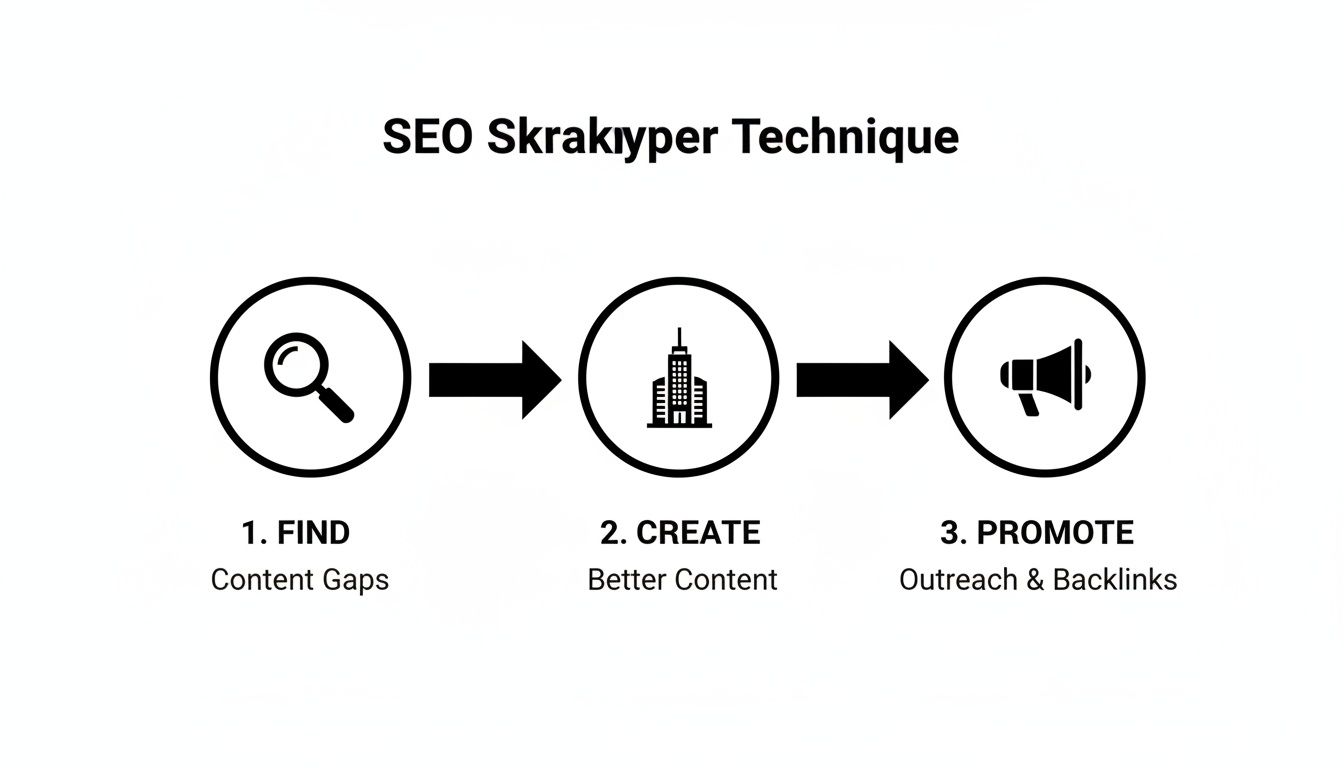
This focused approach helps you zero in on content with proven demand, dramatically increasing your odds of success right from the start.
To simplify the process, here's a quick breakdown of the core components.
The Skyscraper Technique Core Components At A Glance
This table offers a quick summary of the three fundamental stages of the Skyscraper Technique, making it easy to see how each phase contributes to the end goal.
| Phase | Objective | Key Action for Your Business |
|---|---|---|
| 1. Find | Identify proven, high-performing content with existing backlinks. | Use SEO tools to find competitor pages that rank for your target keywords and have a strong link profile. |
| 2. Create | Develop a resource that is significantly superior to the original. | Improve upon the original by making it more comprehensive, up-to-date, better designed, and more useful. |
| 3. Promote | Earn links by reaching out to the right audience. | Contact the webmasters who linked to the original content and pitch your superior resource as a replacement. |
By following this proven framework, you move from guessing what might work to strategically building content designed to win.
Why This Technique Drives Real Results
The power of this strategy is that it’s systematic. You’re not just guessing what might resonate with your audience; you're taking a proven formula and making it better.
When Brian Dean of Backlinko first pioneered this method, he saw a 110% increase in organic traffic to a single post in just 14 days. That article went on to rank #1 for its primary keyword, securing top-three positions for over 150 others and eventually earning over 17,600 backlinks.
The Skyscraper Technique transforms content creation from an art into a science. Instead of guessing what might attract links, you start with content that has a proven track record of earning them.
By using this approach, your goal is to create the single best, most definitive resource on a given topic. This not only attracts powerful new backlinks but also solidifies your brand's reputation as a true industry leader. For a deeper understanding of how these links build your site's authority, check out our guide on what is a backlink profile.
Ultimately, it’s about earning the high-authority backlinks that drive relevant organic traffic and establish your business as the go-to source in a crowded market.
Finding Your Blueprint For Link-Worthy Content
Every great skyscraper starts with a solid blueprint. In this first, critical phase of the SEO skyscraper technique, your job is to find competitor content that’s already successful but has some obvious, exploitable weaknesses. This isn't about reinventing the wheel; it's about finding a proven model and then engineering a much, much better one.
You're essentially hunting for pages with established authority—the ones already ranking on page one and pulling in backlinks—but which have clear cracks in their foundation. This approach immediately tells you there's demand for the topic, ensuring you invest your effort where it actually counts.

Pinpointing The Perfect Target
The goal here is to find content with a high ceiling for improvement. You’re looking for topics that already have a built-in audience and proven link-worthy appeal but are just… okay. The execution is lacking. Honestly, this is where meticulous research separates a winning campaign from a complete flop.
Actionable Example: Imagine you run a KC-based financial advisory firm. You search "retirement planning tips for millennials" and see the top articles are generic lists from national sites. This is your opportunity. You can create a guide specifically for Kansas City millennials, referencing local housing costs, state tax implications, and featuring quotes from local experts.
Your analysis needs to be a forensic audit. You're looking for specific vulnerabilities like:
- Outdated Information: The page cites statistics from five years ago or talks about tools that aren't even around anymore.
- Thin Explanations: The article gives you a list but fails to explain the "why" or "how" behind each point, leaving you with more questions than answers.
- Poor Design & User Experience: It’s a giant wall of text with no images, headings, or breathing room. It's a nightmare to read on a phone.
- Lack of Visuals: It’s missing original images, helpful infographics, or embedded videos that would make complex points easy to grasp.
These weaknesses are your entry points. Every single one is an opportunity to build a taller, stronger, and more valuable resource that both users and search engines will prefer. For a deeper dive into this initial process, our guide on how to conduct keyword research covers these foundational strategies.
Using SEO Tools to Uncover Opportunities
While you can spot some of this with a manual Google search, dedicated SEO tools like Semrush or Ahrefs are a total game-changer. These platforms let you reverse-engineer what's already working at scale. You can plug in a competitor's domain and instantly see their top-performing pages—not just by traffic, but more importantly, by the number of referring domains (backlinks).
A high number of referring domains is the signal you’re looking for. It means the topic is inherently "link-worthy," and other website owners have found it valuable enough to cite. That’s your green light. By analyzing the keyword volume and intent, you can confirm there’s a consistent, hungry audience for the topic you plan to improve.
Finding content with lots of backlinks but obvious flaws is the sweet spot. It proves the topic's value while giving you a clear roadmap for creating something superior. Your goal isn't just to be different; it's to be demonstrably better.
Once you have a list of potential targets, the final step is to qualify them. Choose the one where you can make the most significant improvements. Can you add original research? Create custom graphics? Provide a downloadable checklist that no one else has? The more value you can stack on, the greater your chances of successfully pulling off the Skyscraper Technique and claiming that top spot.
Building A Genuinely Superior Piece Of Content
Okay, you've found your target—that high-ranking but ultimately mediocre piece of content. Now comes the fun part. It's time to build your own version, and the goal isn't just to make it longer; it's to make it undeniably better.
Simply padding your word count is the single most common mistake people make with the Skyscraper Technique. True superiority comes from delivering more value, more depth, and more utility. You're aiming to create the definitive resource on the subject, a piece so thorough that your reader has zero reason to hit the back button.
This is where you take all the weaknesses you spotted in the original content and turn them into your greatest strengths.
Going Beyond Word Count To Add Real Value
Let's circle back to our Kansas City landscaping company. They found a top-ranking article on "low-maintenance garden ideas," but it was just a bland, uninspired list. To build a true skyscraper, they can't just create a longer list. They need to create a fundamentally more valuable experience for the reader.
Here’s a practical breakdown of how they could elevate a simple listicle into an authoritative guide:
- Original Data and Local Insights: Instead of generic advice, they could survey local gardeners about which plants actually survive our unpredictable Midwest weather. Presenting this as "Top 5 Drought-Resistant Plants According to 100 KC Gardeners" adds unique, hyper-local value that no one else has.
- Custom Graphics and Visuals: Forget boring stock photos. Using a free tool like Canva, they could design a custom infographic showing a planting calendar for our specific Zone 6 climate.
- Embedded Video Tutorials: A short, two-minute video tour of a beautiful, low-maintenance garden in a neighborhood like Brookside would be far more compelling than text alone. This adds a dynamic element that keeps people on the page longer.
- Actionable, Downloadable Resources: A simple one-page PDF, like "Your Spring Garden Prep Checklist," is an incredibly valuable bonus. It’s something people can print out and use, giving your content a life beyond the browser tab.
This multi-faceted approach transforms a basic blog post into an indispensable resource, making it far more "link-worthy" when you start your outreach. For more ideas on structuring your content, our guide on how to write website copy is packed with practical tips.
A Framework For Superior Content
The evidence backing this value-first approach is pretty compelling. A well-executed Skyscraper Technique continues to drive incredible results. One SaaS company saw a 36% increase in organic traffic each month by creating deeply improved content, eventually ranking for over 1,300 new keywords. Another firm watched their blog traffic explode from 600 to over 10,000 monthly visitors in just six months—a staggering 1,566% increase.
These results, highlighted in some impressive Skyscraper Technique case studies on seopital.co, prove that when you focus on genuine quality, the payoff is substantial.
To help you map out your own improvements, I've put together a table that shows the difference between a standard piece of content and a winning skyscraper asset.
How to Make Your Content Better Not Just Longer
Use this as a checklist to systematically audit your competitor's content and find clear opportunities to blow it out of the water.
| Content Element | Standard Approach (What to Beat) | Skyscraper Approach (How to Win) |
|---|---|---|
| Data & Statistics | Cites generic, outdated industry stats from years ago. | Includes original survey data, fresh statistics, and local expert quotes. |
| Visuals | Uses generic, uninspired stock photos that add little value. | Features custom infographics, high-quality original photography, or a video tutorial. |
| Depth & Detail | Provides a surface-level overview or a simple list of items. | Offers a deep dive into each point with actionable steps, examples, and expert insights. |
| Practical Utility | Gives the reader information but no tools to apply it. | Includes a downloadable checklist, a printable template, or an interactive calculator. |
| User Experience | A wall of text that is difficult to scan, especially on mobile. | Uses short paragraphs, subheadings, bullet points, and blockquotes for easy reading. |
By using this framework, you're not just guessing what "better" means; you're creating a concrete plan to deliver it.
The core principle of the Skyscraper Technique is not to be marginally better, but to be so overwhelmingly superior that anyone who sees your content immediately recognizes it as the best possible resource on the subject.
Ultimately, your goal is to create a piece of content that feels complete. It should anticipate and answer the reader's next questions, provide practical tools, and present information in a clear, engaging format. When you nail this, you’re not just building a taller skyscraper; you’re building a landmark.
Conducting Strategic Outreach To Earn Backlinks
You’ve poured hours into building a genuinely superior piece of content. It’s longer, more insightful, better designed, and packed with value. But here’s the hard truth: an incredible skyscraper is invisible if it’s built in the middle of nowhere.
Now comes the most crucial part of the SEO skyscraper technique: strategic outreach. This is where you proactively show your new asset to people who have the power to amplify its reach.
Publishing your article is only the halfway point. Without a focused promotion strategy, even the best content will fail to earn the backlinks needed to climb the search rankings. Your goal is to get your new masterpiece in front of the right eyeballs—specifically, the website owners, editors, and bloggers who have already linked to the inferior article you set out to beat.

Finding Your Prime Outreach Prospects
The first order of business is to build a hyper-targeted list of outreach prospects. This isn't a numbers game; it's a quality game. Your list should exclusively contain websites that have already linked to the content you improved upon.
Why? Because they've already demonstrated interest in the topic. They’ve proven they are willing to link to resources about it.
Here's the actionable process:
- Enter the URL of the competitor's article you targeted into a tool like Semrush or Ahrefs.
- Navigate to the "Backlink Analytics" or "Backlinks" report.
- Export the entire list of websites linking to that specific page into a spreadsheet.
- Manually review this list. Remove low-quality sites, forums, and directories. You want to focus on legitimate blogs, news sites, and resource pages.
This curated list is your treasure map. Now, you just need to show them something much better.
Once you have this list, your next task is to find the right contact person at each of these websites. This is often the most time-consuming part, but it’s non-negotiable for success. Look for a content manager, a blog editor, or the author of the specific article that contains the link. A critical part of strategic outreach is knowing precisely how to find anyone's email address to ensure your meticulously crafted message reaches the intended recipient.
Crafting Emails That Actually Get Opened
Mass, generic emails are the fastest way to get your outreach campaign ignored. Personalization is everything. Your email should feel like it was written by a human, for a human.
The goal is to frame your request as a helpful suggestion that benefits their audience, not a self-serving demand.
A successful outreach email has a clear, concise structure:
- A Personalized Opening: Reference a specific article they wrote or something you genuinely appreciate about their work.
- The Reason for Your Email: Gently point out that you noticed they linked to a particular resource.
- The Value Proposition: Introduce your superior content and briefly highlight why it's better (e.g., "It includes updated 2024 data and a downloadable checklist").
- The Soft Ask: Politely suggest that it might be a valuable addition or replacement for their readers.
Your outreach shouldn’t feel like a transaction. It should feel like a contribution. You’re offering a genuine upgrade to improve their content and provide more value to their audience.
Customizable Outreach Templates That Work
While you should personalize every single email, starting with a proven structure helps. Here are a few scripts you can adapt based on who you're contacting.
Template 1 For a Blogger with an Outdated Link
Subject: Quick question about your post on [Topic]
Hi [Name],
I was searching for some info on [Topic] today and came across your excellent article: [Title of Their Article].
I noticed you linked to [Old Article Title]. I just published a more current guide on the same topic that includes [Unique Feature 1, e.g., original survey data] and [Unique Feature 2, e.g., a video tutorial].
It might be a great resource to share with your audience. You can check it out here: [Link to Your Skyscraper Content]
Either way, keep up the great work!
Best,
[Your Name]
Template 2 For a Journalist Who Covers Your Industry
Subject: A new resource for your [Industry] coverage
Hi [Name],
I’ve been following your coverage of the [Industry] space for a while now, and I particularly enjoyed your recent piece on [Their Recent Article].
I saw that you've previously referenced resources on [Topic]. My team just put together a comprehensive guide that explores this from a new angle, including interviews with three local experts.
It could be a useful data point for your future reporting. Here’s the link if you’d like to take a look: [Link to Your Skyscraper Content]
Thanks for your time and all the great work you do.
Regards,
[Your Name]
This strategic approach is a fundamental component of any modern https://websiteservices.io/link-acquisition-strategy/, as it focuses on earning high-quality, relevant links that drive real SEO value.
Right, your skyscraper content is officially live and you’ve started reaching out to your prospect list. Now what?
It’s time to make sure Google can actually find, crawl, and fall in love with all the hard work you’ve put in. This next phase is all about the on-page and technical tweaks that turn a great piece of writing into a high-ranking machine.
Think of it this way: even the most incredible article can get lost in the digital noise without a solid technical foundation. These next steps are crucial for showing search engines what your content is about, why it's valuable, and giving it the best shot at climbing the search results.
Nailing Your On-Page SEO With WordPress
If you’re on WordPress, this part is incredibly easy thanks to some fantastic SEO plugins. Tools like Rank Math or Yoast make managing all the critical on-page elements a breeze, right from your post editor.
Your first job is to craft a killer title tag and meta description. These aren't just for Google; they're your sales pitch in the search results. A compelling title and meta can dramatically boost your click-through rate (CTR), which is a huge signal to Google that your content is hitting the mark.
Here’s a look at the Rank Math interface, where you can easily edit these elements and see a live preview of how they’ll appear on Google.
This preview is gold. It helps you write something that’s both persuasive and fits within the character limits, so your message doesn't get awkwardly cut off.
Crafting A Clean And Optimized URL
Before you even think about hitting that publish button, take a second to look at your URL. A clean, keyword-focused URL is a small but surprisingly important ranking signal that helps both people and search engines understand what the page is about at a glance.
A messy URL might look something like this:yourdomain.com/2024/10/blog-post-final-v2-about-seo
A much cleaner, optimized version is simple and direct:yourdomain.com/seo-skyscraper-technique
Keep it short, descriptive, and stick your main keyword in there. This simple tweak improves readability and gives a clear signal about your content's topic from the get-go.
The Power Of Strategic Internal Linking
Internal linking is probably the most underrated part of on-page SEO. Your brand-new skyscraper article can't just be an island. You need to strategically link to it from other relevant pages on your site, and also link from it to other useful resources you've created.
Internal linking acts like a web, distributing authority and relevance throughout your entire website. When you link from an older, authoritative page to your new skyscraper content, you're essentially telling Google, "Hey, this new page is important, too."
This does a few critical things for you:
- Spreads "Link Juice": It channels authority from your established pages over to your new one.
- Improves Crawlability: It helps search engine bots discover and index your new content much faster.
- Boosts User Engagement: It guides visitors to other relevant info, keeping them on your site longer.
For a deeper dive into these concepts, check out our detailed guide on what is on-page optimization.
Don't Forget Essential Technical Elements
Finally, a few technical checks can make or break your content's performance. It doesn’t matter how amazing your article is—if the page is slow or looks terrible on a phone, people will leave, and your rankings will pay the price.
Make sure your skyscraper page is:
- Mobile-Friendly: Over 60% of all web traffic now comes from mobile devices. Your page has to be fully responsive and easy to use on a small screen. No excuses.
- Fast-Loading: Use a tool like Google's PageSpeed Insights to check your load time. A slow page leads to a high bounce rate, which Google sees as a major negative signal. Compressing your images and using browser caching are two easy wins here.
- Using Schema Markup: Adding schema (or structured data) can help you earn rich snippets in the search results, like FAQ sections or review stars. This makes your listing pop and can seriously boost your CTR.
Is The Juice Worth The Squeeze? How to Measure Your Results
Let's be real: pulling off the Skyscraper Technique is a serious investment of time, money, and creative energy. You can't just throw it out there and hope for the best. Measuring its success is non-negotiable.
Once your masterpiece is live and you've kicked off your outreach, your job shifts from creator to analyst. We're not just talking about watching the traffic meter go up. It's about digging into the KPIs that tell you if this whole effort is actually paying off.
The big three you need to obsess over are organic traffic growth, new keyword rankings, and, of course, the grand prize: new backlinks. Tools like Google Analytics and Semrush are your best friends here. In Analytics, you can isolate traffic specifically to your new skyscraper page to see its direct impact. Meanwhile, Semrush’s position tracking will give you the early good news, showing you which new keywords your asset is starting to climb the ranks for.

Why So Many Skyscraper Attempts Fall Flat Today
It’s important to go into this with your eyes wide open. The Skyscraper Technique isn't the magic bullet it once was, and a lot of attempts fail in today's hyper-competitive world. The number one reason? A fundamental misunderstanding of what "better" content actually means to search engines right now.
A few years ago, "better" was often just a synonym for "longer." Today, that's a one-way ticket to failure. Google’s algorithms have gotten way smarter, prioritizing user intent, deep expertise, and overall content quality far above a simple word count.
A common pitfall is creating a longer article that doesn't actually provide more value. If your content is just a rehash of existing points with added fluff, it won't resonate with users or earn the high-quality links necessary for success.
True superiority now comes from offering unique insights, publishing original data, creating better visuals, and delivering a more intuitive user experience.
Adapting The Technique For Modern SEO
Today's digital world demands a much more sophisticated approach. While the Skyscraper Technique was once famous for quick wins, its success rates have changed dramatically.
While 61% of SEOs still believe in its potential, the practical success rate for campaigns that don't go all-in on quality has cratered to as low as 1-3%. This drop is a direct result of market saturation and Google’s smarter algorithm. But here’s the good news: well-executed campaigns still see success rates between 30-36%, proving that it's the quality of the implementation that separates the winners from the losers. You can discover more insights about these Skyscraper Technique statistics on searchengineland.com.
This gap highlights a critical truth: success with this strategy is absolutely still achievable, but it requires patience and a genuine commitment to creating the best possible resource on the web. Meaningful results now take longer to show up, typically materializing somewhere between months four and six.
Ultimately, your success hinges on a relentless focus on quality and a deep understanding of what your audience truly needs. The commitment to high-quality execution isn't just a best practice; it's the only way to make the seo skyscraper technique work in the long run.
Got Questions? We've Got Answers
Even with a solid game plan, diving into the Skyscraper Technique can bring up a few questions. It's totally normal. Let's tackle some of the most common ones I hear from Kansas City businesses.
How Much Better Does My Content Really Need to Be?
Your content can't just be a little bit better; it needs to be undeniably superior. We're not talking about just adding a few hundred more words. The goal is to create what's known as "10x content"—something that's ten times more valuable than whatever is currently ranking.
This means you need to bring something new to the table. Think unique insights from your own experience, fresh data from a survey you ran, custom-made visuals like infographics, or genuinely useful resources like a downloadable checklist.
The goal is to create a resource so comprehensive and valuable that anyone who finds it immediately recognizes it as the definitive answer on the topic. Simply adding more words without substance is a common mistake that leads to failure.
How Long Until I Start Seeing Results?
Patience is the name of the game here. While some of the early case studies on this technique showed lightning-fast results, the modern playing field is a lot more crowded. For a well-executed campaign, you can typically expect to see meaningful results—like better rankings and a real uptick in traffic—within four to six months.
This timeline gives you enough room for creating truly great content, doing thoughtful outreach, and allowing search engines the time to recognize the authority and value of your new skyscraper asset.
Can This Technique Actually Work for a Local Business?
Absolutely. In fact, it can be a local business's secret weapon for dominating the competition right here in Kansas City. A local landscaping company, for example, can use this exact strategy to own local search results.
The key is to skip the broad, national keywords and zero in on topics with strong local intent. Instead of "best garden plants," you'd target something like "best native plants for Kansas City gardens."
By weaving in local data, quotes from area experts, and maybe even a few local case studies, you create a resource that's uniquely valuable to your specific market. This makes it far easier to earn powerful links from other local blogs, news sites, and business websites.
Ready to build a content strategy that towers over your competition? Website Services-Kansas City specializes in creating and executing powerful SEO strategies, including the Skyscraper Technique, to drive real growth. Let's build your skyscraper together.
