
Promoting a new website really comes down to a two-part game plan: first, build a flawless technical foundation before you launch, and then hit the ground running with a strategic, multi-channel marketing plan from day one. If you get that first part right, everything that comes after becomes significantly easier and more effective.
Building a Bulletproof Pre-Launch Foundation
Before your website even sees the light of day, the groundwork you lay is the single biggest factor in its future success. A beautiful design is completely useless if Google can’t find, crawl, and understand your content. This pre-launch phase is all about building a technically sound launchpad that search engines will love from the very first day.
Think of this early stage as the first crucial step in a much larger journey of learning how to grow your online business. Nail this, and you're already ahead of the curve.
Mastering Your Technical SEO Setup
Think of technical SEO as the plumbing and wiring of your house. It all has to be perfect before you even think about picking out paint colors. For anyone on WordPress, a plugin like Rank Math makes this a lot less painful, but the core principles apply no matter what platform you're using.
Your first job is to make sure search engines can easily find all your important pages. This is where an XML sitemap comes in—it’s basically a roadmap you hand over to Google's crawlers.
Actionable Insight: Once your sitemap is generated (e.g., yourdomain.com/sitemap_index.xml), log in to Google Search Console, navigate to 'Sitemaps' on the left menu, and submit that URL. This directly tells Google, "Here's my map, please index my site."
Next up is your URL structure. Clean, descriptive URLs are way better for both users and search engines. Instead of a messy, meaningless URL like yourdomain.com/?p=123, you want a clean structure like yourdomain.com/services/kansas-city-seo. It immediately tells Google and your visitors what the page is about.
Actionable Insight: In your WordPress dashboard, go to Settings > Permalinks and select "Post name." It's a one-click fix that pays long-term SEO dividends.
Optimizing On-Page Elements for Impact
With the technical nuts and bolts tightened, it's time to refine the on-page elements that both search engines and human users see first. We're talking about your SEO titles and meta descriptions—the stuff that shows up directly in the search results.
- SEO Titles: This is your main headline on the Google results page. It needs to be compelling, stay under 60 characters, and include your primary keyword. For example: "Expert WordPress SEO Services in Kansas City | Website Services".
- Meta Descriptions: This is the short blurb of text under the title in the search results. While it’s not a direct ranking factor, a well-written meta description (around 155 characters) is your mini-advertisement that convinces people to click.
Actionable Insight: Include a call-to-action or unique selling proposition. Instead of just describing the page, try something like: "Boost your local rankings with our proven KC SEO strategies. Get a free analysis today and see how we drive results."
A classic rookie mistake is launching a site with default or placeholder text like "Just another WordPress site." Taking the time to craft unique, optimized titles and descriptions for each of your core pages gives you a massive advantage right out of the gate.
Setting Up Essential Analytics and Tracking
You can't improve what you don't measure. Before you even think about hitting that launch button, setting up Google Analytics (GA4) and Google Search Console is completely non-negotiable.
Imagine launching a beautiful new website for your Kansas City business, only to join the 90.63% of pages that get zero organic traffic from Google. That stark statistic from Ahrefs is a brutal reminder: without a plan, you're invisible. This is why you have to prioritize SEO from day one, using tools like Semrush and Rank Math to get an edge.
GA4 will show you how people actually interact with your site, while Search Console gives you priceless data on how Google sees it—everything from keyword performance and indexing problems to your backlink profile. Connecting these tools before launch ensures you capture every piece of data from your very first visitor. This is the intel you'll need to refine your promotion strategy down the road. And if you're truly at square one, our guide on what to do after buying a domain can help make sure you've covered all the bases.
Before we move on to launch day, here's a quick checklist that summarizes these critical pre-launch SEO tasks. Getting these right is not optional if you want to start on the right foot.
Essential Pre-Launch SEO Checklist
This table breaks down the non-negotiable technical and on-page SEO tasks you absolutely must complete before your new website goes live.
| Task Area | Key Action | Tool/Plugin | Why It Matters |
|---|---|---|---|
| Indexing & Crawlability | Generate & submit an XML sitemap. | Rank Math | Gives Google a clear roadmap to find and index all your important content. |
| URL Structure | Set permalinks to "Post name" or a custom, keyword-rich structure. | WordPress | Creates clean, readable URLs that improve user experience and SEO. |
| On-Page SEO | Write unique SEO titles & meta descriptions for core pages. | Rank Math | Boosts click-through rates from search results by acting as a mini-ad. |
| Analytics & Tracking | Install GA4 & verify your site with Google Search Console. | Allows you to track user behavior and monitor search performance from day one. |
Completing this checklist ensures your website doesn't just look good, but is also primed for visibility in search engines from the moment you go live.
Executing a High-Impact Launch Day Campaign
You’ve got a rock-solid technical foundation. Now it’s time to make some noise. Just flipping the switch and hoping people show up is a recipe for a whole lot of nothing. Launch day requires a coordinated, multi-channel push to create an immediate wave of traffic, buzz, and social proof.
This isn’t just about putting out a press release saying, "We exist!" It's about orchestrating a strategic campaign across email, social media, and even local PR. The goal is to funnel your first, most enthusiastic visitors to your most important content and start building momentum from the first hour.
Crafting Your Social Media Blitz
Your social media channels are your lowest-hanging fruit for instant traffic. But don’t just post once and call it a day. Think of your launch as a mini-event that unfolds throughout the day, creating multiple touchpoints to catch people's attention without being spammy.
A great social launch needs more than just a link; it needs visuals that stop the scroll and tell a quick story.
- Morning Kick-off (9 AM): This is your big announcement. Use a sharp graphic or, even better, a short video showcasing the new site. The message should be celebratory and crystal clear about the problem your new website solves for your audience.
- Midday Feature (1 PM): Shine a spotlight on a specific piece of cornerstone content, like that definitive guide you poured weeks into. Frame it as "the single most valuable post on our new site" to drive clicks directly to your best work.
- Late Afternoon Engagement (4 PM): Shift gears and ask a question to spark a conversation. If you’re a Kansas City marketing agency, you could ask, "What's the biggest online challenge KC small businesses are facing right now?" This moves the focus from you to your community.
Actionable Insight: Use a free tool like Canva to create 3-5 different visual assets (square for Instagram/Facebook, vertical for Stories). Pre-schedule these posts using a tool like Buffer or Hootsuite to ensure your launch-day messaging goes out on time without you having to manually post everything.
The Power of a Targeted Email Announcement
If you have an email list—even a small one—it's your most powerful asset on launch day. These are people who have already raised their hands to hear from you. Your launch email needs to do more than just inform; it has to inspire action and make your subscribers feel like insiders.
Your launch email's subject line is 80% of the battle. Ditch generic phrases like "Our New Website is Live." Go for something benefit-driven and intriguing, like "Your new [Your Niche] resource is here" or "A fresh look and new tools for you."
Keep the email itself concise. Briefly explain why you built the new site and what's in it for them. Highlight one or two key features or pieces of content, and use a clear, bold call-to-action button that sends them to the homepage or a pillar article. For a deeper dive into the whole launch process, our complete guide on how to launch a new website offers more templates and strategies.
Securing Local Media Attention
For a local business, a little local PR can be a game-changer. Journalists at city magazines, local news blogs, and business journals are often on the hunt for stories about new and growing local companies. Pitching them directly can land you invaluable exposure and a powerful backlink.
Your pitch needs to be short, direct, and focused on what makes your business newsworthy from a local angle.
Sample Press Release Pitch Template for a Kansas City Business
Subject: New [Your Industry] Website Launches to Help Kansas City Businesses Thrive
Hi [Journalist's Name],
My name is [Your Name], founder of [Your Company], a new business based right here in Kansas City.
I'm reaching out because we just launched [YourWebsite.com], a new online resource specifically designed to help [Your Target Audience in KC] solve [Specific Problem]. For example, our flagship guide shows local small business owners how to [Achieve a Specific Benefit].
Given your focus on [Mention Their Publication's Focus, e.g., 'the KC tech scene' or 'local entrepreneurship'], I thought our story might be a great fit for your readers.
Would you be open to a brief chat next week?
Thanks for your time,
[Your Name]
[Your Website]
Building Authority in Your First 30 Days
The first month after your website goes live isn't about hitting massive traffic numbers. Forget that for now. This is your window to prove your value, build momentum, and send all the right signals to search engines like Google.
Your mission for these first 30 days is simple: create some high-impact content and start building an early, engaged community. This is where you shift from a one-off launch campaign to a sustainable growth strategy, laying the foundation for everything that comes next.
Developing Your First Pillar Content
Forget about trying to pump out a dozen short, generic blog posts. In your first month, your time is far better spent creating one or two massive "pillar" articles.
A pillar article is a deep-dive, comprehensive guide that covers a core topic in your industry from top to bottom. It's the kind of resource people bookmark, share, and link back to because it’s just that good.
For a new website, these articles pull double duty. They target important search terms and instantly show both users and Google that your site is a serious, authoritative resource. A new web design firm in Kansas City, for instance, might create a monster post titled "The Ultimate Guide to Local SEO for Kansas City Small Businesses."
Your first pillar post shouldn't just be long; it needs to be the best resource on the internet for that specific topic. Aim to create something more thorough, better organized, and more actionable than what's currently ranking on page one.
Tools like Semrush or Ahrefs are your best friends here. Use their keyword research features to find the questions your audience is actually asking. Look for phrases with decent search volume but relatively low keyword difficulty—that's the sweet spot for gaining early traction.
A Natural Approach to Backlink Outreach
With your pillar content live, it's time to start earning those first backlinks. Backlinks are basically votes of confidence from other websites, and they are a massive factor in how Google ranks you.
But blasting out hundreds of generic "link to my site" emails is a fast track to getting ignored and marked as spam. It just doesn't work.
Instead, you need a value-first outreach strategy. The goal isn't just to ask for a link but to build a real connection by offering something genuinely useful first. This simple shift completely changes the dynamic of your request.
The Value-First Outreach Process
- Identify Relevant Blogs: Use Google searches like "[Your Niche] blogs" or "[Your Niche] + 'guest post'" to find non-competing websites that talk to a similar audience. Make a list of 20-30 potential targets.
- Find a Relevant Connection: Read a few of their recent articles. Look for a post where your pillar content would add real, significant value to their readers. Maybe they briefly mention a topic that your guide explains in exhaustive detail.
- Craft a Personalized Email: This is the most critical step. Your email has to prove you've actually read their stuff and aren't just sending a template you found online.
Crafting the Perfect Outreach Email
Your outreach email needs to be short, personal, and focused on providing value. Ditch the overly formal language and get straight to the point.
Here's a simple structure that I've seen work time and time again:
- Personalized Opening: Mention a specific article of theirs you enjoyed. Be genuine about it.
- The Value Proposition: Briefly introduce your resource and explain exactly how it complements their existing content. Frame it as something that will make their article even more helpful for their audience.
- The Soft Ask: Instead of demanding a link, just suggest they check it out to see if it would be a good fit for their readers. It’s a much lower-pressure approach that feels collaborative.
Actionable Insight: Use a template like this: "Hi [Name], I loved your article on [Their Article Topic]. Your point about [Specific Detail] was spot on. I noticed you briefly mentioned [Related Topic], so I thought your readers might find our in-depth guide on [Your Pillar Content Topic] useful. It covers [Specific Benefit 1] and [Specific Benefit 2]. No pressure, but thought it could be a great resource to mention. Either way, keep up the great work!"
This method feels less like a transaction and more like a helpful suggestion from a peer. Not only does it boost your chances of getting that link, but it also helps you build real relationships in your industry.
For those looking to scale these efforts, learning more about how to identify a quality guest posting site can really refine your strategy. By focusing on quality content and genuine outreach in your first 30 days, you’re not just promoting a website; you’re building an asset that will pay off for years to come.
Scaling Up: Your 31-90 Day Growth Plan
Alright, you’ve made it through the first month. The initial launch chaos is behind you, and you've laid a solid groundwork. Now, from day 31 to 90, we shift gears from setup to scale-up.
The buzz from launch day has faded, and that's a good thing. It means we can stop guessing and start making smart, data-driven decisions. This phase is all about taking what we've learned and pouring gas on the fire. We'll introduce some smart paid ads, double down on our winning content, and seriously ramp up our local SEO game.
It’s time to turn that early trickle of traffic into a steady, reliable river.
Launching Your First Smart Paid Ad Campaign
I know, I know—organic SEO is the long game we’re all playing. But a small, strategic paid ad campaign is the perfect shortcut to getting immediate, targeted traffic and, more importantly, priceless data.
Consider this: Google's search engine market share hovers around 91%, making it the undeniable king of intent-driven traffic. For a new website, a tiny paid campaign isn't an expense; it’s an investment in rapid learning.
But please, don't make the rookie mistake of trying to compete for broad, expensive keywords like "Kansas City marketing." Your budget will vanish before you even get a single click. Instead, we’re going to get surgical by focusing on long-tail keywords—those longer, more specific phrases that signal someone is ready to buy.
- Bad Keyword: "SEO services" (Hyper-competitive, low intent)
- Good Keyword: "affordable SEO for KC plumbers" (Way less competitive, sky-high intent)
A small business owner typing in that second phrase is practically holding their credit card. Your first Google Ads campaign should target just a handful of these high-intent phrases with a modest budget, maybe just $10-$20 a day. The goal isn't to get thousands of clicks. It's to get the right clicks and discover which search terms actually convert into leads.
Think of your first ad campaign as paid research. You're paying for immediate feedback on your messaging and landing pages—feedback that could take months to get from organic SEO alone.
Supercharging Your Local SEO for Kansas City
For any local business, your Google Business Profile (GBP) is your single most valuable piece of digital real estate. In this 31-90 day window, we move beyond the basic setup and turn it into a machine that captures all those valuable "near me" searches.
Your number one priority should be generating a steady stream of positive reviews. Actively ask every single happy customer for a review. Make it easy for them. Send a direct link to your GBP review page via email or text right after you’ve finished a job or made a sale.
Beyond reviews, start using GBP Posts to keep your profile fresh and active. These are like mini-blog posts that show up right on your profile in the search results, and they’re incredibly powerful.
Actionable GBP Post Ideas for a KC Business
- Spotlight a Local Project: Post a few photos and a quick story about a recent job you did in a specific neighborhood like Brookside or the Crossroads.
- Announce a Local Event: Are you sponsoring a Little League team or setting up a booth at a community fair? Post about it!
- Offer a Location-Specific Discount: Create a special deal just for customers in a certain part of Kansas City.
These posts signal to Google that you're an active, engaged local business, which directly helps your visibility in local search and on Google Maps.
Using Data to Find and Promote Your Winners
By now, Google Analytics and Search Console have started collecting some juicy data. It’s time to put on your detective hat and dig in to find your "winning" pages—the content that's already getting traction without much help.
First, jump into Google Search Console and head to the "Performance" report. Look for pages that are getting a lot of impressions but have a low click-through rate (CTR). This is a golden opportunity. It means your page is showing up in search, but the title and meta description aren't compelling enough to earn the click. A quick rewrite of those elements can give you an easy traffic boost.
Next, pop over to Google Analytics 4. Check your "Pages and screens" report to see which articles have the highest user engagement. These are your proven assets. Your job now is to double down. Push these winning articles out again on social media, feature them in your next email newsletter, and find new opportunities to build internal links to them from other pages on your site.
This process reinforces their importance to both users and search engines. For more ideas on building a sustainable plan, check out our in-depth guide on how to create a content strategy that drives real growth.
Now that we've broken down the key activities for this phase, let's pull it all together. The table below gives you a high-level snapshot of how the entire 30-60-90 day plan comes together, showing how each period builds on the last.
30-60-90 Day Promotion Plan at a Glance
This table provides a high-level overview comparing the primary focus, key activities, and success metrics for each phase of your initial promotion.
| Timeframe | Primary Focus | Key Activities | Success Metric |
|---|---|---|---|
| Days 1-30 | Foundation & Setup | Technical SEO audit, content creation, social profile setup, initial outreach. | Website indexed, initial keyword rankings, first backlinks. |
| Days 31-60 | Data-Driven Scaling | Smart paid ads, local SEO optimization (GBP), promoting winning content. | Positive ROI on ad spend, increased local visibility, higher CTR. |
| Days 61-90 | Expansion & Authority | Guest blogging, PR outreach, refining conversion paths, analyzing competitor gaps. | Links from authoritative sites, improved conversion rates. |
As you can see, the plan is designed to be cumulative. The foundational work in the first month enables the data-driven scaling in the second, which in turn sets you up for the authority-building and expansion efforts in the third. It's a strategic progression from setup to sustainable growth.
Measuring Performance and Knowing When to Hire an Expert
Launching a new website without tracking your performance is like flying blind. You’re putting in all this work, but you have no real idea if you’re moving in the right direction, let alone what’s actually working. This is the point where you shift from just doing things to making smart, data-backed decisions that actually move the needle.
The two tools you absolutely need to get comfortable with are Google Analytics 4 (GA4) and Google Search Console. They’re free, incredibly powerful, and together they tell you pretty much everything you need to know. Think of them as the command center for your website's growth.
Demystifying Your Key Performance Metrics
The first time you log into GA4, it can feel like a bit much. My advice? Ignore the dozens of reports for now. You only need to focus on a few key metrics that tell the clearest story about your traffic and what people do once they arrive.
- Traffic Acquisition Report: This is your home base. It shows you exactly where your visitors are coming from—organic search, social media, direct visits, or paid campaigns. If you're spending hours on social media but see 90% of your traffic is coming from organic search, that’s a huge clue about where your efforts are paying off.
- Engagement Rate: This metric is far more useful than the old "bounce rate." It tells you the percentage of sessions where a visitor stuck around for more than 10 seconds, triggered a conversion, or looked at more than one page. A high engagement rate is a great sign that your content is hitting the mark.
- Conversions (Goal Completions): This is the ultimate measure of success. A "conversion" is whatever you decide is a win for your business—a contact form getting filled out, a newsletter signup, or a product purchase. Tracking these tells you if your promotional work is attracting the right kind of visitor.
At the same time, Google Search Console gives you a direct line to your search performance. You’ll want to live in the "Performance" report. It shows you which keywords are driving impressions and clicks, plus your average click-through rate (CTR). This is gold for refining your SEO and content strategy. If you need a more detailed walkthrough, our guide on how to track website traffic provides a deeper dive into these essential tools.
The timeline below gives you a visual for how these efforts should build on each other, moving from the initial launch push to sustained growth over the first 90 days.
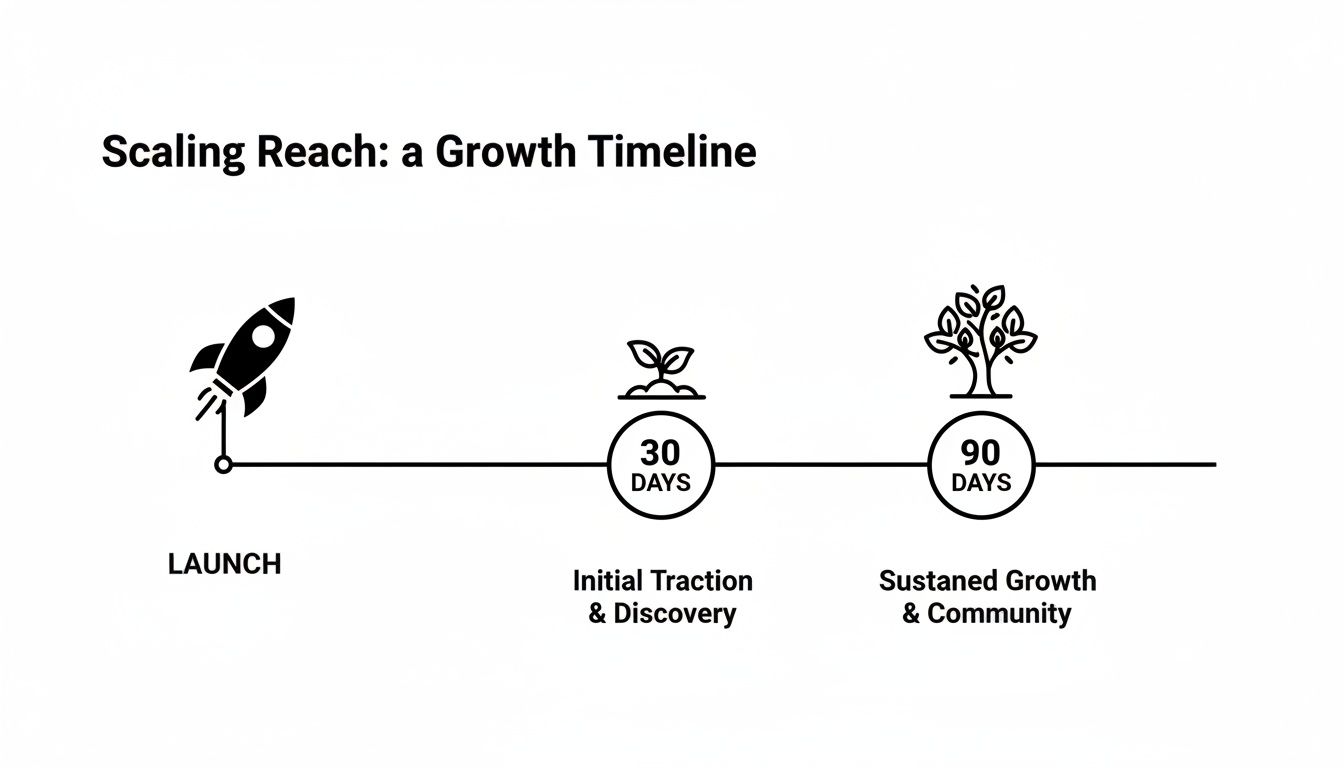
This just reinforces that promotion isn't a one-and-done event. It's a phased process of building, nurturing, and scaling your website's reach over time.
Knowing When to Call in a Professional
At some point, you’re going to hit a wall. Maybe your traffic has plateaued, you aren't getting the leads you need, or you’ve simply run out of hours in the day. This is that critical moment when hiring an expert, like a Kansas City SEO agency, becomes a strategic investment rather than just another expense.
Don't view hiring an expert as admitting defeat. See it as bringing in a specialist to accelerate your growth, just like you would hire an accountant to handle your finances so you can focus on running your business.
So, what are the clear warning signs that it’s time to make that call?
- Your traffic has been flat or declining for months. Despite all your efforts, you can't seem to gain traction. An expert can run a deep audit to find the technical issues or strategic gaps you're likely missing.
- You're ranking for keywords, but they aren't the right keywords. Getting traffic is one thing; getting traffic that actually converts is a whole different ballgame. If your visitors aren't turning into customers, you probably have a targeting problem.
- You simply don’t have the time. SEO and digital promotion are full-time jobs. If you’re spending more time trying to figure out SEO than running your actual business, your return on investment is already in the negative.
Hiring an agency isn't just about outsourcing a to-do list. It’s about getting access to advanced tools, years of experience, and a proven strategy that can dramatically shorten your path to getting real results.
Got Questions About Promoting a New Website?
Navigating the world of website promotion can feel a little overwhelming, especially when you're just starting out. It's totally normal. Most new site owners run into the same hurdles and ask the same questions, so let's tackle a few of the big ones right now.
How Long Does It Take for a New Website to Rank on Google?
This is the million-dollar question, and the honest answer is: it depends. Generally speaking, you can expect it to take anywhere from 3 to 6 months for a brand-new website to start showing up and getting some initial traction for less competitive keywords.
Several things can speed this up or slow it down:
- Your Niche: Trying to rank for "Kansas City dog walkers" is going to happen a lot faster than trying to rank for "best credit cards." The competition level matters, a lot.
- Your SEO Efforts: Consistent, high-quality SEO work from day one makes a huge difference. If you treat it as an afterthought, you're just extending the timeline.
- Content & Promotion: How often you publish genuinely useful content and your efforts to get other sites to link back to you are massive factors.
The bottom line is that patience and persistence are non-negotiable. Google needs time to crawl, index, and ultimately trust your new site. Keep your head down, do good work consistently, and the results will follow.
What's the Best Way to Promote a New Local Business Website?
For any local business, the most powerful first move you can make is to completely own your local search results. Your number one goal should be to become the obvious choice for customers right in your neighborhood.
Start with your Google Business Profile (GBP). This is your digital storefront on Google Search and Maps, and it's completely free. Fill out every single section with high-quality photos, detailed service descriptions, accurate business hours, and a local phone number.
Next, make it a habit to ask for customer reviews. Positive reviews are one of the strongest local ranking signals there is. From there, start creating content that targets location-specific keywords, like "emergency plumbing services in Brookside, KC." This one-two punch builds immense local authority and makes it incredibly easy for nearby customers to find you the moment they need you.
Should I Focus on SEO or Paid Ads First for My New Website?
The best strategy is a smart blend of both, but your long-term priority should always be SEO. Think of SEO as building a valuable asset; it generates sustainable, "free" traffic over time but has a slow start.
Paid ads, on the other hand, are like renting a billboard on the highway. They deliver immediate traffic and are perfect for testing your offers, messaging, and landing pages right out of the gate. This lets you gather valuable conversion data fast.
For a new website, a practical approach is to carve out a small budget for highly targeted paid ads at the very beginning. This will drive your first wave of visitors and potential customers while your organic SEO efforts are still warming up. As your organic traffic starts to grow over the first few months, you can gradually dial back your ad spend, letting your strong SEO foundation carry the load.
Ready to stop guessing and start growing? The experts at Website Services-Kansas City can build a strategic promotion plan that gets your new website the attention it deserves. Learn more about our SEO and web development services.
