
The Skyscraper SEO Technique is a powerhouse strategy for earning the kind of backlinks that genuinely move the needle on your search rankings. It boils down to a smart, three-part process: find popular content that's already attracting links, create a version that's worlds better, and then reach out to the right people to show it off.
What Is the Skyscraper SEO Technique
At its heart, the Skyscraper Technique is a brilliant way to take the guesswork out of content creation and link building. Instead of throwing ideas at the wall and hoping something sticks, you start with topics that are already proven winners.
You zero in on content that already has a strong backlink profile. This gives you a pre-vetted list of websites that are already interested in—and willing to link to—your specific subject.
The analogy is simple but spot-on: find the tallest building in the city, then build one right next to it that’s taller, shinier, and more impressive. It’s guaranteed to get people talking.
This whole approach forces you to create genuinely exceptional content. We’re not talking about just adding a few hundred words. It's about delivering more value on every single level. For small businesses, especially those trying to make a name for themselves in competitive markets like Kansas City, this is a total game-changer. It lets you go toe-to-toe with established giants by focusing on undeniable quality, not just sheer content volume.
The Three Core Pillars of This Strategy
The entire method hinges on three distinct, actionable phases. Nail each one, and you’ll see results.
- Find Linkable Assets: First, you play detective. Your job is to uncover content that’s already a link magnet, proving the topic is in high demand.
- Create Something Better: Next, you have to one-up the original. This could mean making your piece more thorough, more up-to-date, better designed, or packing it with more original insights.
- Strategic Outreach: Finally, you connect with the people who linked to that original piece. You show them your new-and-improved resource and make a compelling case for why it’s a better fit for their audience.
To give you a better sense of how these pieces fit together, here’s a quick breakdown of the process and what you can expect from each stage.
Core Components and Expected Outcomes of the Skyscraper Technique
This table summarizes the three key stages of the Skyscraper Technique and the primary business benefits associated with each step.
| Stage | Action | Primary Business Benefit |
|---|---|---|
| Stage 1: Research | Identify content with a proven track record of attracting backlinks in your niche. | Reduces risk by focusing on topics with validated demand, ensuring your content efforts aren't wasted. |
| Stage 2: Creation | Develop a piece of content that is objectively superior to the existing top performers. | Establishes your brand as an authority and creates a valuable, long-term asset for your website. |
| Stage 3: Outreach | Contact website owners linking to the original content and pitch your superior alternative. | Secures high-quality, relevant backlinks that directly boost your site's search engine rankings and authority. |
Each step builds on the last, creating a powerful cycle that not only earns links but also builds your brand's reputation as a go-to resource in your field.
The Skyscraper Technique isn’t just theory; it has a track record of delivering incredible traffic growth. One SaaS company, for example, saw its organic traffic jump by 36% every month after implementing it, while another site owner doubled their traffic in just two weeks.
Ultimately, this technique works because it's built on a foundation of genuine value. You aren't just begging for links; you're offering an upgrade that benefits everyone involved—the website owner, their readers, and your own SEO. By improving on what’s already out there, you create a resource that naturally deserves to be at the top. To get a better handle on how links influence your rankings, check out our guide on what a backlink profile is and why it's so critical.
Finding Your Perfect Skyscraper Opportunity
The entire success of a Skyscraper campaign boils down to one critical decision: picking the right piece of content to build upon. Nail this, and you're setting yourself up for a win. Choose poorly, and you’re just creating more work with little to show for it.
The goal isn't just to find something good and make it better. It’s about finding a proven "linkable asset"—a piece of content that other websites already love to link to—that also has some obvious, exploitable weaknesses.
You have to dig deeper than a simple Google search. We’re looking for articles that have already collected a solid number of referring domains. These are the pages that editors and site owners have already stamped with their approval, which means you've got a built-in list of outreach prospects waiting for you.
Identifying Content Ripe for Improvement
Your perfect target is a piece of content that’s ranking well but is clearly showing its age. Think of it like a prime piece of real estate with an outdated building on it. The location is fantastic, but the structure is begging for a renovation.
Here are the classic signs of a vulnerable target:
- Outdated Information: The article is packed with stats from five years ago, mentions tools that don't exist anymore, or is riddled with broken links.
- Thin Content: The piece just scratches the surface, giving a 101-level overview of a complex topic and leaving readers with more questions than answers.
- Poor User Experience: The page is a mess. It’s cluttered with ads, takes forever to load, or is just a giant wall of text with zero visuals or smart formatting.
You're not looking for poorly written content. In fact, you're searching for good content that has simply become incomplete or dated over time. These pages often hang onto their rankings because of their existing backlink authority, making them the absolute perfect target.
A Practical Kansas City Scenario
Let’s make this real. Imagine a home services company in Kansas City wants to rank for "basement waterproofing." Using a tool like Semrush, they start analyzing the top-ranking articles for that keyword.
Actionable Insight: They type "basement waterproofing" into Semrush's Keyword Magic Tool and see a competitor's blog post from 2018 ranking in the top 3. Using the Backlink Analytics tool, they discover this old post has links from 75 different websites, including local KC real estate blogs and home improvement sites.
This is a golden opportunity. The topic is clearly link-worthy, but the current leader is vulnerable. By creating a brand-new guide with up-to-date techniques, current building codes, high-quality video walkthroughs, and a clean, modern design, the Kansas City company can build a resource that is genuinely, undeniably superior.
This flowchart gives you a simplified look at the Skyscraper process, which all starts with this critical discovery phase.
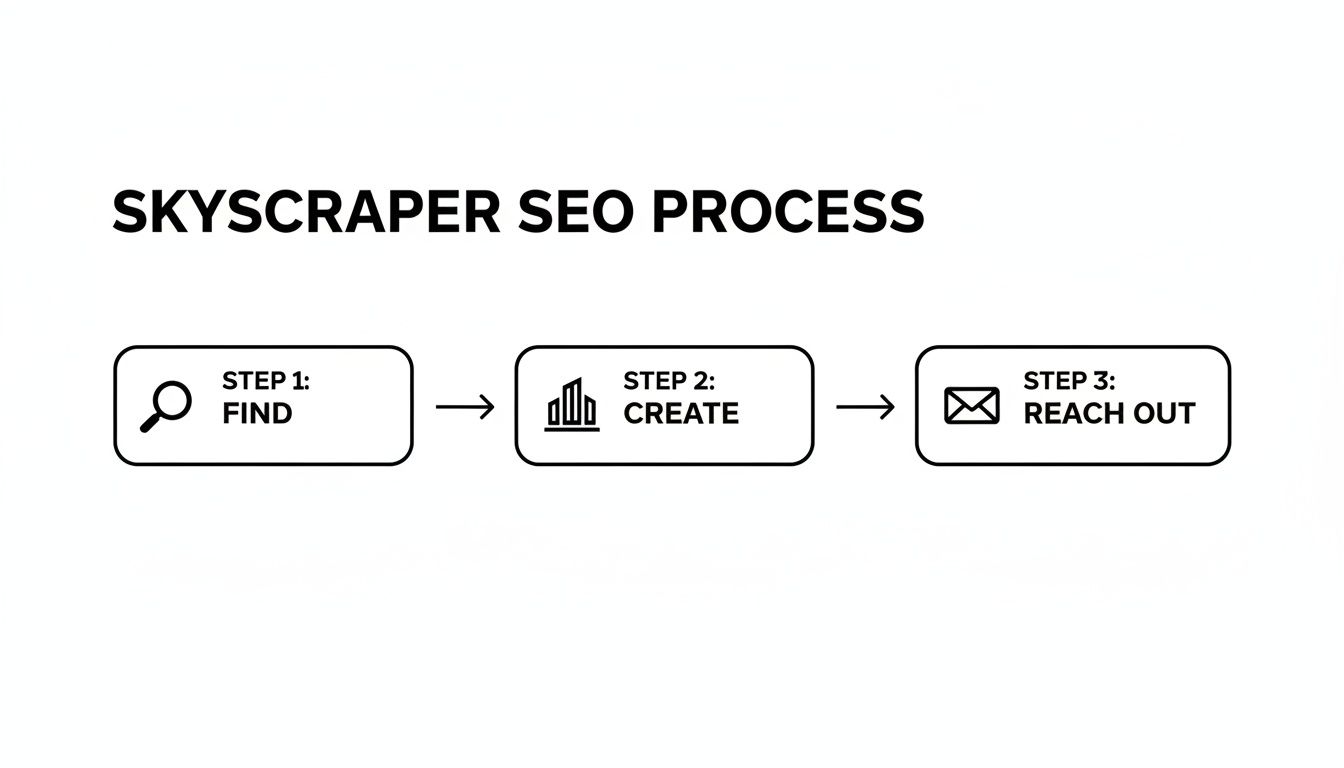
As you can see, finding the right opportunity is the foundational first step. Everything else—content creation, outreach, promotion—is built on this initial research.
Using SEO Tools to Uncover Opportunities
This research phase is where tools like Ahrefs' Content Explorer or Semrush's analytics reports become indispensable. They let you slice and dice the data to find pages that are practically begging to be "Skyscrapered."
Actionable Insight: In Ahrefs' Content Explorer, search for your keyword and apply these filters:
- Referring domains > 50: This ensures the topic is a proven link-magnet.
- Published > 2 years ago: This targets content likely to be outdated.
- One page per domain: This avoids seeing multiple pages from the same site.
This combination points you directly to high-authority, low-maintenance content that you can absolutely outperform.
For a deeper dive into finding these high-value topics in the first place, you can learn more about how to conduct keyword research.
Creating Content That Towers Above the Competition

Alright, you've pinpointed your target content. Now the real work begins. The whole point of the skyscraper seo technique isn’t just to tack on a few extra paragraphs and call it a day. The mission is to create something so objectively superior that it makes the original piece obsolete.
This is your chance to build the definitive resource on the topic—something so thorough, so useful, and so well-presented that it becomes the go-to answer for anyone searching that term.
Think beyond just a higher word count. Real superiority comes from layering in more value. That means digging deeper for fresher insights, presenting information in a more engaging way, and answering questions the competition never even thought to ask.
Elevating a Standard Guide into an Ultimate Resource
Let's circle back to our Kansas City home services company targeting "basement waterproofing." The top-ranking article is a basic, text-only guide from 2018. To truly build a skyscraper, they need to blow it out of the water.
Here’s how they could transform a decent article into an undeniable one:
- Incorporate Rich Media: Instead of just describing foundation cracks, why not produce a high-quality video walkthrough showing homeowners exactly what to look for? Actionable Example: Embed a 2-minute video titled "Spotting Foundation Issues in Your Kansas City Home."
- Create Downloadable Assets: A printable, pre-season checklist for homeowners is a genuinely useful tool that adds massive practical value. Actionable Example: Offer a PDF "Kansas City Rainy Season Basement Checklist."
- Add Interactive Elements: An interactive diagram that explains the different waterproofing systems could make a complex topic dead simple to understand—and highly shareable. Actionable Example: Use a tool like Genially to create a clickable image comparing interior vs. exterior drain tile systems.
When you're brainstorming ways to make your content stand out, it helps to pull in ideas from proven strategies for viral content and SEO growth. These kinds of small, value-packed additions are what turn a simple blog post into an indispensable resource that people bookmark and share for years.
A Checklist for Superior Content
Your job is to find every single weakness in the original content and turn it into a strength in yours. Start by doing a thorough audit of the target piece and look for every possible opportunity to one-up it.
Here’s a quick checklist you can use to systematically find and exploit those weaknesses, ensuring your new content is better in every measurable way.
Content Improvement Checklist
| Improvement Tactic | Description | Example for "Basement Waterproofing" |
|---|---|---|
| Update and Refresh | Replace outdated statistics, examples, and recommendations with the latest information. | Swap old cost estimates with current 2024 pricing data specific to Kansas City. |
| Expand the Scope | Add related subtopics or deeper explanations that the original content only briefly mentioned. | Include a new section on local soil types in the KC area and how they affect foundation integrity. |
| Strengthen Visuals | Use custom charts, high-resolution images, and infographics to reinforce key points visually. | Create a custom infographic comparing the pros and cons of interior vs. exterior waterproofing methods. |
| Improve Readability | Organize sections with clear headings (H2s and H3s) and use short paragraphs and bullet points. | Break up long paragraphs into a scannable list of "5 Common Waterproofing Mistakes to Avoid." |
This structured approach makes sure you're not just adding fluff. You're strategically layering in value that makes your content the clear winner in the eyes of both users and search engines. For a deeper look at crafting compelling text, take a look at our guide on how to write website copy that gets results.
Priming Your Content with On-Page SEO
Finally, even the world's best content needs a solid technical foundation to have a fighting chance at ranking. If you're using WordPress, a tool like Rank Math makes this whole process incredibly straightforward. Before you even think about hitting publish, run through a quick on-page SEO checklist.
While outreach is a key part of the Skyscraper Technique, one study found that over 90% of total backlinks came organically without any direct outreach. This highlights how creating a genuinely superior resource naturally attracts links.
Make sure your focus keyword is in your SEO title, meta description, the first paragraph, and at least one subheading. Always use descriptive alt text for your images, and build out a logical internal linking structure to other relevant pages on your site. This simple prep work primes your content for search engine success right from the moment it goes live.
Mastering Your Backlink Outreach Strategy

So, your killer piece of content is finally live. But hitting "publish" isn't the finish line—it's the starting gun. The next leg of the skyscraper seo technique is all about getting your masterpiece in front of the right people. Specifically, the people with the power to link to it.
This whole process kicks off by circling back to the original article you set out to beat. Fire up a tool like Ahrefs or Semrush and export its entire backlink profile. This spreadsheet is your raw material, a list of every single website that found the old topic valuable enough to link to in the first place.
But don't get too excited just yet. That raw export is messy and full of noise. Your first real job is to filter this down into a clean, high-quality list of actual prospects, not just a mountain of URLs.
Refining Your Prospect List
A massive, unfiltered list will sink your campaign before it even starts. You have to be absolutely ruthless about cutting out the low-quality or irrelevant sites so you can focus your energy where it actually counts.
Here's how to slice and dice that initial export:
- Remove Low-Authority Sites: Filter out websites with a low Domain Rating (DR) or Authority Score (AS). There's no magic number, but using DR 20 as a minimum is a solid starting point.
- Eliminate Irrelevant Links: Ditch any links you find in forum signatures, blog comments, or generic directories. These are low-value links that aren't managed by an editor you can actually contact.
- Check for Relevance: Now, manually eyeball the remaining sites. Does a link from this website still make sense? Is their content high-quality and relevant to your own niche?
This filtering process transforms a list of hundreds of links into a manageable group of high-potential targets. It’s a crucial part of any modern link acquisition strategy because it forces you to prioritize quality over sheer quantity.
Crafting a Non-Spammy Outreach Email
With your curated list in hand, it's time to craft your pitch. Let me be clear: generic, mass-blasted emails are dead on arrival. Personalization is the only thing that gets a reply.
Your email needs to be short, respectful, and focused on providing value. Don't just ask for a link; show them why your resource is a genuine upgrade for their audience. Referencing a specific article on their site proves you've done your homework and aren't just another spammer.
Here’s a simple, effective template you can adapt:
Subject: Quick question about your article
Hi [Name],
I was looking for info on [Topic] and found your excellent article: [Link to Their Article].
I saw you mentioned and linked to [Original, Outdated Article Title]. I actually just published a more current guide that includes [mention one specific improvement, e.g., "local KC soil data" or "2024 pricing"]. You can see it here: [Link to Your Skyscraper Content].
Might be a useful addition for your readers.
Either way, keep up the great work!
Best,
[Your Name]
This approach is about building a connection, not just making a request. For anyone looking to streamline their outreach, services like Folderly can be a valuable asset for managing email deliverability and campaigns.
It's also vital to set realistic expectations. Industry data suggests that a well-run campaign can expect a 1-3% backlink success rate. However, one Ahrefs case study on Skyscraper campaigns managed to hit a 6.50% success rate, which shows you what's possible with a truly refined strategy. A thoughtful, persistent follow-up is absolutely essential for success.
Measuring Success and Troubleshooting Your Campaign
Alright, you've built an incredible piece of content and your outreach emails are officially out in the wild. Now comes the part where we find out if it's all working: tracking results and making smart adjustments on the fly.
Flying blind at this stage is a huge mistake. Success isn't just one number going up; it's about seeing positive momentum across a few key metrics that tell the whole story of your skyscraper seo technique campaign.
The entire point of this is to earn backlinks, so your first and most important checkpoint is your new referring domains. I keep a close eye on this in Semrush or Ahrefs. Are new, high-quality sites linking to your skyscraper content? This is the most direct signal you have that your outreach is hitting the mark.
Next, you have to watch your keyword rankings. Get your main target keyword and a handful of related long-tail variations set up in a position tracker. Don't be discouraged if early progress just looks like jumping from unranked to page five. That initial movement is a critical sign that Google is taking notice.
Key Performance Indicators to Watch
You don't need a massive dashboard with dozens of metrics. Just focus on the vital signs that show your content is actually performing.
- New Referring Domains: This is the big one. How many unique websites are linking to your new article? It's the core success metric for the skyscraper technique.
- Keyword Ranking Improvements: Is your content climbing the search results for its target keywords? Any upward movement is a win and confirms you're gaining traction.
- Organic Traffic Growth: This is the ultimate goal. As your rankings improve, you should see a direct lift in organic traffic to that specific page.
It's really important to have realistic expectations on timing. A 2024 case study suggests businesses should aim for a 20-30% increase in referring domains or organic traffic within six months. Months two and three are often when you'll see those initial ranking jumps, but the most significant results usually start showing up between months four and six. You can read more about the timeline for Skyscraper results on Search Influence.
Common Problems and How to Fix Them
Even the best-laid plans can hit a snag. If you're not seeing the results you hoped for after a couple of months, it’s time to do some troubleshooting.
Problem 1: Low Email Open Rates. If your outreach emails are getting completely ignored, the problem is almost always your subject line or the quality of your prospect list.
Actionable Fix: A/B test a few punchier, more personalized subject lines like "Your [Topic] article" vs. "A new resource for your readers." Be honest with yourself—revisit your prospect list and make sure you filtered out all the low-quality or irrelevant sites.
Problem 2: You're getting links but not ranking. If you've earned some solid links but your content still isn't ranking, the issue might be on your own site.
Actionable Fix: Go back and double-check your on-page SEO factors like title tags and, most importantly, internal linking. Make sure you're linking to your new skyscraper content from other relevant, high-authority pages on your website. This is how you pass your own site's authority to the new page and signal its importance to Google. To get a better handle on this, learning how to track website traffic can help you identify which of your existing pages can send the most powerful internal links.
Common Questions About the Skyscraper SEO Technique
Even with a clear plan, diving into your first Skyscraper campaign can bring up some real-world questions. It's totally normal. Let's walk through some of the most common ones I hear from business owners and marketers when they're getting their hands dirty with this for the first time.
How Much Does This Actually Cost?
The investment for a Skyscraper campaign really boils down to two main buckets: the tools you need and the content you create.
- Tools: To do this right, you’re going to need a subscription to a solid SEO platform like Semrush or Ahrefs. These are essential for finding the right opportunities and tracking your backlinks. You should budget somewhere between $100 to $300 per month. It's not pocket change, but flying blind is way more expensive in the long run.
- Content Creation: This is where the cost can vary wildly. If you've got the chops and the time to write the content yourself, your only cost is your own effort. But if you hire a top-tier writer or an agency, a deeply researched Skyscraper article—especially one with custom graphics or video—could run anywhere from $500 to over $2,000. The price tag depends heavily on how complex the topic is.
How Long Does It Really Take to See Results?
Patience is the name of the game here. The Skyscraper technique is a long-term authority play, not some overnight trick.
You might see some initial buzz or a little movement in the rankings within 2-3 months, but the results that really move the needle—think significant organic traffic growth and solid first-page rankings—typically take 4-6 months to show up. This timeline can speed up or slow down based on how competitive your niche is and how effective your outreach is.
Can This Work for a Brand New Website?
Absolutely. In fact, it's one of the most powerful strategies you can use for a new site.
A brand-new domain starts with zero authority. A single, successful Skyscraper campaign can build a strong foundational backlink profile faster than almost anything else. By creating one truly exceptional resource and earning just a handful of high-authority links, you send a powerful signal to Google from day one that your new site is a credible source worth paying attention to.
For a new website, a single successful skyscraper article can be the catalyst that builds initial domain authority, making it easier for all future content to rank. It's a foundational play.
What Are the Most Common Mistakes to Avoid?
Even seasoned pros can stumble. The biggest pitfalls usually come down to a few critical execution errors that can sabotage the entire effort.
- Poor Content Selection: This is the #1 mistake. Choosing a target article that nobody really links to in the first place, or picking one that's just too competitive to beat, is a recipe for failure.
- "Good Enough" Content: Creating an article that’s only a little bit better than the original won't cut it. Your piece needs to be objectively superior in every way to give someone a compelling reason to swap out their old link for yours.
- Spammy Outreach: Blasting out generic, non-personalized emails is a complete waste of time and will probably get your domain flagged as spam. You have to personalize your outreach and show genuine value. It's non-negotiable.
At Website Services-Kansas City, we specialize in implementing proven SEO strategies like this to build your site's authority and drive real growth. If you're ready to create content that dominates the search results, learn more about our professional SEO solutions.
