
Search intent is the secret ingredient in modern SEO. It’s the simple, human reason behind every single search query. It’s not just about the words someone types into Google; it’s about what they’re trying to accomplish—are they trying to learn something, find a specific website, or buy a product right now?
Figuring this out is the real key to ranking.
Understanding Search Intent: The 'Why' Behind Every Click
Let's use an analogy. Imagine your business is a store in a giant mall, and Google is the mall directory. A shopper walks up and asks for "running shoes." The directory's job is to figure out why they're asking.
Do they want to read reviews and compare different brands (Commercial Investigation)? Are they looking for the Nike store (Navigational)? Or have they already made up their mind and are ready to buy a pair this instant (Transactional)?
That’s exactly what search intent is. It’s Google’s process for decoding a user’s goal so it can show them the most relevant "stores"—your web pages—to solve their problem. Old-school SEO was like a store owner just shouting "running shoes!" at every person who walked by, regardless of what they wanted. It was annoying and it just didn't work.
Today, a winning strategy means creating content that perfectly aligns with what the user is trying to do. This isn't just a good idea anymore; it's a non-negotiable for ranking high and getting real results for your Kansas City business. Google's powerful algorithms, like RankBrain, are specifically designed to reward websites that nail the user's intent.
Why Intent Is a Game-Changer for Small Businesses
When you start focusing on search intent, you stop being just another content creator and become a strategic problem-solver for your audience. This shift helps you in a few huge ways:
- Attract Qualified Visitors: You stop pulling in random traffic and start attracting people who are genuinely looking for what you offer. For a Kansas City plumber, this means ranking for "emergency plumbing repair KC" (high intent) is far more valuable than ranking for "what is a p-trap" (low intent). This leads to higher engagement and way better conversion rates.
- Build Trust and Authority: By giving users the exact answer they need at the exact right moment, you establish your brand as a helpful, credible expert they can rely on. A local financial advisor who provides a clear guide on "how to start a 529 plan in Missouri" builds trust long before the user is ready to hire someone.
- Improve SEO Performance: Google loves to see satisfied users. When your content perfectly matches their intent, you’ll be rewarded with better rankings, lower bounce rates, and more organic search traffic.
The data makes it crystal clear why this is so important. A massive 70% of all searches have informational intent, meaning people are just looking for answers. Another 22% show commercial intent, meaning they’re in research mode, getting ready to make a purchase.
By understanding this breakdown, you can build a content strategy that meets customers at every single stage of their journey, from their first curious question to the final click to buy. You can discover more insights on why this is crucial for small businesses at SERanking.
There are four primary types of search intent that you’ll see again and again. Getting a handle on these is the first step to creating content that truly performs.
Let's break down each of the four core types of search intent with some real-world examples.
1. Informational Intent ("I want to know")
This is the most common type of search intent, hands down. The user has a question and is looking for an answer, a guide, or an explanation. They're in learning mode, not buying mode.
Think of searches that start with "who," "what," "where," "why," or "how."
These are your classic top-of-funnel queries. The user is just trying to understand a problem or a topic. Your job here isn’t to sell, but to educate and be as helpful as possible.
Examples of Informational Keywords:
- "how to fix a leaky faucet"
- "what is content marketing"
- "best restaurants in Kansas City"
- "directions to Arrowhead Stadium"
To capture this audience, you need to create high-value, educational content like blog posts, how-to guides, checklists, and tutorials. The goal is to become the go-to resource they trust.
2. Navigational Intent ("I want to go")
With navigational intent, the user already knows where they want to go. They're just using Google as a shortcut to get to a specific website or page. They're too lazy to type out the full URL, so they just pop the brand name into the search bar.
These searches almost always include a brand name, a product name, or a specific service.
There's not a huge opportunity to "steal" this traffic, as the user has already decided on their destination. The main goal here is to make sure you rank #1 for your own brand name and that your key pages (like your login page or contact page) are easy for people to find.
Examples of Navigational Keywords:
- "Facebook login"
- "Website Services Kansas City"
- "Amazon"
- "Bank of America"
Your homepage, "About Us" page, and "Contact" page are the most common targets for this type of intent.
3. Transactional Intent ("I want to do")
This is the money-maker. The user is ready to take action—they have their wallet out and are looking to make a purchase, sign up for a service, or book an appointment right now.
These keywords often include "buy," "price," "discount," "coupon," or a specific product name.
This is bottom-of-the-funnel traffic, and it's incredibly valuable. These are the people you want landing on your product pages, service pages, or pricing pages. The content needs to be direct, persuasive, and make it ridiculously easy for them to convert.
Examples of Transactional Keywords:
- "buy Nike Air Max 90"
- "Squarespace pricing plans"
- "emergency plumber near me"
- "Website Services SEO packages"
For this intent, you need sharp, conversion-focused landing pages, product pages, and service pages with clear calls-to-action.
4. Commercial Investigation ("I want to compare")
This is the critical middle ground between informational and transactional intent. The user is planning to make a purchase in the near future, but they're still in research mode, weighing their options and comparing different solutions.
These are your "best of" or "vs." searches. They signal that someone is close to making a decision but needs that final bit of information to feel confident.
This is a huge opportunity to position your product or service as the best solution. Content like in-depth reviews, comparison articles, and "best of" listicles are perfect for capturing this high-value audience.
Examples of Commercial Investigation Keywords:
- "best CRM for small business"
- "Mailchimp vs. Constant Contact"
- "iPhone 15 Pro review"
- "top web design agencies Kansas City"
For this intent, your best assets will be detailed product category pages, comparison guides, and list-style blog posts.
To help you keep these straight, here's a quick summary of the four core types of search intent.
The Four Core Types of Search Intent at a Glance
This table is a handy cheat sheet for understanding the main user goals behind a search and what kind of keywords they use.
| Intent Type | The User's Goal | Example Keyword |
|---|---|---|
| Informational | To find information or an answer to a question. | "how to start a blog" |
| Navigational | To find a specific website or brand. | "YouTube" |
| Transactional | To complete a purchase or take a specific action. | "buy cheap running shoes" |
| Commercial Investigation | To compare products or services before buying. | "best coffee maker reviews" |
Understanding these categories is the foundation for creating a content strategy that works. By matching your content to these different goals, you can attract the right people at the right time.
Breaking Down The Four Main Types Of Search Intent
To really get what search intent is all about, you have to move past the theory and see how it plays out in the real world. Every single search query falls into one of four main categories, and each one represents a different step in a customer's journey. Mastering these four types is like getting the playbook for connecting with your audience at the exact right moment.
This simple concept map shows the core motivations behind every search—the "why" behind the keyboard—and how it branches into what someone wants to learn, how they plan to solve a problem, or what they're ready to buy.
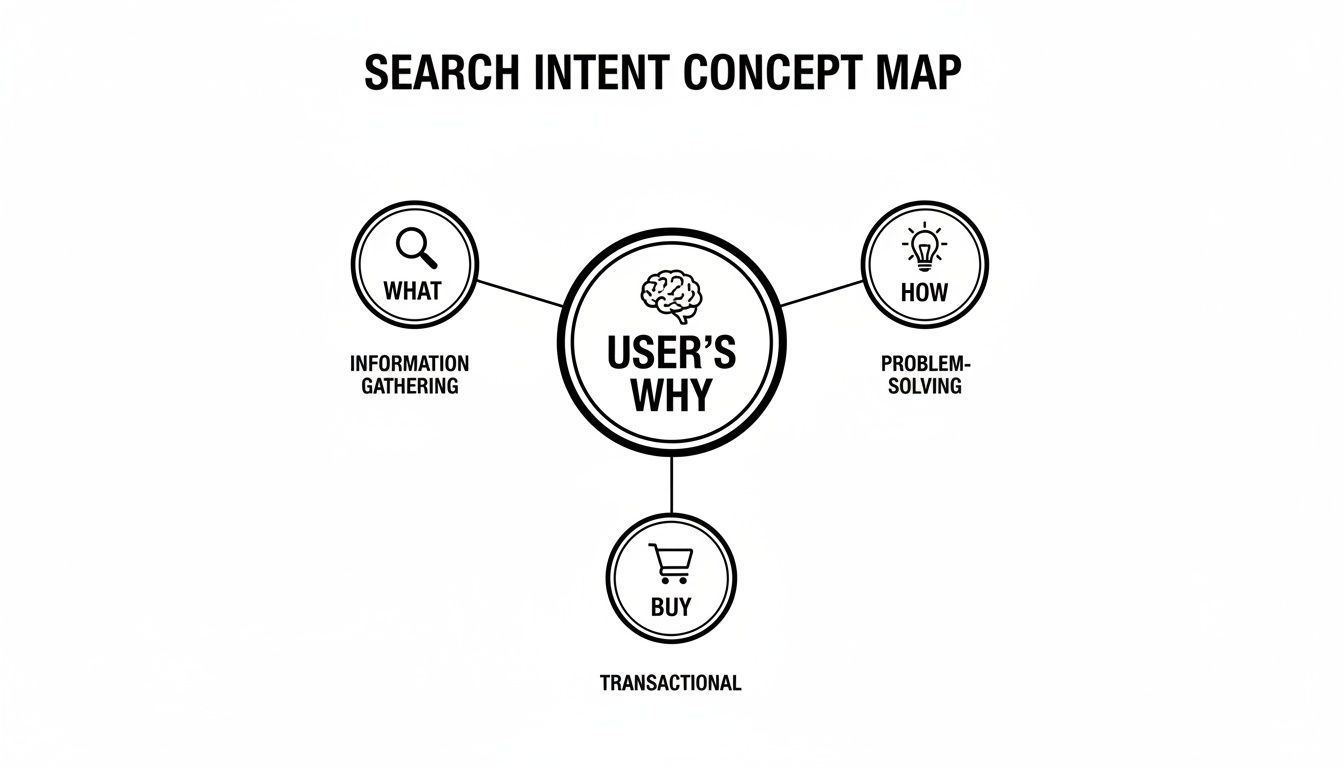
As you can see, it all starts with a user's goal. That goal then steers them toward finding knowledge, hunting for solutions, or making a purchase. Let's dig into how these motivations translate into the specific types of intent you need to know.
Informational Intent: The Need To Know
This is the big one. Informational intent is easily the most common type, covering the vast majority of all searches. At this stage, the user is purely in learning mode. They’ve got a question or a problem and are looking for answers, explanations, or a bit of guidance. They are nowhere near ready to buy; they’re just gathering intel.
A homeowner in Kansas City might search for "how to fix a leaky faucet" or "signs of a failing air conditioner." They aren't looking for a plumber just yet, only knowledge.
User Motivation: "I need to understand something. Give me a clear, helpful answer that solves my immediate question."
For a business, this is your chance to be the helpful expert. Your goal isn't a hard sell. It's to build trust and authority by providing the absolute best information you can.
Practical Examples:
- A boutique on the Plaza could create a blog post titled "What to Wear to a Fall Wedding in Kansas City."
- An HVAC company could publish a guide on "How to Lower Your Energy Bills in the Summer."
- A digital marketing agency might write an article explaining "What is Local SEO and Why It Matters."
Navigational Intent: The Need To Go
With navigational intent, the searcher already knows exactly where they want to go. They’re just using Google as a shortcut to get to a specific website or physical location. Think of it like punching a known address into your GPS.
These searches almost always include a brand name, like "Helium SEO login" or "Made in KC store hours." The user has a clear destination in mind, and your only job is to make it dead simple for them to get there.
Optimizing for this intent is all about ensuring your own branded pages—your homepage, contact page, or customer portal—rank number one and are impossible to miss. For a deeper look at getting these pages right, check out our guide on what is on-page optimization.
Commercial Investigation: The Need To Compare
This is the crucial research phase right before a purchase. The user fully intends to buy something soon, but they haven't made a final decision yet. They are actively comparing options, reading reviews, and looking for the best possible solution to their problem.
This intent sits squarely between learning and buying. A user might search for "best SEO company in Kansas City" or "Mailchimp vs Constant Contact." They've moved past the basic "what is" questions and are now weighing their options.
User Motivation: "I'm close to making a decision, but I need help comparing my options to feel confident I'm choosing the best one."
Content that targets this "commercial investigation" phase is incredibly valuable. This is where you can directly influence a potential customer's decision by showcasing your expertise and highlighting what makes your product or service the superior choice.
Content that satisfies this intent includes:
- Comparison Guides: "WordPress vs Shopify for Small Business"
- "Best Of" Lists: "Top 5 Web Designers in Kansas City"
- In-Depth Reviews: "A Complete Review of the Yoast SEO Plugin"
Transactional Intent: The Need To Buy
This is the final step, the moment of truth. The user has done their research and is ready to take action—to buy, book, or sign up. These are the high-value "money" keywords because they show a clear and immediate desire to convert.
Transactional keywords often have modifiers like "buy," "price," "discount," or "for sale." A search for "emergency plumber KC" is transactional; that person needs help now. Similarly, someone searching "buy tickets for Chiefs game" is ready to pull out their credit card.
Your service pages, product pages, and pricing pages must be perfectly optimized for this intent. The content needs to be persuasive, straightforward, and remove any and all friction from the conversion process. Your goal is to make it as easy as possible for the user to complete their action.
How To Uncover Search Intent For Your Keywords
Knowing the theory behind search intent is one thing, but actually putting on your detective hat to figure it out consistently—that’s what separates good SEO from great SEO. Instead of just guessing what your audience wants, you need a repeatable process to find the real “why” behind their searches.
Fortunately, Google leaves a trail of breadcrumbs for you to follow. Once you learn how to read these signals, you can move from guesswork to a data-backed strategy that actually delivers results.
Let's walk through three proven methods to decode the intent for any keyword you’re targeting.
Analyze The Search Results Page Directly
The single best source of truth for understanding search intent is the search engine results page (SERP) itself. Google's entire business model is built on giving people exactly what they want, so the top-ranking pages are a masterclass in what the algorithm believes searchers are looking for.
Actionable Insight: Before writing a single word, search your target keyword in an incognito window. Are the top results blog posts, product pages, listicles, or videos? The dominant content type is your blueprint. Don't try to rank a product page if Google is showing "how-to" guides.
Just type your target keyword into Google and look for patterns. Don't just glance at the blue links; analyze the entire page for these features:
- Featured Snippets: See a big answer box at the top? That’s a massive clue for informational intent. Users want a quick, direct answer to a "what is" or "how to" question.
- "People Also Ask" Boxes: This is a goldmine for informational intent, literally spelling out the follow-up questions your audience has. Answering these in your content is a powerful way to align with their needs.
- Video Carousels: The presence of videos often points to informational intent, especially for "how-to" guides, tutorials, or anything that's easier to show than tell.
- Local Packs (Map Results): A map with three local businesses is an undeniable sign of local, navigational, or transactional intent. The searcher wants to find a business "near me."
- Shopping Ads and Product Grids: These features scream transactional and commercial intent. Google knows the person is in a buying mood and is showing them products directly.
By paying close attention to these SERP features, you’re letting Google tell you exactly what kind of content to create. The SERP is your cheat sheet.
Spot Telltale Keyword Modifiers
The extra words people add to their core search query are direct signposts pointing to their intent. These keyword modifiers act like shortcuts, helping you categorize keywords without even needing to look at the SERP.
For example, a search for "WordPress SEO" is broad and could have mixed intent. But when someone adds a modifier, their goal becomes crystal clear. Learning to spot these is a key step in mastering your keyword research.
Common Keyword Modifiers and Their Corresponding Intent
This simple cheat sheet maps common keyword additions to their most likely search intent, helping you quickly categorize keywords and plan your content strategy.
| Keyword Modifier | Likely Search Intent | Content Format to Create |
|---|---|---|
| how to, what is, guide, tutorial, tips | Informational | Blog Posts, How-To Guides, Checklists |
| best, top, review, vs, comparison, alternatives | Commercial Investigation | "Best Of" Lists, Comparison Articles, In-depth Reviews |
| buy, price, discount, for sale, near me | Transactional | Product Pages, Service Pages, Pricing Pages |
| [Brand Name] login, [Brand Name] hours | Navigational | Homepage, Contact Page, Login Portal |
This isn't an exhaustive list, but it covers the most common signals you'll run into. Creating a simple "cheat sheet" like this can speed up your content planning and ensure every article you write is aimed at the right target. To effectively uncover search intent for your keywords, it's essential to understand how to gather and utilize relevant information; you can further explore various web data use cases for SEO to enhance your research.
Leverage Powerful SEO Tools and Your Own Data
While manual analysis is crucial, SEO tools can dramatically speed up the process and give you data at scale. Platforms like Semrush have built-in features that analyze and assign an intent category to keywords automatically, saving you a ton of time.
This can be incredibly helpful when you're sorting through thousands of potential keywords. The tool does the initial heavy lifting, flagging terms as informational, commercial, transactional, or navigational so you can focus your manual analysis on the most promising targets.
Beyond third-party tools, your own website's data is an untapped resource. Log into your Google Search Console account.
Pro Tip: Head over to the 'Performance' report and click on the 'Queries' tab. This shows you the exact search terms people are using to find your site. You can analyze these queries to see the real-world intent of your current audience and spot opportunities where you might be attracting the wrong type of visitor to a specific page.
This whole process is vital because organic search fuels 46.98% of all traffic, and matching intent is the key to capturing your share of it. With 94.74% of queries being long-tail—meaning highly specific—small businesses gain a huge edge by precisely identifying and serving these user needs.
Crafting The Right Content For Each Search Intent
Understanding search intent is like knowing what your customer wants before they walk in the door. Now it's time to put that insight to work. The bridge between attracting visitors and actually winning their business is creating content that perfectly matches their goal.
This is your playbook. We're moving past the theory and into the practical steps of building the exact pages Google wants to rank and your future customers are desperate to find.
Optimizing For Informational Intent: The Ultimate Guide
When someone has informational intent, they’re in learning mode. Your job is to be the best teacher on the block—the most helpful, clear, and trustworthy source on the topic. Forget the sales pitch for a minute. Your goal here is to educate and build authority.
The best tools for this job are long-form blog posts, detailed "how-to" guides, and step-by-step checklists.
A Winning Template for Informational Content:
- Title Tag: Start with action-oriented phrases like "How To," "What Is," or "A Complete Guide To." Make it obvious you have the answer.
- Headings (H2s & H3s): Structure your article like a table of contents. Use your subheadings to answer all those follow-up questions you found in the "People Also Ask" section.
- Introduction: Get right to it. Acknowledge their question and promise a clear, straightforward answer. No fluff.
- Body Content: Keep your paragraphs short. Use bullet points and numbered lists to make complex information easy to scan and digest. Embed helpful images or short videos to illustrate your points.
- Call-to-Action (CTA): Your CTA shouldn't be "Buy Now." It should offer more value, like "Download our free checklist" or "Subscribe for more pro tips."
For example, a marketing agency in Kansas City targeting "what is search intent in seo" would create a comprehensive guide—just like this one—that breaks down the concept with real examples and advice you can actually use.
Winning With Commercial Intent: The Comparison Review
For commercial investigation, the user is weighing their options. They're on the verge of a decision but need a final nudge of confidence. Your content has to help them compare, evaluate, and choose the best solution for their specific needs.
The most powerful formats are "best of" listicles, in-depth product reviews, and direct "vs." comparison articles.
Your job is to be the knowledgeable friend giving unbiased advice, helping the user make a smart decision. This builds immense trust right before the purchase.
How to Structure a Powerful Comparison Page:
- Title Tag: Use persuasive modifiers like "Best," "Top," "Review," or "vs." Think something like, "Best SEO Companies in Kansas City."
- Introduction: State the page's purpose immediately—to help the user compare the top options and find the perfect fit.
- Comparison Table: This is non-negotiable. Create a table that stacks key features, pricing, and pros/cons side-by-side for easy scanning.
- Individual Reviews: Briefly break down each option, highlighting its unique strengths and who it’s the best fit for.
- The Verdict: End with a clear recommendation. Don't be afraid to declare a "winner" for different scenarios (e.g., "Best for small businesses," "Best for e-commerce").
- CTA: Guide them to the next step. This could be a soft CTA like "Learn More" or a more direct one like "Get a Free Quote" if you're comparing your own services.
Converting Transactional Intent: The Perfect Service Page
When intent is transactional, the user is ready to act. There’s no room for confusion. Your product or service page must be a frictionless path to conversion, giving them all the info they need to pull the trigger with confidence.
This goes for service pages on a WordPress site just as much as product pages on a Shopify store.
Critical Elements of a High-Converting Transactional Page:
- Compelling Headline: Clearly state the service or product and its number one benefit. For example: "Professional WordPress SEO Services That Drive Growth."
- Crystal-Clear Pricing: Don't make people hunt for pricing information. Display it prominently. If you offer custom quotes, make the "Request a Quote" button impossible to miss.
- Visible Call-to-Action: Use a bright, contrasting button with action-oriented text like "Get Started Now" or "Add to Cart." Put it above the fold and repeat it further down the page.
- Social Proof: Weave in testimonials, case studies, or customer logos. This is how you build trust and dismantle any last-minute hesitation.
- Concise Copy: Use bullet points to highlight the features and, more importantly, the benefits. For more guidance, our article on how to write website copy offers a ton of practical tips.
This is especially critical when you're targeting local searches. A staggering 46% of all Google searches include local intent, which adds up to roughly 1.6 billion queries every single day. For local businesses, blending this with transactional keywords is a powerhouse strategy. Consider that 76% of people who search for something local on their phone visit a store within 24 hours, and 28% of those searches lead to a purchase. This proves that optimizing a service page for local transactional queries drives real-world business.
Mastering Navigational Intent: The Optimized Homepage
Finally, for navigational intent, the user already knows who you are and is just trying to find your website. Your main job is to make sure your homepage and key pages rank #1 for your brand name so they can find you easily.
Optimization here is straightforward but absolutely essential.
- Homepage Title Tag: Your brand name should always come first. A great format is "Brand Name | Brief, Keyword-Rich Tagline."
- Clear Navigation: Your main menu needs to be intuitive. It should allow users to quickly find your services, about page, and contact information without having to think.
- Contact Information: Make your phone number and address clearly visible in the header or footer. This instantly satisfies users who are just looking for that specific information.
By meticulously crafting your content to match each of these four intents, you create a seamless journey that guides visitors from their first question to their final purchase, building trust and driving business growth every step of the way.
Auditing Your Website For Search Intent Mismatches
Optimizing new content for search intent is a great start, but some of your biggest growth opportunities are probably already hiding on your website. This is where an intent mismatch audit comes in. An intent mismatch happens when the content on your page doesn't line up with what a user actually wants when they search a given keyword. It’s a super common issue that can silently kill your rankings.
Think of it like a hardware store sending a customer who asked for "hammers" to the aisle with detailed blueprints on hammer manufacturing. The information is related, but it completely misses the user's goal. Performing an intent audit helps you find and fix these disconnects to finally unlock the true potential of your existing pages.
Pinpointing Problem Pages with Data
Your first step is to become a data detective. You need to find the pages that Google is showing people, but that aren't connecting. The most obvious symptom of an intent mismatch is a high number of impressions paired with a disappointingly low click-through rate (CTR).
This pattern is a huge red flag. It tells you that Google sees your page as relevant enough to show in the search results, but users take one look at your title and description and think, "Nope, that's not what I'm looking for."
You can easily hunt down these pages using Google Search Console:
- Navigate to the Performance report.
- Select the Pages tab to see your top-performing URLs.
- Click on a specific page you want to investigate.
- Now, switch to the Queries tab to see the keywords driving impressions to that page.
What you're looking for here are surprises. Is your in-depth blog post about "how SEO works" getting impressions for a transactional term like "hire SEO expert Kansas City"? That's a classic mismatch. Is your product page showing up for a problem-aware informational query? These are the pages that need your immediate attention.
Diagnosing and Fixing the Mismatch
Once you’ve found a problem page, it's time to figure out what went wrong. Open the page and the SERP for its target query side-by-side. Ask yourself: what type of content is Google actually ranking? If the top results are all "best of" listicles and your page is a single service page, you have a clear format mismatch.
A common mistake is trying to force a single page to serve multiple, conflicting intents. A page can't be both a definitive informational guide and a high-converting sales page. Trying to do both usually means failing at both.
To fix these issues, you have three main options:
- Rewrite and Repurpose: If the mismatch is minor, you might just need to rewrite the content. This could mean updating your title tag, meta description, and H1 to better reflect the user's goal, or restructuring the content to be more scannable and direct.
- Redirect (with caution): If you already have a better page for that keyword's intent, you can implement a 301 redirect. This sends users and search engines to the more appropriate page, consolidating your ranking signals and improving the user experience.
- Create a New Asset: Often, the best solution is to create a brand-new piece of content specifically designed to match the intent. If your service page is ranking for an informational query, write a new blog post that answers that query, then internally link it back to your service page.
Performing this audit regularly can also help you find and fix other underlying issues. For instance, you might discover pages that aren't ranking because they are disconnected from your site's structure. You can learn more about how to find these valuable but hidden pages in our article on orphan pages in SEO.
Got Questions About Search Intent? Let's Clear Things Up.
Even with a solid plan, a few questions always seem to pop up. It's totally normal. Let's tackle some of the most common ones I hear from clients, so you can move forward with confidence.
Can A Single Page Rank For Multiple Search Intents?
Yes, but you have to be careful. It’s a tricky balancing act. A really comprehensive guide page could absolutely satisfy an initial informational search (like "what is landscape fabric") and then lead into a commercial one ("best landscape fabric").
However, every page needs one primary intent. This is non-negotiable. Trying to be everything to everyone is a classic mistake that usually ends with you ranking for nothing at all. The best approach is to build the page around that main goal and then use smart internal links to guide visitors to other pages that handle their secondary needs.
How Often Does The Intent For A Keyword Change?
Search intent isn't set in stone. It can shift—sometimes slowly, sometimes overnight—because of new technology, seasonal trends, or major world events. A perfect example is "video conferencing software." For years, the intent was mostly commercial, but in early 2020, it suddenly became intensely informational ("how to use").
It's crucial to periodically check the live search results for your most important keywords. This is the only way to make sure your content stays aligned with what your audience wants right now, preventing your rankings from slowly decaying over time.
Is Search Intent More Important Than Backlinks?
This is like asking if an engine is more important than the wheels on a car. They are two sides of the same SEO coin, and you absolutely need both to get anywhere.
Think of it this way:
- Matching search intent is your ticket to the game. It proves your content is relevant and deserves to even be considered by Google.
- High-quality backlinks are the resources and expert coaching that help you win that game. They give you the authority to outperform your competitors.
In modern SEO, having one without the other is a recipe for frustration. Great content that perfectly matches intent is what earns the backlinks you need to climb the ranks and stay there.
Ready to stop guessing and start aligning your website with what your customers are actually searching for? Website Services-Kansas City specializes in creating and optimizing WordPress websites that are perfectly tuned to user intent. Our expert SEO audits and strategies will uncover your biggest growth opportunities.
Learn how our SEO services can boost your rankings today at https://websiteservices.io
