
Calculating your return on investment for SEO boils down to a simple formula: (Revenue from SEO – SEO Investment) / SEO Investment. This isn't just about crunching numbers; it’s about translating vague metrics like traffic and rankings into a hard dollar amount that proves whether your marketing is actually profitable.
Why Measuring SEO ROI Is a Game Changer
You're putting time and money into search engine optimization, but can you prove it's making you money? This is the core challenge for countless business owners, from brand-new e-commerce stores to established local service providers. If you want to build a predictable revenue engine, moving beyond vanity metrics isn't just a good idea—it's non-negotiable.
Tracking your return isn’t just about justifying an expense. It’s about making smarter business decisions. When you know exactly which campaigns and keywords are delivering a positive return, you can stop guessing and start allocating your resources with confidence.
The Power of Data-Driven Decisions
Imagine a local contractor in Kansas City who starts tracking their SEO performance closely. They quickly notice that blog posts about "emergency roof repair" are generating high-value leads that turn into paying customers. At the same time, their articles on "DIY gutter cleaning" bring in plenty of traffic but almost no real business.
Armed with this data, they can confidently double down on the content that attracts ready-to-buy customers, directly boosting their bottom line.
This is the power of knowing your numbers. It lets you:
- Allocate your budget effectively by investing in strategies that are proven to work. For example, if you see that local SEO for "Kansas City SEO agency" drives more qualified leads than national keywords, you can shift your budget to create more location-specific content and build local citations.
- Build a strong case for sustained growth by showing stakeholders a clear line between investment and revenue.
- Identify and eliminate underperforming tactics before they waste any more of your resources.
The real value of measuring SEO ROI lies in turning your marketing from a cost center into a strategic growth driver. It provides the clarity needed to scale your efforts confidently and predictably.
SEO's Proven Impact on the Bottom Line
The data consistently shows that SEO delivers one of the highest returns of any marketing channel out there. For instance, a staggering 57% of B2B marketers see SEO as their most effective channel, beating out both paid ads and social media.
This isn't just hype. SEO leads have an impressive 14.6% close rate, which absolutely dwarfs the 1.7% you’d get from outbound methods like print ads or cold calls. If you're curious, you can check out more eye-opening SEO ROI statistics to see the full picture.
Understanding what is organic search traffic is the first step toward harnessing this power for your own business. By accurately measuring its financial impact, you unlock the ability to turn search visibility into sustainable profit.
Setting Up Your ROI Tracking Foundation
Before you can even think about calculating the return on your SEO, you have to get your measurement system dialed in. Think of it as laying the groundwork for a house; without a solid foundation, everything else you build is going to be wobbly and unreliable. This is the critical step where you connect your SEO efforts to actual business outcomes.
Proper tracking isn't about drowning in data. It’s about capturing the specific actions that tell you a visitor is moving closer to becoming a customer. For a Kansas City plumber, that might be a phone call. For a Shopify store, it’s a completed sale. Simple as that.
Configure Your Core Tracking Tools
First things first, you need to get your essential tools talking to each other. The goal is to make sure they all speak the same language—the language of leads and revenue. This setup is absolutely crucial because it ensures you’re giving credit where credit is due.
Getting this foundation in place is pretty straightforward. You just need to connect a few key platforms and tell them which user actions actually matter to your business.
- Google Analytics 4 (GA4): This is your command center for understanding everything happening on your website. You'll want to set up specific conversions that align with your business goals, like a "Contact Us" form submission or a newsletter signup.
- Google Search Console: This tool gives you a direct line to Google, showing you exactly how your site is performing in organic search. When you link it to GA4, you can see which search terms are driving traffic and conversions, drawing a clear line from your keyword strategy to your bank account. If you're new to this, our guide on how to set up Google Search Console will walk you through it.
This simple visualization breaks down the process: you invest in SEO, you measure the results with the right tools, and then you use that data to fuel real growth.
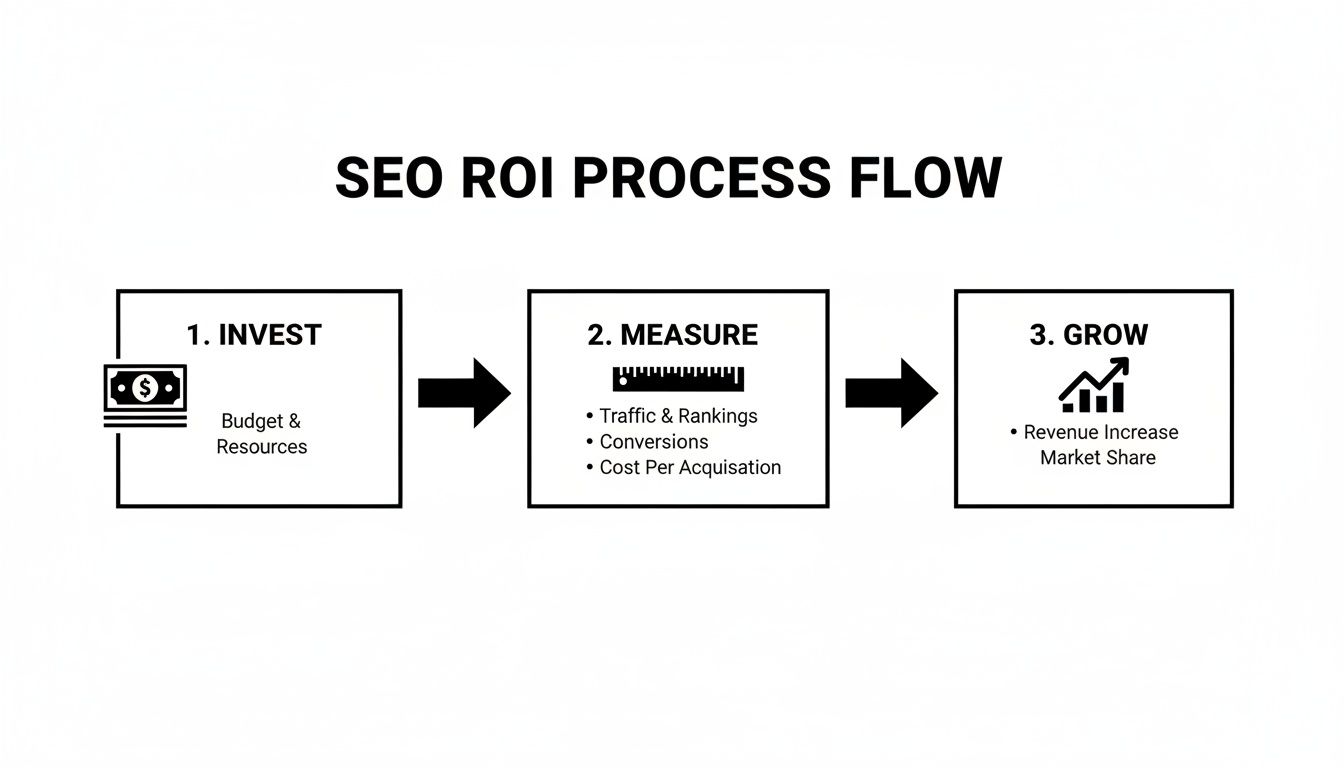
The key takeaway here is that measurement is the bridge between your investment and your growth. Without it, you're just spending money and hoping for the best.
Here are the core tools you'll need to start measuring your SEO ROI accurately, what they do, and why they're critical for your business.
Essential Toolkit for SEO ROI Tracking
| Tool | Primary Function | Why It's Essential |
|---|---|---|
| Google Analytics 4 (GA4) | Tracks website traffic, user behavior, and conversions. | This is your central hub for seeing how organic visitors interact with your site and what actions they take. |
| Google Search Console | Monitors organic search performance, keywords, and clicks. | It connects your SEO efforts (keywords and rankings) directly to the traffic arriving on your site. |
| E-commerce Platform | Manages online sales, products, and revenue data. | For online stores, this provides the raw revenue numbers you need to calculate a precise ROI. |
These platforms work together to give you a complete picture, from the initial search query all the way to the final sale.
E-commerce Tracking for Online Stores
If you run an online store on a platform like Shopify or WooCommerce, setting up Enhanced Ecommerce tracking in GA4 isn't just a good idea—it's non-negotiable. This integration tracks the entire customer shopping journey, not just the final click.
With a proper setup, you can see exactly which organic keywords and pages are leading to:
- Product Views: Which items are grabbing the most attention from your search traffic.
- Add to Carts: How well your product pages are turning browsers into potential buyers.
- Completed Purchases: The metric that matters most—actual, hard revenue.
This level of detail is a game-changer. Imagine seeing that a blog post you wrote about "how to choose the best coffee grinder" has directly led to $5,000 in coffee grinder sales over the last three months. That’s the kind of data that justifies your content spend and lets you calculate an ironclad SEO ROI.
Understanding Attribution Models
Finally, let's touch on attribution models. It sounds technical, but the concept is simple: how do you give credit for a sale when a customer interacts with your brand multiple times before buying?
A huge mistake many businesses make is relying on a "last-click" attribution model. This gives 100% of the credit to the very last thing a customer did before converting, which is dangerously misleading because it ignores every other touchpoint that warmed them up.
For example, a customer might first find your brand through a Google search (SEO). A week later, they see a retargeting ad on Facebook, and a few days after that, they finally buy after clicking a link in your email newsletter.
A last-click model would give all the credit to email, making your SEO look like a total failure. A smarter model, like a data-driven or linear model, spreads the credit across all of those touchpoints. This gives you a much more accurate picture of how SEO contributes to your bottom line—often playing a huge role at the start of the customer's journey.
Getting an Honest Look at Your Total SEO Investment

Before you can even think about measuring SEO ROI, you have to get a firm grip on the "I"—your total investment. This is where so many businesses get it wrong. The real cost of SEO goes way beyond the monthly invoice you get from your agency.
If your cost calculation is vague or incomplete, your ROI number will be a fantasy. It’ll make it impossible to know if your strategy is actually profitable. The most common mistake I see is overlooking all the hidden costs that don't show up on a single line item but are absolutely part of your investment.
Getting this right means tracking every dollar and every hour that goes into improving your search presence.
Beyond the Agency Retainer
That monthly agency fee is the obvious starting point, but it's just one piece of the puzzle. A real SEO strategy has a lot of moving parts, and many of them have their own price tags. You need to account for all of it to get an honest financial picture.
Let's break down all the direct, out-of-pocket expenses you’re likely paying for.
- Essential SEO Tools: Your subscriptions to platforms like Ahrefs, Semrush, or Moz Pro are direct investments. These are the tools of the trade for research and monitoring. A typical small business might spend $100 to $500 per month here.
- Content Creation: Content is never free. Whether you're paying freelance writers, using your in-house team, or buying stock photos, it all adds up. You need to calculate the cost per article or per hour. If you want to get a better handle on this, check out our guide on how to create a content strategy.
- Link Building Campaigns: Are you paying for specific outreach services, sponsored content, or a digital PR firm? These are direct SEO expenses and must be included.
- Technical SEO Fixes: Did you pay a developer to speed up your site or implement structured data? Those billable hours are a one-time SEO investment.
Valuing Your Internal Time and Resources
This is, without a doubt, the most overlooked part of the entire SEO investment. The time your own team spends on SEO-related tasks has a very real monetary value. Ignoring it will seriously inflate your ROI, making it look much better than it is.
To get this right, you have to put a dollar value on your team’s time.
The true cost of SEO includes the hourly value of every team member who touches the campaign—from the marketing manager planning keywords to the intern uploading blog posts. This comprehensive view is the only way to calculate an honest and actionable ROI.
Let's walk through a quick, practical example for a small e-commerce business based right here in Kansas City.
Scenario: A Local Kansas City Boutique
- Identify the Team Member: The Marketing Manager handles the SEO strategy.
- Determine Their Hourly Rate: Their salary is $65,000 a year. With benefits, the company’s total cost is closer to $80,000. Divide that by 2,080 working hours in a year, and you get a loaded hourly rate of $38.46.
- Track Their SEO Hours: They spend, on average, 10 hours a month on keyword research, talking with the agency, and planning content.
- Calculate the Internal Cost: 10 hours/month * $38.46/hour = $384.60 per month.
That $384.60 is a real, tangible cost. It has to be added to your agency retainer, tool subscriptions, and any other hard costs to find your true total investment. Only then can you start calculating an ROI that actually reflects how your business is performing.
Connecting SEO Efforts to Real Revenue
Okay, you've got your tracking foundation built and a clear handle on your total investment. Now for the most important part: connecting your SEO work to actual, real-life dollars. This is where we move past vanity metrics like traffic reports and ranking charts and prove that your strategy is putting money back into the business.
The whole goal is to isolate the revenue that came from organic search, whether it happened directly or indirectly. This is the absolute core of any meaningful SEO ROI calculation. Without it, you’re just guessing, unable to tell the difference between activities that just create noise and those that truly grow your bottom line.
Pinpointing Direct Revenue from Organic Search
The cleanest, most straightforward way to measure SEO's impact is by tracking direct conversions from organic traffic.
These are the simple, one-and-done deals: a user finds you on Google, lands on your site, and immediately takes a valuable action in that same session. In Google Analytics 4 (GA4), this data is pretty easy to find.
For an e-commerce store, this means filtering your reports to show only the purchase revenue generated by the "Organic Search" channel. For a service business, it means tracking the number of form submissions or phone calls—your defined goals—that came from that same channel. This gives you a hard, defensible number for revenue driven directly by your SEO.
Of course, getting traffic is only half the battle. A huge part of this process is knowing how to increase website conversion rate, because more visitors are only valuable if your site can actually turn them into customers.
The Hidden Value of Assisted Conversions
Here's a hard truth: focusing only on direct conversions tells a dangerously incomplete story. The modern customer journey is a winding road, not a straight line.
Think about it. A potential customer might discover your brand through a blog post they found on Google. They leave, see one of your social media ads a week later, and finally make a purchase after clicking a link in an email newsletter.
In that scenario, a "last-click" attribution model gives 100% of the credit to email, completely ignoring SEO's vital role in starting that relationship. This is where assisted conversions are a game-changer. SEO often acts as the "first touch," kicking off a conversation that other channels later get to close.
Ignoring assisted conversions is like only giving credit to the person who scores a goal, while ignoring the player who made the critical pass. To truly understand your SEO ROI, you must acknowledge its role across the entire customer journey.
GA4's attribution reports are built for this. They help you see which channels played a role along the way, giving you a far more accurate picture of SEO's real contribution to your bottom line.
If you’re a service-based business and want to really dig into this, our complete guide to SEO for lead generation is a fantastic resource.
Here’s a simple table to help you understand the difference between these two critical measurement methods.
Direct vs Assisted SEO Revenue Attribution
A comparison of two key methods for attributing revenue to your SEO efforts to understand the full impact of your investment.
| Attribution Method | What It Measures | Example Scenario | Importance |
|---|---|---|---|
| Direct (Last-Click) | Revenue from users who convert in the same session they arrived from organic search. | A user searches "buy running shoes," clicks your result, and immediately purchases a pair of sneakers. | Provides a clear, conservative baseline for SEO's direct financial impact. It's the easiest number to defend. |
| Assisted (Multi-Touch) | Revenue from conversions where organic search was a touchpoint earlier in the customer journey. | A user finds your blog via Google, leaves, returns a week later via a social ad, and then makes a purchase. | Reveals the true, broader influence of SEO. It shows how SEO introduces and nurtures customers who convert later. |
By looking at both direct and assisted conversions, you move from seeing SEO as just another channel to understanding it as a foundational piece of your entire marketing ecosystem.
Assigning a Monetary Value to Your Leads
For businesses that don't sell products directly online—think service providers, contractors, or B2B companies—attaching a dollar value to organic traffic requires one extra step. You need to figure out what a single lead is actually worth.
The formula is surprisingly simple:
Lead Value = Average Customer Lifetime Value (LTV) x Lead-to-Customer Close Rate
Let’s imagine a local Kansas City roofing company:
- They know the average customer is worth $8,000 over their lifetime (LTV).
- Their sales team closes 1 out of every 10 qualified leads from the website (a 10% close rate).
Plugging that into the formula: $8,000 (LTV) x 0.10 (Close Rate) = $800 per lead.
Just like that, every time a qualified lead comes through their "Contact Us" form from organic search, they can confidently assign $800 in revenue to their SEO efforts. If they generate 20 organic leads in a month, that's $16,000 in attributable revenue.
This simple calculation transforms abstract lead numbers into concrete financial data, making it possible for any type of business to measure its SEO ROI.
Why Customer Lifetime Value Matters Most
Using a one-time sale value in your ROI calculation is a fine start, but using Customer Lifetime Value (LTV) gives you a much more powerful and accurate measure of SEO's long-term impact.
SEO is unique. It doesn't just attract a customer for a single transaction; it builds brand authority and trust that can lead to years of repeat business and referrals. An organic searcher who finds you through an informative, helpful blog post is often more loyal and has a higher LTV than a customer you snagged with a short-term discount ad.
When you factor LTV into your revenue calculations, you capture this long-term value. More often than not, it reveals that your SEO ROI is significantly higher than you initially thought.
The SEO ROI Formula in Action

Alright, you’ve done the legwork. You've figured out your total investment and tracked down your organic revenue. Now it's time for the payoff—turning those abstract concepts into hard numbers that give you a clear verdict on your marketing performance.
The good news is, the actual calculation is refreshingly simple.
The core of how to measure SEO ROI really just boils down to one straightforward formula:
(Gain from Investment - Investment Cost) / Investment Cost * 100
This little equation turns your raw data into a clear percentage, showing you exactly how much you're getting back for every single dollar you've put in.
A Real-World Kansas City Example
Let's make this tangible. Imagine a local Kansas City home remodeling company with a WordPress website. For the last six months, they've been investing in a targeted SEO strategy, and now they want to see the results.
First, we need to tally up their total monthly investment. It’s more than just an agency fee.
- Agency Retainer: $2,500
- Content Creation (2 articles): $500
- Internal Time (Marketing Manager): $400
- SEO Tools (Semrush): $130
Add it all up, and their Total Monthly SEO Investment is $3,530.
Next, let's figure out their gain. In the past month, their SEO efforts brought in:
- Qualified Organic Leads: 25 (tracked via form submissions in GA4)
- Lead-to-Customer Close Rate: 20% (they know 1 in 5 solid leads becomes a client)
- Average Project Value (ACV): $15,000
From here, the revenue calculation is simple:
- New Customers from SEO: 25 leads * 0.20 close rate = 5 new customers
- Total Revenue Generated: 5 customers * $15,000 = $75,000
Now we can plug everything into our ROI formula:
($75,000 Revenue - $3,530 Investment) / $3,530 Investment * 100 = 2,024%
That's a staggering 2,024% ROI for the month. For every $1 they invested in SEO, they got over $21 back. This is the kind of data that justifies budgets, fuels growth, and makes marketing teams look like heroes.
Factoring in Customer Lifetime Value
But the story doesn't end there. The true power of SEO is acquiring customers who come back again and again. This is where an LTV-adjusted ROI calculation can reveal an even more impressive picture.
Let's say our Kansas City remodeler knows from experience that the average client comes back for another project within three years. This brings their total Customer Lifetime Value (LTV) up to $25,000.
If we run the numbers again using LTV instead of the initial project value:
- LTV-Adjusted Revenue: 5 new customers * $25,000 LTV = $125,000
Now the ROI calculation is even more compelling:
($125,000 Revenue - $3,530 Investment) / $3,530 Investment * 100 = 3,441%
This LTV-adjusted ROI of 3,441% shows the true, long-term impact of their strategy. It proves SEO isn't just about one-time sales; it's about building a sustainable pipeline of high-value, loyal customers who drive profit for years to come.
Of course, hitting numbers like these hinges on your ability to turn website visitors into leads in the first place. For a deeper dive into that, check out our guide on how to improve website conversion rates.
The results you see will vary based on your industry and strategy. Understanding industry benchmarks is a great starting point. Recent data shows that thought leadership content can skyrocket returns to 748% ROI, making it a game-changer for new websites and e-commerce brands. Further analysis of campaigns reveals that strategic SEO with high-end content (around 8 pieces a month) combined with generative engine optimization can achieve a 9.10 ROAS (return on ad spend equivalent) and break even in just 9 months.
Common Questions About Measuring SEO ROI
Even with a clear formula, you're bound to run into roadblocks once you start trying to connect the dots between your SEO spend and your bank account. It’s totally normal.
Let's walk through some of the most common questions I hear from business owners and clear up the confusion.
How Long Does It Take to See a Positive SEO ROI?
This is always the first question, and the honest answer is: it takes time. SEO is a long-term investment, not a quick fix like running a paid ad.
While you might see some quick wins from technical fixes, a realistic timeframe to start seeing a positive, measurable ROI is typically 6 to 12 months.
For anyone in a hyper-competitive industry or launching a brand-new website from square one, it’s smarter to plan for a 12 to 18-month horizon before you see significant returns. The key here is consistency. SEO’s impact is cumulative, meaning it builds on itself month after month.
Don't pull the plug after three months because you aren't seeing a massive return. SEO is like planting a tree, not flipping a switch. The initial months are for laying the foundation—the real growth comes later.
How Do I Measure ROI for a Service Business Without Online Sales?
This is a classic hurdle for contractors, consultants, and B2B companies. The trick is to assign a hard monetary value to every lead you generate. You don't need some complex system to figure this out.
As we covered earlier, you can calculate this by knowing your lead-to-customer conversion rate and the lifetime value (LTV) of an average client.
Let’s use a real-world example. Say a Kansas City law firm knows that for every 20 qualified leads from their website, they sign one new client worth an average of $10,000.
- Lead Value Calculation: $10,000 LTV / 20 leads = $500 per lead.
Now, every form submission or phone call tracked from organic search in GA4 can be confidently assigned a value of $500. This simple step turns abstract lead counts into tangible revenue figures, making your ROI calculation a breeze.
What if My Organic Traffic Is Up but My ROI Is Still Low?
This is a classic sign of a conversion problem, not a traffic problem. It means your SEO is doing its job—it's getting the right people to your digital front door. The issue is that your website isn't convincing them to come inside once they arrive.
When you see this pattern, it's time to pivot your focus to Conversion Rate Optimization (CRO).
- Analyze User Behavior: Dive into your GA4 data. Look at high-traffic pages that also have high bounce rates. Where are people dropping off? Use tools like heatmaps (e.g., Hotjar) to see where users are clicking and where they aren't. This can reveal confusing navigation or overlooked CTAs.
- Review Your Website: Are your calls-to-action (CTAs) clear and compelling? Does your site build trust with things like testimonials and case studies? Is the user experience smooth on both desktop and mobile? An actionable insight would be to A/B test your button colors and copy. For a Kansas City business, adding local testimonials with photos can dramatically increase trust and conversions.
Often, small tweaks to a page's layout, copy, or CTAs can make a massive difference in turning that hard-won traffic into actual revenue.
Can I Measure the ROI of a Specific SEO Tactic?
Yes, but it requires more granular tracking and a bit of patience. While it’s nearly impossible to isolate the impact of a single backlink, you can absolutely measure the ROI of larger initiatives.
- For Content Marketing: If you create a big piece of cornerstone content, like an in-depth guide, you can track its specific performance in GA4. Monitor how much organic traffic it generates, how many leads come through its unique CTAs, and how its rankings improve over time. For example, a web design firm in KC could create a guide on "KC Website Design Trends" and track how many project inquiries originate directly from that page.
- For a Link Building Campaign: After a dedicated push to boost a specific service page, you can track its performance lift. Look for improved keyword rankings for that page, a jump in its organic traffic, and a subsequent rise in conversions that originated from that URL.
The key is to set up specific tracking before you start the tactic. This lets you create a "before and after" snapshot to clearly see the impact of your investment.
Ready to stop guessing and start measuring the true financial impact of your SEO? The team at Website Services-Kansas City specializes in creating data-driven strategies that deliver measurable results. Let us build a plan that connects your SEO efforts directly to your bottom line. Learn more about our SEO solutions.
