
If you want to learn how to write product descriptions that actually sell, you have to stop thinking of them as filler text. A great product description is your digital salesperson. It’s the bridge that connects a static product image to a confident, completed purchase.
It does this by zeroing in on customer problems, turning dry features into exciting benefits, and building the trust needed to click “Add to Cart.”
Why Most Product Descriptions Fail to Convert

Let's be honest: most product descriptions are an afterthought. They get treated like a data-entry task—just another box to check before hitting the “publish” button. This is exactly why so many product pages feel completely lifeless and fail to make a real connection with potential buyers.
The single biggest mistake is focusing on the what instead of the why. A description that just lists specifications, dimensions, and materials is speaking a language customers simply don't care about. It describes the product, sure, but it doesn't sell the solution.
The Psychology of the Online Shopper
When someone lands on your product page, they’ve arrived with a problem, a need, or a desire. They aren't just buying a "gold sequinned top"; they're buying the feeling of "channeling their inner Beyoncé" at an upcoming party. They don't want a "family calendar with beautiful illustrations"; they want to "get their entire family life organised in one beautiful swoop."
Effective product descriptions tap directly into these underlying emotions and aspirations. They answer the unspoken question in every shopper's mind: "How will this make my life better?"
Most descriptions fail because they completely ignore this critical emotional piece. They provide the facts but offer zero vision.
A product is really just a souvenir of a brand experience. Customers don't buy things; they buy feelings and solutions. Your description's job is to paint a clear picture of that feeling.
This disconnect creates a huge barrier to purchase. Without a physical item to touch or try on, shoppers rely entirely on your words and images to build their confidence. A bland, feature-focused description leaves a trust gap that leads to hesitation and, ultimately, a bounced visitor.
Bridging the Gap Between Features and Benefits
The absolute core of a persuasive description is translating technical features into tangible, real-world benefits. This is where most e-commerce stores drop the ball. A feature is a factual statement about the product, while a benefit explains how that feature actually helps the customer.
It sounds simple, but look at these common failures:
-
Listing a feature: "Made with water-resistant nylon."
-
Instead of the benefit: "Keeps your laptop and valuables safe during an unexpected downpour."
-
Listing a feature: "1-inch image sensor."
-
Instead of the benefit: "Captures stunningly clear photos even in dimly lit restaurants."
Failing to make this simple translation forces the customer to do all the mental work of connecting the dots. In a fast-paced online environment, most just won't bother.
To give you a quick reference, here’s a breakdown of the key elements that transform a boring description into a selling machine.
| Key Elements of a Winning Product Description | |
|---|---|
| Component | Purpose |
| Target Audience Focus | Speaks directly to a specific customer persona, using their language and addressing their pain points. |
| Benefit-Driven Language | Translates every feature into a tangible benefit that solves a problem or fulfills a desire. |
| Engaging Tone of Voice | Reflects your brand’s personality (e.g., witty, professional, luxurious) to build a connection. |
| Scannable Formatting | Uses short paragraphs, bullet points, and bold text to make key information easy to digest quickly. |
| Sensory and Emotional Words | Uses descriptive language that helps the customer imagine using and experiencing the product. |
| SEO Optimization | Includes relevant keywords naturally to help the page rank in search engines for what people are looking for. |
Getting these components right is what separates a product page that just exists from one that actively drives sales.
The e-commerce world is incredibly competitive. With e-commerce projected to hit 22% of global retail sales and over 75% of consumers shopping online monthly, your descriptions are often your final pitch. A well-crafted description is a powerful tool to not just inform but also persuade, directly impacting your bottom line. To learn more about how small tweaks can have a big impact, check out our guide on how to improve website conversion rates. You can also explore additional e-commerce statistics and consumer behavior insights from LuckyOrange's analysis.
Turning Product Features Into Compelling Benefits
If you really want to write product descriptions that connect with people, you have to do more than just list out specs. It’s about inviting your reader to imagine how your product solves a real, nagging problem in their life.
This is the classic shift from features to benefits, and it's what turns a dry, technical detail into a story that actually sells.
A simple trick I’ve used for years is the “So What?” test. For every single feature you list, just ask yourself, “So what?” This little question forces you to dig deeper and uncover the genuine, human benefit hiding behind a bullet point.
- Feature: This backpack is made of water-resistant nylon.
- Ask: "So what?"
- Answer: "So, rain won't soak through and ruin your laptop on your commute."
See the difference? “Water-resistant nylon” is a feature. “Keeps your laptop safe in a downpour” is a benefit. One is a spec; the other is peace of mind.
Once you’ve found that core benefit, you can bring it to life with sensory and emotional language. You’re not just selling a product; you’re selling an experience. The "soft embrace" of a memory foam pillow or the "crisp, bold scent" of freshly roasted coffee beans helps a customer mentally experience your product before they even click "buy."
Applying Sensory Language
When you describe a cosmetic with a “silky finish,” you’re letting the reader feel the texture before they even open the box. That kind of tactile detail sparks the imagination and builds a ton of trust, especially for products like textiles, skincare, or home goods.
But be careful to avoid generic, empty adjectives. Anyone can say their product is “high quality.” Prove it instead. Ditch the cliché and get specific. Instead of “durable construction,” try something like “reinforced stitching that holds twice the weight of standard bags.” That kind of precision shows you’re not just making things up—you’re showing real value.
Your tone of voice plays a huge role here, too. A quirky gadget’s description might have a fun, conversational feel, while a luxury watch demands a more refined and confident tone. Always make sure the voice matches your brand and, more importantly, the expectations of your audience.
- Keep your tone consistent with the rest of your marketing.
- Use words and phrases your ideal customer would use themselves.
- Vary your sentence length—a short, punchy sentence can have just as much impact as a longer, more descriptive one.
For more on nailing this narrative style, our guide on how to write website copy has some great complementary tips that will sharpen your product descriptions.
Shaping Vivid Benefit Narratives
When a feature is particularly cool or unique, don't just state the benefit—tell a tiny story around it. A little narrative can make your product instantly memorable.
For that quirky gadget, you might write, “One press and your desk plant waters itself, leaving you to focus on your hustle.” This shows off its utility while also giving it a bit of personality.
Similarly, a description for a piece of luxury jewelry could start with the image of “the soft glow of polished metal against candlelight.” You’re painting a picture and selling an entire mood, not just a necklace.
A compelling benefit narrative transforms specs into stories that customers remember.
This approach is what makes your product stand out when someone is scrolling quickly. When you pair these little stories with clean headings and scannable bullet points, you guide the reader straight to the value and give them a reason to stop and pay attention.
Embedding Benefits In Headlines
Your headline is the first thing people read, so it's the perfect place to lead with a benefit. A great headline instantly connects a feature to a desirable outcome.
For example, a headline like “Stay Dry and Stylish in Any Weather” is miles better than “Durable, Water-Resistant Material.” The first one sets an immediate expectation of both function and style, while the second one is just… bland. A benefit-driven headline does the hard work for the customer so they don't have to.
Here are a few more examples:
- Capture Every Adventure With Rugged, Waterproof Gear
- Wake Up Refreshed on a Cool, Breathable Mattress
- Slice and Dice Meals With Precision Ceramic Blades
When you structure your descriptions this way, you’re guiding customers from curiosity straight to conviction. This approach works perfectly whether you’re on Shopify, WordPress, or any other platform.
Before you hit publish, always read your description out loud. If a sentence feels clunky or robotic, smooth it out. Your brand’s voice should feel like it’s coming from a real person.
Testing Benefit Statements
Once you’ve dialed in your benefit statements, don’t forget to test them. Even small tweaks to your wording can make a big difference.
For instance, you can weave benefits into your calls-to-action. A button that says “Discover the Difference in Every Drop” is far more enticing than a generic “View Product.” I’ve seen small wording shifts like this boost clicks by 15% or more.
Remember, a benefit doesn't have to be a life-changing promise. Even a small, practical improvement—like a battery that charges faster or a pan that’s easier to clean—can be a powerful selling point when you frame it around saving the customer time and frustration.
This mindset shift is what it's all about. You’re not just listing features; you’re showing people how your product makes their lives just a little bit better. Weave these benefit-driven stories throughout your product pages, and you’ll create a shopping experience that feels personal, builds trust, and drives conversions.
Optimizing Descriptions for Google and Shoppers
A beautifully written product description is useless if your customers can't find it. This is where search engine optimization (SEO) becomes your best friend, making sure all your hard work gets seen by both Google and the shoppers actively looking for what you sell.
The goal isn't to cram your copy with robotic-sounding keywords. Not at all. It’s about figuring out what your customers are actually searching for and then naturally weaving those terms into a description that’s persuasive, scannable, and genuinely helpful. A great description serves two masters: the search engine and the human reader.
Finding the Keywords Your Customers Use
Before you write a single word, you have to get inside your customer's head. What phrases are they typing into Google when they need a product like yours? Answering this question is the absolute foundation of product page SEO.
Guessing isn't a strategy. You need to find the real search terms people are using. This doesn't have to be complicated or expensive, either. You can get started by just typing your main product idea into Google and checking out the "People also ask" section and the related searches at the bottom of the page. These are clues straight from the source.
For a more structured approach, you'll want to dive into keyword research. You can learn more about this in our detailed guide on how to conduct keyword research. The key is to find a primary keyword (like "waterproof hiking backpack") and a handful of secondary, more specific keywords (like "lightweight backpack for day hikes" or "30L waterproof rucksack").
These keywords are your building blocks for creating a description that actually ranks.
Weaving Keywords Into Your Copy Naturally
Once you have your target keywords, the real art is placing them where they’ll have the most impact without sounding clunky or forced. You always write for humans first, then optimize for search engines.
Here’s where you should focus your efforts:
- Product Title (H1): This is the most important spot. Your primary keyword absolutely must go here. For example, "Aura Lightweight Waterproof Hiking Backpack."
- Opening Paragraph: Try to mention your primary keyword within the first 100 words. This immediately confirms to both Google and the reader that they've landed in the right place.
- Subheadings (H2s or H3s): Use your secondary keywords in subheadings to break up the text and target related search queries. A subheading like "Designed for All-Weather Adventures" is a perfect, natural spot for a variant keyword.
- Image Alt Text: Describe your product image accurately and include a keyword if it fits. For example,
alt="Woman wearing the Aura waterproof hiking backpack on a mountain trail."
The best SEO is the kind the reader doesn't even notice. Your keywords should feel like a natural part of a helpful, compelling description, not a checklist of terms you're trying to rank for.
By placing keywords in these strategic locations, you're sending clear signals to search engines about your page's topic, which is critical for ranking.
Making Your Descriptions Scannable
Let's be honest—online shoppers rarely read every single word. They scan. According to studies, you have less than 15 seconds to capture their attention. A dense wall of text is the fastest way to make them hit the "back" button.
To fight this, you have to prioritize scannability. This means using formatting to guide the reader's eye to the most important information. Think short, punchy paragraphs, benefit-driven bullet points, and strategic bolding.
This visualization shows a simple but powerful framework for turning a dry product feature into a customer-focused benefit—perfect for those scannable bullet points.
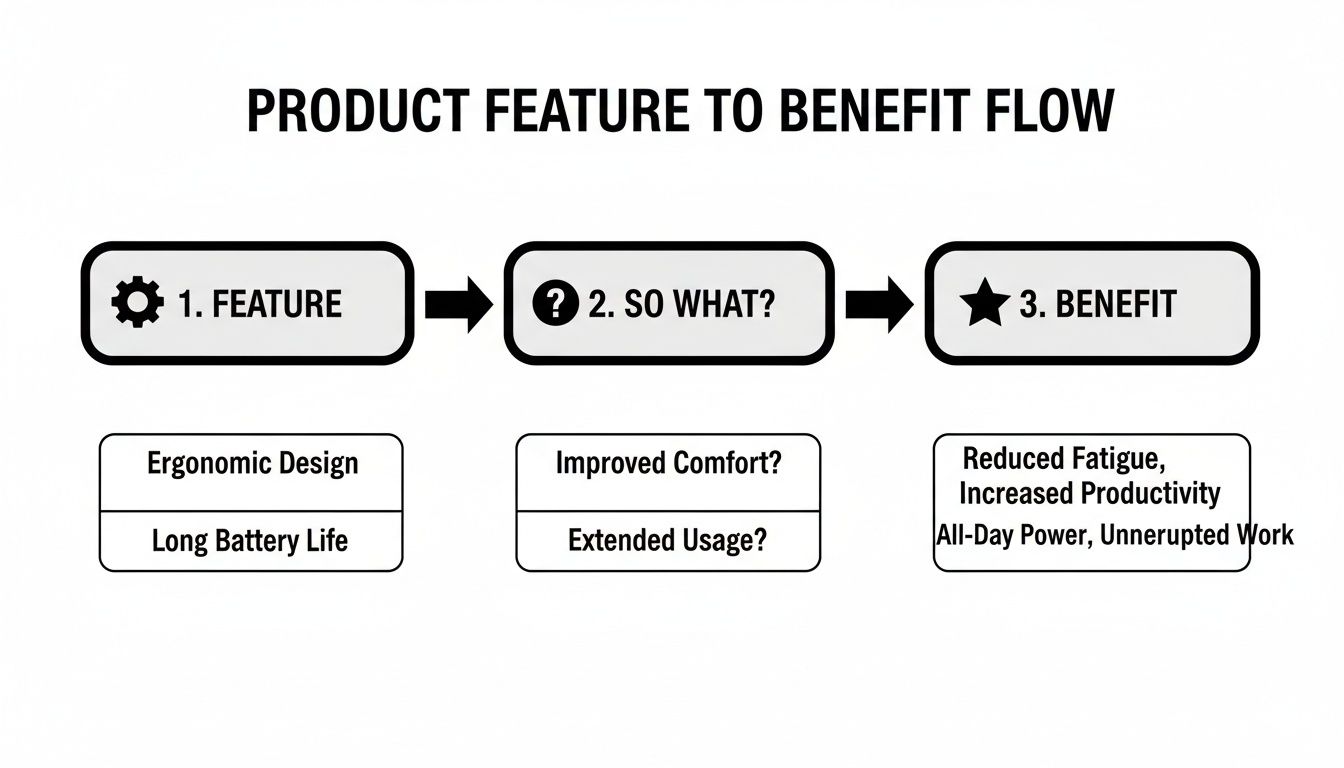
This flow from Feature to "So What?" to Benefit is a killer way to craft compelling copy that both shoppers and search engines will love.
Harnessing Structured Data with Product Schema
Beyond just keywords, you can give search engines even more specific information using something called product schema. This is a type of structured data that tells Google exactly what your page is about—a product—and provides key details like price, availability, and review ratings right in the search results.
This not only makes your listing more visible but can seriously increase your click-through rate. A search result with a star rating and price is way more appealing than a plain text link.
Platforms like Shopify handle a lot of this for you automatically, while WordPress users can easily set it up with SEO plugins like Rank Math. As search engines continue to evolve, it's more important than ever to understand how your content appears in new formats. Learning how to rank in Google AI Overviews can help you stay ahead of the curve.
Using AI and Templates to Work Smarter
Let's be honest: writing unique, compelling descriptions for dozens—or hundreds—of products is a massive bottleneck. It’s the kind of repetitive work that can bring any e-commerce project to a grinding halt.
This is where you bring in the tools. Think of AI like ChatGPT or Jasper as your creative assistant—a junior copywriter who's fantastic at brainstorming but still needs your expert eye to finalize the work.
These tools are brilliant for beating writer's block. Instead of staring at a blank page, you can generate a few drafts in seconds, explore different benefit angles, or play with various tones of voice. Getting that initial momentum is often the hardest part, and AI gets you over that first hurdle instantly.
But here’s the critical mistake I see people make: they rely on AI to do all the work. The raw output is almost always generic. It lacks the brand voice, emotional spark, and sensory details that actually connect with a customer and drive a sale. Your job is to take that AI draft and inject the human expertise.
A Practical AI-Assisted Workflow
To make AI a useful partner instead of a crutch, you need a clear process. Don't just type "write a product description" and hope for the best. You have to feed it the right ingredients to get a quality result you can then polish into something great.
Here’s a simple, effective workflow I use:
- Provide Rich Context: Give the AI your target audience persona, the key features, and the primary benefit you want to highlight. For instance, tell it you're writing for "busy urban professionals who value convenience and time-saving features."
- Request Specific Formats: Ask for the exact pieces you need. I often ask for a headline, a short intro paragraph, and five benefit-oriented bullet points. This breaks the task into manageable chunks and gives you a structured starting point.
- Humanize and Refine: This is where you earn your keep. Edit the generated text to match your brand's unique voice. Triple-check every technical detail for accuracy, and weave in the sensory language and emotional connection that AI almost always misses.
The goal is to use AI for the grunt work of drafting. This frees you up to focus on the high-value tasks of polishing, personalizing, and fact-checking. A clear process like this is a core part of building an efficient workflow, much like when you set out to create a content strategy for your entire brand.
The demand for these tools is exploding. The AI text generator market was valued at USD 392.0 million in 2022 and is projected to hit USD 1,402.3 million by 2030, driven largely by e-commerce. In fact, the e-commerce segment alone captured 24.6% of revenues in 2022 as stores use these tools to automate descriptions.
A Battle-Tested Product Description Template
While AI helps with the initial draft, a solid template ensures you never miss a critical element. A consistent structure helps customers find what they need fast and guides them logically toward making a purchase.
This template is a great starting point you can adapt for almost any product. It’s built to be scannable, persuasive, and optimized for both real shoppers and search engines.
Headline: Lead with the primary benefit.
Example: Get a Full Night's Sleep on Our Cooling Memory Foam MattressIntro Paragraph (2-3 sentences): Set the scene and connect with the customer's problem or desire.
Example: Tired of tossing and turning on a mattress that traps heat? The Arctic Dream Mattress is engineered with gel-infused foam to actively pull heat away from your body, ensuring you stay cool and comfortable all night long.Benefit-Driven Bullet Points (3-5 points): Translate key features into clear benefits. Use bold text to highlight the main takeaway of each point.
- Stay Cool All Night: Our proprietary gel foam disperses body heat, preventing overheating and night sweats.
- Pressure-Relief Comfort: Layers of adaptive foam contour to your body, relieving pressure on your hips and shoulders for a pain-free morning.
- No More Motion Transfer: Sleep soundly even if your partner moves. Our base layer absorbs movement so you won’t be disturbed.
Closing Paragraph (1-2 sentences): Reiterate the core value and build confidence in the purchase.
Example: Join over 10,000 happy sleepers who have transformed their nights with the Arctic Dream. It's time to invest in the restorative sleep you deserve.Call to Action (CTA): Tell the customer exactly what to do next.
Example: Add to Cart & Experience a Cooler Sleep Tonight
This structure covers all the bases. It hooks the reader, solves their problem, provides scannable proof, and gives them a clear, unmissable next step.
Testing and Refining Your Copy to Boost Sales
Let’s be honest: your first draft of a product description is never the final one. It’s just the starting line. The real difference between a product page that just sits there and one that consistently drives more revenue is a commitment to data. It’s about ditching guesswork and letting your customers tell you what works.
This all starts with a simple but incredibly powerful technique: A/B testing, sometimes called split testing. The idea is a breeze to understand. You create two versions of your product description (we’ll call them Version A and Version B), show each to a different slice of your audience, and see which one performs better.
This approach takes all the subjectivity out of the equation. Your customers, through their actions, will tell you exactly which words are the most convincing. You’d be amazed how tiny tweaks in wording, tone, or structure can lead to massive shifts in how people behave.
What to Test for Maximum Impact
Figuring out what to test can feel like a huge task, but there’s one golden rule: only change one element at a time. If you switch up the headline, the bullet points, and the call-to-action all at once, you’ll have no idea which specific change actually made the difference.
Kick things off by testing the elements that have the biggest sway over a buyer's decision. Here are a few high-impact ideas to get you started:
- Your Headline: Pit a benefit-focused headline against a more descriptive one. For example, which works better? "Experience Blissful, Uninterrupted Sleep" or "Premium Cooling Gel Memory Foam Mattress."
- The Call-to-Action (CTA): Play around with different verbs and a sense of urgency. "Add to Cart" is the old standby, but what about "Claim Your Comfort Now" or "Start Sleeping Better Tonight"? The latter might create a much stronger emotional connection.
- Benefit Order: The very first benefit in your bullet points usually grabs the most attention. Try reordering your list to see if leading with a different key feature improves how people engage with the page.
- Tone of Voice: Test a playful, conversational tone against one that’s more professional and to the point. This can reveal some surprising truths about what really connects with your specific audience.
- Description Length: Does a short, punchy description work better than a more detailed, in-depth version? The only way to know is to test whether your customers prefer a quick summary or all the nitty-gritty details.
By isolating these variables, you can gather clean, actionable data on what truly gets your shoppers to pull the trigger on a purchase.
Tools and Metrics for E-commerce Platforms
The good news is you don’t need a degree in data science to run effective A/B tests. Most modern e-commerce platforms have built-in tools or easy-to-use apps that handle all the heavy lifting for you.
For Shopify store owners, apps like Neat A/B Test or Shogun Page Builder make it incredibly simple to set up experiments right on your product pages. If you're running on WordPress with WooCommerce, plugins like Nelio A/B Testing or even Google Optimize (which integrates easily) offer powerful testing features.
Once your test is live, you need to know what to measure. Sure, the end goal is always more sales, but focusing on a few key metrics will give you the full story:
- Conversion Rate: This is the big one—the percentage of visitors who actually make a purchase.
- Add-to-Cart Rate: This shows how many visitors add the product to their cart. It’s a great indicator of initial interest and intent to buy.
- Click-Through Rate (CTR) on the CTA: This tells you how compelling your call-to-action button is.
Keeping an eye on these numbers helps you build a complete picture of your store’s performance. For a closer look at the foundational metrics, our guide on how to track website traffic offers a solid starting point.
Remember, testing is an ongoing process of refinement, not a one-and-done task. Each test gives you a new piece of the puzzle, an insight you can use to make your next description even better. It’s a cycle of continuous improvement.
Beyond just the copy, a full-circle approach to boosting sales involves the bigger picture of e-commerce conversion. For a wider view on improving sales, check out this practical guide to improving e-commerce conversion rates. By consistently testing and learning, you stop guessing what works and start making informed decisions that directly grow your revenue.
Got questions? Good. Even with a solid plan, a few common sticking points always seem to crop up right when you’re in the creative zone. Let’s tackle some of the most frequent questions I get from e-commerce owners so you can keep writing with confidence.
How Long Should a Product Description Be?
There’s no magic number that fits every product, but a great starting point is somewhere in the 150-300 word range. This gives you enough room to hit the key benefits, weave in a little story, and sprinkle in your SEO keywords without making your customer’s eyes glaze over.
That said, if you’re selling something highly technical—like a professional camera or specialized industrial gear—you’ll need more space. The goal is to answer every single question a potential buyer might have. The trick is to keep it scannable. Use short paragraphs and plenty of bullet points to make sure all that crucial info is easy to digest, especially on a phone.
Can I Use the Manufacturer's Description?
I’m going to be blunt here: avoid using the manufacturer's description at all costs. It’s a huge missed opportunity.
First, copying and pasting that text creates duplicate content. Search engines like Google can penalize your site for this, which means you’re shooting your own SEO in the foot. But more importantly, those descriptions are almost always dry, generic, and packed with features instead of benefits. They don't have your brand's voice, and they certainly don't speak to your specific customer.
Writing a unique description is your chance to stand out from every other retailer selling the exact same thing.
Using the manufacturer's description is like showing up to a party wearing the same outfit as ten other people. It's your chance to tell a better story, connect with your audience, and give shoppers a real reason to buy from you.
What Are the Biggest Mistakes to Avoid?
Beyond the duplicate content trap, a few other common missteps can absolutely kill your sales. Steer clear of these, and you’ll be miles ahead of the competition.
Here are the top offenders I see all the time:
- Listing Features, Not Benefits: Nobody cares about a "1-inch sensor." What they care about is taking "stunningly clear photos, even when the lights are low." Always connect the feature to the real-world benefit.
- Relying on Empty Clichés: Words like "high-quality" are meaningless fluff. Prove it. Instead of saying that, try something like, "crafted from full-grain Italian leather that develops a rich, beautiful patina over time." See the difference?
- Writing a Wall of Text: Huge, dense paragraphs are a nightmare to read, especially on mobile (where most people are shopping). Keep your paragraphs short—just a sentence or two—and break things up with bullet points.
- Forgetting Basic SEO: You could write the most persuasive description in the world, but if it doesn't include the keywords your customers are actually searching for, no one will ever find it.
- Ending with a Whimper: Don't just let the description trail off. Give your customer a clear next step. A strong call-to-action like "Add to Cart & Transform Your Morning Routine" guides them and closes the deal.
At Website Services-Kansas City, we specialize in crafting SEO-driven content and building websites that not only look great but also perform. If you're ready to turn your product pages into powerful sales tools, we can help.
Explore our professional website development and SEO solutions.
