
Strategic link building isn't about collecting as many backlinks as you can get your hands on. It's the art of earning high-quality, relevant links back to your website. For a new site, this process is probably the single most important factor in building credibility with search engines and getting noticed in a very crowded digital world.
Why Link Building Is Your New Website’s Foundation
Launching a new website can feel a lot like opening a shop in a ghost town. You might have the best products or the most brilliant content, but if there are no roads leading to your front door, you're going to stay invisible. Strategic link building is how you build those roads.

Forget the outdated, spammy tactics from a decade ago. Modern link building is all about building a long-term foundation for your site's reputation. Every high-quality backlink you earn is like a vote of confidence from another website, telling search engines like Google that your content is trustworthy, valuable, and deserves to be seen.
To put it simply, outdated link building was about quantity and shortcuts. Modern, strategic link building is about quality and building real relationships.
Here’s a quick summary comparing the old way with the new.
Modern vs Outdated Link Building at a Glance
| Tactic Type | Description | Risk Level | Long-Term Value |
|---|---|---|---|
| Modern (White Hat) | Earning links naturally through high-value content, guest posting on relevant sites, and building genuine relationships. | Low | High – Builds lasting authority and trust. |
| Outdated (Black Hat) | Buying links in bulk, using private blog networks (PBNs), or adding links to spammy directories and forums. | Very High | None – Often leads to penalties and de-indexing. |
Sticking to modern, white-hat strategies is the only way to build a brand that lasts. It protects your site from penalties and creates a foundation of authority that pays dividends for years to come.
Moving Beyond Simple Link Counts
It’s not about how many links you get; it’s about where you get them from. A single link from an authoritative, highly relevant site in your industry is far more powerful than a hundred links from low-quality, random directories. This is because search engines are smart enough to prioritize signals that demonstrate real expertise and trust.
For new websites, this process directly shapes your site's perceived authority. As you earn these relevant backlinks, you'll see a gradual increase in what's known as what Domain Authority means, a key metric that helps predict your site's ability to rank.
The harsh reality is that most content goes completely unnoticed. Without a proactive strategy to build links, even the most brilliant articles and guides will likely fail to gain any traction and contribute to your business goals.
The Sobering Statistics of Online Content
The competition for attention online is absolutely brutal. A massive analysis of web content revealed a shocking fact: a staggering 94% of all web pages get zero external backlinks.
That means for every 100 articles published, 94 of them remain practically invisible to search engines when it comes to authority signals. This stat hammers home why a passive "if you build it, they will come" approach is a surefire recipe for failure in today's world.
This playbook will give you a clear, step-by-step approach to strategic link building, focusing on the modern techniques that actually deliver real results. We’ll cover everything from creating content people want to link to, all the way to executing outreach that gets a response.
Creating Content That People Actually Want to Link To
You can't start a fire without wood. In the world of strategic link building, your content is the fuel. Before you write a single outreach email or even think about asking for a link, you need a solid foundation of "linkable assets"—content so genuinely valuable that other websites feel compelled to reference it.
This means moving beyond your standard blog posts and creating resources that serve a real, tangible purpose for your audience.
This principle is the core of earning backlinks naturally. When you create something truly useful, unique, or authoritative, the need for aggressive outreach shrinks because you’ve already given them a compelling reason to link to you.
The goal is to become a primary source of information, not just another blog repeating what’s already been said.
Brainstorming Your First Linkable Asset
The best linkable assets solve a tough problem, answer a complex question definitively, or present data in a new and interesting way. Yes, they require more effort than a typical blog post, but the return on that investment is exponentially higher.
Instead of just guessing what might work, start by analyzing what already resonates within your niche. For example, a Kansas City-based marketing agency could create an interactive map of the city's top digital networking events. This isn't just another blog post; it's a dynamic tool that local business blogs and event organizers would be genuinely eager to share with their audiences.
Here are some proven types of content that consistently attract high-quality backlinks:
- Original Data and Research: Conduct your own survey, analyze industry trends, or compile public data into a unique report. A study on "The Rise of E-commerce in Midwest Small Businesses" would be a magnet for links from business journals and marketing blogs.
- Comprehensive Guides and Tutorials: Aim to create the single best resource on a specific topic. If your competitors have "10 Tips for X," you create "The Ultimate Guide to X," complete with videos, infographics, and downloadable checklists.
- Free Tools and Calculators: Develop a simple, web-based tool that solves a common problem. For a real estate agent, this could be a "Kansas City Mortgage Affordability Calculator." These kinds of assets can earn links for years because of their sheer utility.
- Curated Local Resources: Compile a "best of" list or a detailed local guide. Think "The Definitive Guide to Kansas City's Co-working Spaces," packed with pricing, amenities, and real user reviews.
This initial investment in creating high-value content is what separates a frustrating, low-return link building campaign from a wildly successful one.
Creating genuine value is the first and most critical step. Your content must be optimized and ready to act as a magnet for high-quality backlinks before you begin any outreach. This foundational work ensures your efforts will be rewarded.
Building Content with "Link Intent"
Once you have a great idea, you need to build it with "link intent." This just means structuring your content in a way that makes it incredibly easy and desirable for others to cite.
Put yourself in the shoes of a journalist or blogger looking for a source. They need statistics to quote, charts to embed, and expert definitions to reference. By baking these elements directly into your content, you make their job easier—and your content far more linkable.
Key elements to include for link intent:
- Specific, quotable statistics: Bold key numbers like "73% of small businesses in our survey reported…"
- Visual assets: Simple charts, graphs, and infographics are highly shareable and almost always get linked back to the original source.
- Clear definitions: Provide concise, expert definitions for key industry terms. This positions you as an authority they can lean on.
- Expert roundups: Feature quotes from other experts in your field. They are highly likely to share and link to the content they're featured in.
For instance, a Kansas City web design firm could publish a data study on local website performance, highlighting that "local businesses with websites loading in under 2 seconds see a 15% higher conversion rate." That single, bolded statistic is a perfect "link trigger"—a bite-sized piece of data that another blog can easily grab and cite.
Optimize Your Asset for Discovery
Finally, before you can expect anyone to link to your content, they need to be able to find it. This involves basic on-page SEO to ensure it's visible to both search engines and the people who might want to link to it.
Your content should be structured logically with clear headings (H2s and H3s) and a descriptive URL. The title needs to be compelling and accurately reflect the content's value. Properly optimizing your page signals to Google that it's a high-quality resource, which increases its chances of ranking and being discovered organically over time. For a deeper dive into this organic approach, explore our guide on how to build backlinks naturally.
By focusing on creating exceptional value first, you fundamentally change the link building dynamic from asking for favors to offering a valuable resource.
Finding High-Quality Link Opportunities
Okay, you've created some genuinely valuable, link-worthy content. Now for the fun part: finding the right websites to target.
This isn't about blasting your link to hundreds of random sites and hoping something sticks. That's a rookie mistake. This is detective work—a focused process of identifying prospects where your content provides real, tangible value.
A single, relevant link from a trusted site in your niche is worth more than dozens of links from irrelevant, low-authority domains. Quality over quantity is the golden rule here.
It’s time to put on your prospector's hat and start digging for gold.
Reverse Engineer Your Competitors' Success
One of the most efficient ways to get started is to simply see who’s already linking to your competitors. It's a bit of digital snooping that pays off big time.
If a website links to a similar piece of content from a rival, they’ve already shown they’re interested in your topic. This makes them a warm prospect for your outreach—not a cold call.
Tools like Semrush or Ahrefs are your best friends here. Just plug in a competitor's URL, and you'll get a complete list of their backlinks. Suddenly, you have a ready-made list of websites that are actively linking to content in your industry.
Actionable Insight: Don't just look at who links to your competitors' homepages. Dive deeper and analyze which specific pages or blog posts are earning the most links. If a competitor's "Ultimate Guide to BBQ in KC" has 50 links, that's a clear signal that a better, more comprehensive guide on that topic could be a huge win for you. Create your superior version and reach out to the same sites, showing them why your resource is now the best one available.
But don't just copy their list. Look for patterns. Are they getting links from specific types of blogs, local news sites, or industry resource pages? This intelligence helps you refine your strategy and uncover entire categories of link opportunities you might have missed.
Hunt for Local and Niche Resource Pages
So many websites curate "resource pages" or "useful links" lists for their audience. Finding these pages is like discovering a directory of pre-qualified link prospects. These webmasters are actively looking for high-quality content to share with their readers.
For a local business, this tactic is incredibly powerful. A Kansas City-based company could search for terms like:
- "kansas city business directory"
- "best kansas city resources" + "your industry"
- "local kansas city links" + "your industry"
These simple searches can uncover hyper-relevant opportunities on local chamber of commerce sites, community blogs, and business directories that are eager to feature a new local venture. These links aren't just relevant; they send strong local signals to search engines.
Actionable Insight: Use advanced search operators to find these pages more effectively. Try searching Google for inurl:resources "kansas city" + "your keyword" or intitle:"useful links" "kansas city". This filters out the noise and takes you directly to the pages you're looking for.
Uncover Opportunities Through Digital PR
Beyond direct prospecting, a huge chunk of high-authority links are earned through digital PR. This strategy involves creating something genuinely newsworthy—like an original data study or a unique industry insight—and promoting it to journalists, bloggers, and publications.
In fact, the top tactic used by 67.3% of marketers for link building is digital PR, focusing on landing links from news sites and magazines. This approach positions your brand as an authority, leading to powerful, natural mentions. You can discover more insights about these link building statistics to see just how big its impact is.
Vetting Your Prospect List
Once you have a list of potential targets, the final step is vetting. Not every opportunity is a good one. A quick quality check ensures your outreach efforts are spent on prospects that will actually move the needle.
Before adding a site to your final outreach list, ask these three questions:
- Is it relevant? Does the site's content align with your industry and audience? A link from a completely unrelated site holds very little weight.
- Does it have authority? Use an SEO tool to check its Domain Authority or Authority Score. Focus on sites with a respectable score, indicating they are trusted by search engines.
- Is it a legitimate site? Does the website look professional and have a real audience? Avoid sites that look spammy or exist only to sell links.
Building a carefully vetted prospect list is the foundation of an effective outreach campaign. While some marketers turn to services to find a guest posting site, doing your own diligent research ensures every link you pursue aligns perfectly with your strategic goals. This meticulous process prevents wasted effort and maximizes the impact of your link building.
Crafting Outreach That People Actually Reply To
So, you’ve created some truly phenomenal content and have a solid list of potential link prospects. Now comes the most human part of the whole process: the outreach. This is where so many link-building efforts completely fall apart, disappearing into an abyss of generic, automated emails that get deleted in a heartbeat.
Great outreach feels less like a cold transaction and more like the start of a genuine professional conversation. Your goal is to stand out by being respectful, personal, and focused on providing real value. It’s time to ditch the mass-produced templates and get personal.
That simple shift in mindset—from "I need to get a link" to "I want to build a relationship"—is the secret to long-term success. The connection you make today could easily turn into multiple opportunities down the road, from future collaborations to more natural backlinks. If you want to dive deeper into this, our guide on how to leverage SEO guest posts is packed with insights on building these kinds of partnerships.
Before a single email goes out, you need a repeatable workflow for prospecting. It's a simple process: analyze potential sites, find the right person to contact, and vet them to make sure they're a good fit.
This flowchart breaks down the simple, three-step link prospecting process you should follow every time.
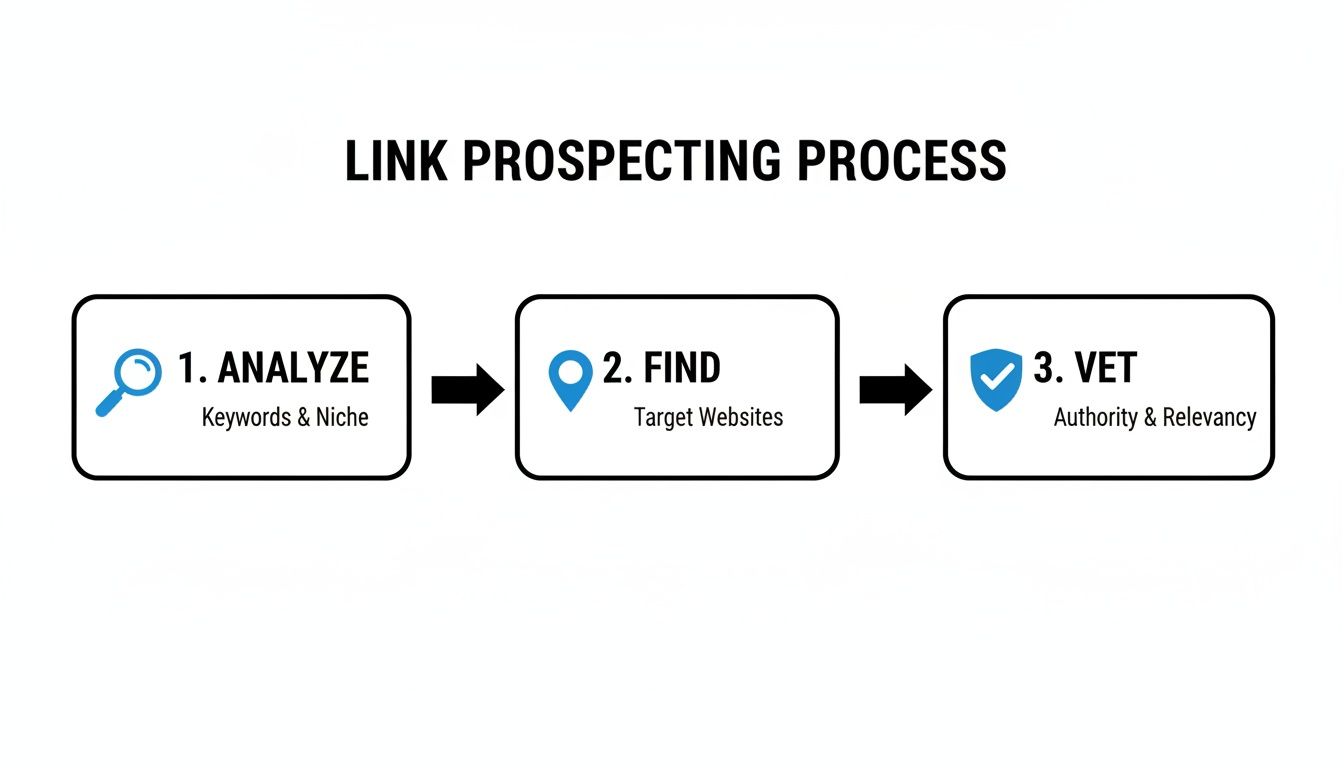
Following a system like this ensures every email you send is aimed at a well-researched, highly relevant prospect, which massively boosts your chances of getting a reply.
The Anatomy of an Outreach Email That Works
Look, nobody has time to read a novel about your company. You have just a few seconds to grab their attention and prove you’re not another spammer clogging up their inbox. The best emails are concise, personal, and show their value right away.
I've sent thousands of these emails, and the ones that work almost always follow a similar structure. Here’s a breakdown of the key components that get the job done.
| Email Component | Purpose & Best Practice | Example Snippet |
|---|---|---|
| A Specific Subject Line | Grab attention without being clickbait. Mentioning their site or a specific article shows you've done your homework. | Quick thought on your article about KC startups |
| The Personalized Opening | Prove you’re a real person who has actually read their stuff. Reference a specific point from their content that you genuinely liked. | Hi [Name], I really enjoyed your recent post on local KC breweries. Your point about Boulevard's seasonal releases was spot on! |
| The Value Proposition | Quickly explain why you’re contacting them. This is where you introduce your content as a helpful resource for their audience. | Since you write about local business, I thought you might find our new data study on consumer spending in Kansas City interesting. |
| The Simple Request | Make your ask clear, direct, and easy. Don't be vague. Politely suggest where your link could add value to their existing content. | Would you consider adding a link to our study in your post? No worries if not, but I thought it could be a great resource for your readers. |
This structure is effective because it respects their time and puts their audience's needs first. You're not just begging for a link; you're offering a relevant resource that genuinely enhances their work.
Going Beyond the Template
The snippets above give you a solid framework, but the real wins come from genuine personalization. Before you hit send, ask yourself this one question: Could this same email be sent to a hundred other people just by changing the name?
If the answer is yes, you need to dig deeper.
- Reference a Social Post: "Saw your recent post on X about SEO tools and had to reach out…"
- Mention a Podcast Appearance: "Heard you on the [Podcast Name] last week and loved your take on…"
- Find Common Ground: "As a fellow Kansas City business owner, I appreciated your article on…"
These small, personal touches show you’ve actually invested time in understanding who they are, making them far more likely to invest their time in reading what you have to say. For more ideas on how to stand out, it's worth checking out some effective cold email templates that are designed specifically to get replies.
Tracking and Following Up
Good outreach is organized outreach. You don’t need a fancy CRM to get started; a simple spreadsheet will do the trick. Just track the website, contact name, email, date of first contact, and the date for your follow-up. This simple step keeps you from sending duplicate emails or forgetting to follow up entirely.
Sending a single, polite follow-up 5-7 days after the first email is perfectly fine. A quick, friendly bump can often catch someone who was just too busy to reply the first time around.
Patience is a crucial virtue in link building. It's not about immediate wins but consistent, thoughtful effort over time. The relationships you build are as valuable as the links themselves.
It’s also important to set realistic expectations. Success in link building doesn't happen overnight. In fact, one study found that 57.1% of SEO professionals typically see tangible results from their link-building efforts within a 1-3 month timeframe. It just goes to show that persistence pays off.
How to Measure Your Link Building Success
You’ve done all the hard work—creating killer content, sending out carefully personalized emails, and building relationships. So, what now? How do you actually know if all that effort is paying off?
Measuring the success of a strategic link building campaign goes way beyond just counting how many new links you got. True success is about the real, tangible impact those links have on your business. It's time to move past the vanity metrics and zero in on the key performance indicators (KPIs) that truly matter. These are the numbers that prove your strategy is building a foundation for sustainable growth.
Key Performance Indicators That Matter
When you're trying to figure out what's working, you need to look at a balanced set of metrics. Each one tells a different piece of the story, from the immediate boost in traffic to the slow-burn growth of your site's authority over time.
These KPIs give you the full picture of your campaign's performance:
- Referral Traffic: Are real people actually clicking on the links you’ve built? Jump into your Google Analytics and see how much traffic is coming from the sites that now link to you. A great link doesn't just pass SEO value; it sends you relevant, engaged visitors.
- Keyword Ranking Improvements: Keep a close eye on the search rankings for the specific pages you're building links to. If you built links to your "Kansas City SEO services" page, is it starting to climb the results for those keywords? This is a direct sign that Google is recognizing those new authority signals.
- Organic Traffic Growth: At the end of the day, the goal is more visibility. Is your website's overall organic traffic on an upward trend? While lots of things can influence this, a successful link building campaign is one of the primary drivers of long-term organic growth.
- Domain Authority (DA) or Authority Score (AS): Track your site's authority metric in tools like Moz or Semrush. While it’s a third-party score, a steady increase over time is a great indicator that your efforts are building your site's overall credibility in the eyes of search algorithms.
Proactive Risk Management and Profile Monitoring
Let's be real: not all links are created equal. A huge part of strategic link building is actively managing risk and making sure you aren't accidentally attracting low-quality or spammy backlinks that could wreck your site's reputation with Google. It’s all about building a strong, healthy foundation.
Proactively monitoring your backlink profile isn't optional—it's non-negotiable. You have to know who is linking to you at all times. This regular check-up helps you spot potential problems before they turn into full-blown crises.
A healthy backlink profile is your site's immune system. Ignoring it leaves you vulnerable to penalties and ranking drops. Regular monitoring is the best preventive medicine for your SEO.
To keep your profile squeaky clean, get into the habit of regularly reviewing your incoming links. You can learn how to check backlinks in Google directly through Search Console, which gives you a straight look at how the search engine sees your site. This is how you identify and disavow any toxic links that could be holding you back.
The Financial Impact of a Coordinated Strategy
Putting money into link building isn't just another line item on a budget; it's a direct investment in your site's growth engine. The data consistently shows a powerful connection between dedicated link building and significant traffic increases.
For example, businesses that allocate around 28% of their SEO budget to link building often see some seriously impressive returns. Those that manage to acquire 30-35 quality backlinks can average over 10,500 monthly visits, showing a clear path from getting a link to growing your audience. You can dig into more data on the impact of link building budgets to get a better sense of the potential ROI.
By tracking these essential KPIs and actively managing your backlink profile, you can confidently measure the real-world success of your campaigns. This data-driven approach ensures your efforts are not just building links, but building a stronger, more visible business.
Common Link Building Questions Answered
When you're first dipping your toes into link building, it's totally normal for questions to bubble up. Let's tackle some of the most common ones I hear, so you can move forward with your first campaigns feeling a lot more confident.
How Many Backlinks Do I Actually Need?
This is easily one of the most asked questions, and the honest-to-goodness answer is: it depends. There’s no magic number. Instead of getting hung up on a specific count, your focus should be on the quality and relevance of the links you're earning.
One single, powerful link from an authoritative site in your industry can move the needle far more than 50 low-quality links from random directories. A much better goal is to aim for a steady, consistent flow of high-quality links over time. The best way to get a realistic benchmark is to analyze your top competitors—that'll show you what it really takes to compete in your space.
Is It Better to Build Links Myself or Hire an Agency?
Doing it yourself is a fantastic way to learn the ropes of SEO. You get to control every single aspect of your brand's outreach, and it ensures every interaction is completely authentic. It's also cost-effective, but be prepared—it demands a serious investment of time and comes with a steep learning curve.
On the other hand, hiring a specialized agency brings expertise, proven workflows, and valuable industry connections right to your doorstep. This is quickly becoming the go-to path for businesses that need to scale their efforts without the internal overhead. In fact, projections show that by 2026, a whopping 60% of businesses will outsource their link building, simply because they recognize the specialized skill set it requires.
What’s the Difference Between No-Follow and Do-Follow Links?
A do-follow link is the standard type of backlink you're aiming for. It passes authority (or "link equity") from one site to another, and these are the links that have the most direct impact on your search engine rankings.
A no-follow link has a small bit of code (rel="nofollow") that tells search engines not to pass that authority along. You’ll find these all over the place in blog comments, forums, and on social media. While they don't give you that direct SEO boost, they can still drive a ton of valuable referral traffic and get your brand name out there. A natural, healthy backlink profile will always have a mix of both.
How Long Does It Take to See Results?
Link building is a marathon, not a sprint. While you might see a nice little bump in referral traffic right after landing a great link, the real impact on your keyword rankings and organic traffic takes time to build up.
As a general rule, you can expect to see noticeable, positive movement within 3 to 6 months of consistent, high-quality link building. Patience and persistence are everything here.
This timeline can shift based on how competitive your industry is, the quality of your content, and the authority of the links you're building. If you're looking for a solid foundation, this is a great resource for understanding what a link building strategy entails. Ultimately, this is all about building a sustainable foundation for long-term growth, not chasing quick, fleeting wins.
At Website Services-Kansas City, we specialize in building the high-quality, natural backlinks that drive real growth for your business. Let us handle the complexities of SEO so you can focus on what you do best. https://websiteservices.io
