
A link audit SEO strategy is a comprehensive health check for your website's online reputation. It’s a deep dive into every single site that links to yours, designed to find and neutralize harmful links while ensuring you preserve the ones that are genuinely helping you rank.
Think of it as the first step in diagnosing why your traffic has plateaued, suddenly dropped, or simply isn't growing as expected. Mastering this process is fundamental to any long-term SEO success.
Why a Link Audit Is Your SEO Secret Weapon

It’s a common story: a local business owner launches a fantastic new website, but it languishes on page five of Google, struggling for visibility. More often than not, an invisible anchor is holding them back—a messy, unmanaged backlink profile built up from old SEO tactics or negative attacks.
Backlinks are supposed to be votes of confidence from other websites, but not all votes are equal. Some are powerful endorsements; others are pure digital spam.
A proper link audit goes beyond simply counting your links. It helps you understand the story your backlinks are telling Google. Think of it as spring cleaning for your site's reputation. You must systematically sort through every link to determine its true value, keeping the strong, relevant ones and neutralizing the toxic junk that’s dragging you down.
Uncovering Hidden Risks and Opportunities
Flying blind with your backlink profile is a critical SEO mistake. Without an audit, you might have dozens of low-quality links from spammy directories or irrelevant foreign blogs pointing to your site, and you wouldn't even know it. These "toxic" backlinks can actively damage your credibility with search engines, leading to penalties or suppressing your rankings.
A thorough link audit process accomplishes several critical goals:
- Identifies Harmful Links: It shines a bright light on the spammy, irrelevant, or manipulative links that could land you a Google penalty.
- Protects Your SEO Investment: By cleaning up your link profile, you’re safeguarding the hard work you've invested in content creation and on-page optimization.
- Reveals Competitive Gaps: Analyzing your competitors' backlink profiles can uncover high-quality link-building opportunities you’re currently missing.
- Builds a Strong Foundation: A clean profile ensures your future link-building efforts are far more effective, setting you up for sustainable growth.
A classic mistake is focusing only on building new links without ever looking at the ones you already have. A link audit isn't just a defensive move; it’s a proactive strategy that clears the path for future success by making sure your foundation is rock-solid.
The Real-World Impact of a Clean Profile
The results of a diligent link audit can be dramatic. Imagine discovering your e-commerce site has been weighed down by toxic backlinks from shady directories you never knew existed. By disavowing them, you can remove the negative weight and open the floodgates for organic growth.
For instance, a local service business might see a 20% jump in organic leads within three months of cleaning up a profile filled with old, spammy forum links. This happens because Google can finally recognize the true value of their legitimate, high-quality links. Pruning low-quality backlinks and focusing on acquiring relevant ones can lead to first-page rankings for a host of valuable keywords.
Ultimately, a link audit gives you clarity and control over your backlink profile. It allows you to stop reacting to ranking drops and start proactively shaping your profile into a powerful asset that boosts your authority and drives organic traffic.
Gathering Your Complete Backlink Profile
To execute a link audit that actually improves your rankings, you need the complete picture, not just a partial snapshot. A common pitfall is relying solely on the free data from Google Search Console. While GSC is an essential starting point, it often provides an incomplete view, sometimes missing a significant portion of the links pointing at your site.
Relying on a single source is like trying to solve a puzzle with half the pieces missing. You’re guaranteed to miss critical toxic links or overlook valuable opportunities. That’s why a professional link audit SEO process always involves pulling data from multiple, powerful sources.
Building Your Master Backlink Database
The goal here is to create a single, comprehensive spreadsheet that acts as your command center for the entire audit. This "master file" will combine exports from several industry-standard tools, giving you the most complete dataset possible.
Start by exporting your link data from these three key platforms:
- Google Search Console (GSC): This is your baseline. It's Google's direct data on what it sees linking to your site. The export is straightforward and gives you a solid, free foundation.
- Semrush: Known for its massive link index, Semrush is invaluable for finding links that GSC misses. Its Backlink Analytics report is essential for a thorough review.
- Ahrefs: Another powerhouse, Ahrefs boasts one of the most active web crawlers, second only to Google. It frequently uncovers unique referring domains that other tools don't catch.
By combining reports from GSC, Semrush, and Ahrefs, you create a powerful, triangulated view of your backlink profile. This method ensures that very few links—good or bad—slip through the cracks. For an in-depth guide, you can also explore other ways of how to find backlinks on Google.
Here's a quick look at the essential tools for gathering backlink data, highlighting what makes each one valuable for your audit.
Comparing Top Backlink Analysis Tools
| Tool | Primary Strength | Cost | Best For |
|---|---|---|---|
| Google Search Console | Free, direct data from Google | Free | Establishing a baseline and seeing what Google prioritizes. |
| Semrush | Massive link index & competitive analysis | Paid | Uncovering links GSC misses and analyzing competitor profiles. |
| Ahrefs | Most active crawler, fresh data | Paid | Finding the newest links and unique referring domains. |
Pulling from all three gives you the most robust dataset possible, ensuring you're not operating with any major blind spots.
Combining and Cleaning Your Data
Once you have your CSV exports, the next step is to merge them into one Google Sheet or Excel file. This is where the real work begins. You'll need to remove duplicate entries, as all three tools will almost certainly report many of the same links.
Actionable Tip: Use the "Remove Duplicates" function in your spreadsheet software, targeting the column containing the referring page URLs. This simple action instantly cleans up your list, leaving you with a unique set of all known backlinks.
After de-duplicating, your master file is ready. This consolidated document is the foundation for the entire audit. It’s a complete inventory that allows you to analyze every single link pointing to your website from a single, organized dashboard.
This meticulous data-gathering phase is non-negotiable for a serious link audit. It transforms an overwhelming task into a manageable process and sets the stage for accurately identifying which links are assets and which are liabilities. Don't skip this step; the quality of your analysis depends entirely on the completeness of your data.
Analyzing Each Backlink for Quality
You’ve gathered all your backlink data into one master spreadsheet. Now comes the analytical phase. This is where you transition from data collection to making informed judgments about what’s helping your SEO and what’s hurting it.
This part of a link audit is less about automated scores and more about developing a keen eye for quality. You're learning to separate genuine endorsements from the digital junk that could be dragging your site down.
Looking Past the Surface-Level Metrics
Your spreadsheet is likely filled with columns like Domain Authority (DA), Spam Score, and other metrics from your tools. While these numbers provide a useful starting point, they are not the whole story.
A high DA doesn't automatically mean a link is good, and a low Spam Score doesn't guarantee it's safe. You have to dig deeper. A truly expert analysis—one that actually protects your rankings—comes from looking at each link through several qualitative lenses.
This quick flowchart can help you decide which tool to lean on, depending on whether you're just kicking the tires or ready for a full-blown investigation.
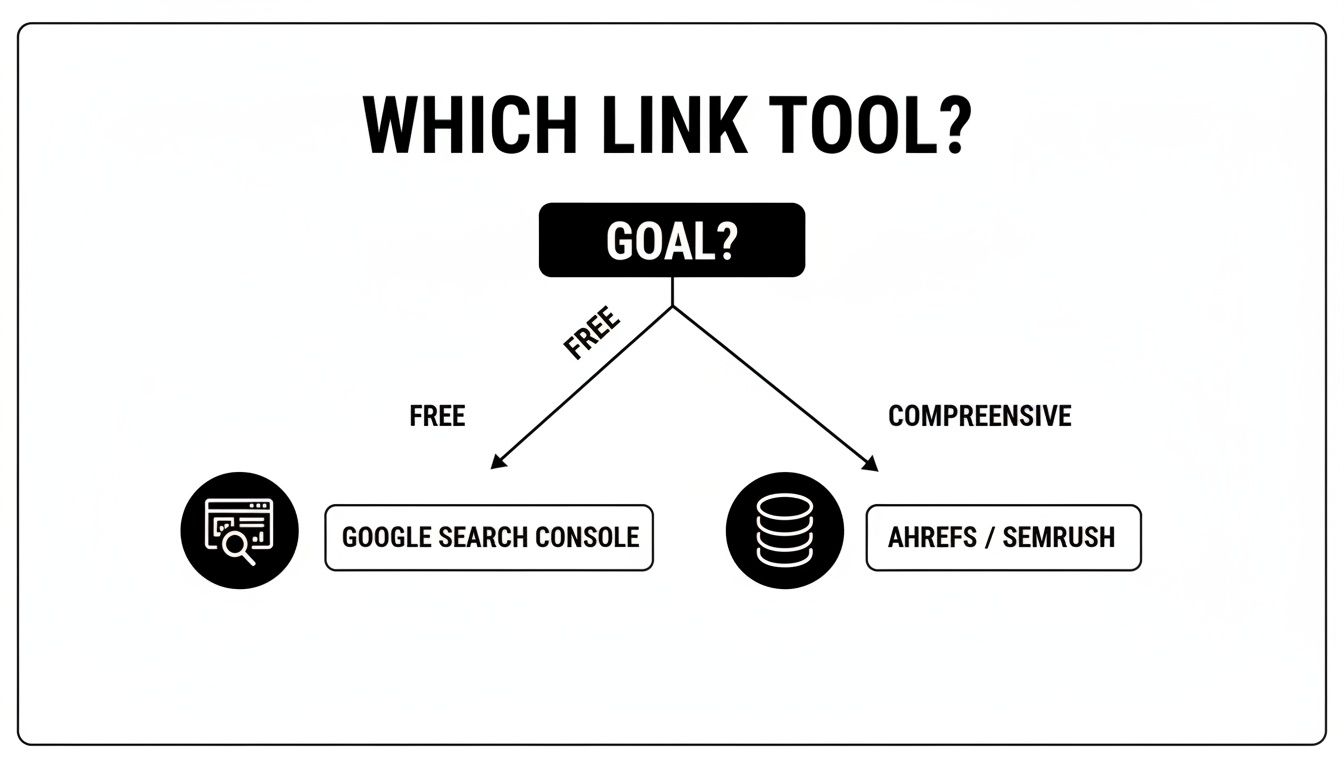
As you can see, Google Search Console is perfect for a free, foundational overview. But for a really comprehensive audit, you'll need the firepower of a tool like Semrush or Ahrefs.
The Three Pillars of a Quality Link Assessment
As you go down your list, evaluate every single link using this three-part quality framework. This will help you make consistent, defensible decisions about what to keep and what to remove.
- Topical Relevance: Does the website linking to you operate in a related field? Example: For a Kansas City law firm, a link from the Missouri Bar Association website is SEO gold. A link from a Russian casino blog is a massive red flag, even if its metrics look okay.
- Website Authority and Trust: This is where metrics like what does domain authority mean come into play, but you need to add human context. Does the site feel legitimate? Does it have a professional design, original content, and an "About Us" page, or does it look like a thin, ad-stuffed link farm? A quick manual review is non-negotiable.
- Anchor Text Profile: What words are used in the link? A natural profile includes brand mentions ("Website Services-Kansas City"), naked URLs ("www.websiteservices.io"), and descriptive phrases ("this guide to link audits"). A profile stuffed with over-optimized, exact-match keywords ("best kansas city seo company") from low-quality sites is a classic sign of manipulative tactics that Google penalizes.
Remember, Google's algorithms are incredibly sophisticated. A single, highly relevant link from an authoritative source in your industry is worth more than a hundred low-quality links from irrelevant websites.
A Simple Workflow for Sorting Your Links
Let's turn this analysis into an action plan. Go back to your master spreadsheet and add a new column called "Action" or "Status." Now, as you review each backlink, tag it with one of these three categories.
- Keep: These are your valuable assets. High-quality, relevant links from authoritative sites in your niche. Mark them and move on.
- Review: This is your "maybe" pile for links you're unsure about. Perhaps the site looks decent, but the relevance is questionable, or the authority is low. Park these here for a second look.
- Remove / Disavow: This is the toxic waste. These links come from obvious spam sites, paid link networks, foreign-language sites, or are completely irrelevant. These are the ones you'll target for cleanup.
By tagging every link, you’ll transform that overwhelming list of URLs into a clear, organized plan. You'll see exactly which links are helping, which are hurting, and which ones need a closer look, making the next steps of your audit far more manageable.
Removing and Disavowing Harmful Backlinks

You've meticulously sorted your backlinks and identified the toxic ones. Now comes the active cleanup phase of the link audit SEO process—it’s time to neutralize those harmful links.
There are two primary methods for this: manual removal and using Google's Disavow Tool.
The best practice is to always attempt manual removal first. Google prefers to see a good-faith effort to clean up your profile at the source. It demonstrates proactive management of your site's reputation, not just a shortcut to hide bad links.
The Manual Removal Outreach Process
This process involves contacting the webmaster of a site with a toxic link and politely asking them to remove it. You'd be surprised how often this works, especially if you are professional and direct.
First, find the contact information. Look for a "Contact Us" page or an email address in the footer. If that fails, a WHOIS lookup can sometimes reveal the domain owner's details.
Once you have an email, draft a short, clear message. Avoid accusatory language; many webmasters may not even be aware the link exists, as it could have been placed by automated tools or a previous owner.
Here's a simple template that gets straight to the point:
Subject: Link Removal Request for [Your Website Name]
Hello [Webmaster Name or "Admin"],
I hope this email finds you well.
We are conducting a routine backlink audit for our website, [Your Website URL], and identified a link from this page on your domain:
[URL of the page with the link]
To align with our current SEO strategy, we would be very grateful if you could remove this hyperlink.
Thank you for your time and consideration.
Best regards,
[Your Name]
[Your Website]
Track every outreach attempt in your master spreadsheet, noting the date sent and any response. Give them a few weeks to reply. Some will comply, some will ignore you, and some may ask for payment (never pay for link removal).
When and How to Use the Disavow Tool
For the toxic links that remain after your outreach efforts, Google's Disavow Tool is your final option. This tool is powerful but must be used with extreme caution. Disavowing a link tells Google to ignore it when evaluating your site, which can help you recover from or prevent a penalty.
Warning: Disavowing healthy links by mistake can cause significant damage to your SEO. Only use this tool for links that are obviously spammy, manipulative, or part of a clear violation of Google's guidelines. To protect your site, it's critical to understand and identify various link schemes that Google penalizes.
The process involves creating a simple text file (.txt) that lists the URLs or entire domains you want Google to ignore.
- To disavow a specific page: List the full URL on its own line:
http://spam.example.com/stuff/comments.html - To disavow an entire domain: Add
domain:before the URL:domain:shadyseo.com
Critical Warning: Using the
domain:command is a powerful, site-wide action. Be absolutely certain an entire site is toxic before using it, as it will nullify all links from that domain—both bad and potentially good.
Your final file is a simple list, with one entry per line. You can add comments for your own records by starting a line with a # symbol.
Once your file is ready, submit it via the Google Search Console interface for the correct property. Be patient; it can take several weeks or even months for Google to fully process the file. If you need more guidance, reviewing a comprehensive Google disavow list can provide useful examples.
By combining polite manual outreach with the careful use of the Disavow Tool, you can effectively scrub your backlink profile and build a healthier foundation for your SEO.
Building a Healthier Backlink Profile Post-Audit
Completing a link audit isn't the finish line; it’s the starting point for a smarter SEO strategy. Once you’ve cleaned up your profile and submitted your disavow file, your focus must shift from defensive cleanup to proactive growth. This is how you transform a one-time project into a sustainable engine for authority and traffic.
The first step after cleanup is to monitor your key metrics. You won't see changes overnight, but keep a close eye on your keyword rankings (especially for high-intent terms) and organic traffic in Google Analytics.
These numbers are your feedback loop. They confirm whether your link audit SEO efforts are working. A steady climb in visibility for your target keywords a few weeks after the audit is a strong signal that Google is reassessing your site more favorably.
Proactive Link Building Strategies
With a clean slate, every new link you build carries significantly more weight. Now is the time to build a backlink profile that is not just clean, but powerful and intentional. Instead of letting random, low-quality links accumulate, you can now focus on earning high-value endorsements.
Your strategy should be multi-faceted, focusing on quality and relevance. Here are a few actionable tactics that deliver excellent results:
- Create Data-Driven Content: Develop content that is a valuable resource. For a local Kansas City business, this could be a report on local market trends or a unique case study. Journalists and bloggers crave original data, making this an effective way to earn links from local news and industry publications.
- Strategic Guest Posting: Identify authoritative blogs in your industry—the ones your actual customers read. Writing a genuinely helpful guest post for these sites establishes you as an expert and earns a highly relevant, in-context backlink.
- Leverage Local Partnerships: Collaborate with other non-competing local businesses or community organizations. Sponsoring a local event, co-hosting a webinar, or being featured on a partner’s website can generate some of the most trusted and authoritative local links available.
The goal is to build a diverse, natural-looking backlink profile. A healthy mix of different link types from a variety of authoritative sources sends a much stronger signal to Google than getting dozens of links from the exact same type of site.
Sustaining Momentum Over Time
A successful post-audit strategy is about consistent, deliberate action. Link building should not be a one-time campaign. Dedicate ongoing resources to acquiring high-quality links each month. Creating a formal link acquisition strategy is the best way to maintain momentum and align your efforts with your business goals.
Beyond building new links, implementing smart link reclamation strategies is crucial. This involves finding unlinked mentions of your brand online and simply asking the publisher to turn the mention into a live link. It’s one of the most efficient ways to recapture lost equity and boost your SEO.
Ultimately, the audit clears the runway. The proactive, high-quality link building that follows is what allows your website to take off, building the authority needed to drive meaningful organic growth for years to come.
Got Questions About Your Link Audit? We've Got Answers
Even with a clear roadmap, diving into a full-blown link audit can feel a little daunting. It's totally normal for questions to pop up. Let's cut through the jargon and tackle some of the most common concerns I hear from business owners getting ready to clean up their backlink profile.
How Often Should I Perform a Link Audit?
For most businesses, conducting a thorough link audit once a year is a solid benchmark. This allows you to identify and address any problematic links that have emerged before they can cause significant damage.
However, certain situations may require a more frequent schedule. Consider a quarterly check-in if you:
- Operate in a highly competitive industry where negative SEO is a risk.
- Are engaged in an active, large-scale link-building campaign.
- Have recently acquired a domain with an unknown backlink history.
And, of course, if you ever experience a sudden, unexplained drop in organic rankings or traffic, a link audit should be the first item on your diagnostic checklist.
Will Disavowing Links Hurt My SEO?
This is a critical question. When used correctly, Google's disavow tool is a powerful ally that can significantly help your SEO by telling Google to ignore links that are harming your site's reputation.
However, it is a precision tool, not a sledgehammer. If you are too aggressive and disavow good, authoritative links by mistake, you will absolutely damage your rankings by erasing the value they pass to your site. This is precisely why manual removal outreach is always the preferred first step.
Think of the disavow tool as your last resort. A link should only go into your disavow file when you are 100% certain it's toxic and all your attempts to have it removed manually have failed.
Can I Do a Link Audit Myself or Should I Hire a Pro?
You can definitely perform a basic link audit on your own, especially for a newer or smaller website. By following the framework in this guide and using tools like Google Search Console, you can identify and handle the most obvious issues. It's a great way to manage your site's basic hygiene on a budget.
However, for a truly deep and comprehensive analysis, hiring a professional SEO agency is a wise investment. Experts bring two key advantages:
- Premium Tools: They subscribe to advanced software like Semrush and Ahrefs, which provide a far more complete and accurate picture of your backlink profile.
- Experience: An experienced SEO professional has analyzed thousands of link profiles. They can better distinguish between a genuinely toxic link and one that is merely low-quality but harmless—a critical distinction that prevents you from accidentally removing valuable links.
What Is the Difference Between a Bad Link and a Toxic Link?
This distinction is crucial for a successful audit. While the terms are sometimes used interchangeably, they represent two different levels of risk.
A "bad link" is simply unhelpful. It might come from an irrelevant, low-authority site and provides no real SEO value, but it isn't actively hurting you. These can generally be ignored.
A "toxic link," on the other hand, is actively harmful. These are the links that can trigger Google penalties and suppress your rankings. They typically originate from:
- Obvious spam sites, link farms, or directory sites with no editorial standards.
- Paid link schemes designed to manipulate search results.
- Private Blog Networks (PBNs).
- Websites in foreign languages with no relevance to your audience.
These toxic links are the primary targets of your removal and disavowal efforts. Finding and neutralizing them is the core purpose of a link audit.
At Website Services-Kansas City, we specialize in turning complex SEO challenges into clear, actionable growth plans. If you're ready to clean up your backlink profile and build a stronger foundation for your website's future, let our experts handle the heavy lifting. Learn more about our professional SEO audit services.
