
A local citation builder is a service or tool that gets your business listed across the web. The whole point is to push your company's Name, Address, and Phone number (NAP) out to important online directories like Google Business Profile, Yelp, and other platforms relevant to your industry. It's a foundational piece of getting found in local search results.
The main goal? To make sure your business information is consistent and accurate everywhere it shows up online.
Why Citations Are a Cornerstone of Local SEO
Before we get into the nuts and bolts of building citations, you have to understand why they're so critical for local SEO. Think of the internet as a giant web of information. When search engines like Google crawl that web, they're looking for consistent signals that prove your business is real and located where you say it is.
Every accurate citation you build is like a small vote of confidence. It tells Google, "Yes, this plumbing business in Kansas City is legit, it's really at this address, and this is its phone number." The more of these consistent "votes" you collect across reputable sites, the more trust you build with search engines.
The Power of NAP Consistency
The heart and soul of any good citation strategy is NAP consistency. This means your business Name, Address, and Phone number must be identical across every single online listing. I mean identical.
Even a tiny difference—like using "St." on one directory and "Street" on another—can create confusion for search engines and chip away at the trust you're trying so hard to build. For example, a Kansas City marketing agency using "123 Main St, Kansas City, MO" on Google Business Profile but "123 Main Street, KC, MO" on Yelp is sending a mixed signal. This small discrepancy forces Google to question which version is correct, potentially hurting your ranking.
Inconsistent information sends mixed signals, making it harder for Google to confidently rank your business in local search results. For a new website or a small business just trying to get a foothold, this consistency isn't just important; it's non-negotiable. It’s the bedrock of your entire local online presence. If you're looking for a deeper dive, check out our guide on what is a local citation.
Each consistent citation is more than just a listing; it's a digital breadcrumb that leads both search engines and potential customers directly to your door. Inconsistent citations scatter those breadcrumbs, leading them astray.
Dominating the Google Map Pack
The holy grail of local search is landing a spot in the Google Map Pack (or the "Local Pack"). This is that prime real estate at the top of the search results—the box with three business listings and a map. Getting into this box can be a game-changer, dramatically increasing calls, website visits, and foot traffic.
A strong and consistent citation profile is one of the most powerful factors influencing your Map Pack ranking. Google cross-references the information in your Google Business Profile with data from directories all over the web. When it finds dozens of high-quality citations all perfectly matching your profile, its confidence in your business's legitimacy and local relevance skyrockets.
Turning Online Visibility Into Real Customers
In the dog-eat-dog world of local search, building consistent citations across the right directories gives you a serious edge. One of the most telling statistics is that 46% of all Google searches have local intent. This means nearly half of all searchers are looking for a nearby business, often right when they're ready to make a purchase.
This is where a local citation builder comes in, ensuring your business is visible at that critical moment. For a Kansas City business, showing up for "SEO company near me" can mean the difference between landing a new client and being completely invisible.
How to Perform an Effective Local Citation Audit

Before you even think about building new citations, you have to know where you stand right now. Jumping into a citation campaign without a thorough audit is like trying to drive to a new city without a map—you'll get lost, waste time, and probably end up somewhere you didn't want to be.
An audit uncovers your complete digital footprint, showing you what’s working and, more importantly, what’s broken. We're talking about finding those harmful inconsistencies that confuse search engines. Think old phone numbers, slight address variations, or duplicate listings from a previous business at your location. These little errors can silently sabotage your local SEO efforts. A proper audit turns that chaos into a clear, actionable plan.
Gathering Your Digital Footprint
First things first, you need to find every single place your business is already mentioned online. You'll probably have more listings than you realize, many of them created automatically by data aggregators or even by well-meaning customers. The key is to be methodical.
Automated tools like BrightLocal or Moz Local are a great place to start. They scan hundreds of directories in minutes and spit out reports flagging inconsistencies in your Name, Address, and Phone number (NAP). These platforms give you a fantastic high-level overview and are brilliant for catching common errors across the big-name sites.
But don't stop there. You need to supplement the tools with a bit of manual detective work using Google. Use specific search operators to uncover citations the automated scanners might have missed:
"Your Business Name" + "Your City""Your Business Name" + "Your Phone Number""Your Street Address" + "Your Business Name" -site:yourwebsite.com
This hands-on approach often reveals unstructured citations on local blogs, news sites, or community forums that are just as important for search engines to see.
Organizing and Analyzing Your Findings
Once you've collected all this data, you need to get it organized. Honestly, a simple spreadsheet is the most effective tool for tracking and managing your citations. This document will become the central hub for your entire cleanup and building campaign.
I recommend creating a spreadsheet with these columns to keep everything straight:
- Directory URL: The direct link to your listing.
- Status: Note if the citation is Correct, Incorrect, a Duplicate, or Needs to be created.
- Correct NAP: Your official business name, address, and phone number.
- Listed NAP: The exact information currently shown on the directory.
- Notes: A spot for login details, the date you requested a change, or any other relevant info.
- Priority: Rank each cleanup task (High, Medium, Low) based on the site's authority.
An organized audit spreadsheet isn’t just a to-do list; it’s your strategic roadmap. It allows you to prioritize high-impact fixes, like correcting your phone number on Yelp, over minor issues on obscure directories, ensuring your efforts deliver the best possible results.
This structured approach transforms a messy pile of data into an actionable strategy. You can see at a glance where the most damaging inconsistencies are and prioritize your cleanup efforts accordingly. For businesses looking for a managed solution, exploring services that build local citations can streamline this entire process, from audit to execution.
Creating Your Action Plan
With your audit spreadsheet complete, the last piece of the puzzle is creating a clear action plan. Start by tackling the most critical errors first—incorrect business names, phone numbers, or addresses on high-authority sites like Google Business Profile, Yelp, and Bing Places. These foundational listings have the biggest impact on your local rankings.
Next, go after the duplicate listings. Claim and then delete or merge any duplicates you find to consolidate your authority and eliminate any confusion for search engines.
Once the cleanup is handled, your spreadsheet will clearly show the gaps in your profile. It becomes a perfect roadmap, highlighting the high-value directories where you need to build new, perfectly consistent citations. This audit ensures every single action you take moves your local SEO forward.
Choosing Your Citation Building Strategy
Okay, your audit is done, and you’ve got a clear picture of your digital footprint. Now comes the big decision: How are you actually going to build all these new citations and fix the broken ones?
You’re basically looking at two paths. You can roll up your sleeves and go the manual route, or you can tap into the power of an automated local citation builder.
Each way has its own perks and is built for different business needs. The right call for you really boils down to your budget, how much time you can spare, and what you’re trying to achieve with your local SEO.
The Manual Citation Building Approach
Going manual means you’re in the driver’s seat for every single submission. You personally head over to each directory, create an account, and fill out your business profile, piece by piece. This method gives you absolute control and precision.
It's the perfect strategy for businesses that need to hit very specific or niche directories that automated services might just gloss over. For instance, a local law firm in Kansas City would want to manually make sure their listings on Avvo and FindLaw are absolutely perfect, since those platforms are critical in their industry.
The downside is exactly what you'd expect: it’s a ton of work. Building out just 20-30 high-quality citations can easily eat up hours of tedious data entry.
The Automated Citation Builder Approach
Automated services and data aggregators are all about speed and scale. These platforms take your single, correct NAP and blast it across a huge network of hundreds—sometimes thousands—of online directories. If you want efficiency, this is your ticket.
Think about a retailer with multiple locations. They simply don't have the bandwidth to manually manage listings for 50 different stores. For them, an automated solution is essential to keep everything consistent and under control.
While it’s incredibly fast, you do trade off some of that surgical precision you get with manual work, and you have less control over how each individual listing looks. But the sheer volume of distribution is a massive advantage for casting a wide net and establishing a broad online presence fast.
Your choice between manual and automated isn't just about time versus money. It's about control versus scale. A targeted manual effort is like a skilled archer hitting a specific target, while an automated service is like a wide net cast to catch as many fish as possible.
Making the Right Decision for Your Business
So, how do you actually choose? Let's break it down into a simple framework to help you find the right balance for your specific situation.
- For New Businesses or Tight Budgets: Start manually. Focus on getting flawless listings on the top 20-30 foundational directories like Google Business Profile, Apple Maps, and Yelp. This builds a strong, accurate base without any upfront cost.
- For Established Businesses Seeking Growth: A hybrid approach is often the sweet spot. Use a local citation builder to handle the broad distribution, then circle back and manually build citations on those high-value industry and local directories.
- For Multi-Location Businesses or Agencies: Automation is non-negotiable. The sheer complexity of managing multiple NAPs makes manual building impractical and a recipe for errors.
Manual vs Automated Citation Building: A Quick Comparison
This table breaks down the key differences between manual and automated citation building to help you weigh the pros and cons for your business.
| Feature | Manual Building | Automated Builder / Aggregator |
|---|---|---|
| Control & Precision | High. You have full control over every detail of each listing. | Lower. Less control over individual listings, focused on broad consistency. |
| Time Investment | Very High. Requires hours of dedicated data entry and management. | Low. Submits your information to hundreds of sites in a short time. |
| Cost | Low (in dollars). The primary cost is your own time. | Moderate. Typically involves a subscription or one-time fee. |
| Niche Directories | Excellent. Perfect for targeting specific industry or hyper-local directories. | Limited. May not cover niche directories relevant to your industry. |
| Scale & Speed | Low. Very difficult to scale, especially for multiple locations. | High. Built for speed and can handle hundreds of locations with ease. |
| Best For | New businesses, tight budgets, and businesses needing to target niche directories. | Multi-location businesses, agencies, and anyone prioritizing speed and scale. |
Ultimately, the best approach depends on balancing your resources—time, money, and manpower—with your strategic goals for local visibility.
Local citation builders have really changed the game for how new LLCs and businesses with fresh domains can compete. In fact, data shows 71% of local SEO marketers now prioritize dedicated link-building strategies that specifically include citations. This is closely tied to other off-page SEO work, which you can read more about in our guide on local link building. For a closer look at the data, you can check out the full findings about local SEO statistics over at seoprofy.com.
Executing Your Citation Building Campaign
Alright, you’ve got your strategy mapped out. Now it's time to get your hands dirty and actually start building the citations that move the needle on your local rankings. This is where a methodical, tiered approach really pays off, helping you build a powerful and diverse citation profile that search engines trust. The goal is to create a repeatable process you can use for any new business or location.
Your campaign should start with a solid base before you even think about branching out. This visual breaks down the typical workflow for building a comprehensive citation profile from the ground up.
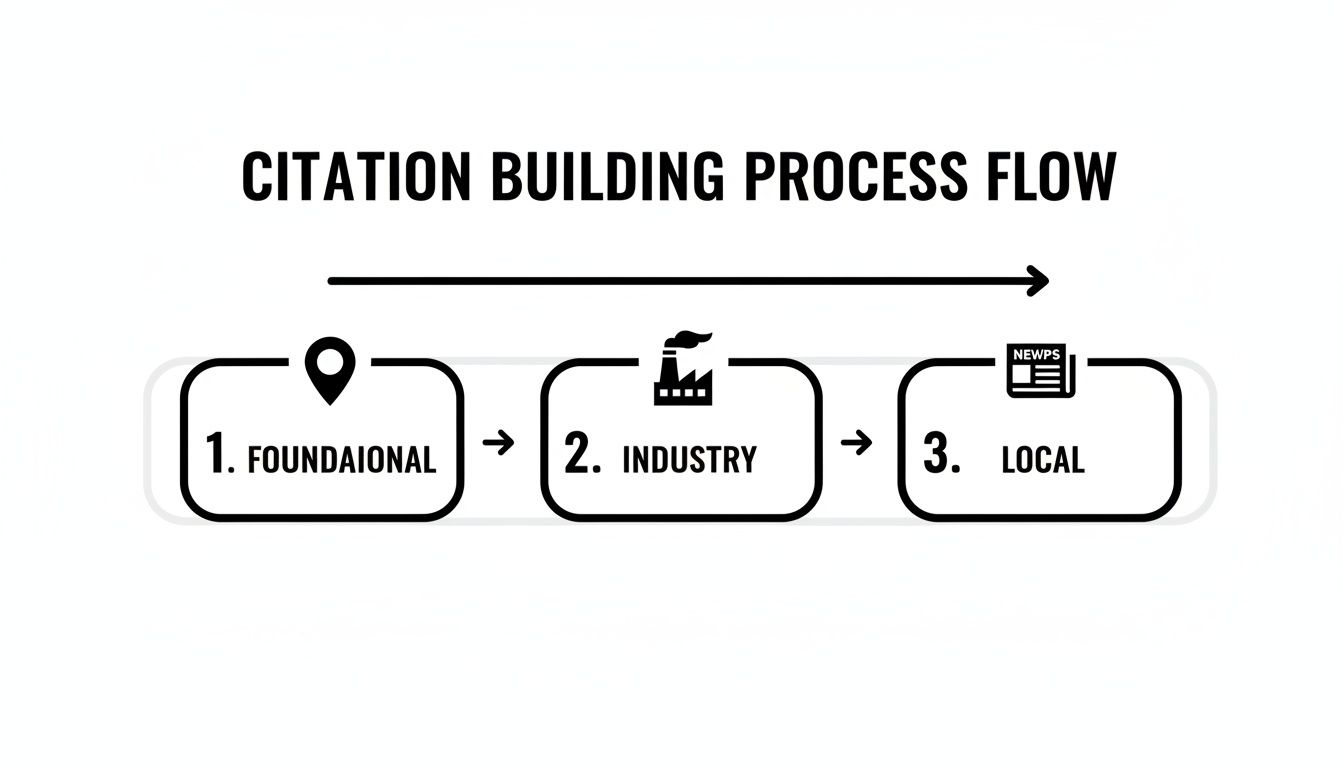
This layered strategy starts with the must-have platforms, then moves into niche-specific directories, and finishes with hyper-local opportunities that scream relevance to Google.
Securing Your Foundational Citations
Think of this first group of citations as the absolute non-negotiables. These are the major data aggregators and high-authority platforms that search engines like Google lean on heavily to verify your business's existence and location. Getting these right is your top priority.
Your initial checklist has to include:
- Google Business Profile: This is the big one—the most important citation of all. Make sure it's completely filled out, verified, and a perfect match for your official NAP.
- Bing Places for Business: As the second-largest search engine, Bing is a critical platform to cover. Don't skip it.
- Apple Maps: This is essential for capturing all that search traffic from iPhone users and other Apple devices.
- Yelp: Despite its love-hate relationship with business owners, Yelp remains a powerful authority signal for local search. Research from BrightLocal shows Yelp was a source in 33% of AI-powered searches, proving it's still very much in the game.
Pro Tip: Before you submit to a single directory, create a master document with your 100% accurate business information. This should have your exact business name, address, phone number, website URL, business description, and categories. Copy and paste from this document for every single submission to eliminate the risk of typos and inconsistencies.
Identifying High-Value Niche and Local Directories
Once your foundational listings are locked in, it’s time to build relevance by targeting directories specific to your industry and your city. This is where a manual or hybrid approach really shines, as you can pinpoint opportunities your competitors might be completely overlooking. These are the citations that tell Google not just where you are, but what you do.
For industry-specific directories:
A Kansas City law firm, for example, absolutely must be listed on Avvo and FindLaw. A local contractor should be on platforms like HomeAdvisor and Angi. These niche sites carry serious weight within their fields and are strong trust signals.
For geo-specific directories:
Look for opportunities that firmly plant your business in its local community. Great examples include:
- Your local Chamber of Commerce website (e.g., KC Chamber of Commerce).
- City-specific business directories (e.g., ThinkKC.com).
- Sponsorship pages for local events or sports teams (e.g., sponsoring a 5K at The Nelson-Atkins Museum of Art).
- Listings on the websites of nearby, complementary businesses.
These hyper-local mentions are incredibly valuable. They are a core part of what search engines are looking for, and you can learn more about how they fit into the bigger picture by reviewing the top local SEO ranking factors.
Acquiring Unstructured Citations
Not all valuable citations come from neat, structured directories. Unstructured citations are mentions of your business—ideally with your NAP—on places like local blogs, news articles, or community forums. While they're harder to get, they are incredibly powerful because they appear so natural and organic to search engines.
For example, a local Kansas City food blogger mentioning your restaurant by name and address is a fantastic unstructured citation. You can chase these down by:
- Sponsoring a local charity event.
- Putting out a press release for a company milestone.
- Hosting a community workshop or event.
- Partnering with other local businesses for some cross-promotion.
This multi-layered approach—starting with the foundational giants, adding industry and local relevance, and then layering in natural mentions—is how you create a robust and defensible citation profile. It’s a process that moves beyond simple directory submissions and starts building true local authority.
Maintaining Your Citations for Long-Term Success

Getting your citation profile into pristine shape is a huge win, but the work doesn't stop there. This isn't a "set it and forget it" task. The web is constantly changing; directories get updated, users create their own listings for your business, and old, incorrect information can bubble back to the surface.
This is why ongoing maintenance is just as important as the initial build-out. It’s what protects all your hard work and secures your local SEO authority for the long haul.
Without a maintenance plan, your perfectly consistent NAP data can slowly fall apart, a process known as citation decay. It happens for a ton of reasons—data aggregators pushing old info, competitors making edits, or even well-meaning customers creating a new, incorrect listing. Proactive monitoring is the only way to catch these issues before they can mess with your rankings or confuse potential customers.
Setting Up a Monitoring System
The first piece of a solid maintenance plan is a system to watch your live citations for any unwanted changes. You need a way to get alerted when a new, rogue listing pops up or when one of your accurate ones gets altered without you knowing. This doesn't have to be a complicated or expensive process.
Here are a few practical ways to keep an eye on things:
- Schedule Regular Audits: Block off some time each quarter to run a quick mini-audit. You can use the same search operators and tools from your initial deep dive to quickly spot any new duplicates or inconsistencies.
- Set Up Google Alerts: This is a simple but effective tactic. Create alerts for your business name combined with different address or phone number variations. This can help you find new, unstructured mentions of your business popping up across the web.
- Use Citation Tracking Tools: Services like BrightLocal's Citation Tracker can put this whole process on autopilot. These tools constantly scan your listings and shoot you a notification the moment something changes, saving you a ton of time on manual checks.
A good monitoring workflow is your early warning system. It keeps small data discrepancies from snowballing into major SEO headaches.
The Protocol for Business Information Updates
Sooner or later, your core business info is going to change. Maybe you move to a new office, get a new phone number, or go through a rebrand. When that happens, a fast and methodical update across your entire citation footprint is absolutely critical. Mess this up, and you risk a serious drop in rankings and customer trust.
Moving your business without updating your citations is like changing your house number but not telling the post office. Mail gets lost, people can't find you, and confusion reigns. In the digital world, this confusion directly impacts your bottom line.
When your NAP changes, follow this exact protocol:
- Update Your Core Assets First: The very first places to update are your own website and your Google Business Profile. These are your most authoritative digital properties, and they're the first place Google looks for verification.
- Tackle Foundational Directories: Next up, manually update your listings on the other big players like Apple Maps, Bing Places, and Yelp. Get these core directories squared away before moving on.
- Deploy a Local Citation Builder: Once your main assets are correct, use a local citation builder service to push the new, accurate information out to the hundreds of other directories and data aggregators. This is how you distribute the update at scale and ensure consistency everywhere.
This process is vital because with 76% of people who search for something nearby on Google visiting a store within a day, businesses with incorrect information lose out on immediate revenue. Regular monitoring allows you to measure the impact of these updates. For an in-depth guide, you can learn more about how to track website traffic to see how changes in your local presence affect user engagement.
Understanding this data is key for any business, especially since stats show 99% of consumers used the internet to find local businesses last year. You can learn more about these local SEO findings and how to capitalize on them by visiting customwebaudits.com. This proactive approach keeps your online presence healthy and ensures your initial investment continues to pay dividends.
Frequently Asked Questions About Local Citation Builders
Even with a clear strategy, diving into local citations can bring up a lot of questions. It's a detailed process, and it's smart to get your bearings before you jump in. Let's tackle some of the most common questions business owners have about using local citation builders and wrangling their online presence.
How Long Does It Take To See Results From Building Citations
Patience is a virtue here, but you won't be waiting forever. You can often see an initial lift in visibility within a few weeks as foundational listings on major platforms like Google Business Profile and Apple Maps get indexed. Google crawls these high-authority sites constantly.
However, the full impact on your local search rankings usually becomes more noticeable over 3 to 6 months. This longer runway gives data aggregators and smaller directories time to process and push your information across their networks. It's the consistent effort over this period that builds lasting authority.
Are Paid Citation Services Worth The Investment
For the vast majority of businesses, the answer is a hard yes. While you can absolutely build citations by hand for free, the time you'll sink into it is massive. Building and verifying just 20-30 listings can easily eat up an entire workday.
A paid local citation builder or a managed service buys you back dozens of hours of tedious, repetitive work. The cost is often minimal when you weigh it against the value of your time and the new customers who will find you. It frees you up to focus on running your business, not doing data entry.
Think of a paid service as an investment in efficiency and accuracy. It's not just about saving time; it's about making sure the job is done right, at scale, without the risk of manual typos that could undermine your entire effort.
What Is More Important A High Quantity Or High Quality Of Citations
Quality will win over quantity every single time in local SEO. It is far better to have 50 perfectly accurate citations on authoritative, relevant directories than 200 inconsistent listings on low-quality, spammy sites. Search engines are all about trust, and trust is built on quality signals.
Your focus should be on building a strong, relevant profile. Start with the foundational directories, then move to top-tier industry-specific and geo-specific sites that your customers actually use. This targeted approach sends much stronger signals to Google than a spray-and-pray approach ever could. For Kansas City businesses, getting listed on 25 must-have sites like the BBB and YellowPages builds instant legitimacy, especially when aggregators like Neustar Localeze automatically push that clean NAP to hundreds of other outlets.
Despite top services including GBP management (52%) and citations, a shocking 58% of businesses skip local SEO entirely. This leaves a massive opportunity on the table, as 32% of U.S. consumers search for nearby businesses multiple times a week—efforts that can drive same-day visits. To dig into this data, check out the full research on these powerful local SEO statistics.
Should Service-Area Businesses Build Citations
Absolutely. Even if you don't have a physical storefront customers can walk into, citations are critical for validating your business's legitimacy and service area to Google. Many modern directories even let you hide your physical address while still defining a specific service radius.
This is how you show up in local search results and on maps when people in your target towns are looking for what you do. For a plumber, an electrician, or a mobile dog groomer, this is essential for connecting with clients right in their neighborhood.
Ready to stop worrying about inconsistencies and start dominating local search? The experts at Website Services can audit, clean up, and build a powerful citation profile for your business, ensuring you get found by the customers who matter most. Get in touch with us today to see how we can help.
