
Search engine optimization, or SEO, is the practice of increasing your website's visibility when people search for your products or services on search engines like Google. The higher your pages rank in the search results, the more likely you are to attract new and loyal customers to your business.
Your Digital Welcome Mat
Imagine you've just opened a fantastic new storefront in a busy part of Kansas City. You could have the best products in town, but if nobody can find you, it’s all for nothing. SEO is how you put up bright, clear signs and get your shop listed at the top of every digital map.
It's not about trying to fool Google. It's about making it incredibly simple for search engines to understand what you offer and show you to the right people.
When someone types a question into a search bar, Google’s one and only goal is to provide the most helpful, relevant, and trustworthy answer it can find. The work you do with SEO is what convinces Google that your website is that answer. This involves fine-tuning your content, your site’s technical foundation, and your online reputation.
More Than Just Keywords
The whole game started back in the mid-1990s with some pretty basic tricks like keyword stuffing. The term "search engine optimization" was first used around 1997, but things really changed when Google showed up with algorithms that cared more about authority and relevance.
What was once a niche tactic has exploded into what’s projected to be an $86.8 billion industry by 2025, now powered by sophisticated AI that understands language almost like a human.
Ultimately, the goal is to get the right people to your website. We're not talking about random clicks; these are potential customers actively searching for the exact solution you provide. This is how a simple website becomes a powerful engine for generating leads.
SEO is the art and science of persuading search engines like Google to recommend your content to their users as the best, most relevant, and most authoritative solution to their problem.
Effective SEO helps you show up at the exact moment a customer needs you, building trust and credibility before they even think about making a purchase. This creates what's known as organic search traffic, which is almost always the most valuable and highest-converting source of visitors for a business.
By focusing on SEO, you're not just chasing rankings. You’re building a sustainable, long-term asset for your business that pays for itself over and over again.
To really get this right, you need to understand the different pieces that make up a modern SEO strategy. Let's break down the core components you'll need to master.
The Core Components of Modern SEO
Here's a quick look at the main pillars of SEO that we'll be exploring in this guide. Each one plays a critical role in building a strong, visible online presence.
| Component | What It Covers | Why It's Important |
|---|---|---|
| On-Page SEO | Optimizing individual page elements like titles, headings, and meta descriptions. | Tells search engines exactly what your content is about, page by page. |
| Technical SEO | Improving site speed, mobile-friendliness, and crawlability. | Ensures search engines can easily find, understand, and index your website. |
| Content | Creating high-quality, relevant, and valuable articles, guides, and pages. | The foundation of SEO; it's what earns rankings and attracts users. |
| Backlinks | Earning links from other reputable websites back to your own. | Acts as a "vote of confidence," building your site's authority and trust. |
| Local SEO | Optimizing for location-based searches and Google Maps. | Crucial for businesses serving a specific geographic area, like Kansas City. |
| Analytics | Tracking performance, measuring traffic, and analyzing user behavior. | Provides the data you need to know what's working and how to improve. |
As you can see, SEO isn't just one thing—it's a collection of interconnected disciplines that all work together. By focusing on these core areas, you'll build a strategy that's built to last.
The Three Foundational Pillars Of SEO
To really get what search engine optimization is all about, it helps to break it down into its three core components. Think of these as the foundational pillars holding up your entire online presence. A strong strategy requires building all three at the same time; if you ignore one, the others will eventually start to wobble.
This diagram shows how these pillars—On-Page, Technical, and Off-Page SEO—come together to form a complete optimization strategy.
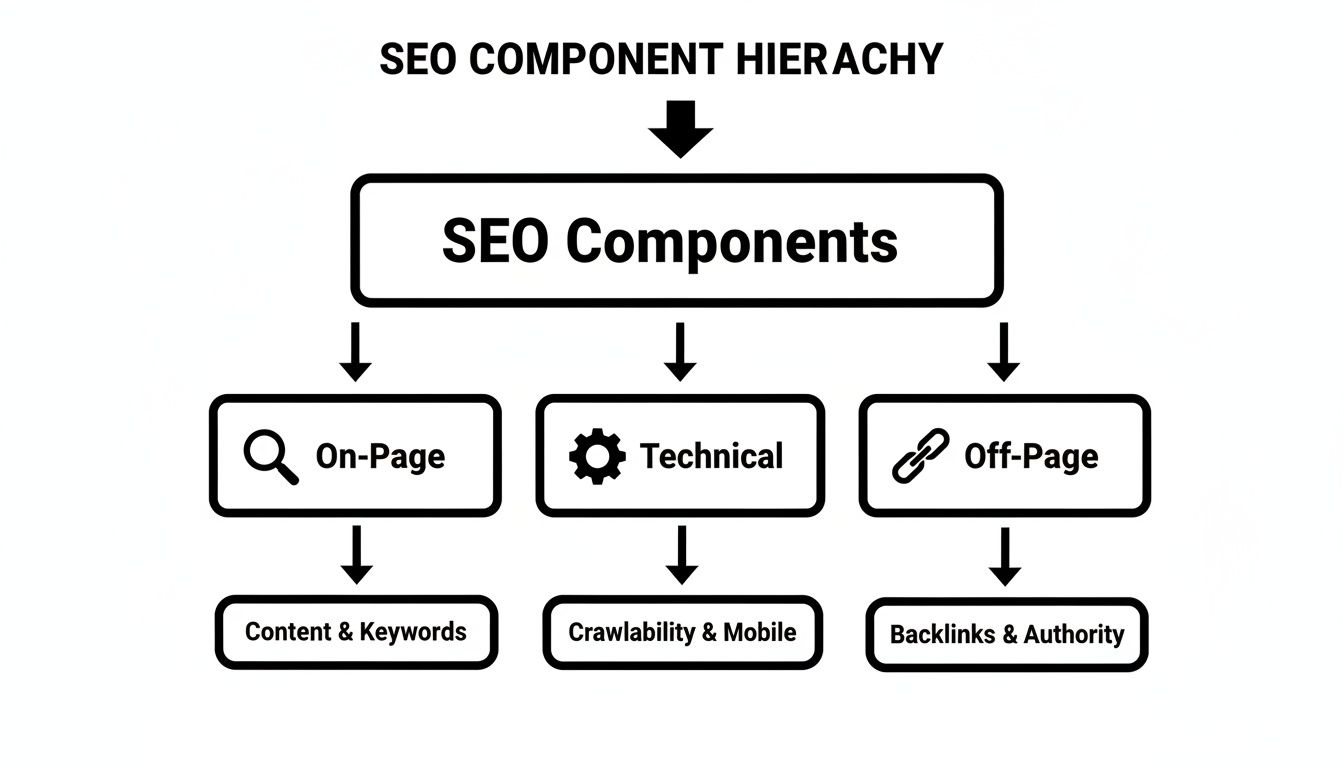
As you can see, each pillar handles a totally different part of your website, from the words people read on the screen to the behind-the-scenes code and your site's reputation across the web.
On-Page SEO: The Content You Control
On-Page SEO covers everything you can directly see and control on your website's pages. This is where you line up your content with the exact terms and questions your potential customers are typing into search engines. It’s all about making your content undeniably relevant.
Practical Example: A Kansas City bakery wants to rank for "artisan wedding cakes." They would strategically place that exact phrase in key spots on their wedding cake service page:
- Page Title:
Artisan Wedding Cakes in Kansas City | The Sweet Slice Bakery - Main Headline (H1):
Bespoke Artisan Wedding Cakes - Image Alt Text:
artisan-wedding-cake-with-floral-design-kansas-city.jpg
Getting your on-page SEO right tells search engines precisely what each page is about, helping them match your site to the right searcher. To get a better handle on this crucial first step, you can explore our detailed guide on what is on-page optimization. This pillar is your chance to speak directly to both your audience and the search algorithms.
Technical SEO: Your Website's Foundation
Next up is Technical SEO, which focuses on the structural health of your website—the "behind the scenes" stuff that visitors don't see but definitely feel. This pillar makes sure your site is fast, secure, and a breeze for search engine crawlers to navigate and understand.
A slow-loading website is like a physical store with agonizingly long checkout lines; people will get frustrated and just leave. Key elements of technical SEO include:
- Site Speed: Making sure your pages load in a snap, especially on mobile.
- Mobile-Friendliness: Ensuring your site looks and works great on any smartphone or tablet.
- Security: Using HTTPS to encrypt data and protect your visitors' information.
- Crawlability: Creating a clean site structure so search engines can easily find and index all your important pages.
Actionable Insight: Go to Google's PageSpeed Insights and enter your website's URL. If your mobile score is in the red (below 50), one of the quickest fixes is to compress your images. Use a free tool like TinyPNG to shrink image file sizes without sacrificing quality, which can dramatically improve your load time.
This part of SEO became non-negotiable after the "mobile revolution." Once mobile searches officially surpassed desktop back in 2015, Google started giving priority to mobile-friendly sites. This all led to Mobile-First Indexing, where Google primarily uses the mobile version of a site for ranking, a policy fully rolled out by September 2021. Today, with Core Web Vitals, page speed is an official ranking factor, and some data suggests that sites failing these metrics can see 24% lower rankings.
Off-Page SEO: Building Your Digital Reputation
Finally, Off-Page SEO involves everything you do away from your website to build up its authority and reputation online. While this includes things like social media mentions, it’s overwhelmingly about one thing: backlinks.
A backlink is simply a link from another website pointing back to yours.
Think of high-quality backlinks as votes of confidence or referrals from other respected sources on the internet. When a reputable website links to your page, it signals to Google that your content is trustworthy, authoritative, and valuable.
Practical Example: Let's go back to our bakery. If a popular Kansas City food blogger like KC Food Guys writes an article about the best local bakeries and links to their "artisan wedding cakes" page, that’s an incredibly powerful off-page signal. It's not about getting the most links; it's about getting the best ones. A single link from an authoritative site is worth far more than hundreds of links from low-quality, spammy websites.
Building a strong backlink profile takes time and effort, usually by creating amazing content that people naturally want to share and reference. When you master all three—On-Page, Technical, and Off-Page SEO—you create a powerful, well-rounded strategy that drives real, sustainable growth.
How Content Fuels Your SEO Engine
If technical SEO is the foundation of your house and backlinks are its curb appeal, then content is the engine running in the garage. You can build the fastest, most authoritative website on the block, but without great content, you’re not going anywhere. It's the actual substance that answers your audience's questions, solves their problems, and gives Google a reason to rank you in the first place.

Let's be clear: effective SEO content has nothing to do with stuffing keywords onto a page. That's old-school thinking. It’s all about creating valuable, relevant, and genuinely helpful information that makes a real difference for your audience. When you do that, you send a powerful signal to search engines that your site is a credible resource worth showing to more people.
Understanding Google's E-E-A-T Guidelines
To get a handle on what Google actually considers "quality," you need to know about its E-E-A-T guidelines. The acronym stands for Experience, Expertise, Authoritativeness, and Trustworthiness. It’s the very framework Google’s human quality raters use to assess whether a webpage is reliable and its information is solid.
Think of it this way: if you need serious financial advice, you'd listen to a certified financial planner, not some random person shouting in a forum. Google uses the exact same logic, rewarding content that shows real-world knowledge and undeniable credibility.
- Experience: Does the author have actual, hands-on experience with the topic?
- Expertise: Does the author have deep, specialized knowledge in the field?
- Authoritativeness: Is the website or author seen as a go-to leader in their industry?
- Trustworthiness: Is the information accurate, transparent, and something you can rely on?
The obsession with quality really kicked into high gear after a seismic algorithm shift. One of the biggest game-changers was Google's Panda Update on February 23, 2011, which was built to promote high-quality sites and bury the low-effort "content farms" that were flooding search results with junk. Before Panda, these low-quality sites were gobbling up as much as 30% of top positions. After it rolled out, Google confirmed it demoted 12% of US search queries, a massive change that forced everyone to start focusing on real value. You can read more about how Panda and other updates shaped the SEO landscape in this comprehensive history of SEO on WebFX.
Creating Content That Ranks Step-By-Step
So, how do you actually create content that both your audience and search engines will love? It all comes down to a clear, repeatable process that puts your users' needs at the very center of everything you do. This is the heart and soul of any content marketing effort that gets real results.
A well-defined plan ensures you're not just creating content for the sake of it, but are strategically targeting topics that will pull in the right kind of audience. If you need help building that foundation, our guide on how to create a content strategy is the perfect place to start.
Here’s a practical, step-by-step approach you can follow:
- Find Your Customer’s Questions: Use tools like Semrush or AnswerThePublic to uncover the exact questions your ideal customers are typing into Google. Actionable Insight: Look for "People Also Ask" questions on Google's search results page for your target topic. These are direct insights into what your audience is curious about. Create a section in your article that directly answers 3-4 of these questions.
- Analyze What's Already Winning: Before you write a single word, search for your target keyword and study what’s already on page one. What format is the content (blog posts, videos, product pages)? How deep do they go? What specific subtopics do they cover? Your mission is to create something 10x better.
- Outline and Structure Your Article: A great article is easy to read and skim. Use clear headlines (H2s and H3s), short paragraphs, and visual breaks like bullet points and images. A solid outline makes sure your content flows logically and hits every single point your reader is looking for.
- Write Comprehensive, Genuinely Helpful Content: This is where you put your expertise on full display. Answer the user’s question completely, accurately, and with authority. Give them actionable insights, practical examples, and real data to back up what you're saying. The ultimate goal is to be the last click—the resource so good they don't need to go back to Google.
The secret to great SEO content is simple but not easy: Serve your user first. When you create the absolute best resource on a topic, you naturally earn the signals—like backlinks and high engagement—that Google uses to rank pages.
Winning The Neighborhood With Local SEO
For any business with a physical address—whether it’s a Kansas City law firm or a downtown coffee shop—the real goal is getting local customers through the door. This is where a specialized slice of SEO comes in, and it's an absolute game-changer. Local SEO is all about making your business impossible to miss when people search for things like "personal injury lawyer near me" or "best coffee in Kansas City."
When someone makes a local search, Google's mission is to serve up the most relevant, nearby options instantly. This usually results in the "Map Pack" (or "Local Pack")—that valuable box with three business listings and a map right at the top of the search results. Landing a spot in that prime digital real estate can drive a serious amount of foot traffic your way.

The engine driving your local visibility is your Google Business Profile (GBP). Think of it as your digital storefront on Google. It's a free, incredibly powerful tool that you absolutely have to claim and optimize.
Supercharging Your Google Business Profile
An unclaimed, bare-bones GBP listing is a massive missed opportunity. To really own your local search results, you have to treat your profile like a core part of your website. It needs consistent attention to show Google you're an active, reputable business in the community.
Practical Example: A Kansas City law firm shouldn't just list its name and hours. A fully dialed-in profile would feature:
- High-Quality Photos: Images of the office, the legal team, and the building exterior build trust and make your business feel real.
- Detailed Service Descriptions: Instead of a generic "Law Firm," they’d list specific practice areas like "Car Accident Litigation," "Workers' Compensation," and "Wrongful Death Claims."
- A Consistent Flow of Reviews: Actively encouraging clients to leave positive reviews is critical. So is responding professionally to all feedback, good or bad.
This constant activity sends strong signals to Google that your business is relevant and serving the community, making you a top contender for the coveted Map Pack.
For Kansas City business owners looking to get a leg up, here’s a quick checklist to get your local SEO in order.
Local SEO Checklist for Kansas City Businesses
This simple, step-by-step list will help any local business boost its visibility in local search results.
| Action Item | Why It's Critical | Quick Tip |
|---|---|---|
| Claim & Verify Your GBP | This is your foundation. An unverified profile is invisible and can't be optimized. | Search for your business on Google Maps and click "Claim this business." |
| Fill Out Every Profile Section | A complete profile shows Google you're a legitimate, active business, which improves trust. | Don't skip the Q&A section. Proactively add and answer common questions yourself. |
| Upload High-Quality Photos | Photos make your business tangible and build customer confidence before they even visit. | Add new photos regularly (at least monthly) to keep the profile looking fresh and active. |
| Get Consistent Customer Reviews | Reviews are a massive trust signal for both Google and potential customers. | Send a direct link to satisfied customers asking for a review right after a positive experience. |
| Ensure NAP Consistency | Inconsistent business info erodes Google's trust, directly harming your local rank. | Use a tool like Moz Local to check your listings across major directories for inconsistencies. |
Following these steps is the fastest way to build a strong local presence that turns "near me" searches into paying customers.
The Foundation of Local Trust: NAP Consistency
Beyond your GBP, another make-or-break factor in local SEO is NAP consistency. This acronym stands for Name, Address, and Phone Number. It is absolutely vital that this core information is identical across every single online directory, social media profile, and citation site where your business appears.
Actionable Insight: Do a Google search for your business phone number in quotes (e.g., "(816) 555-1234"). This will show you many of the places your business is listed online. Check the top 10 results to ensure your Name and Address match exactly what's on your Google Business Profile. Fix any inconsistencies you find.
Even tiny inconsistencies—like listing "St." on one site and "Street" on another, or using different phone numbers—create confusion for search engines. This eats away at the trust Google has in your business's location and contact details, which can directly torpedo your local rankings.
Ensuring your NAP is consistent on platforms like Yelp, Yellow Pages, and industry-specific directories builds a web of trust signals that reinforces your authority. To get a deeper look at what drives a successful local campaign, you can explore the most important local SEO ranking factors in our complete guide. Mastering these local signals is how you win the neighborhood.
How To Measure Your SEO Success And ROI
Good SEO isn't a guessing game; it's a science. If you really want to know if your efforts are paying off, you have to look past feel-good numbers like social media likes and zero in on the metrics that actually grow your business. Measuring success is all about drawing a straight line from your SEO work to real-world results.
The goal isn't just to rank higher. It's to pull in the right kind of visitors who turn into paying customers. This means tracking specific, actionable data that tells a clear story about your return on investment (ROI). Thankfully, you don't need a massive budget; some of the best tools for the job are completely free.
Key Metrics That Actually Matter
To get a real handle on your SEO performance, you only need to focus on a handful of core metrics. These numbers give you a direct line of sight into how your visibility is translating into business, ensuring you're working on what truly moves the needle.
- Organic Traffic: This is the number of people who find your site through a search engine without you paying for an ad. A steady climb in organic traffic is the first, most basic sign that your strategy is starting to work.
- Keyword Rankings: Tracking where you show up for your target keywords reveals how your visibility is improving. Just moving from page three to page one for a valuable term can be a total game-changer for your clicks.
- Click-Through Rate (CTR): This is the percentage of people who see your site in the search results and actually click on it. A high CTR tells you your page titles and descriptions are doing their job and grabbing attention.
- Conversion Rate: This is the big one. It’s the percentage of visitors who take a desired action—filling out a contact form, buying a product, or signing up for your newsletter. This is where SEO meets revenue.
The ultimate measure of SEO success isn't just traffic—it's profitable customer action. If your organic visitors aren't converting into leads or sales, your strategy needs a tune-up, no matter how high you rank.
Calculating Your SEO Return On Investment
Figuring out your ROI takes the guesswork out of your SEO investment. It turns abstract ideas like "brand awareness" into cold, hard numbers. Let's walk through a simple, practical example for a Kansas City service business.
Case Study: A Kansas City Plumber
Imagine a local plumber invests $1,500 per month into an SEO campaign. Over six months, their total investment comes out to $9,000.
- Track New Leads: Using a tool like Google Analytics, they track every contact form submission that comes from organic search. The campaign generates 60 new leads during that six-month period.
- Determine Lead-to-Customer Rate: From experience, the owner knows they close about 1 in 3 leads, turning those 60 leads into 20 new customers.
- Calculate Average Customer Value: The average plumbing job brings in $750 in revenue.
- Calculate Total Revenue: With 20 new customers at $750 each, the campaign generated $15,000 in new revenue.
From there, the ROI calculation is straightforward:
(Revenue from SEO – Cost of SEO) / Cost of SEO = ROI
($15,000 – $9,000) / $9,000 = 66.7% ROI
This simple math proves the campaign wasn't an expense—it was a profitable investment that paid for itself and then some. By learning how to track website traffic effectively, you can run these same numbers for your own business. It gives you the clarity to make smart marketing decisions and invest confidently in your growth.
Your Next Steps and Common SEO Pitfalls
Alright, so you’ve got a handle on the moving parts of SEO. But knowing how the engine works is one thing; actually getting behind the wheel and driving is what gets you somewhere. With a solid grasp of the basics, you can start making changes that matter.
But be warned: the road to the top of Google is also littered with traps that can send you sliding backward.
The goal isn't to do everything at once. You want to build momentum. Start with a few small, smart wins to create a foundation, and then you can layer on the more advanced stuff.
A Simple Roadmap to Get Started
Before you get lost in complex strategies, nail the fundamentals. A quick audit of your own website is the best place to start because it will immediately show you what’s broken and where the easiest wins are. This helps you focus on the tasks that give you the biggest bang for your buck right out of the gate.
Here’s a practical, step-by-step plan to get the ball rolling:
- Run a Basic Website Audit: Use a free tool like Google's PageSpeed Insights to check how your site performs on mobile and how fast it loads. Look for obvious problems like broken links or missing page titles that you can fix right away.
- Find Your First Target Keywords: Don't try to rank for everything. Brainstorm a short list of 5-10 "long-tail" keywords (phrases of three or more words) that your ideal customer would actually type into Google. For example, a Kansas City boutique should target "women's summer dresses downtown KC," not just "dresses."
- Optimize One High-Priority Page: Pick a single, important page—maybe a key service page or a popular blog post. Weave your target keyword into the page title, the main heading (H1), and naturally a few times in the text. This makes its topic crystal clear to search engines.
Critical Mistakes and Black-Hat SEO to Avoid
Knowing what not to do is just as important as knowing what to do. Some outdated or flat-out unethical tactics, often called "black-hat SEO," promise lightning-fast results but can get you in serious trouble with Google. We're talking about penalties that can bury your site in the search results or even get it removed entirely—damage that is incredibly hard to undo.
Sustainable, ethical SEO is the only real path to long-term success. Shortcuts and manipulative tricks almost always backfire, destroying the trust you’ve worked so hard to build with both search engines and your audience.
Steering clear of these common mistakes is non-negotiable for any serious business. Be skeptical of anyone promising guaranteed #1 rankings or instant results; those are massive red flags for shady practices.
Here are some of the most dangerous SEO pitfalls to avoid at all costs:
- Keyword Stuffing: This is the ancient practice of cramming your keyword into your content over and over again until it sounds like a robot wrote it. Modern search engines are way too smart for this. They see it as spam, and it provides a horrible experience for your visitors.
- Buying Spammy Backlinks: Paying for links from low-quality, irrelevant sites (often called "link farms") is a direct violation of Google's rules. One single, high-quality backlink that you've earned is worth more than thousands of these toxic links.
- Cloaking: This is a purely deceptive technique where you show one version of your page to search engines and a completely different version to human visitors. It's a blatant attempt to manipulate rankings and a surefire way to get penalized.
By focusing on creating real value for your users and avoiding these manipulative tactics, you build a strong, penalty-proof foundation. This approach is what positions you for sustainable growth and establishes your website as a trustworthy authority in your space.
Got Questions About SEO? We've Got Answers.
Jumping into search engine optimization can feel a bit like learning a new language. It's totally normal to have questions pop up along the way. Let's tackle some of the most common ones I hear from business owners just like you.
How Long Does It Actually Take to See SEO Results?
This is the big one, isn't it? The honest answer is that SEO is a marathon, not a sprint. While quick technical fixes might give you a small bump in a few weeks, the meaningful results you're after—like landing on page one for valuable keywords—typically take 4 to 12 months to materialize.
The timeline really depends on your starting point, how competitive your industry is, and how consistently you work at it. The whole point is to build real, lasting authority with search engines. It's a steady, patient approach that pays off for years, unlike paid ads that vanish the moment you stop paying the bill.
Can I Just Do SEO Myself, or Should I Hire Someone?
You can absolutely handle some SEO basics on your own. Things like on-page optimization and creating good content are great places to start, and a tool like Rank Math can definitely help guide you.
However, SEO is a deep and complex field that really is a full-time job.
An experienced agency brings a whole toolkit to the table: specialized knowledge, expensive analysis tools like Semrush, and the dedicated hours it takes to do deep technical audits and strategic link building. This professional approach almost always gets you faster, bigger, and more reliable results.
What's the Difference Between SEO and SEM?
This is a really common point of confusion, but the distinction is pretty simple once you break it down.
- SEO (Search Engine Optimization): This is all about earning organic, or unpaid, traffic from search results. The focus is on improving your site's quality and relevance so it ranks naturally.
- SEM (Search Engine Marketing): This is the bigger picture. It's an umbrella term that includes both organic SEO and paid advertising strategies like Pay-Per-Click (PPC) ads.
So, you could say SEO is the art of earning your visibility, while SEM covers both earned and paid methods.
Is SEO Just a One-Time Project?
Absolutely not. Thinking of SEO as a one-and-done setup is one of the biggest and most costly mistakes you can make. It's an ongoing process that demands constant attention.
Search engine algorithms are always changing, your competitors are constantly trying to outrank you, and what your customers are searching for is always evolving. Real SEO requires continuous work—publishing fresh content, monitoring your site's technical health, building new backlinks, and tweaking your strategy based on what the data tells you.
Think of it as essential, ongoing maintenance for your most important digital asset.
Ready to stop guessing and start growing with a proven SEO strategy? The team at Website Services-Kansas City specializes in technical SEO audits, WordPress optimization, and strategic link building that delivers measurable results. We offer a 100% money-back guarantee, so you can invest in your online growth with total confidence. Learn how we can help your business get found on Google by visiting us at https://websiteservices.io.
