
Guest post SEO isn't just about writing an article for another website. It’s a strategic play to earn high-quality backlinks, build up your brand’s authority, and tap into entirely new audiences. Done right, it’s a powerful tool that drives referral traffic and sends strong trust signals to search engines, giving your site’s rankings a serious boost. For a business in Kansas City, for example, a well-placed guest post on a popular local business journal's website could drive immediate local traffic and significantly improve rankings for "Kansas City [your service]" searches.
Why Guest Post SEO Is a Power Play for Growth
Guest posting has come a long way from being a simple link-building tactic. Today, it's a core strategy for establishing yourself as an authority and driving sustainable growth. In a crowded online world, a single, well-placed guest post on a respected industry blog can do more for you than dozens of low-quality links combined.
It’s not just about the backlink, either. It’s about putting your brand directly in front of an engaged audience that’s already interested in what you have to say.
Successful campaigns prove that a smart guest posting strategy delivers more than just rankings. It generates qualified referral traffic from readers who are primed to care about your niche. This traffic almost always converts at a higher rate because it arrives with a built-in layer of trust borrowed from the host website.
This flow chart breaks down the core process of a successful guest posting strategy.
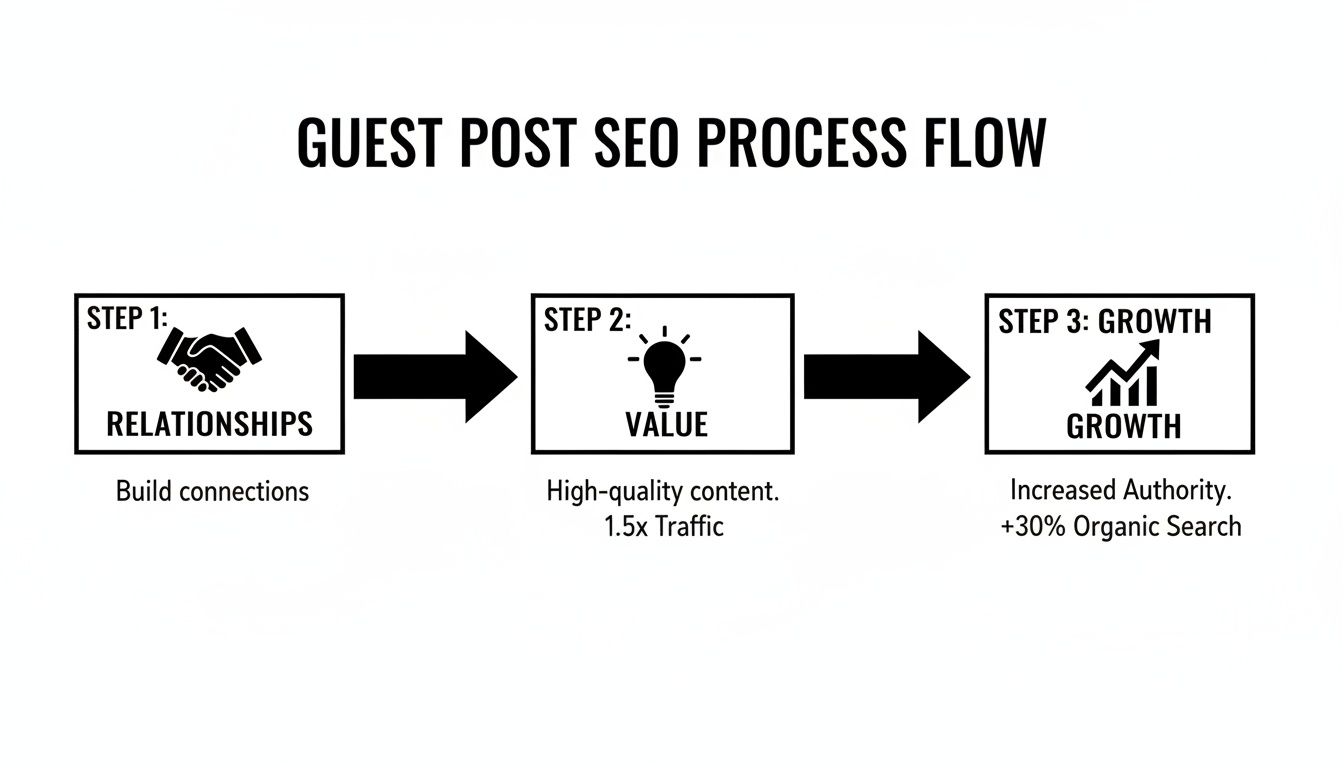
The key takeaway? Real SEO growth is built on a foundation of authentic relationships and high-value content.
The Modern Framework for Guest Blogging
The modern approach to guest post SEO is all about building genuine relationships and delivering real value. Search engines are incredibly good at spotting the difference between an authentic content partnership and a lazy, transactional link placement.
When you contribute a genuinely helpful article to another site, you create a win-win that search engines are designed to reward. This involves a shift in mindset:
- Building Relationships: Moving from cold, generic outreach to creating real collaborative partnerships with editors and site owners.
- Delivering Genuine Value: Crafting content that solves the host's audience's problems, not just content that serves your own promotional goals.
- Earning Authority: Gaining real credibility by being featured on respected platforms within your industry.
A great guest post serves three masters: the host's audience, the host's SEO goals, and your own. When you prioritize the first two, the third one takes care of itself.
Ultimately, a strong guest blogging plan is a critical piece of a larger content marketing strategy. When you integrate it correctly, it stops being an occasional task and becomes a repeatable process that consistently builds your authority.
For those ready to dive deeper, understanding how this fits into a complete link acquisition strategy is the next logical step. This guide will walk you through a repeatable process to transform your guest posting efforts from a chore into a primary driver of your business’s online success.
Finding and Qualifying High-Value Guest Post Targets

The entire foundation of a successful guest post SEO campaign is built on finding the right places to publish. Sure, you can start with the obvious Google searches like "write for us + [your niche]," but that’s just scratching the surface. The real gold is buried in your competitors' backlink profiles. A little reverse engineering here can uncover dozens of high-value targets you’d never find otherwise.
Using a tool like Ahrefs or Semrush, you can pull a list of every site linking to your top competitors. But don't just export a spreadsheet and start blasting out pitches. That’s a rookie mistake. The key is to look for patterns.
I always start by identifying sites that have linked to multiple competitors. This is a massive green light. It tells you the editor is open to content from various players in your industry and isn't locked into some exclusive deal with one brand. These are your prime targets, and they should go to the top of your list.
Beyond Basic Backlink Analysis
Once you’ve got a raw list of potential sites, the real work begins. This is where rigorous vetting separates a link that moves the needle from one that’s a complete waste of time. A high Domain Authority (DA) or Domain Rating (DR) score is a decent starting point, but it's just one number—it doesn't tell the whole story.
You have to dig deeper to see if a site is actually healthy and relevant. I've seen plenty of sites with a high DR that are actually part of a private blog network (PBN) or have traffic that's falling off a cliff. A link from a site like that could actually do more harm than good.
A valuable guest post target isn't just a platform with a high domain rating; it's a thriving community with an engaged audience that aligns perfectly with your own. Traffic and relevance matter more than any single vanity metric.
To properly qualify your prospects, you need a checklist that goes beyond those surface-level metrics. This is what ensures you’re investing your time and content creation efforts wisely.
The Ultimate Vetting Checklist
Before you even think about writing a pitch, every single site on your list needs to pass this qualification process. This is how you guarantee you’re only chasing opportunities that will give you a real, positive boost in both SEO and brand authority.
- Consistent Organic Traffic: Is the site's traffic growing, or is it at least stable? Use an SEO tool's organic traffic graph to check trends over the last year. A sudden, sharp drop-off is a huge red flag. A site with 10,000 monthly visitors that's growing is often better than a site with 50,000 that's in decline.
- Topical Relevance: How closely does this site's content actually align with your niche? A link from a hyper-relevant site sends a much stronger signal to Google than one from a generic news aggregator. For a Kansas City law firm, a link from a national legal blog is far more valuable than a link from a general business website.
- Audience Engagement: Look for signs of life. Are people leaving thoughtful, recent comments on blog posts? Are articles getting shared on social media? An active community means a real, engaged readership. No comments or shares in months is a warning sign.
- Outbound Link Profile: Take a look at who the site links out to. If you see it’s full of links pointing to spammy or low-quality websites (casinos, payday loans), run the other way. A clean outbound link profile is a great sign of a well-maintained, credible publication.
- Content Quality: Go and actually read a few of their recent posts. Are they well-written, in-depth, and genuinely helpful? High editorial standards are a great indicator that the site is valued by both search engines and its readers. Look for unique insights, data, and expert authors.
This vetting process might seem like a lot of work, but it’s hands-down the most important step in building a powerful backlink profile. By focusing on these qualitative signals, you make sure every single guest post you write is a meaningful investment in your long-term SEO success.
Crafting Outreach Emails That Editors Actually Open

Let's be honest—your outreach email is the first, and biggest, hurdle in any guest post SEO campaign. Editors at quality publications are drowning in pitches. They get dozens a day, and most get deleted in the blink of an eye. If you're using a generic template, you're just making it easy for them to hit the trash button.
Personalization and genuine value are the only things that cut through that noise.
Think of it this way: you’re not just asking for a link. You’re trying to start a professional relationship. The best pitches I've ever seen (and sent) prove you’ve done your homework and aren't just blasting out emails to a list you bought. A great email shows you actually understand their audience and have a specific, valuable idea that will make their blog better.
The Anatomy of a Winning Pitch
Your entire goal is to make it ridiculously easy for the editor to say "yes." This means your pitch needs to be concise, crystal clear, and show them the value right up front. Forget the long, rambling introductions about who you are; get straight to the point and show them you respect their time.
I’ve sent thousands of these emails over the years, and the structure that consistently works is simple: a compelling subject line, a personalized opening, a clear value proposition, and a simple call to action. Each part has a specific job to do in getting your pitch from the inbox to the "approved" folder.
The most critical piece of the puzzle is identifying and solving a problem for them. This usually means finding a content gap on their blog that you are uniquely qualified to fill.
Your pitch isn't about what you want (a backlink); it's about what you can give (a great piece of content their audience will love). When you frame it this way, your success rate will skyrocket.
From Generic to Magnetic
Let's look at a real-world example of what not to do. A generic pitch sounds something like this: "I'm a fan of your blog and would love to write a guest post for you. I can write about SEO." I can tell you from experience, this is lazy and will be ignored 100% of the time. It puts all the work on the editor to figure out what you should write about.
Now, let’s flip it to a personalized, value-driven approach that actually gets a response.
-
Weak Subject: Guest Post Pitch
-
Strong Subject: Content Idea: Closing Your [Specific Niche] Content Gap
-
Weak Opening: I read your blog and it's great.
-
Strong Opening: I just finished your article on keyword research for beginners. The point you made about long-tail keywords was spot-on. I especially liked the case study from the local KC business.
-
Weak Proposal: I can write about any SEO topic.
-
Strong Proposal: I noticed you have excellent foundational content but nothing covering advanced local SEO tactics for service-based businesses. I'd like to propose an article titled "5 Untapped Local SEO Strategies for Plumbers in 2024," complete with case study data from a client we helped in the Kansas City area. I've even outlined the key sections to show you the structure.
This approach immediately proves you're a careful reader who has identified a specific opportunity. You’ve done the heavy lifting, making the editor's job simple. It transforms you from a stranger asking for a favor into a potential collaborator offering a solution. This is the absolute core of effective guest post outreach.
Writing and Optimizing Content for SEO and Audiences

Getting that "yes" for a guest post is a huge win, but let's be real—that's only half the battle. Now comes the hard part: creating a piece of content that genuinely wows the host's audience while also hitting your own guest post SEO goals. It’s a delicate dance between providing value and being strategic.
The classic mistake is to get laser-focused on your backlink. A truly great guest post should feel like it was written by an in-house expert. It needs to seamlessly match the host blog's style and solve a real problem for their readers. Your SEO benefit is just the natural byproduct of doing that job incredibly well.
This means your content has to be original, insightful, and backed up with evidence. Don't just rehash the same old ideas. You need to bring a fresh angle, share a personal story, or use unique data to make your point land.
Weaving in Links Naturally
Your backlink is the prize, but how you place it matters—a lot. It has to feel editorially justified and add real value for the person reading. A clunky, forced, or overly promotional link is an instant red flag for editors and search engines alike.
Context is everything. Your link should point to a resource that logically expands on a specific point you're making. For instance, if your guest post is about content strategy and you briefly mention the importance of clear messaging, that’s a perfect spot to link out. For readers who want to go deeper, our guide on how to write website copy provides an excellent framework.
Beyond your main link, a well-rounded article includes a few other links to build credibility and show you’ve done your homework:
- Internal links: Drop in 2-3 links to other relevant articles on the host's blog. This shows you’re a team player, helps their own SEO, and is a surefire way to get your post approved faster.
- External links: Link out to 1-2 authoritative, non-competing sources (like a research study or industry statistics) to back up your claims. This boosts your article's credibility.
- Your backlink: Place your one strategic link where it feels most helpful and natural, often within the first 30-50% of the article.
The best backlink is one the reader is happy to click because it offers a logical next step in their learning journey. It should never feel like an advertisement.
Choosing the right anchor text is a key part of this strategy. You need a natural mix to avoid looking manipulative.
Anchor Text Strategy Comparison
Here’s a quick breakdown of the different types of anchor text and when to use them for the best impact.
| Anchor Text Type | Example | SEO Impact | Best Use Case |
|---|---|---|---|
| Branded | "according to Website Services" | High | Building brand recognition and authority. Safe and effective. |
| Exact Match | "SEO guest posting guide" | Very High | Use sparingly; can look spammy if overused. Points directly to a page about that specific keyword. |
| Partial Match | "this guide to guest posting" | High | A more natural-looking variation of a keyword-rich anchor. A great balance. |
| Naked URL | "https://websiteservices.io/…" | Medium | Looks very natural and is great for diversifying your profile. |
| Generic | "click here" or "read more" | Low | Use for clear calls-to-action, but provides little SEO context. Avoid for primary link building. |
A healthy, natural-looking backlink profile will have a mix of all these types. For a single guest post, leaning toward branded or partial match anchors is often the safest and most effective bet.
On-Page SEO for Guest Posts
While the content has to serve the audience first, you can't just ignore the fundamentals of on-page SEO. These practices make your article more scannable and search-engine-friendly, which boosts its chances of ranking on its own and driving traffic for years to come.
Run through these quick optimization checks before you hit "send":
- Image Optimization: If you're providing images, make sure they have descriptive file names (e.g.,
guest-post-seo-checklist.jpg) and alt text. - Keyword Placement: Naturally weave the target keyword (or a close variation) into your title, the first paragraph, and at least one subheading. Don't force it.
- Meta Description: You might not have the final say, but suggesting a compelling meta description (155 characters or less) shows you’re a pro and makes the editor's job easier.
- Readability: Use a tool like Hemingway Editor to ensure your sentences are clear and concise. Aim for a grade 8 reading level or lower for broader appeal.
Ultimately, the most powerful SEO signal your guest post can send is engagement. When your article genuinely resonates with the host's audience—sparking shares, comments, and real discussion—its SEO value multiplies. Always write for the reader first. The search engine rewards will follow.
How to Measure the Real Impact of Your Guest Posts
Getting your guest post published feels like the finish line, but it’s really just the starting gun. Your work isn’t done. The real value of guest post SEO isn't just about getting the placement; it’s about tying that effort back to actual business results.
If you aren't tracking what happens next, you're just creating content in a vacuum, hoping it's moving the needle for your brand.
Proving the return on investment (ROI) is everything. Top-tier guest post placements can easily run from $500 to over $1,000, especially on authoritative sites. With that kind of investment in time and money, you can't just cross your fingers and hope for the best. You need to track performance.
Key Performance Indicators to Monitor
To get a real sense of your guest post’s impact, you have to look beyond a simple "link acquired" checkmark. The most powerful insights come from combining data from free tools you already have, like Google Analytics 4 (GA4) and Google Search Console.
Here’s what I always keep a close eye on:
- Referral Traffic: This is your most direct signal. In GA4, head over to the "Traffic acquisition" report and filter by "Session source." Look for traffic coming from the domain where your guest post went live. A steady stream of visitors clicking through from that site is a fantastic sign that the content is resonating. Set up a custom alert to notify you of spikes from new referring domains.
- Organic Keyword Rankings: This is where the rubber meets the road. Use Google Search Console to see if the keywords you targeted with your anchor text are climbing. Go to the "Performance" report, filter by the target page URL on your site, and check if its average position has improved since the post was published. A jump from position 12 to position 7 for a key term is a huge win.
- Referring Domain Growth: A successful campaign should steadily increase your total number of referring domains. This metric, which you can track in tools like Ahrefs or Semrush, is a high-level sign of your site's growing authority. It’s a core piece of analyzing your what is backlink profile.
- Branded Search Volume: This one is often overlooked. As your brand gets mentioned on more authoritative sites, you'll naturally see more people searching directly for your company name. You can monitor this in Search Console to get a read on how your guest posting is lifting overall brand awareness.
The ultimate goal is to connect the dots. A guest post on Site A led to a 15% increase in referral traffic, which coincided with a two-position jump in rankings for our target keyword, ultimately driving three new leads. That's a story you can take to your boss or client.
By setting up a simple tracking dashboard or spreadsheet for each guest post, you can start to see patterns emerge. You might discover that posts on a certain type of blog always drive the most referral traffic, or that a specific anchor text strategy is crushing it for boosting rankings.
This data-driven feedback loop is what allows you to refine your strategy, double down on what works, and prove the undeniable value of your guest posting efforts.
Got Questions About Guest Posting for SEO? We've Got Answers
Even with a solid plan, it's totally normal for questions to pop up once you start digging into a guest post SEO strategy. Getting clear, straightforward answers helps you navigate the common hurdles and move forward with confidence. Let's tackle some of the most frequent questions I hear.
How Many Guest Posts Do I Need for Results?
This is usually the first question people ask, but there’s no magic number. Quality will always crush quantity. A single guest post on a top-tier, highly relevant industry site can deliver more SEO value than ten posts on low-authority, generic blogs.
My advice is always to focus on consistency over sheer volume. A realistic and effective goal for most businesses is to lock down 2-4 high-quality placements each month. With a sustained, quality-focused campaign like that, you can typically expect to see initial ranking improvements for your target keywords within three to six months. For a competitive local market like Kansas City, consistent, high-quality local and industry-specific links are key to standing out.
Should I Pay for Guest Post Placements?
This is a tricky area, so let's be direct. Google's official guidelines prohibit paying directly for links that pass PageRank. However, the reality is that many reputable online publications charge "editorial" or "publishing" fees to cover their operational costs—things like editing, design, and site maintenance.
The key is to understand the intent. Are you paying a site that exists only to sell links, or are you compensating a legitimate publication for their time and resources in a genuine content collaboration? You absolutely want to avoid sites that explicitly sell links. Instead, focus on building partnerships where any fee is part of a transparent process that delivers value beyond just the backlink, like brand exposure to a real, engaged audience.
A healthy guest posting strategy focuses on earning placement through value. If a fee is involved, it should be for editorial services, not for the link itself.
What About Reciprocal Linking?
Reciprocal linking is just when two websites agree to link to each other. While it sounds like a simple win-win, excessive link swapping can be a red flag for search engines if it starts to look unnatural or manipulative.
That said, a one-off link exchange with a relevant partner can be perfectly fine if it provides genuine value to both audiences. For a deeper dive, you can learn more about what is reciprocal linking and how to approach it safely. The best practice, however, is to focus on earning one-way links from your guest posts, as they carry more undisputed SEO weight.
Ready to build authority and climb the rankings with a professional guest posting strategy? Website Services-Kansas City specializes in securing high-quality, in-content backlinks that drive real results. Let us handle the research, outreach, and placement so you can focus on your business. Explore our SEO solutions today.
