
Before you can build a towering skyscraper, you need to pour a solid foundation. The same exact principle applies to your link building strategy. If you jump straight into outreach without understanding your current position, you're navigating without a map—and you'll get lost fast.
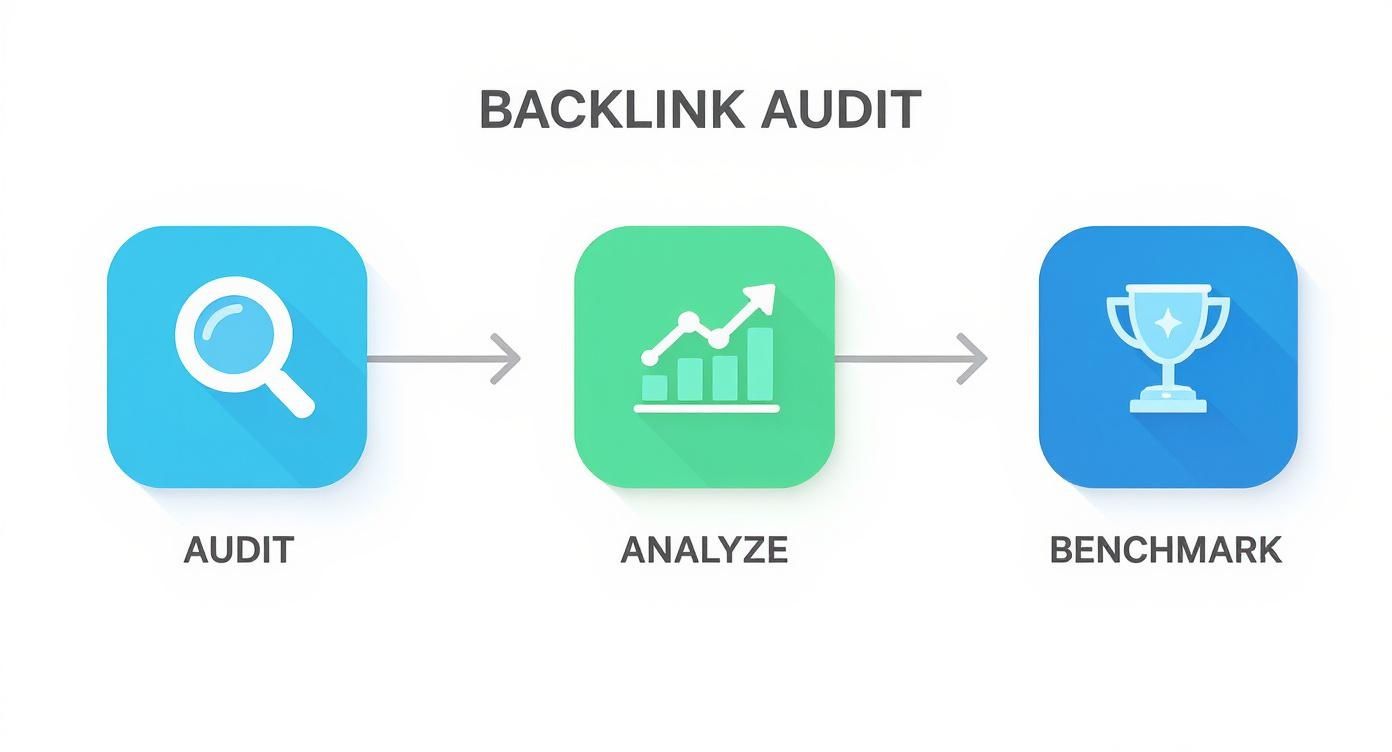
That’s why the first, most critical step is to conduct a thorough backlink audit. This isn't just about downloading a list of domains from Ahrefs or SEMrush. It’s an investigative process to figure out where you stand right now. A deep dive into your what is a backlink profile reveals your greatest strengths and most glaring weaknesses.
What to Look For in a Backlink Audit
Your audit should focus on three core areas: pinpointing your most valuable link assets, spotting any toxic or junky links, and understanding the context behind every single link you have. This initial analysis will shape every decision you make from here on out.
Start by cataloging your current links and sorting them by metrics like Domain Rating (DR) or Authority Score (AS). But don't just stop at the numbers. You have to ask the right questions about each link:
- Relevance: Does the linking site operate in a similar niche? For a local Kansas City business, a link from a local KC-based blog is far more valuable than a random link from an unrelated international site.
- Authority: Is the linking domain a trusted source? High-authority links act as powerful votes of confidence in the eyes of search engines.
- Context: Is the link placed naturally within a piece of relevant content? An in-text link within a blog post is typically way more powerful than one buried in a footer or a generic directory listing.
This simple framework helps you move beyond a simple tally of backlinks and start to understand their true quality and impact.
Benchmarking Against Your Competitors
Once you have a clear picture of your own profile, the next step is to see how you stack up against the competition. This isn't about blindly copying their strategy; it's about uncovering opportunities they might have missed and identifying the high-authority sites that are already linking to businesses just like yours.
A competitive backlink analysis is one of the most effective ways to build a realistic roadmap. It shows you what’s achievable in your niche and reveals the exact domains that are open to linking to your industry peers.
For instance, if you're a small business in Kansas City, analyze the backlink profiles of the leading local agencies. Tools like Ahrefs' "Link Intersect" can show you which websites link to multiple competitors but not to you. This is an absolute goldmine of qualified prospects who have already proven they’re willing to link to businesses in your market.
This kind of intelligence transforms your link building from pure guesswork into a targeted, data-driven strategy.
How to Find and Qualify High-Value Link Opportunities
Alright, with your backlink audit done, you've got a solid baseline. Now for the fun part: the active hunt for new links—the kind that actually moves the needle on your authority and brings in real, relevant traffic. We’re not just aimlessly casting a wide net here. This is a targeted search for high-value partners.

Reverse-Engineer Your Competitors
One of the smartest, most efficient ways to find prime link prospects is to see who’s already linking to your competitors. These sites have already proven they’re interested in your niche, which makes them incredibly warm leads for your own outreach.
Just pop a competitor's domain into a tool like Ahrefs or SEMrush and head straight to their backlink profile. You're looking for high-quality, relevant sites that you could realistically get a link from, too.
Let’s say you run an e-commerce store selling eco-friendly cleaning supplies in Kansas City. A quick analysis of a top national competitor might reveal they have links from:
- Blogs focused on sustainable living.
- "Best of" product roundup articles.
- Local KC news sites featuring green businesses.
This isn't about "stealing" their links. It’s about uncovering a pre-qualified list of websites that are already part of the conversation you want to join.
Hunt for Unlinked Brand Mentions
It happens all the time: websites will mention your brand, products, or services without actually linking back to your site. These are pure gold—some of the easiest link-building wins you'll ever get. The hard part is already done; you just need to ask for the credit.
You can set up alerts for your brand name and key product names using tools like Google Alerts or Mention. When you find an article that mentions you without a link, reach out to the author or editor with a polite request.
A simple email saying, "Thank you for mentioning our brand in your article! Would it be possible to add a link to our homepage so your readers can learn more?" is often all it takes to turn a mention into a valuable backlink.
This tactic is a quick win that reinforces your brand authority while improving your backlink profile with minimal effort.
Discover Broken Link Building Opportunities
Broken link building is a classic for a reason: it provides immense value to both you and the website owner you’re contacting. The whole idea is to find a broken (404) link on another website and offer your own relevant content as a perfect replacement.
You're literally helping the site owner fix an error on their page—improving their user experience—while earning a relevant backlink in return. A great way to find these is to use an SEO tool browser extension to check for broken links on resource pages or articles within your niche.
Imagine finding a popular home improvement blog with a resource page called "Helpful Links for DIYers." If you spot a dead link that once pointed to an article about non-toxic paint, you can pitch your own guide on that very topic as the ideal replacement. It's a true win-win.
Qualifying Your Link Prospects
Finding a potential link is only half the battle. Now comes the crucial step: qualification. Not all links are created equal, and a bad one can do more harm than good. Before you even think about reaching out, you need to vet each prospect against a few key criteria.
- Topical Relevance: Does the website's content actually align with your business? A link from a completely unrelated industry is confusing for search engines and offers little real value.
- Website Authority: Use metrics to get a sense of a site's strength. You can learn more about what does domain authority mean in our detailed guide, but the bottom line is you want links from sites that search engines already trust.
- Organic Traffic: A site with steady, real traffic is a sign that it’s valued by users and search engines alike. A link from a site like this is far more likely to send referral traffic your way.
This careful vetting process is what separates a professional, sustainable link building strategy from amateurish spam. The industry is rapidly shifting away from purely transactional tactics like basic guest posting toward more reputation-driven methods.
In fact, 48.6% of SEO professionals now rank digital PR as the most effective link building technique. With 61% of marketers planning to invest in link building in 2025, it’s clear the focus is squarely on quality over quantity. You can find more details on these link building statistics and trends at BuzzStream.
Creating Content That Naturally Earns Backlinks
Let's be honest: the most powerful links aren't forced through endless, generic outreach emails. They're earned. At the heart of any modern, sustainable link building strategy is exceptional content—stuff people genuinely want to reference, share, and cite.
This is the fundamental difference between begging for links and becoming a resource that naturally attracts them.
The entire goal is to create linkable assets. Think of these as pieces of content so valuable that other site owners, journalists, and bloggers feel compelled to link back to them. This approach shifts your focus from chasing short-term wins to building long-term authority, turning your website into a go-to resource in your industry.
Identifying Your Link Magnets
Not all content is created equal when it comes to attracting backlinks. While a standard blog post might be great for your audience, linkable assets are specifically engineered to be cited. They are typically data-rich, incredibly comprehensive, or uniquely helpful.
A few proven formats consistently act as link magnets:
- Original Research & Data Studies: Publishing unique data is arguably the most effective way to earn high-authority links. Journalists and bloggers are always hunting for credible statistics to support their arguments, and if you're the original source, they have to link to you.
- Comprehensive "Ultimate" Guides: A truly exhaustive guide on a relevant topic can become the definitive resource. When others write about that subject, it's far easier for them to link to your complete guide than to explain every single detail themselves.
- Free Tools & Calculators: Creating a simple, free tool that solves a common problem for your audience is a fantastic way to generate passive links. People will link to it from resource pages, mention it in articles, and share it as a helpful utility.
- Compelling Infographics & Visualizations: People love to share and embed well-designed visuals. A strong infographic can simplify a complex topic, making it highly shareable and a prime target for links from other blogs covering the same subject.
Comparing Link-Worthy Content Types
To help you decide where to focus your efforts, this table breaks down the most effective types of linkable assets. Each one targets a slightly different kind of linker, but they all share one thing in common: they provide undeniable value.
| Content Type | Format | Primary Link Target | Key to Success |
|---|---|---|---|
| Original Research | Data study, survey results, industry report | Journalists, news sites, authoritative blogs | Unique, citable statistics and a clear, compelling narrative. |
| Ultimate Guide | Long-form blog post, "how-to" resource hub | Bloggers, industry publications, resource pages | Unmatched depth and comprehensiveness on a specific topic. |
| Free Tool | Interactive calculator, generator, simple web app | Resource pages, "best tools" listicles, bloggers | Solves a specific, recurring problem for your target audience. |
| Infographic | Data visualization, process flowchart | Bloggers, social media shares, visual content sites | A simple, powerful story told through compelling design. |
Ultimately, choosing the right format comes down to your resources and your audience's needs. The key is to commit to creating the absolute best version of that asset on the web.
Brainstorming Content That Serves Two Audiences
To create a successful linkable asset, you have to think about two distinct audiences at the same time: your target customer and the person you want a link from (like a journalist, blogger, or editor). Your content idea must provide immense value to both.
A powerful linkable asset sits at the intersection of what your audience needs to know and what journalists need to cite. If it only serves one, it won't achieve its primary goal of earning high-quality backlinks.
For instance, a Kansas City-based marketing agency could create a data study titled "The State of Small Business Digital Marketing in the Midwest." This is immensely valuable to their potential clients (Midwest small business owners) and is also a unique, citable resource for local news outlets and national business publications. It perfectly aligns with their expertise and serves both audiences simultaneously.
The initial brainstorming and planning phase is absolutely critical. To build a robust framework, it's wise to learn more about how to create a content strategy that integrates these link-earning principles from the very beginning.
From Idea to Execution
Once you have a winning idea, the execution determines whether it earns links or falls flat. A great concept with sloppy execution will fail to gain any traction.
Let's walk through a practical look at bringing a data-driven piece to life.
First, you need to gather unique data. You could run a survey using a platform like SurveyMonkey, analyze your own internal customer data (anonymously, of course), or compile public data from various sources into a single, insightful report.
Next, you have to find the narrative. Data is just numbers until you find the story within it. Look for surprising trends, counterintuitive findings, or stats that challenge common industry assumptions. The headline of your report should be the most interesting story you discovered.
Finally, you must design for citability. Present your findings as clearly as possible. Use bold text for key stats (like 78% of respondents), create simple charts and graphs for each major data point, and write a concise summary at the top. You have to make it incredibly easy for a journalist on a tight deadline to grab a statistic and its source.
Imagine you're an e-commerce store that sells eco-friendly products. You could survey 1,000 customers and publish a report on "2025's Top Sustainable Shopping Trends." Highlighting a key finding like, "65% of consumers are willing to pay more for products with plastic-free packaging," gives journalists a compelling, ready-to-use statistic they can easily cite—with a link back to your study.
This is how you turn your content into a primary source, dramatically increasing its link-earning potential.
Mastering the Art of Personalized Outreach
Even the most brilliant, link-worthy content we just talked about needs a nudge to get seen. Hitting "publish" and hoping for the best isn't a strategy—it's a recipe for disappointment. This is where effective, human-centered outreach comes into play. It's the engine that gets your content in front of the right people.

Forget the generic, mass-blasted templates that flood inboxes and get deleted on sight. Successful outreach is about building genuine connections, and that requires personalization, a clear value proposition, and a deep respect for the other person's time.
The goal here isn't just to snag a single link. It's to start a real relationship that could lead to more collaborations and organic mentions down the road.
Anatomy of an Irresistible Outreach Email
A winning outreach email is a delicate dance. You have to be direct, show your value, and prove you’ve actually done your homework, all without taking up too much of their time. Get this right, and you’ll see your response rates climb dramatically.
Let's break down what separates a great email from one that ends up in the trash.
- The Subject Line: This is your first impression, so make it count. It needs to be compelling but not clickbaity. I find that something clear and personalized, like "Question about your article on [Topic]" or "[Their Site Name] + [Your Site Name] idea," works wonders.
- The Personalized Opener: The first sentence has to prove you're not a robot. Reference a recent article they wrote, a social media post, or something specific about their work. This one move immediately separates you from 99% of the spam they get every day.
- The Value Proposition: Get straight to the point. Why are you emailing them, and what’s in it for them? Clearly and concisely explain how your content can add value to their audience or improve one of their existing articles.
- The Clear Ask: Don't be vague. State exactly what you're hoping for. Whether you’re suggesting your resource as an addition or offering a guest contribution, make the next step totally obvious.
Finding the Right Person to Contact
Sending the perfect email to the wrong person is a complete waste of everyone's time. Before you write a single word, you have to pinpoint the right contact. Blasting a generic "info@" address or a contact form should always be your last resort.
Your outreach is only as effective as your prospecting. A highly personalized email sent to a general inbox will almost always be ignored. Invest the time to find the specific editor, journalist, or content manager responsible for the topic you're pitching.
Tools like Hunter.io or VoilaNorbert are great for finding email addresses associated with a domain. I also use LinkedIn to identify people with the right job title, like "Content Manager," "Managing Editor," or "Staff Writer." This targeted approach makes sure your carefully crafted message actually lands in the right inbox.
Frameworks Over Rigid Templates
While rigid, copy-paste templates are a recipe for failure, adaptable frameworks give you a solid structure to build on. Think of them as a checklist, not a script. For different scenarios like broken link building or resource page outreach, the core elements stay the same, but your angle will change.
For instance, while some outreach focuses on getting a link in existing content, other approaches involve pitching new content entirely. You might consider learning more about the nuances of an SEO guest post strategy to see how that framework differs from simple resource pitching.
The Art of the Follow-Up
Let's be real: people are busy, and inboxes are chaotic. A single email can easily get lost in the shuffle. A polite but persistent follow-up is absolutely essential for any successful link building campaign. Don't be afraid to send a gentle reminder.
Here’s a simple, non-annoying follow-up plan that I've found works well:
- First Follow-Up (3-5 Days Later): Send a brief, friendly reply to your original email. A simple, "Just wanted to follow up on this and see if it might be a good fit" is often all you need.
- Second Follow-Up (7-10 Days Later): This is usually my final attempt. I'll try a different angle or offer some additional value. If you still don't hear back, it's time to respectfully move on.
Being persistent shows you’re confident in the value you’re bringing to the table. Just make sure to keep it professional and respectful of their time.
Integrating AI and SEO Tools into Your Workflow
Working smarter, not just harder, is the key to modern link building. Manual processes will only get you so far. To stay competitive, you have to bring in tech that streamlines your work and gives you a data-driven edge. This is where AI and specialized SEO tools become a non-negotiable part of your workflow.
Platforms like Ahrefs and BuzzStream aren't just for audits or rank tracking anymore. They are powerful engines that can dramatically speed up prospect discovery, help you analyze competitor strategies at scale, and even sharpen your outreach.

Supercharging Prospect Discovery and Analysis
Manually sifting through thousands of potential link prospects is a massive time sink. Modern SEO tools automate this entire process, letting you quickly find high-potential targets based on hyper-specific criteria.
Let's make this real. Imagine you're a Kansas City-based e-commerce store selling eco-friendly products. Instead of just Googling around, you could use Ahrefs' Content Explorer to find every article that mentions "sustainable products" but doesn't already link to your site. Just like that, you have a hyper-targeted list for an unlinked brand mention campaign.
These tools also arm you with critical data points to qualify prospects in seconds:
- Domain Authority (DA) / Domain Rating (DR): Quickly gauge a site's overall authority.
- Organic Traffic Estimates: Make sure you're targeting sites with a real, engaged audience.
- Topical Relevance Scores: See how closely a site's content aligns with your niche.
This data lets you focus your energy on prospects that are actually likely to provide a valuable, relevant backlink, making your entire strategy far more efficient.
Leveraging AI for Content and Outreach
AI is rapidly changing how we approach both content creation and outreach. Instead of guessing what topics might earn links, you can use AI-powered tools to spot trending subjects before they become completely saturated.
For instance, an AI tool could analyze social media and news trends to flag a rising interest in "upcycled home decor." This insight lets you create a timely, data-rich article on the topic, positioning it as the go-to resource for journalists and bloggers who will inevitably be covering the trend.
By using predictive analytics, you shift from a reactive to a proactive link building model. You're not just creating content you hope will earn links; you're creating content based on data that shows it is likely to attract them.
AI can also help personalize outreach at scale. Certain tools can analyze a prospect's recent articles or social media activity to suggest custom opening lines for your emails. This helps you build genuine rapport without spending hours on manual research for every single contact.
Building a Predictive Link Building Strategy
Looking ahead, the integration of AI is only getting deeper. The next wave of link building will use predictive models to optimize backlink acquisition with incredible precision. SEO tools with machine learning will analyze domain authority, content relevance, and historical data to pinpoint high-potential sites that perfectly match your goals. This data-first approach moves beyond manual prospecting, paving the way for targeted outreach that boosts both conversion rates and link quality. You can uncover more about these future link building trends and how they will shape success in 2025.
Measuring Success and Budgeting for Your Campaign
A link building strategy is only as good as the results it brings in. If you don't have a clear way to measure success, you're basically just flying blind—spending time and money without knowing if any of it is actually working. This final piece of the puzzle is all about tracking your return on investment (ROI) and setting a realistic budget to keep your efforts effective and sustainable.
Defining Your Key Performance Indicators
To actually prove the value of your link building, you need to look beyond a simple link count. The right key performance indicators (KPIs) tell a story about how your work is impacting the bottom line. You need to focus on the metrics that tie directly to business growth.
Your reporting should really center on a few core KPIs:
- Keyword Ranking Improvements: Keep a close eye on where your target keywords are sitting in the search results. A steady climb for your most important commercial keywords is one of the clearest signs that your strategy is paying off.
- Organic Traffic Growth: As your rankings get better, you should see a matching increase in organic traffic. Use Google Analytics to watch this, paying special attention to the specific landing pages you're building links to.
- New Referring Domains: The number of unique, quality websites linking to you is a huge signal of growing authority. The goal is to get links from new, relevant domains, not just more links from the same couple of sites.
- Referral Traffic: Don't forget that links have a direct impact, too. A solid backlink from a relevant, high-traffic site should be sending qualified visitors straight to your page. This is a real, immediate benefit of your work.
Creating Reports That Demonstrate Value
When you're showing results to clients or your boss, clarity is everything. A simple, visual report is always going to be more powerful than a massive spreadsheet. Your job is to connect your link building activities to tangible business outcomes, showing a clear cause and effect.
A great report doesn't just show data; it tells a story. Frame your metrics around business goals, like "Increased organic traffic to our key product page by 25%" instead of just "Acquired 10 new backlinks."
Organize your reports to highlight progress over time. Pull in charts and graphs from tools like Google Analytics and Ahrefs to visualize the trends in organic traffic, keyword rankings, and referring domain growth. This makes it easy for anyone to see the positive momentum your campaign is building.
Budgeting for a Sustainable Link Building Strategy
Real link building requires a realistic budget, and it’s critical to understand the current financial landscape when you're planning. As the competition gets more intense, the costs of earning high-quality backlinks are climbing right along with it. This is why many businesses face the strategic decision of whether to handle this in-house or outsource backlink building based on their expertise and budget.
The money being put into link building shows just how important it has become. Today, nearly 46.5% of businesses set aside between $5,000 and $10,000 per month just for these efforts. Backlinks now take up an average of 28% of a company's total SEO budget. Over the last four years, the cost of a single outreach campaign has shot up by 150%, now averaging about $1,000. But even with rising costs, 85% of marketers agree that link building will remain a core part of SEO for the next five years, which tells you everything you need to know. You can explore more of the data behind these financial link building trends on Loopex Digital.
This data gives you a solid benchmark for setting your own budget. Whether you're a small business starting with a few hundred dollars a month or a larger company investing thousands, the most important thing is consistency. A sustained, long-term investment will always beat sporadic, short-lived campaigns. By tracking your KPIs and budgeting wisely, you can build a powerful link building machine that delivers measurable, lasting growth.
At Website Services-Kansas City, we specialize in creating and executing data-driven SEO strategies that build authority and drive real business growth. Our team builds natural, in-content backlinks that are designed to improve your search rankings and increase organic traffic. https://websiteservices.io
