
Choosing the right SEO agency doesn't start with their sales pitch. It starts with you. The whole process hinges on defining what success actually looks like for your business, vetting an agency's real-world performance, and making sure their strategic brain works for your specific business model. Getting this internal clarity first is the only way to find a true partner, not just a vendor.
Define Your SEO Goals Before You Start Your Search

Before you schedule a single discovery call, the most critical work happens inside your own four walls. Rushing to find an agency without a clear destination in mind is like hiring a driver and not giving them an address. You’ll spend a lot of money and burn a lot of time, but you won't end up anywhere useful.
The very first step is to translate your big-picture business ambitions into specific, tangible SEO outcomes. What does "growth" actually mean for you?
Moving Beyond Vague Objectives
"More traffic" is not a goal; it's a byproduct. To choose an SEO agency that will actually move the needle, you have to dig way deeper. Your objectives must be tied directly to your business model and how you make money.
Let’s look at a couple of real-world scenarios:
- For a local Kansas City plumber: The goal isn't just random website visitors; it's generating qualified leads. Success is measured by a sharp increase in phone calls and contact form submissions from homeowners inside their service area. A key performance indicator (KPI) would be ranking in the Google Map Pack for "emergency plumbing services in KC."
- For a national e-commerce store selling handmade leather goods: The goal here is direct sales revenue. Success is tracked through organic transaction volume and average order value. A crucial KPI might be ranking for "buy handmade leather wallet online."
These two businesses need completely different strategies. Defining your unique goal ensures you don't end up paying for a generic plan that doesn't serve your bottom line.
Key Takeaway: An SEO strategy should be a direct extension of your business plan. If an agency's proposed KPIs don't align with your revenue goals, they are not the right partner.
To make sure you have your ducks in a row, it helps to run through a quick internal checklist. This simple exercise ensures you’re prepared and can lead the conversation with potential agencies, rather than just reacting to their pitch.
Your Pre-Hiring SEO Checklist
Here's a quick summary of the internal homework you need to do before you start evaluating agencies. Completing these tasks will ensure you approach the process with clear goals and realistic expectations.
| Task | Why It's Crucial | Example Outcome for a KC Business |
|---|---|---|
| Define Your Primary Business Goal | Connects SEO efforts directly to revenue. Prevents paying for vanity metrics like "traffic." | "Increase qualified leads for our commercial HVAC services by 25% in the next 12 months." |
| Identify 3-5 Key KPIs | Creates measurable benchmarks to hold an agency accountable. No ambiguity. | "Track monthly increases in contact form fills, phone calls from the website, and rankings for 'commercial HVAC repair Kansas City'." |
| Calculate Customer Lifetime Value (LTV) | Helps you establish a realistic, value-based budget. Shifts focus from cost to ROI. | "A new commercial client is worth $10,000 over 3 years, so we can invest up to $3,000/mo to acquire several." |
| Know Your Target Audience | Ensures the agency targets the right people with the right message, not just generic keywords. | "We target facility managers in the KC metro area, not residential homeowners. Content must address their specific pain points." |
Walking through this checklist puts you in the driver's seat, armed with the data you need to make a smart, informed decision.
Identifying Your Key Performance Indicators
Once your primary objective is crystal clear, you can nail down the metrics that actually matter. These KPIs will become the yardstick for measuring an agency's performance. Without them, you have no objective way to know if your investment is paying off.
Start by asking what actions you need customers to take.
- Lead Generation: Focus on conversions (form fills, calls), cost per lead, and Google Business Profile interactions.
- E-commerce Sales: Track organic revenue, conversion rate, and rankings for transactional keywords.
- Brand Awareness: Monitor keyword visibility, branded search volume, and organic traffic growth.
This groundwork is fundamental for any business owner serious about their online presence. For a deeper dive into the technical and strategic elements, you can learn more about how to improve website SEO in our detailed guide. Establishing these metrics internally first gives you total control over the conversation with potential agencies.
Establishing a Value-Based Budget
Finally, you have to determine your budget. Don't just pull a number out of thin air or start by searching for the cheapest option. Instead, think about the value a successful SEO campaign will bring to your business. If a single new client is worth $5,000 to you, what are you willing to invest to acquire several of them each month?
Approaching your budget from a return-on-investment perspective completely changes the conversation from cost to value. A $3,000 per month retainer might sound expensive on its own, but if it generates $15,000 in new business, it's an incredibly profitable investment.
This initial financial planning ensures you can have realistic conversations and evaluate proposals based on potential returns, not just the price tag. With these foundational elements in place—clear goals, defined KPIs, and a value-based budget—you are now ready to start your search with purpose and clarity.
How to Vet an Agency's Real-World Performance

Any agency can throw together a polished sales pitch and a website packed with impressive logos. But talk is cheap. The real challenge when you’re figuring out how to choose an SEO agency is separating the storytellers from the true performers.
This is your due diligence phase—where you look past the curated case studies and dig for tangible proof of their impact.
True performance isn’t about vague promises; it’s about measurable business results. A slick presentation might show a graph of traffic shooting up, but that metric is meaningless without context. Your job is to find out if they just drove clicks or if they actually grew a client's bottom line.
Look Past the Case Study Highlights
Case studies are marketing materials, plain and simple. They’re designed to show an agency in the best possible light. While they offer a glimpse into an agency's process, you need to treat them as a starting point for deeper questions, not the final word on their abilities.
When you're looking at a case study, ask yourself:
- What specific results are they claiming? "Increased organic traffic by 200%" sounds great, but it’s a hollow victory if that traffic didn’t convert into leads or sales. Look for metrics that matter, like a 30% jump in qualified demo requests or a 45% boost in e-commerce revenue.
- How relevant is this client to my business? Success for a national software company doesn't automatically mean they can get results for a local service business in Kansas City. Their strategies might be completely different.
- What was the timeline? Did these results take six months or three years? This helps you set realistic expectations for your own engagement.
Key Takeaway: A great case study focuses on business outcomes, not just SEO metrics. If an agency can't connect its work directly to a client's revenue or lead generation goals, that's a huge red flag.
The real evidence comes not from what the agency says about themselves, but from what their past and current clients say. This is where you need to pick up the phone.
Contacting References and Asking the Right Questions
A reputable agency will gladly provide you with references. If they hesitate or make excuses, consider it a deal-breaker. Once you have a list of contacts, don't just ask if they were "happy" with the service. You need to dig for specifics that reveal the true nature of the partnership.
Use this script as a guide for your reference calls:
- "What was the biggest business challenge you hoped the agency would solve?" This question frames the conversation around business goals from the start.
- "Can you describe their communication and reporting process? Was it clear and consistent?" This uncovers their client management style and level of transparency.
- "Did you feel like their team understood the unique challenges of your industry?" This assesses their ability to adapt strategies to different market landscapes.
- "What was one area where they exceeded your expectations, and one area where they could have improved?" Asking for both positives and negatives often yields the most honest feedback.
- "Would you hire them again for a similar project?" This is the ultimate test of satisfaction.
These conversations will give you an unfiltered look into what it's actually like to work with the agency day-to-day. You'll learn about their responsiveness, their problem-solving skills, and their ability to deliver on their promises—insights you'll never find in a PDF.
Assess the Team and Their Industry Experience
Finally, you need to evaluate the specific team that will be working on your account. Don't be swayed by the senior strategist who runs the sales call; you need to know who will be handling the daily execution.
An agency’s link-building philosophy, for instance, is critical. To understand different approaches, you can learn more about how to outsource backlink building and the strategies involved.
Industry experience is a massive advantage. An agency with a portfolio of successful local service businesses in a market like Kansas City will have a deep, nuanced understanding of your competitive landscape. They'll already know the local search terms that matter and the strategies that work for businesses like yours.
A generalist agency, on the other hand, will be starting from scratch, learning your industry on your dime. Insist on knowing who will manage your account and what relevant experience they bring to the table.
The Right Questions to Uncover an Agency's Strategy
The discovery call is your single best shot at looking under the hood of a potential SEO partner. This is where you move past their polished website and cherry-picked case studies to see how they actually think. Arming yourself with the right questions will reveal their strategic depth, their transparency, and whether they're a genuine partner or just another vendor selling a one-size-fits-all package.
Generic questions will only get you generic answers. Instead of asking "Can you get us to rank #1?", which any reputable agency will tell you is impossible to guarantee, you need to probe their process. The goal is to understand how they'll approach your specific business challenges, not just what results they promise.
Probing Their Link Building Philosophy
One of the most telling areas to explore is an agency's approach to link building. Backlinks are an incredibly powerful ranking signal, but the methods used to get them can either build your site's authority or get it penalized by Google. This is a non-negotiable area for clarity.
A strong agency will talk about a multi-faceted, ethical strategy focused on earning links, not just buying them.
- Weak Answer: "We have a network of sites we use to get you powerful links quickly." This is a massive red flag. It often points to a private blog network (PBN), which can lead to severe, site-killing penalties.
- Strong Answer: "Our strategy is all about earning links. We focus on creating high-quality content, targeted outreach to relevant publications in your industry, and digital PR. We prioritize links from authoritative sites that will send you relevant referral traffic, not just 'link juice'."
This distinction is absolutely critical. An ethical approach is slower but builds sustainable, long-term authority. A risky one offers a short-term boost at the risk of long-term disaster.
Understanding Their Technical SEO Process
I've seen so many agencies that are great at content but fall flat on the technical side of SEO. A website with a poor technical foundation is like a car with a powerful engine but flat tires—it's just not going anywhere fast. You need to know if they have the expertise to handle the backend complexities that are crucial for search engine crawlers.
Ask them directly: "Can you walk me through your process for a technical SEO audit? What specific tools do you use, and what are the first three things you'd check on our site?"
A competent agency will immediately mention things like:
- Checking crawlability and indexability using tools like Google Search Console.
- Analyzing site speed and Core Web Vitals with PageSpeed Insights.
- Reviewing structured data (schema markup) to enhance your search listings.
- Ensuring proper mobile responsiveness and a logical site architecture.
If they give you a vague response or can't name specific tools and processes, it's a good sign they lack the technical depth needed to build a strong foundation for your success.
Key Insight: A great SEO partner isn't afraid to get technical. Their ability to clearly explain complex topics like schema markup or crawl budget is a strong indicator of their expertise.
Gauging Communication and Adaptability
An SEO strategy is not a "set it and forget it" activity. It demands constant monitoring, analysis, and adjustment based on real-world data. The agency's communication style and willingness to adapt are just as important as their initial plan. This is where you find out if you're hiring a collaborator or just an order-taker.
The most important question you can ask is this: "How will you communicate progress, and how do you adapt the strategy based on performance data and our feedback?"
Look for a response that includes a clear reporting cadence (monthly or bi-weekly), defined KPIs that are actually tied to your business goals, and a process for strategic reviews. They should be able to explain how they use data from tools like Google Analytics and Semrush to pivot when something isn't working.
This conversation also sets the stage for how they’ll handle keyword research, a fundamental part of any strategy. To get up to speed before that call, check out our guide on how to conduct keyword research to understand the process.
If their answer revolves solely around a static monthly report with ranking numbers, it suggests a lack of strategic agility. A true partner will work with you, incorporating your industry insights to refine the strategy over time. They understand that SEO is a dynamic process, not a one-time fix.
Decoding SEO Pricing and Spotting Red Flags
Let's talk about the part of this process that can feel the most like walking through a minefield: the money. When SEO proposals start hitting your inbox, you’ll see everything from dirt-cheap hourly rates to eye-watering monthly retainers, making it nearly impossible to compare apples to apples.
Getting a handle on these different pricing models is the first step. But honestly, it's just as important to sharpen your senses for what’s not in the proposal. This is where you have to be vigilant. A slick sales pitch or a promise that sounds too good to be true can easily lock you into a bad partnership that wastes your money and, in some cases, actively harms your website.
Understanding Common SEO Pricing Models
There's no single "standard" price for SEO, and that's because the scope of work can vary so dramatically from one business to the next. Most agencies will structure their proposals around a few common models, and knowing which one fits your needs is key.
For example, a project-based fee is perfect if you have a specific, one-off task in mind, like a deep-dive technical SEO audit or cleaning up the mess from a Google penalty. You get a clear deliverable for a fixed cost without signing up for a long-term commitment.
On the other hand, a monthly retainer is the go-to model for ongoing SEO campaigns. This is what you want for sustained, long-term growth that involves things like content creation, link building, and continuous optimization. SEO is a marathon, not a sprint, and this structure gives an agency the runway to build momentum over time.
Pro Tip: Be extremely skeptical of agencies offering retainers for under $1,000/month. Real, quality SEO takes a ton of time, genuine expertise, and resources. Rock-bottom prices almost always mean they're cutting corners, likely with shoddy content or risky, automated link-building tactics that can get you penalized.
Here's a quick look at the pricing models you'll most likely see.
Comparing Common SEO Pricing Models
This breakdown should help you make sense of the proposals you get, showing how each structure works, what you can expect to pay, and where they fit best.
| Pricing Model | Typical Monthly Range | Best For | Potential Pitfall |
|---|---|---|---|
| Monthly Retainer | $1,500 – $5,000+ | Consistent, long-term growth (content, link building, technical monitoring). | Scope creep without clear deliverables; paying for inactivity if the plan isn't robust. |
| Project-Based | $1,000 – $7,500+ (one-time) | Specific, defined tasks like a site audit, migration, or initial keyword strategy. | Doesn't account for ongoing optimization needed to see long-term results. |
| Hourly Consulting | $100 – $300+ per hour | Strategic guidance, training your in-house team, or addressing specific technical issues. | Costs can quickly escalate without a strict cap on hours; lacks accountability for results. |
Ultimately, the right model depends entirely on your goals. Don't let an agency push you into a retainer if all you need right now is a one-time audit.
Red Flags That Scream "Run the Other Way"
While pricing can be a bit confusing, some promises and behaviors are just flat-out, unambiguous red flags. Spotting these early will save you a world of headaches, a lot of money, and maybe even your website's reputation.
The most infamous red flag of all time is the guarantee of #1 rankings. No ethical, competent agency on the planet can promise this. Search engine algorithms are insanely complex, they change constantly, and they're influenced by hundreds of different factors. A guarantee isn't a sign of confidence—it's a sign of either profound ignorance or outright dishonesty.
Another huge warning sign is a lack of transparency. If an agency gets cagey about their methods, hiding behind some "secret sauce" or proprietary process, they're probably using tactics that could get your site penalized. A real partner will be an open book about their link-building process and content strategy. They should be able to explain why they're doing what they're doing.
Here are a few other critical warning signs to watch for:
- An Obsession with "Link Juice" or DA Scores: While metrics are useful, a myopic focus on numbers without context is dangerous. An agency that only talks about boosting your Domain Authority is missing the point. For a better understanding of this metric's role, you can learn what Domain Authority means and why it's just one piece of a much larger puzzle.
- No Access to Your Own Data: You should always have full ownership and administrative access to your Google Analytics and Google Search Console accounts. Period. An agency that sets these up under their own name is holding your data hostage.
- Using a Generic Gmail Address: A professional agency will have a branded domain for their email communications. A generic address (e.g., KCSEOgurus@gmail.com) often indicates a small, less-established, or fly-by-night operation.
In the end, trust your gut. If a proposal feels off or the sales pitch is loaded with jargon and empty promises, it’s always better to walk away and keep looking for a transparent, strategic partner.
Making the Final Call and Kicking Off a Strong Partnership
You’ve done the heavy lifting—you've vetted candidates, decoded proposals, and asked all the tough questions. Now, with a couple of top contenders in front of you, it’s time to make the final call. This isn't a decision you should make on gut feeling alone; it needs a structured, objective approach to make sure you’re choosing a long-term partner, not just another vendor.
The transition from a promising prospect to a trusted partner is a make-or-break moment. A smooth start sets the tone for the entire relationship, building a foundation of collaboration and trust that’s essential for getting real results.
Using a Scorecard for a Data-Driven Decision
When you're comparing your top two or three agencies, it’s easy for their pitches and personalities to start blending together. A simple scorecard is the best way to cut through the noise and compare them on the criteria that actually matter to your business. It turns a subjective feeling into a much more quantifiable decision.
Just create a simple spreadsheet and score each agency from 1 to 5 across these key areas:
- Strategic Depth: Did their proposal show they genuinely understand your business goals, or did it feel like a generic, copy-paste template?
- Industry Experience: Have they shown you real-world success with businesses similar to yours—whether in size, industry, or local market?
- Communication Style: Were they transparent, clear, and quick to respond during the vetting process? Do you feel confident they’ll report on progress in a way that makes sense to you?
- Team Expertise: Did you get a good sense of the actual team who will be working on your account? Do they have the technical and creative chops you need?
- Cultural Fit: This one is crucial. Do you feel a genuine rapport? A strong partnership thrives on mutual respect and a collaborative energy.
Total up the scores for each agency. This simple exercise often makes the right choice surprisingly clear, grounding your decision in data rather than just a persuasive sales call.
This flowchart gives you a quick decision tree for spotting some of the most common red flags you might encounter during your evaluation.
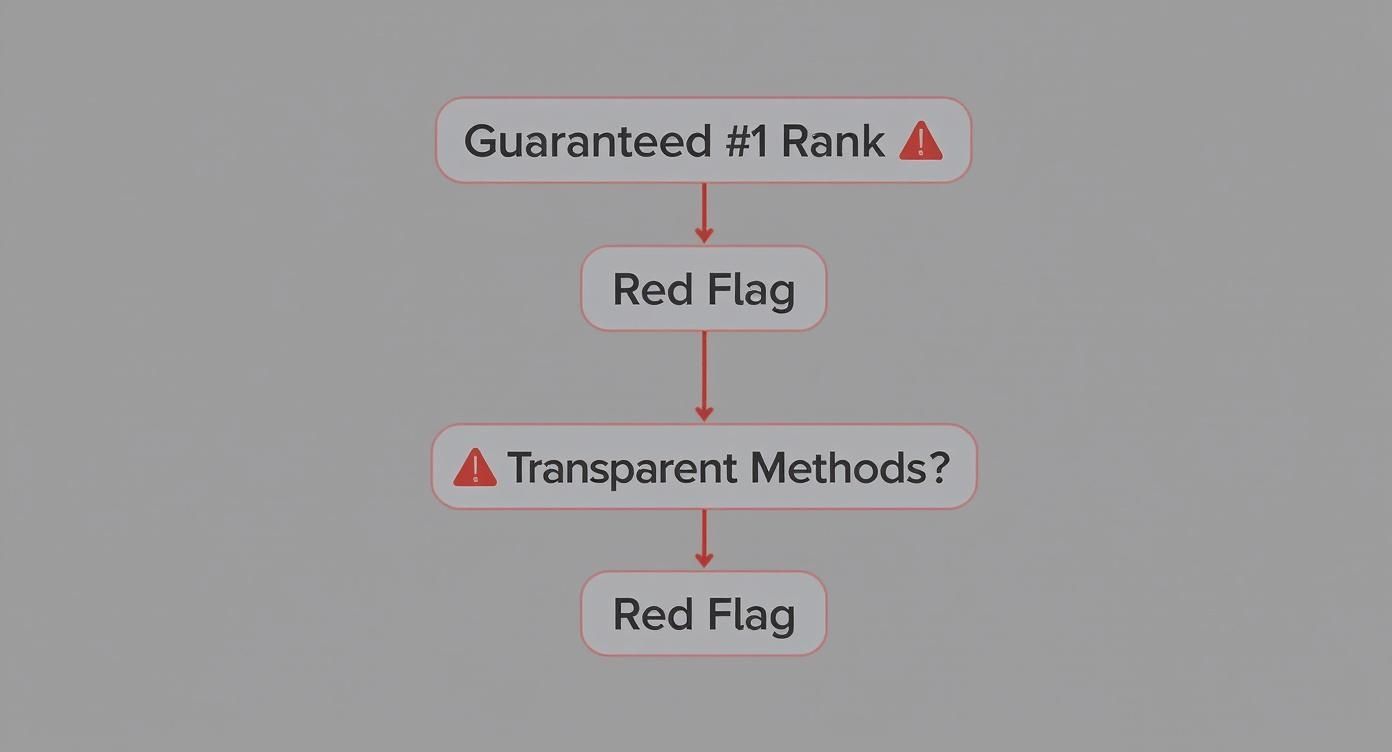
As the chart makes clear, promises of guaranteed rankings and a total lack of transparency are non-negotiable dealbreakers.
Reviewing the Contract with a Fine-Tooth Comb
Once you've made your choice, the contract is the final checkpoint. Don't just skim it. This document defines the rules of engagement for your entire partnership, and an unclear or one-sided contract is a massive red flag.
Pay extremely close attention to these three areas:
- Scope of Work (SOW): This needs to be incredibly specific. It should list the exact deliverables you’ll get each month—things like, "two 1,500-word blog posts," "ten high-authority backlinks," or "one monthly technical health report." Vague terms like "ongoing optimization" just aren't good enough.
- Ownership of Assets: The contract must state, in no uncertain terms, that you retain 100% ownership of all work they produce, including content and any website changes. You should also have full administrative access to your Google Analytics and Google Search Console accounts from day one.
- Termination Clause: What happens if things just don’t work out? A fair contract will have a clear out-clause, typically a 30-day written notice period. Be very wary of long-term contracts (over 12 months) with no easy exit—it suggests the agency isn't confident they can keep you around based on performance alone.
Key Takeaway: A contract is a tool for clarity, not confusion. A trustworthy agency will welcome your questions and be willing to make reasonable adjustments to ensure you feel comfortable and protected.
Kicking Off a Strong and Collaborative Partnership
The first 30 days of your engagement are crucial. They set the stage for success. A well-structured onboarding process ensures both teams are aligned, expectations are crystal clear, and the agency has everything it needs to hit the ground running.
A strong kickoff process should include a few key steps:
- The Official Kickoff Call: This is way more than a simple meet-and-greet. It’s a strategic session to review your goals, confirm the initial 90-day plan, and establish the primary points of contact on both sides.
- Granting Access and Onboarding: The agency will need access to your website's backend, Google Analytics, and Google Search Console. A professional agency will have a secure, straightforward method for sharing these credentials. If you haven’t set up all your tools yet, our guide on how to set up Google Search Console provides a clear, step-by-step walkthrough.
- Establishing a Reporting Cadence: Agree on the frequency and format of performance reports right away. Will you have a monthly call to review progress? What specific KPIs will be included in the report? This ensures you're always on the same page about what success actually looks like.
This initial phase is all about open communication and setting clear expectations from the start. A proactive, organized onboarding is one of the best signs that you’ve made the right choice and are beginning a partnership built for long-term growth.
Frequently Asked Questions About Hiring an SEO Agency
Even after you’ve done all your homework, a few questions always pop up right before you sign on the dotted line. It’s a big decision, and you’re investing a lot of trust and money into a partnership. Let's clear up some of the most common questions we hear from business owners just like you.
How Long Does It Take to See SEO Results?
This is always the first question, and the only honest answer is: it depends.
You might see some small, early wins—like a few keywords climbing up the rankings—within the first 3-4 months. But significant, needle-moving results, like a steady stream of qualified leads or a real jump in organic sales, typically take 6 to 12 months to materialize.
SEO is a long-term investment, not a quick hack. The timeline really hinges on a few key factors:
- Your starting point: A brand-new website with zero authority is starting from scratch and will take longer to gain traction than an established site that already has some history with Google.
- Your industry's competition: Trying to rank for "Kansas City plumber" is a completely different ballgame than ranking for a niche, long-tail keyword. The more competitive your space, the longer the climb.
- The agency's strategy: An aggressive plan that heavily incorporates content creation and link building will usually move the needle faster than a more conservative, technically-focused approach.
A good agency will be upfront about this from day one. They should give you a 90-day plan focused on foundational fixes and a 6-month outlook for when you can expect to see initial KPI growth. If anyone promises you page-one rankings in a few weeks, run.
Should I Hire a Local or National SEO Agency?
For a business with a physical storefront or a specific service area—which covers most businesses here in Kansas City—hiring a local agency is almost always the right move.
A local team just gets it. They have an intuitive understanding of the local market, how people in your area search, and what it really takes to show up in the Google Map Pack. A big-name national agency might look impressive, but they won't have the on-the-ground knowledge of your community.
Local SEO is its own beast, requiring a specific focus on Google Business Profile optimization, local citation building, and community-focused content that a generalist national firm often overlooks.
What Is a Reasonable Budget for Small Business SEO?
Prices can be all over the map, but for a small business looking for a comprehensive SEO retainer from a reputable agency, a realistic budget typically starts between $1,500 and $5,000 per month.
You need to be extremely skeptical of agencies offering plans for under $1,000. At that price point, corners are definitely being cut somewhere. Quality SEO involves deep research, expert-level strategy, high-quality content, and time-consuming outreach—it's just not possible to deliver that kind of work at rock-bottom prices without resorting to risky, automated tactics that can do more harm than good.
How Often Should My Agency Communicate With Me?
A professional agency will set a clear and consistent communication schedule right from the start. You shouldn't ever have to wonder what's going on.
At a minimum, you should expect:
- A monthly performance report: This needs to be more than just a data dump from a tool. It should explain what the numbers actually mean, what work was done, and what the game plan is for the next month.
- A monthly strategy call: This is your time to go over the report, ask all your questions, and give feedback on the direction things are heading.
- Direct email access to your account manager: You should feel comfortable reaching out when you have a question and expect a response within a reasonable timeframe (usually one business day).
Consistent communication is the bedrock of a good agency partnership. If an agency goes dark on you for weeks at a time, that’s a massive red flag.
Ready to partner with an SEO agency that understands your business and delivers real results? Website Services-Kansas City offers transparent, results-driven strategies tailored for small businesses. Get your free, no-obligation SEO audit today!
